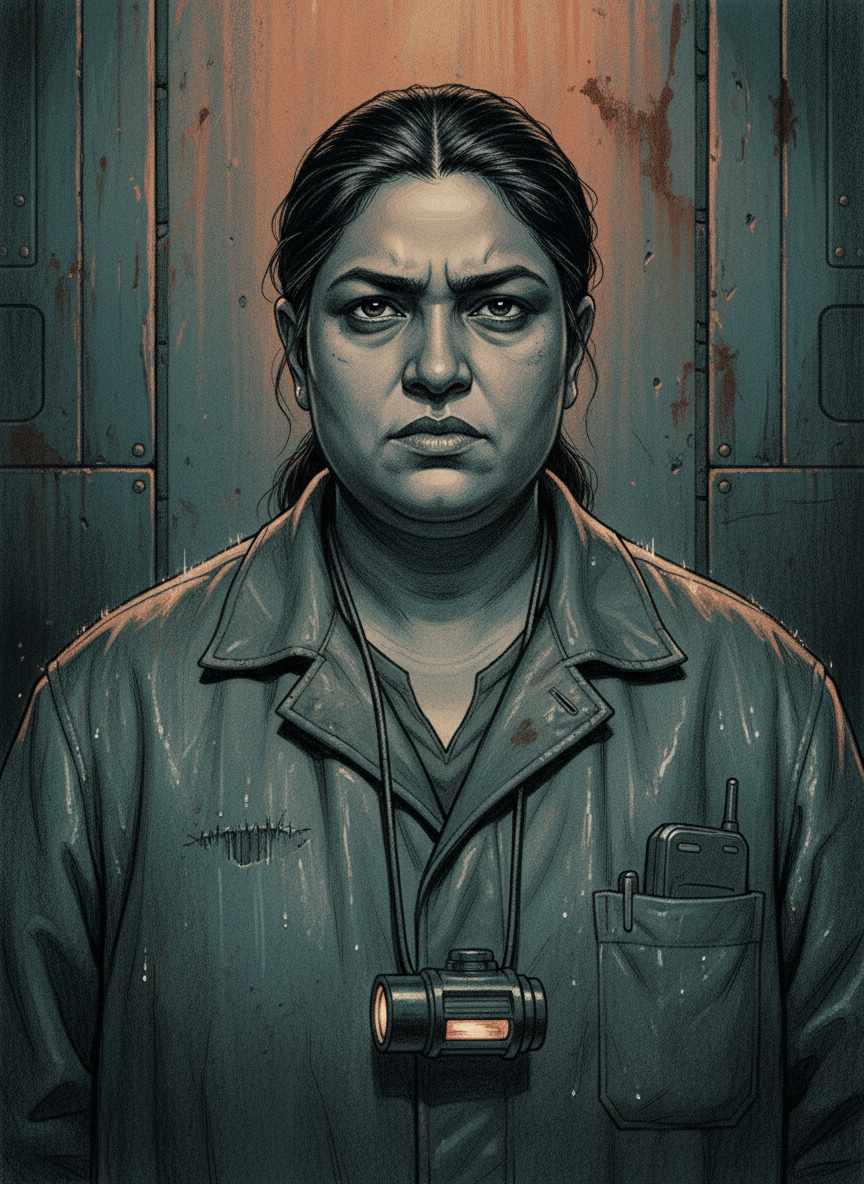
Dock C smells like a toaster left on. Hot dust, sodium light, and under it the grind of the spin ring coming round on the hour, which on Hollow Dessai means the floor leans a half-degree and every crate stack sighs against its straps.
0340 by the dock clock. 0110 by hull time on the Peg Hatcher, which left two days ago without me. 1920 by the chapel clock, which is set to a city on Earth that nobody aboard this rock has ever visited. Three clocks on one asteroid. It is the only place I know where you can be late and early for the same job and still get docked pay.
Twelve scrip to break and re-tally one crate. That is the whole contract. A man named Feo who runs the bonded floor's night side put it on the board because the manifest weight and the scale weight disagreed by nine kilos, and because nobody with a proper berth wants to spend the back half of a shift on their knees with a torch in their teeth. Three days idle makes twelve scrip a reasonable number. Three days idle makes most numbers reasonable.
DSS-4471. Standard eight-foot bonded box, corners locked the same way ISO corners have locked for a hundred and thirty years, dull green under the lamps, bar code panel scuffed pale. It sits out of rotation on the cold end of the floor with a two-metre gap around it, which is the first thing wrong. Crates are gregarious. They stack. A crate standing alone on a bonded floor is a crate somebody has been walking around.
The second thing wrong is that it is sweating. Condensation beaded along the lower seam, a dark crescent on the deck plate under it, hot floor and something colder inside.
I do the Fleet thing before I do the thinking. Ten years of it and it does not wash out.
Torch on the seal first. Hold it steady, get the whole tag in frame, get the number, get the wire twist. My handset is six years old and the lens has a scratch across the corner that puts a comet on every photograph I take. Click. Again from the side, so the twist shows. Click.
Then the manifest, aloud, because that was the rule, and the rule existed so that the marine behind you and the clerk beside you and the recorder in the corner all heard the same words at the same time, and later nobody could say the provost invented a line.
"Dessai bonded, Dock C, four-four-seven-one. Consignor, Sereva Salvage Holdings. Consignee, blank. Contents, ceramic feedthroughs, insulator grade, two hundred twelve units. Declared mass four one zero. Scale mass four one nine."
Nobody hears it. The scrubber in the overhead ticks, ticks, ticks, the way it has ticked for nine years while the Hollow puts off replacing it.
I cut the seal clean. Not through the number. Through the wire below the number, one snip, so the tag stays whole and readable in my palm. Habit. I have not had the authority to cut a seal since the armistice dissolved my Fleet and my rank and my pension in the same paragraph, and I still cut them like the court is watching.
The latch bars go over with the flat bang they always make. Cold air comes out around my wrists.
She is lying on the packing quilts on her side with her knees drawn up, and she is nineteen, maybe twenty, and she has been dead about four days. Dark hair cut short and grown out past the cut. Nails bitten. Someone has folded her hands. That is the part that stays with me; someone in this took a minute to fold her hands.
Around her throat there is a ring of burn. Clean. Unbroken. A perfect band of it, edge to edge, the same width the whole way round, the skin gone grey-glazed like something fired.
I do not say anything. I do not step back.
I put the torch in my teeth and photograph her the way I would photograph any cargo. Whole box, showing the corner tag in frame. Then her, three angles, no closer than a metre. Then the burn, close, with my thumb beside it for scale, and I am careful not to touch her. Ten years old, that discipline, and the hands do it without being asked.
I look at the packing. No ceramic feedthroughs. No two hundred twelve units. Quilts, a water bladder, empty, and a plastic pail, and an ankle strap bolted through the crate wall with a wing nut on the outside, which is a thing you do to something you intend to still have when you open the box.
The strap is not fastened. Somebody unfastened it before they folded her hands.
"There's no crate on this floor tonight."
She has come up the aisle without me hearing her, which on a steel deck takes intent. The night dock clerk. Bacsal, per the plate on her coverall, R. BACSAL, the name badge riveted on over an older name that was ground off. Small, forty-odd, hair scraped back, a bar-code wand on a coil at her hip like a sidearm. She is holding it out at arm's length, pointed at DSS-4471, and she squeezes it.
The wand chirps the flat negative chirp.
"No read," she says. "Nothing here." Her eyes are on the open crate. She is not looking away from it. She is just saying words in the order she has said them before, and I can hear the wear on them, the way you can hear a step that has been walked ten thousand times.
"Look at her," I say.
"There's no crate on this floor tonight," Rosalinda Bacsal says again, and her hand with the wand in it is shaking hard enough that the coil taps her thigh, tap, tap, and she will not stop pointing it at the box, as though the chirp is a thing she can make true if she does it enough.
Boots on the ramp. Three sets, coming fast.
Fast is what I mind. Feo posted that job on the board six hours ago; Bacsal found me here maybe ninety seconds ago; and here is a man in a good grey jacket already at the end of the aisle with two dock hands behind him, and nobody called him.
"Ivar Pell," he says. He does not offer a hand. He looks into the crate for exactly as long as it takes to confirm a number. "You're off the Hatcher. Karkera."
"Was."
"Three days on the floor, no berth, papers out of date." He says it the way you read a weather board. "Twenty scrip for the tally. Feo's twelve and my eight, and you stop now. There's a berth going on the Anjali Rao, Dock A, pulls for Tavish in nine days. I can put your name on it."
Behind him, the two hands have already got the come-along on the crate corner and are walking the straps over without being told where. They do not look in. That is the tell. Two men who work a bonded floor and do not look inside an open box.
"Where's it going?" I say.
"Incinerator lock," Pell says. "Contamination on the manifest. Spoiled organics." He watches me. "It's a sad thing. It's also not on this floor tonight."
The spin ring comes round and the whole deck leans and settles and every strap on Dock C creaks at once.
I put out my hand. Pell counts eight scrip into it and Bacsal, without being asked, without being looked at, puts twelve more on top out of the night-side box, and her fingers are cold.
I let go of the crate. The hands walk it away down the aisle on the come-along, wheels ticking on the deck seams, and the cold air trails off it in the sodium light, and Pell goes with them, and the scrubber ticks, and Rosalinda Bacsal stands where she is with the wand hanging dead on its coil.
Twenty scrip in my left pocket.
In my right, inside the coat lining, the cut seal tag with the number whole on it, and the handset with seven photographs and a comet in the corner of every one.
"Nine days," I say to nobody, "is a long time."
The Sump is the bar, singular, because Hollow Dessai has one of everything and two of nothing. Down four steps off the ring road, sodium tubes in wire cages, six tables bolted to the deck, onions frying somewhere behind a bead curtain and a cigarette going in the corner under a sign that says NO SMOKING — FIRE SUPPRESSION OFFLINE, which is two facts that somebody thought belonged on the same sign. Gin is three scrip, distilled off the ag deck, cut with electrolyte so you don't cramp; beer is four and worse. Behind the bar, where a mirror ought to be, there is a rack of grey card sleeves in pigeonholes, forty or fifty of them, each with a label in grease pencil, and above the rack a slate written in the same hand and the same units as the drinks: ASKED & ANSWERED — VERIFIED ONLY — 1 MIN 14 / 3 MIN 35 / FULL 90. NO CREDIT. Underneath, in smaller letters: cards checked against packet record, ask for the paperwork. A man two stools down has paid his fourteen and is sitting with the earpiece in and his hands flat on the bar and his eyes shut, and nobody in the room looks at him, because on a rock this size everyone has either bought a minute or is saving for one.
The barman is a big slow-moving man with burn scar up one forearm, Obed Sithole per the tab he opens for me, and I buy two rounds for the table nearest the door and one for him, and I do not ask a single question for eleven minutes by the dock clock, because a question you pay for is answered wrong and a question you wait for is answered twice. The cough arrives before the woman does. Scrapline coverall, cuffs wired shut at the wrists, hair in short flat twists going grey at the front, and a chest that sounds like a scrubber that has not been replaced in nine years. She puts down a torch nozzle wrapped in a rag, sets her elbows wide, orders gin, is told the stranger's already bought it, and prices me in one look.
"No," she says. "Once, maybe. Not twice. Obed — same again, and it's on me, for the provost." She grins at whatever moves on my face. "Ten years in the one trade marks you, friend. Strike a seal in this bar and three of us stand up out of our chairs." Thandeka Molefi, cutter, fourteen years on the line, says her lungs are a rental and she is behind on the payments, and laughs, and coughs, and drinks through it. She is very good company for about four minutes at a stretch and then a door closes somewhere behind her eyes and she talks about torch gas. I let her buy the round back, because that is the whole of the arrangement between us and neither of us needs it written down: I don't ask, she doesn't lie, and we see how long that holds.
So I say it to the room instead of to her. "Here's the bit I can't square. Bonded box, sat out of rotation on the cold end of C, two metres of clear deck all the way round it, night-side clerk puts the wand on it and gets nothing back off it at all, and by the time I've carried the latch bars over there's a grey jacket standing at the top of the aisle that nobody called and nobody logged — so somebody on this rock is running crates that are on no sheet anywhere, and that's a trick, that's a proper trick, and what I want out of this room is the one name: who signed for it?"
The table by the door goes quiet in the way a table goes quiet when it is deciding whether to be helpful. Sithole wipes a glass. It is the old woman with the cigarette who answers, without turning round. "C floor belongs to Pell. Pell belongs to Vurrel Aggerman. Aggerman holds the scrapline lease, the incinerator lock, and a deadhead hull out on the far ring that hasn't moved in a year and draws more power than the chapel does." She taps ash into her palm. "And save your breath on warrants. Nearest bench is Tavish, four weeks in a packet if it ever comes, and every paper that reaches us is a month stale the day it lands. That isn't why nobody touches him, mind. Aggerman's bonded to the Ossoy factor. Thirty years of ledger between the two of them. Lean on Aggerman and you're leaning on the Ossoy, and they don't forget a debt and they won't sell you the forgetting, so there's nobody on this rock stupid enough. Two, at a push."
"One and a half," Thandeka says, and laughs, and it goes wrong halfway and she has to hold the bar.
"The girl inside it," I say, "was nineteen, twenty at the outside, four days dead give or take the cold, ankle strap bolted through the wall behind her, and a burn ring round the throat, even width, no break in it, all the way round—"
Her glass goes down on the bar too hard and too early, gin still in it, and she is already turned away, already saying something to Sithole about a card in the third row he keeps telling people is not for sale, don't ask, don't even point at it — and the spin ring comes round on the hour and the floor leans its half-degree and every glass in the Sump slides a centimetre north, and I sit there with my drink and I file it: forty-four years old, no papers, twenty scrip, and one woman in this room who cannot hear the words throat and burn in the same sentence.
The chapel is up the ring road past the water lock, one door, no sign, because on a rock with one of everything a sign is a luxury. Inside: eleven fold-down seats off a passenger hull, a strip of prayer carpet worn through to the backing at the knees, and a tannoy horn bolted over the doorframe with its cone split and the wires cut clean at the terminal, which tells me somebody didn't tear it down in a temper, somebody unhooked it on purpose with a tool. No Sounder. There hasn't been one working off this chapel in a while; the offices card on the wall is nine months old and the grease pencil under it says NO OFFICES HELD — SEE FACTOR. And the clock. Dessai keeps three and the chapel's is the third, set to some city on Earth that nobody here has stood in, and it does not just run eight hours out from the dock clock, it runs its own date, because the office year turns at vespers and the dock day turns at midnight, so a thing that happened on the eleventh down at C floor gets written in this room as the tenth or the twelfth depending on the hour and the man holding the pencil. A day and a half of daylight between two clocks in one asteroid. Somebody could hang a whole career on that gap. Somebody has.
The lectern has the enrolment book on it, spiral-bound, plastic covers, the kind of ledger a chandler sells for two scrip. Three columns ruled by hand: name, date presented, presented by. Forty-one lines over six years, and they thin out after the armistice the way everything does. I photograph the whole page first, then the columns, then each entry, and I read the presented-by column aloud to the empty seats because that is how it was done for ten years and the habit does not wash. Eight of the last eleven carry the same three initials. Line thirty-eight has been taken out with a blade. Not struck through — struck through leaves a name. Scraped, four or five passes, then rubbed with something soft, and the paper under it has gone thin and furred. I put the torch flat on the page and sight along it and I get the ghost: the pressure of the pen has dented the sheet below, and the dent survives what the blade took. A short first name. A date in the chapel's own reckoning. And the presenter's initials still sitting there untouched at the end of the line, because whoever cut the name out never thought the line mattered without it.
"Nasreen." The door does not bang; he holds it. Big man, unhurried, cardigan over a coverall, a vacuum flask in one hand and two enamel cups hooked on two fingers of the other, and he sets them on the lectern's edge and pours without asking, and the coffee is hot, which on this rock is a statement of ownership. "You'll excuse the hour, and the cups — Obed tells me you lifted the tally job off the board, which is good news for the board if not for that knee of yours, and I do know what three idle days will do to a person, having had a run of them myself the winter the Ossoy yard shut its doors; now, the chapel draws off the same bus as C floor and the far ring, and has done since the lease was written, so a light burning in here at this hour registers in two other rooms before it registers in this one, and I would not have you take that for watching, because it is not watching, it is an allocation against a power budget, and I would rather set the tariff in front of you myself than leave you to arrive at some colder reading of it on your own. The Arden Gall pulls for Kadesh in nine days by the dock board. Her tug goes up to the riser tonight. Five days, should you care to be aboard, and the berth is settled, and I would not care to have it put to me afterwards that a former provost carrying papers eleven weeks out of date had been sleeping in a chapel held on my lease — out of date is not unlawful, you understand me, it is merely inconvenient, and inconvenience is a matter of housekeeping." Through the slit window behind him the far ring is lit: tug lamps swinging, radiators up, a hull under power that the board says does not move for another day and a half. I drink his coffee. I do not take his berth. And I think: here is a man who has just discussed a nineteen-year-old with a burn ring all the way round her throat, out loud, for ninety seconds, courteously, and has not once had to go near a word he doesn't own. Then he goes, and the door holds itself shut behind him, and I turn back to line thirty-eight and sight the torch along the dent again — the hard backslant, the crossed seven in the date — and I have seen that seven once tonight already, on something somebody handed me, and I will have it placed before the dock clock turns.
Dock C at 0512 and the day side is coming on, which on Hollow Dessai means four more lamps in the overhead and the same scrubber ticking. The clerk's cage is a two-metre box of steel mesh at the head of the aisle with a shelf, a stool, a terminal, a coffee can of spare bolts and a strip of grease pencil down the mesh where somebody has kept a tally of something for years and never labelled it. Rosalinda Bacsal is still in it. She has not gone off shift and she has not sat down. I put my hands flat on the shelf where she can see both of them and I do it the way I would do a manifest, small true things first, stacked, so the big one has nowhere left to stand. "That wand of yours lifts a bar code off a wet panel at two metres in this light, because I stood and watched you clear four boxes on the warm end at 0338 and you never once broke stride, so don't hand me the wand; and a no-read doesn't just go away either, a no-read drops an exception line into the gate log with a time sat on it, which means if four-four-seven-one genuinely wouldn't take the scan there'd be a line on your sheet at 0341 saying exactly that, and there isn't one, I'm reading your sheet from here — so the crate didn't fail to read, Rosalinda, the crate wasn't on the floor to read, and pulling a bonded box off the floor count takes a login, and a login is a name."
"Bonded transfers go on the gate log by seal number." Flat, fast, the warmth gone out of it. "If it's not on the gate log, sir, there's nothing I can tell you. That's the procedure. The procedure's all I work."
"How many a month?"
"Not on my sheet."
"How many a month come off this floor and never come back onto the count — and don't give me the sheet again, because you're the one that keys the sheet, you're the one that signs off the sheet, and every one of those exception lines you didn't write is a thing you didn't write on purpose, so let's have a number, and let's have it while I'm asking quietly, because I don't stay quiet long down here."
She looks at the grease-pencil strip on the mesh beside her head, and she does not answer for long enough that the scrubber ticks four times, and then she says, "Eleven," and then, quieter, and this is the once, this is the whole of it, the apology and the joke and the clerk all gone and something underneath them that has been awake for a very long time: "Eleven. I count them out. I count them back in empty. I've never had the number wrong, not once. I want to have it wrong. God. One time, I want to have it wrong." Then the door shuts behind her eyes and she is straightening the transfer slips on their spike. "Nineteen months on nights, me. Port time, not hull time. I can't give you a name, love. Sorry. I can't."
Two hundred and nine boxes, and most of them ceramic feedthroughs, I'll grant her that; and I am still doing the arithmetic when I pass the tally board by the ramp head and stop with my hand on the rail. The board is cork and paper and pin, the tally job I lifted is still pinned there with a line through it, and next to it, four hot-work permits for the scrapline, pre-dated, one per day, and the date on every one of them is written in a hard backslant with the seven crossed. Same pen pressure. Same crossed seven I raised off line thirty-eight with a torch held flat, forty minutes ago and a seven-minute walk from here. Whoever presents people to that chapel writes the burn slips too. I fold one permit into my coat lining with the seal tag and the handset and I take the stairwell up to the ring road, and there are two of them on the half-landing, and they are quiet and they are neat and neither of them says a word, which tells me the instruction was an hour somewhere dark, not a body.
Three seconds. The near one gets my forearm across the bridge of his nose because he has committed to a grab and cannot change his mind about it; the far one gets the heel of my boot on the outside of his knee, which is a joint that does not argue; the near one goes down four steps and takes the handrail with the back of his head on the way. Then it is over and I am sitting on the step above them with my ribs on fire and my own knee screaming, and the far one is crawling, and he says, "Not here. The lock," to nobody, and they go up and out. Two weeks of hurting, minimum. In my fist, torn off a lanyard, a plastic dosimeter card, film badge still in it, printed across the top SEREVA SALVAGE HOLDINGS, and under that a hull ident rubbed half away by somebody's thumb over a long, long year of wearing it.
The cutting shed is on the far end of the scrapline, dry as a kiln, forty degrees under the extraction hood and no bottle in it anywhere because gas and gin share a shed exactly once. Thandeka Molefi is racking segments when I come in and she looks at my knee first and my ribs second and does not ask. I do not have the patience left to work her the long way, so I put the three things on her bench in order, flat, spaced apart, the way you lay evidence for a bench that is never going to sit.
"One. Photograph, 0343 dock time, C floor, my thumb in the frame so you've got your scale, and what's sitting under my thumb is a burn ring on a nineteen-year-old, closed, even, skin fired grey. Two. Dosimeter card, Sereva Salvage Holdings across the face of it, which I took off a man's lanyard on the stairwell half-landing forty minutes ago with my own hands, and the hull ident's been thumbed down to nothing over about a year of a man wearing it, so you'll read it to me, because you've had a torch on whatever that card belongs to for a fortnight and your hands know that hull better than the print does. Three. Hot-work permit, dated before it was ever written, lifted off the tally board at the ramp head, one of four sitting up there together, and the hand on it is the same hand I took off a chandler's ledger in a chapel four minutes from this door, with a torch held flat to the page."
She picks up the card. She does not look at it long. "Merry Ann." Her thumb goes over the worn place, the way his did. "Aggerman's. Deadhead. Far ring."
"Now give me the rest of it, all of it, and don't be tidy about it."
"Inner ring's off her. Two weeks of it. Wet cut, slow, nothing hot near the grey." She reaches behind her without turning and lifts a segment off the third rack, a curved section, grey-glazed on the concave face, drag lines down the kerf where her own cut ran. She puts the photograph beside it. Then calipers, out of her hip pocket, because her hands have to be doing something and there is nothing in this shed to drink. She sets the points on the segment's inner face, reads it, sets them against the image, walks the scale off my thumb. She does it twice. The second time is not for me. "Curve doesn't argue," she says. "Fits."
"And there's a replacement ring half-fitted in the hole already, still two segments short of whole, which is why the far-ring lamps came up last night a day and a half ahead of what the board says that hull is doing, and why two lads were put on me for an hour in a dark room instead of walking me to the incinerator lock, because an hour is exactly what it takes to get a tug off a mooring and away — now put your eyes on this one." I put the handset down on the bench with the enrolment page on it, line thirty-eight scraped out, the presenter's initials still sitting there, and I turn it so the date is under the shed lamp. Then I take the nearest of her own grease-pencil tags off the rack and set it next to the screen. Hard backslant. Crossed seven. The same pressure, the same wrist, on a chandler's ledger in a chapel four minutes' walk from here and on a cut tag in a shed that isn't. "So tell me that's a coincidence, Thandeka. Go on, say the word coincidence to me and I'll stand here and take the whole of it, because I've got two weeks of being hurt by strangers ahead of me and there's nothing at all in my next nine days but this."
She sets the calipers down. She sets the tag down square with the edge of the bench, and then squares it again.
"I hand them up." Flat. No question back. "To him. New ones. Ja."
"Why. And take your time with it."
"Every voice I hand up is a run I don't make." She puts two fingers in her collar and opens it, coverall and the shirt under it, and there is a band across the base of her neck, old, faded to the colour of a weld scar, unbroken, the full circuit of it, the same width as the segment on her bench because it was made by a segment on somebody's bench. "Bekri hull, sixty-four. Fourteen months. Two offices. They kept the ring on me between transits, keep you in practice. You want how it works? Nobody's got how it works. I've got what it left." She closes the collar. "Lungs I rent. This one's bought."
"Line thirty-eight. Give me the name that was scraped off it."
"Meriem Sadeq. Nineteen. Hollow Bekri, ag deck there, came in off a packet run with a kitbag and nothing in her papers and I stood her a gin and I walked her up the ring road myself and I wrote her onto that line with my own pencil." She says it in one piece, and that is the only sentence she gives me whole all morning. Then she goes and stands where the hood draws and takes a long breath she cannot afford. "Thirty-nine's written already."
"Written when, and by whose clock?"
"Vespers. Chapel reckoning, not hull." Her hand finds the striker on its lanyard and works the wheel, dry, no gas, a small dead click, again, again. "So she's aboard. Two hours. Three. That's your tug on the lamps."
I say the word out loud, because it has not been said out loud on this rock yet and I want it said in front of a witness, in a room with her name on the permits. "Harvest run. Deadhead hull, nothing in the holds, headed out Sounder-side, into transit and back and into transit again until whatever does the imitating gets sick of being asked, and the answers come off carded and get sold across a bar at fourteen scrip the minute, checked against packet record, paperwork on request — I know what it is, Thandeka, I know exactly what it is, down to the seal numbers, because my Fleet ran them for four years and I read the manifests out loud while marines kept a muzzle on the room, and I didn't come up this scrapline to forgive you, I came up it to be told which lock that tug went out of."
The striker clicks and stops. Through the shed's slit port, down the curve of the rock, the far ring is lit up — radiators bright, two tug lamps swinging on the mooring lines, a third one moving now, slow, in the direction that means away. The dock clock over the bench reads 0607. Two and a half hours since I cut a seal and said a manifest to nobody.
Out of the shed and the scrapline air hits cold after forty degrees, and my knee makes its opinion known on the first grating, and behind me there is a barrow coming: Thandeka, two bottles strapped upright, nozzle in its rag, hoses coiled over the handle, moving faster than a woman with rented lungs has any business moving.
"Thirty-nine," I say. "Name. Give it me now, while we've still got legs under us, because in eleven minutes that tug has her off the mooring and after that it's four weeks in a packet and a bench on Tavish that won't read the top line of it, never mind the rest."
"Naledi. Mabaso. Seventeen." Four breaths for three words. "Ag deck. Bekri run. Wrote her in Tuesday."
"And what are you walking out here for — and don't hand me your conscience, Thandeka, because your conscience had a fortnight and a pair of calipers and it stopped in the shed with the gas bottles the whole while, so give me the real one, and give it me short, because short is what we've got."
"Inner ring's parted." The barrow wheel catches a seam and she wrenches it straight. "Two segments out. Splits under load, she's not walking off it." Cough, held down, swallowed. "So she doesn't leave the mooring. That part's mine."
So there it is. One hull moving, one clerk sitting in a steel cage nine minutes the wrong way, and a choice that has to be made before the ring road forks: the gate log with a login and a name on it, which is the only thing on this rock that voids thirty years of Ossoy ledger and puts Aggerman where a factor can see him — or the mooring line, and a seventeen-year-old with a collar on her and a drive ring that's two segments short of whole. Evidence keeps. Girls don't. I take the pre-dated hot-work permit out of my coat lining, photograph it front and back with my thumb on the date for scale, and put it flat on the bottles.
"That walks you and a torch straight past the mooring watch and it's dated today in your own hand, so use it, don't explain it, and don't let anybody unbolt anything I haven't got a picture of first." Then the fork, and the cage at the aisle head with the day lamps on and Rosalinda Bacsal still standing in it nineteen hours into nineteen months. I put my face against the mesh. "Line thirty-nine went up to the far ring at vespers by the chapel's clock, which is the eleventh down here and the tenth up there, and she's seventeen years old, and you will count her out tonight and you will count her back in empty in about thirty-one days, give or take, and you'll have the number right, because you always do have the number right. So print the gate log. Every login on it, every exception line you never wrote, eleven a month, nineteen months of them. Have it in your hand when I come back through that door, and if I don't come back through that door, you have it in your hand anyway."
She doesn't say sorry. That's the first time.
I go out the ramp head at a run I'll pay for.
Fourteen minutes of ring road in about nine, and the last four on a knee that has stopped filing complaints and started sending invoices. The far ring bay is cold enough to see your own breath in the sodium, and it is loud: mooring winches under load, the flat toneless warning horn that means clamps releasing, and the tug out past the gallery glass with her lamps swinging as she takes up slack on a hull a hundred and forty metres long with SEREVA painted over an older name on her flank. The Merry Ann is already off two of her four clamps. Down at the number three line, seventy metres away on the low catwalk, there is a barrow with two bottles strapped upright in it and a small blue point of flame standing off a nozzle, and a figure in a scrapline coverall bent over a shackle, and a mooring watchman standing three paces back reading a pre-dated hot-work permit with a torch, exactly as he was told to do by nobody. Good. That is thirty-one days of somebody's life buying itself a minute, and I have my own minute to spend, because between me and the gangway tube there is a mesh gate, and in front of the mesh gate there is a good grey jacket.
"Mr Karkera." Pell does not move his hands out of his pockets. There is one dock hand at his left shoulder, a big one, young, hands hanging loose, and I know that stance; that is a man who has been told an hour, not a body, and who has already been paid. "The tug for the Arden Gall goes up tonight. The berth is settled. It will remain settled at eight."
"Settled. That's your word, is it — settled — then take another one off me: there's a girl of seventeen on that hull with a piece of grey relic bolted round her throat at the width of my thumb, unbroken, all the way round, not one join in it, and in about ninety seconds she's cast off toward a riser hung on a parted inner ring that splits under load, which makes this a cargo matter, Mr Pell, and cargo is the one trade I'm actually qualified in — so you stand there and give me the seal number on her, go on, give me the manifest line, tell me who signed for it, because down at Dock C there's a clerk running off nineteen months of gate log with your login stamped on every page, and I would hate for you to be the last man on this rock to hear his own name read out—"
He nods once at the hand, the way you nod at a trolley to go left, and that is the whole of the negotiation. The hand comes in with his arms wide to wrap me up and hold, because hold is the instruction, and a man committed to holding cannot also be committed to guarding anything; I put my shoulder under his and let his own weight carry him past into the mesh, and the gate takes him with a sound the bay is too loud to care about. Pell's hands are still in his pockets when I hit him, which is his one mistake and the only one he gets — flat of the forearm across the bridge, once, and then the mesh again, and he sits down on the deck plate with his legs out in front of him like a man who has been handed a schedule he cannot read. I take the gate release off his belt, because his belt has the gate release on it, and three seconds are up. The hand is getting a knee under himself. The horn goes to its second tone. Down at number three the blue flame is still burning and the barrow has not moved, and I do not look at it twice, because looking twice is a thing you do for people you intend to come back for, and the tube ahead of me is already walking its concertina in on itself at both ends. I go into it sideways at a dead limp with my coat lining slapping against my ribs — seal tag, permit, a handset full of photographs — and the Merry Ann takes her third clamp off under my boots, and the deck of her comes up to meet me the way a deck does when a tug has decided the argument is over.
The tube lets me out onto a receiving flat with the deck already live under my boots, and behind me the concertina closes on itself and the clamp horn goes to its third tone, which is the tone that means the argument is finished and the tug has the weight. One lamp in three. Cable runs zip-tied along the overhead where the trim panels came off and never went back. She is cold inside, four degrees, maybe five, and she smells of dust on hot electrics and nothing else at all, because a hull with no cargo and no galley running has nothing else to smell of. At the ladder head somebody has written on the bulkhead in grease pencil, OFFICES — 3 — DO NOT ANSWER, and under it a tally in five-bar gates that runs four lines across and stops without a total. I go up. The old passenger gallery is forty metres of stripped seat rails and one table bolted through the deck at the far end with a worklight over it, and under the worklight there is a seventeen-year-old sitting very straight with her hands flat on the tabletop, an ankle strap through the table leg, a plastic pail beside her, and a segment of grey relic closed round the base of her neck on two bolts with the wing nuts on the outside where she cannot reach them.
"Naledi Mabaso. I'm not crew, I'm not his, and I've nothing on me that'll touch a wing nut, so let's not start the morning with me telling you I can get that off your neck when I can't — what I am is the man who cracked a bonded box on C floor at 0343 today with a girl inside it, a girl written into the same book you're written into, one line above yours, and I'm putting that to you flat so you know precisely what's standing in front of you and precisely how many hours behind it's running." She looks at my knee. She looks at my hands. She does not look at the strap, which tells me she has already spent some hours not looking at it. "Can I ask you something first," she says, not as a question, and then: "Thandeka. Is she on the dock, or is she on the hull?" I tell her the dock. She takes that in, and her jaw sets, and she says, "There was a ewe on Bekri carried a dead lamb three days and ate every ration I put down," and then the flatness cracks and closes again and she is reciting numbers at me, bay four, two hundred head, feed at oh six and eighteen, weights logged and the card signed in her own hand, which is the last thing she was ever in charge of and she is holding it in front of her with both hands. And it is while she is doing that that I turn round and see what the rest of the gallery is for. Pigeonholes. Grey card sleeves, three hundred of them, maybe four, racked in bolted steel from deck to overhead down the port side, every sleeve labelled in grease pencil in the same backslant with the same crossed seven, and the labels are the labels off the rack behind Obed Sithole's bar because this is where that rack comes from. There is a bench under it with a player on it, a foot switch, one earpiece, and a horn speaker for demonstrating to a buyer, and the horn is live, running a sample on a loop at low volume, and it is my brother.
I photograph the rack first. Whole wall, then each column, then the bench, then the label on the sleeve sitting in the player's slot, KARKERA A. — DEMO — 1 MIN, and my hands do all of it without asking me, ten years of doing it that way, while the horn says my name and waits four seconds and says it again. Ashwin, dead nine years in the Churn off the Serhat Roy and never one piece of him came back. He tells me about the blue door at Dhadhar and who shut it, which is true, and which four people alive ever knew. Then he says, very reasonably, that I have not answered him yet. I have been taught since I was twenty-two that you do not answer, and there is no argument about it anywhere in this trade, and I find that my mouth is open and there is air already moving in my chest, so I stop using my mouth and use my legs instead: six steps to the breaker panel at the end of the rack, cover up, the third one down is the only one with a label on it and the label says GALLERY, and I put it over and the horn dies in the middle of my name. Then I go back and take the card out of the slot and put it flat in the coat lining, because a card is a thing with a number on it and a hand on the label, and I am not carrying it for the voice. I am carrying it because somebody made it, and somebody labelled it, and somebody sold it at fourteen scrip the minute across a bar four minutes' walk from a chapel with its tannoy wires cut.
"Nasreen. You will have come through that tube cold, and there is coffee, and as it happens I have the second cup on me, which this morning I would not have called foresight and now find I am glad of." He has come the length of the gallery without hurrying and without announcing himself, cardigan over the coverall, flask and cups again, and he sets them down on the bolted table beside the girl's flat hands. "Now, the berth on the Arden Gall held until eight, and it is well past eight, and neither of us is served by pretending otherwise; but a hull under tug is thirty hours off the riser, and a very great deal can be reallocated inside thirty hours, a passage back down on the tender among them, which I would settle from my own side and not post against your account — and as to the gallery breaker, you will find that circuit is drawn on the far ring lease and not on the hull at all, so putting it over is not a thing I would describe as damage; irregular, perhaps—" "Then give me the word for her. Go on. Not irregular, not out of sequence, not 'spoiled organics' — the word. Nineteen years old, Meriem Sadeq, hands folded by somebody who took the ankle strap off her first, a segment of relic bolted shut round her throat, and your writer's put a blade to line thirty-eight and scraped her name out and left the initials sitting there in the ruled space — so before you talk to me about tenders and allocations, Mr Aggerman, you'll answer the one thing I've been asking on this rock since 0343, and you'll answer it standing in front of her, because she's the witness now and there isn't another one coming: who signed for it?" He does not raise his voice, because he never has and never will. He says that a ledger thirty years old is not undone by a photograph, and he puts out his hand for the card, palm up, courteous, patient, the same hand that poured me coffee in a chapel three hours ago and the same hand that keeps the book, and he lets it rest on the edge of the bolted table while he waits for me to be reasonable.
Three seconds. I take the wrist with my left, flat on the steel, and bring the breaker cover down on it with my right, once, and the sound the cover makes is louder than anything he says, which is nothing. Then it is over. He goes down on one knee beside the table and holds the hand in against his chest with the other one and breathes, in through the nose, out, in, out, and the flask rolls off the table and goes the length of the gallery on the slope of the tug's burn, unscrewing itself as it goes. Naledi Mabaso watches it go past her. Nobody has said a word for about fifteen seconds. Under the deck the tug note steps down half a tone and settles, and we are all three of us thirty hours from a riser on a hull with two segments missing out of her inner ring.
Fifteen seconds and the adrenaline goes out of me the way water goes out of a holed tank, all at once and from the bottom, and what is left is the cold and the tug note and a man kneeling on the deck holding his own hand. I do the wing nuts before anything else, because the rest of it can wait an hour and that cannot. Photograph first: the segment closed round her neck, both bolt heads, both nuts, my thumb beside the left one for scale, three frames, and the lens puts its usual white streak across the corner of every one. Then the nuts. The near one comes off with fingers and a bad noise from the thread. The far one does not, because somebody has staked the thread with a punch, which means somebody stood behind a seventeen-year-old with a hammer and thought about her getting the ring off herself and made sure she couldn't. There is a toolroll under the player bench where whoever racks the sleeves keeps his gear — nut driver, snips, a stub of grease pencil, half a roll of zip ties — and the water-pump pliers in the end pocket take the nut off in four bites, and the staked thread comes with it. The segment opens. It weighs about what a full kettle weighs and it is colder than the air. "Leave the skin under it alone, don't scratch at it, don't rub it, don't put a finger near it until I've had three clean frames of that neck with my thumb in shot for scale — so sit, stay sat, keep your chin where it is, and when I've got them you can stand up and walk the deck as long as you want. Ankle strap after. That one's a wing nut on a table leg and nothing more, and whoever fitted that wasn't half as careful as the one who did your throat."
She stands and does not fall over, which is more than my knee is managing. She holds the light for me while I get the segment on the tabletop with the bench square behind it, and she looks at it lying there, and then she says, flat, "You opened a box this morning. Was the ring still on her when you did?" I tell her no; unbolted, hands folded, the mark already glazed over. She takes that in. "So it comes off after. When there's nothing left underneath to hold it." Then, in a lower voice, entirely without weather in it: "A ewe three days down will still get up for you. You think she's come right. She hasn't. She's only standing." She goes and looks out of the gallery port at Dessai getting smaller and starts in on bay four again, the feed times, the weights, and I let her run, because everybody gets one thing to hold and that is hers.
Aggerman has got himself sitting with his back against the table leg and the hand inside his cardigan, and he is grey around the mouth, and he starts in on me from the deck in the same courteous unhurried register, the tender schedule, the far ring lease, the demurrage that will accrue against the hull if she misses her slot at the riser — and stops in the middle of a clause. "I will not say it with the girl standing there." No qualifier, no lease, no allocation, four words short of everything he has ever said to me, and then the shutter comes down and he is explaining that any statement made under duress is of no use to a bench at Tavish in any event. Fine. Let it sit. The hull phone is on the forward bulkhead, hardwired, not on the gallery circuit I killed, and the tug answers on the second press: Emeka Nzeogwu, master of the Bright Sennet, who wants to know who is talking on a deadhead's phone at 0723 and, behind him, somebody on the mooring channel still going on about hot work burning on number three and a cutter who will not come off the shackle and somebody shouting a name I can't make out over the winch. I do not ask. I say: the consignor is aboard with a crushed right hand, he needs a surgeon and Dessai has one, and a hull thirty hours off a riser with a parted inner ring isn't making a throat at the end of it whatever the board says, so book the tender, put it alongside at hour twenty-six, and log three passengers down — Aggerman, V.; Mabaso, N.; and me, and you can spell mine off the papers, they're eleven weeks out of date and I'll not pretend otherwise. He asks who pays. I say the man with the hand pays, he always has. Then I take the grease pencil out of the toolroll and go to the ladder head and write under the tally that nobody ever totalled: TENDER — H26 — 3 PAX, and the time, dock clock, because the dock clock is the one Rosalinda Bacsal is standing in front of with nineteen months of gate log coming off a printer, and she has until the factor's cage shuts to be holding it.
The tender comes alongside at hour twenty-six and takes three and a half hours getting us down, and the factor's cage on Dessai shuts at noon, dock reckoning, so we make it with eleven minutes in hand: me limping, Naledi walking on her own two feet, Aggerman with a surgeon's splint on the right hand and his cardigan buttoned over it. The Ossoy factor keeps a pressure window and a steel shelf and a stamp on a chain, and behind the glass he is three metres of patience who has never breathed the same air as any of us and has never once had to. Rosalinda Bacsal is already standing at the shelf with nineteen months of gate log in a roll under her arm, nineteen hours turned into forty-eight, and she does not hand it over. She unrolls it on the steel and she reads it out herself, flat, in her own voice, at a volume I did not know she had. "September, eleven. October, eleven. November, eleven. December, eleven — that December is keyed twice on the twelfth. My keying error, sir. Not his." Page. Page. "Two hundred and nine crates off the floor count. Two hundred and nine back on, empty. My login on every line. I keyed them. They were on my sheet, every one, and I put them there, and I took the money, and the count never once came up wrong." Then she looks up at the glass, and she does not say sorry. The factor reads the roll for six minutes without moving anything except his eyes, and then he signs at the window with two long fingers — the sign is the one everybody on a dock knows, the flat closing sweep that means account ended — and he writes AGGERMAN, V. into the ledger in his own hand, in the column where a bond goes when it is forfeit, and thirty years stops. Nobody arrests anybody. There is nobody here to. What there is, is the lease off him by the afternoon, the far ring hull under the factor's lien by evening, and Vurrel Aggerman standing on the wrong side of a window he has been standing on the right side of since before the war, saying nothing whatsoever about allocations.
The Merry Ann comes back down on the wire at 0300 the next morning and goes straight onto the scrapline, and the card rack out of her gallery goes into the incinerator lock by the factor's order, three hundred and some sleeves, which is the first time that lock has been used on what it says on the tin. Thandeka Molefi they got off number three shackle at the fourth time of asking, with a torch that had run its bottle dry and a left hand cooked through the glove, and she spent two days in the Dessai clinic on a berth Rosalinda paid for out of nineteen months of frightened money that she had never once spent on herself. On the third morning Thandeka opens the chapel with a spanner, reconnects the tannoy at the terminal where somebody cut it, and holds the office of the third hour standing up, sober, with the burn on her hand dressed and her collar open so the old mark shows, and eleven fold-down seats behind her with four people in them. It runs fifty minutes. She does not miss a line. The rest of Rosalinda's money goes on packet freight, which is nine scrip a name to Bekri and she pays for two, and I stand at the purser's counter on Dock A while Margit Halvorsen writes the first one into the outbound book in front of me and reads it back the way the trade requires: "Sadeq, Meriem. Aged nineteen. Of Hollow Bekri, ag deck. Died at Hollow Dessai on or about the seventh, dock reckoning. Next of kin, father, Bekri ag deck four, name unknown, ask at the chapel. Body not recoverable. Freight paid in full, R. Bacsal, Dessai bonded, night side." Four weeks to Bekri and the news will be a month stale when it lands, and it will land, which is the whole of what I came up the scrapline for and all I was ever going to get.
The Arden Gall pulls for Kadesh at 0410 dock, 2110 hull, and half past nine at night by a chapel clock set to a city with rain in it, and the three of them still disagree and always will. Naledi is going the other way, on the Bekri run, with a berth and a card signed in her own hand; she asks me one more question on the ring road and I give her the true answer, which is that I do not know either. My knee is two weeks off useful. Twenty scrip became eleven and eleven became nine. The duffel is the same duffel, the torch is in the side pocket where it has been for six years, and my papers expired eleven weeks and four days ago and nobody at the ramp head looks at them, because nobody at a ramp head ever does until it is convenient. In the coat lining there is a seal tag with the number whole on it, a handset with a scratched lens, and one grey card sleeve I have not put in a player and am not going to. He can keep saying it. I walk up the ramp, and the floor leans its usual fraction under me as the ring comes round, and behind me the scrubber on C floor ticks on, unreplaced, nine years and counting.
The Arden Gall gives working passage the two bunks aft of her galley, and mine has somebody else's name still on the locker door in grease pencil, three letters of it rubbed out by shoulders going past. I stow the duffel with the torch in the side pocket, and I put the seal tag from DSS-4471 and the handset flat under the mattress in the fold of the liner, because a hull carries what a coat lining can't for five days and a transit after that. Nobody has asked for my papers. The mate wanted my name for the watch bill and how much I can lift, in that order, and she wrote both on the bulkhead in the same pencil as the locker door, and that is the whole of the legal process I have been subject to since 0343 on a bonded floor eight days ago.
Dessai goes small off the quarter over about four hours, and for the first two of them you can still pick out the scrapline: torches working the far end of the rock, two of them, then three, small blue points that go out and come on again as the cutters walk their kerfs, taking the Merry Ann down into sections that will be worth something to somebody. The chapel draws off the same bus and I cannot see it from here, and it does not matter, because I know what hour it is by the dock clock and I know what Thandeka Molefi is doing at that hour now, standing up, sober, with the tannoy reconnected and the seats mostly empty. Two hundred and nine crates. One name into the outbound book with the freight paid, one girl on the Bekri run with a berth, one man on the wrong side of a pressure window with his hand in a splint. That is not a verdict and I am not going to call it one. It is a count, and the count is right, which is more than this rock has had in nineteen months.
The card is in with the seal tag. Grey sleeve, grease pencil on the label in a hand I could pick out of forty, one minute of my brother saying a true thing about a blue door on Dhadhar and then observing, reasonably, that I have not answered him. In five days there will be a riser off the bow and a Sounder aft holding the offices through the tannoy for six days straight, and I will lie in a bunk with my eyes open and listen to a stranger recite, and under it I will hear whatever I hear, and I will not open my mouth. The card stays in the mattress. I am not carrying it to play it. I am carrying it because the hand on that label is one I could pick out of forty, and the trade that pays that hand is still running on four other rocks I could name, and one day I may be standing next to a man who worked it, and when I do I want the thing itself in my fist and not a story about it.
— End —