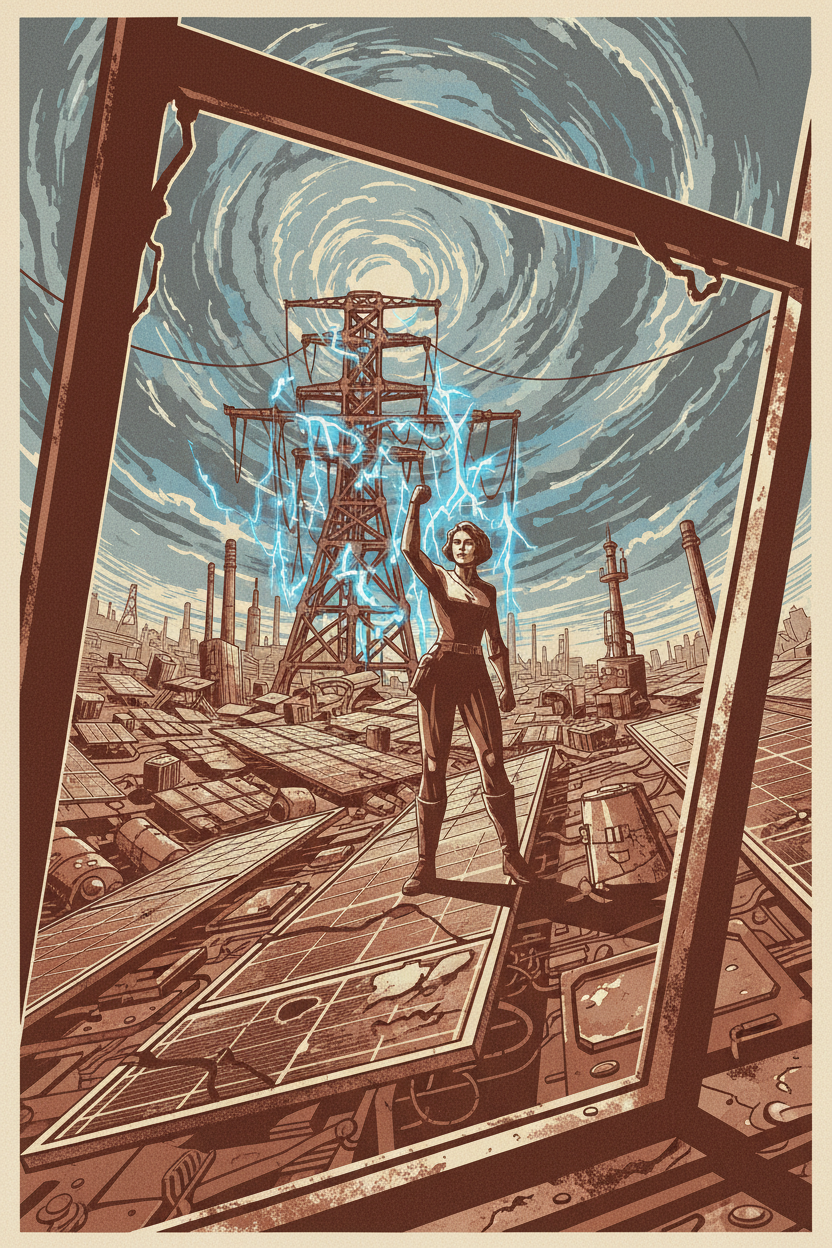
Talia stood at the edge of the solar array, her fingers brushing the cold metal of the photovoltaic panels as she scanned the readouts. The grid had been running smoothly for weeks—until the morning shift reported the first case. A worker had gone silent mid-task, his eyes wide but his voice gone, as if something had swallowed it. She traced the anomaly to a single node near the outer ring, where the solar collectors met the frayed edge of the colony’s infrastructure. The data flow was erratic, flickering like a dying star. She knew what it was before she even spoke the word—Silence Virus. The virus had never reached the Patchwork Frontier before, and now it was here, hiding in the static of the grid. She pressed a hand to her earpiece and called Jorin. “We’ve got a problem,” she said, her voice steady but urgent. “The virus is spreading through the systems.”
Jorin arrived minutes later, his boots crunching over the gravel as he moved with the practiced grace of a soldier. He studied the readouts with a frown, his jaw tight. “We need to isolate the node,” he said. “If it’s in the grid, it could spread to the entire colony.” Talia nodded, already working. She pulled up the diagnostics, her mind racing through the possible pathways the virus could take. The system was old—patched together from salvaged parts and borrowed tech—but it was reliable. That was what made it dangerous. If the virus could adapt to the grid, it could adapt to anything. She reached for the emergency override, but the controls flickered, the interface glitching as if something were trying to push through. She pressed her palm against the console, willing it to respond, but the silence in the room felt heavier than before. Jorin stepped closer. “Talia?” His voice was low, careful. She turned to him, but his mouth was moving and no sound came out. Her breath caught. The virus was already here.
The first tremor of fear passed through her like a ripple in water, but she forced herself to focus. She had to move fast. The grid was the colony’s lifeblood, and if it failed, so would they. She pulled out her handheld scanner and began running diagnostics, her mind racing through the possibilities. The virus was not just a belief—it was a force, a thing that could slip through the cracks of both technology and mind. She thought of the old stories, of the soldiers who had lost their voices on the battlefield, of the settlements that had fallen silent and never recovered. She would not let that happen here. She tapped the scanner against her palm, grounding herself in the rhythm of the machine, the hum of the solar array. She had to fix it. She had to stop it. And she would. She had to.
Talia’s fingers flew over the controls, her mind a blur of calculations and warnings. The virus was not just in the system—it was in the rhythm of the grid, the pulse of the array. She could feel it, like a current running beneath the surface, slipping between the lines of code and the currents of energy. She pulled up the diagnostics again, scanning for anomalies, for any sign of where it had entered. The interface flickered again, and this time she saw it—a distortion in the signal, a tremor in the flow. It was coming from the outer node, the same place she had identified before. But now it was spreading. She turned to Jorin, her voice measured but sharp. “It’s moving. The node is unstable, and the virus is following the signal. If we don’t act now, it’ll be everywhere—inside the comms, the power grid, even the life-support systems.” She pressed a hand to her earpiece. “We need to isolate the node and shut it down before it connects to the core.”
Jorin’s eyes narrowed, his jaw tight. He had seen the virus before—on the front lines, in the silence of battle where men had lost their voices and never regained them. But this was different. This was not the battlefield, where survival meant discipline and control. This was the colony, and the virus was moving like a shadow in the dark. He nodded once, his voice clipped and steady. “We secure the node. No talk. No risk.” He moved without hesitation, his steps precise, his mind already mapping the route. He knew the layout of the array, the routes between the panels, the places where the signal could be cut. He reached for his comm, but his mouth moved and no sound came out. He stopped, his hand hovering over the device. Talia saw the flicker of fear in his eyes, but he did not speak. He simply turned back to her, his expression unreadable.
The silence between them was thick, pressing. Talia forced herself to breathe, to focus. She had no time for fear. The virus was moving, and she had to be faster. She pulled the handheld scanner from her belt and activated it, the device humming as it analyzed the surrounding systems. The readings were erratic, the signal flickering like a dying star. She stepped forward, pressing the scanner to the console. “We need to cut the flow. If we can disrupt the signal, we might be able to contain it.” She turned to Jorin again, but his eyes were fixed on the terminal, his hands moving over the controls with practiced efficiency. He was still speaking, but no sound came out. She caught the movement of his lips, the way his jaw tightened, the way he fought to be heard. She reached for him, her fingers brushing his wrist. “Jorin,” she said, her voice steady. “We’re still here. We’re still together.” The silence between them was deep, but it was not yet absolute. And as long as there was silence, there was still a chance to fight.
Talia’s hands moved over the console with practiced precision, but her mind was a storm of calculations and uncertainties. The virus was no longer just a signal in the grid—it was a presence, a force that moved like a current through the colony’s systems, seeking gaps, seeking weakness. She had spent her life understanding the flow of energy, the rhythm of the array, but this was something else. This was not a malfunction or a failure—it was an invasion. She pulled the scanner closer, the device humming as it analyzed the surrounding data. The readings were erratic, the signal flickering like a dying star. She pressed her palm against the console, willing it to respond, but the silence in the room felt heavier than before. She could feel it pressing in, wrapping around her like a current, trying to pull her into its stillness.
Jorin stood beside her, his hands moving over the controls with practiced efficiency, but his mouth was still, his lips moving in silence. She could see the tension in his jaw, the way he fought to maintain control, to keep the soldier’s discipline even as the virus threatened to steal his voice. He was not the kind of man to panic, but she could feel the strain in him, the way he fought to stay focused, to stay present. He glanced at her, his eyes dark with the weight of what they faced, but no sound came from his mouth. She reached for him, her fingers brushing his wrist. “We’re still here,” she said, her voice steady but low, as if the virus might be listening. “We’re still together.” She forced herself to breathe, to focus. The virus was not just in the systems—it was in the air, in the silence, in the way the colony’s hum had changed, like the world had gone still.
The scanner beeped sharply, drawing her attention. A new anomaly had appeared, a pulse in the signal that didn’t belong. She pulled up the data, her eyes scanning the lines of code and energy flow. The virus was spreading faster than she had expected, moving through the grid like a wave, seeking the core. She knew what she had to do. The forbidden technology—hidden deep in the colony’s archives, buried under layers of regulation and fear—was the only way to stop it. But that was a choice she wasn’t ready to make. Not yet. She turned to Jorin, her voice measured but urgent. “We need to isolate the core before it connects to the main systems. If we don’t act now, we’ll lose everything.” She hesitated, the weight of the decision pressing against her ribs. The colony’s survival depended on it. But so did something else. Something she wasn’t ready to face.