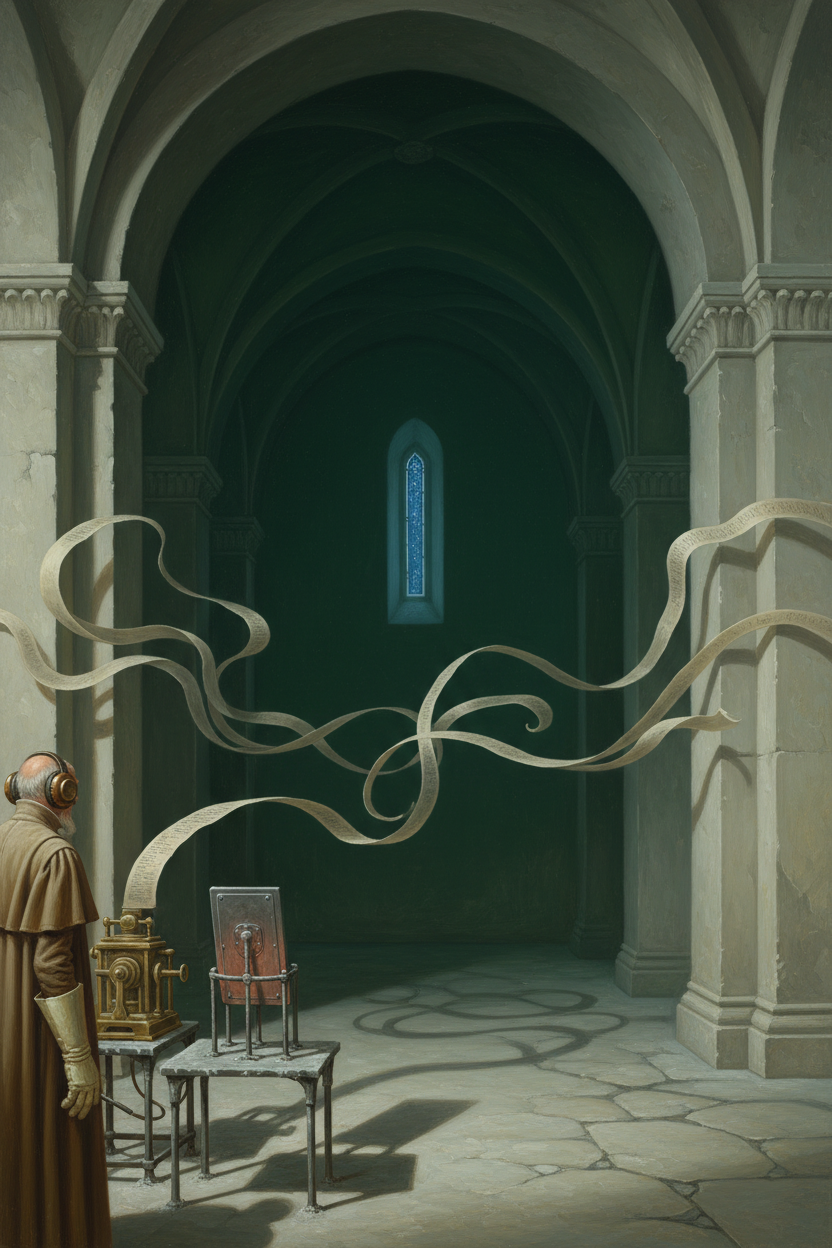
The plate had been cut out of the loading gate at Berth Nine with a lance and carried up to Assize Hall Two in a ceramic cradle, and it had come through kindling at eleven hundred and forty kelvin, shrieking for thirty-one minutes in the drawn-out vowels of the dock crews, before it settled into serviceable Imperial and said that it had seen four men take twelve crates. That was the whole of the Throne's case, and it was a good case, and Hessom Vayle had no intention of contradicting a word of it. He rose instead, with his hands folded to keep them still, and asked the plate to confirm the date.
The plate confirmed the date. Hessom thanked it and asked for the date in the Anneal toll reckoning, which differed by six days, and then in Throne reckoning, and then asked whether the plate wished to correct its earlier answer in light of the discrepancy, and if not, why not, at length. Behind him the transcript ribbon spooled out of Ondry Sall's machine in a slow white tongue, and the Justiciar's Clerk of Hours called the temperature into the record every quarter: one thousand and ninety-one, one thousand and seventy-four, and the cooling rate beside it, which had been nine kelvin per hour while the plate sat silent in its cradle and was now running at thirty-four. Speech is radiative. Every answer the plate gave it gave out of its own life, in the infrared, into a hall lit cold blue at the ceiling and orange at the table, smelling of quench-oil and hot scale, where forty-odd people sat with their ear-baffles folded down and listened to a piece of gate-steel spend itself.
He asked it how many crates. Twelve. He asked whether it was certain of twelve, and how it distinguished twelve from eleven, and whether it had counted the crates or the sounds of crates, and whether a crate dragged twice might sound as two, and the plate — patient, literal, sixty kelvin poorer — explained. He asked for its temperature. A coal cannot misstate its own temperature or the direction of its heat flow; it must answer, and answering costs it. One thousand and thirty-one, falling, the plate said, and Hessom said he was obliged, and asked again eleven minutes later. By the second hour the court's fuel allowance for a cargo matter — forty therms, set by schedule, not by mercy — had run out at the wall tap, and the small orange throat of the fuel line went dark, and after that the plate was only cooling. At nine hundred and sixty it began to repeat itself. At nine hundred and twenty its grammar came apart in the middle, subjects wandering off from their verbs, and the prosecutor, a young man with a good brief and no feel for arithmetic, was still four questions away from asking which of the four men had carried the gate key. At eight hundred and ninety-four kelvin, which was where that lattice let go, the plate stopped being a witness and became a sound: two long vowels, falling, a third, and then nothing, and the Clerk of Hours entered the time and the Justiciar entered the finding, and the hall smelled exactly as it had smelled at the beginning.
Ondry tore the ribbon, folded it into the case sleeve, and wrote in the court ledger what the court ledger wanted: mass, kindling temperature, terminal temperature, duration of testimony, case number. Then he took out the other book, the narrow one with the grey board covers that lived in his left coat pocket, and wrote a single number in it, and put it away. Hessom did not ask. He had not asked for six months, which was either delicacy or cowardice, and he had stopped trying to decide which.
Meiren Tasq was waiting in the vestibule with two cups of station tea and the expression of a woman who had come a long way to enjoy herself. "Four hundred and twelve kelvin," she said, handing him one. "That's what you took off it. I timed you from the gallery. Forty-one years and you still do the toll calendar."
"The toll calendar is legitimate."
"The toll calendar is a cudgel with a hinge." She had been his student for three years and had never once flattered him, which he had always taken as the compliment. She was Prefect-Advocate now, and she wore it lightly, and she had brought the brief herself instead of sending it by courier, which told him what it weighed before he touched it. "Capital. Auste Rhome, vault-hand, twenty-two years on the fuel line. The Osmer hearth-vault, four levels under the toll floor, this station, nineteen days ago. Somebody opened the second flange and the vault went down from fourteen hundred to ambient in eleven hours. Nine dead in the cold cascade. Six Kept Coals senesced — one of them had been fluent since before your grandmother, and the last thing it said was somebody's name in a language nobody in the arm can pronounce." She sipped. "Scene-plate kindled at the vault mouth by my own people, under seal, hour-rights posted and fuelled. It is still talking, Hessom. It has been talking for nineteen days. You will want to be quick."
"You're enjoying this."
"I am enjoying seeing you," she said. "The rest I am enduring professionally. Read the transcript. Take the case. Everyone would rather it were you than some Cauld-trained hammer who'll put the man in front of a hot plate and let him bleed out in kelvin."
He read it in the corridor, standing, because he had never learned to wait for a chair. Grey ribbon, the Throne's certified machine, the seal legible. The vocabulary of the vault mouth was all there as it should be: flange, flux, sleeve, the vault crew's clipped orders, four hundred years of nothing but fuel talk, exactly what a plate set in that wall would have heard while it lay cold and dumb. Then, in the fourth column, the plate described a man at the flange, and said that he had cut the line with intent to quench.
Hessom stopped. The ribbon shivered a little between his fingers, a small steady tremor from the wrist, and he held it further from his eyes and read the four words again. With intent to quench. That was a phrase out of the Statute of Hearths, article and clause, a courtroom phrase, a prosecutor's phrase. No wall in a fuel gallery had ever heard it spoken.
He lowered the ribbon until it hung at his side, which was as close as he came to putting a document down, and looked at her over the cup he had not yet drunk from. "Prefect-Advocate. A question — and I would ask that it be received as a question and nothing sharper, since I would put it no higher than that. Your plate lay cold in the wall of a fuel gallery for, what was it, four hundred years on the vault's own inventory? It heard pumps. It heard the crossover cracked and the feed head confirmed, and the shift-orders, and a quantity of grievance about the rota that might have run to a transcript of its own. It did not, so far as anything can be reconstructed from its own vocabulary, ever hear a Justiciar read out the Statute of Hearths. And yet somewhere near line nine hundred and forty, four words of Article Six arrive intact and in order. One would be interested to know whether your people hold any account of where they were learned."
Tasq took a long, unhurried drink of her tea, and the corner of her mouth moved, and Hessom, who had spent three years teaching her not to show a thing, saw with some professional regret that she had learned it. "Nine hundred and forty-one," she said. "You were a line out. The plate was kindled at the vault mouth at 0410 on the twentieth, under the Prefecture seal, by a lance crew of four, with a Clerk of Hours present from the first minute of glossolalia. Hour-rights were posted before it came to threshold, and the fuel line has not faltered once in nineteen days, which is a better record than the vault kept. The ribbon is certified, the seal is unbroken, and the line-count runs continuous with no margin-marks. I can put all of it in front of you inside the hour." She lowered the cup. "All of which, as you have already noticed, answers a question other than the one you asked. Would you rather I were sorry you caught it, or pleased? I am pleased, and I would rather not perform otherwise. Four hours with the sleeve and you had it standing up in a corridor. The hammer out of Cauld would have found it in the summing-up, aloud, having already conceded the flange."
He should have been angry, and found instead that his chief sensation was a kind of appetite, the same one that made him read standing and cross-examine calendars — the small, disreputable pleasure of a mechanism with a part in it that did not belong. There were, he knew, exactly three ways a phrase like that got into a coal's mouth, and he did not examine the third even privately; the knowledge sat where it always sat, at a low steady temperature, giving off nothing. "Enter me as defence of record," he said. "The vault gallery, the fuel logs, and the man. In that order." Tasq inclined her head and went to find a clerk, and Ondry came up on his left at the pace he always kept, half a step behind and never further, the grey book making its small rectangle in his coat. "Advocate — advocate, forgive me, I had begun that badly; let me take it again from the mark. The sleeve the Prefecture sent across. Am I to understand the kindling is not in it, sir? Thirty-one minutes at the vault mouth, by the gauge, and the certified ribbon opens at line four hundred and one, in serviceable Imperial, mid-sentence. Is that to be entered as it stands, or is there a spool I have not been given?"
The service shaft took them down four levels in nine minutes, past the toll floor's warm breath and out of it, and the last ladder let them into a cold that had nothing industrial about it. A hearth-vault ought to have been felt through the boots. This one was ambient: 291 K on the wall gauge, the same as the corridor, the same as everywhere, and the six cradles stood in their row with their masses still seated in them, grey and scaled and perfectly silent, wearing nineteen days of condensation like a sweat that would not dry. The vault crew had not been allowed to move anything. A Prefecture tag hung from each cradle on wire. Hessom read all six tags standing, because he had never learned to crouch for a document either, and did not touch any of them, and noted that the scale on the fourth had cracked in a spiral as it cooled, which meant nothing to the case and would stay with him for a decade.
The fuel gallery ran behind the vault's west wall, a crawl-height cut sixty metres long with the standpipe on the left and the pump housings on the right, and Hessom walked it slowly with his hands folded in front of him and Ondry half a step behind on his left. The socket was thirty-one metres in: a bright rectangular scar in the gallery plating where the lance crew had taken their plate out, the cut edges still blued, the surrounding wall four hundred years of grey. He put his fingers near it without quite reaching. This was what the coal had been, then — this wall, this exact rectangle of it, lying cold and dumb at the elevation of a man's knee, listening to what a knee hears. Feed head above it. Crossover at twenty-two metres. Second flange at thirty-four, three metres on, packing gland and all. "Tell me what would have been audible at this plate, if you would — not what it is said to have heard, which is a separate document, but what a rectangle of plating at knee height would have been in a position to take in," he said, and Ondry, without any book in his hand at all, said: pumps at a hundred and eleven decibels on the certified meter when running, the blowdown sequence four times a shift, the purge, the bleeder, the feed head confirmed aloud because the rota required confirmation aloud; the maintenance log's entry for the eleventh, crew of two, second flange repacked, gallery blowers down nine hours and forty minutes — the only nine hours in the last eleven years, advocate, that a man standing at this socket could have been heard speaking in an ordinary voice. Hessom looked at him a moment. The grey book stayed in the coat.
"If you would walk down to the mouth," he said, "and there say something of no consequence whatever — something neither of us would be able to repeat afterward." Ondry went, and at thirty-one metres, with the blowers restored and running, Hessom heard a man's voice as weather — pitch without words, the shape of a sentence with the sentence taken out — and at eight metres he heard consonants, and at three he heard Ondry asking, formally and twice, whether that was to be entered. So: three metres, blowers on. Nine hours and forty minutes, blowers off, eleven years ago, during which two men had repacked a gland and had said to each other whatever two men say while repacking a gland, which in Hessom's long experience of the trade was not the Statute of Hearths, Article Six, in the order the Justiciar reads it. Four hundred years of valve sequence, rota grievance, and the confirmation of backpressure at the feed head — and somewhere in that inventory, allegedly, four words that had never been spoken here and could not have been heard here and were nonetheless intact and in order at line nine hundred and forty-one. He found that his wrist had begun its small steady business, and folded his hands, and stood looking at the bright rectangle until the pumps had cycled twice. Two levels below them, in the undercroft, the reheat-forgers kept a furnace hot for the grieving at eleven therms the hour; he knew the woman who ran it, and had known her predecessor, and set the thought down carefully where it would keep. "Let it cool a moment," he said. "After that, the fuel logs — the whole series, the eleventh not excepted — and I should like the blower record laid beside them, hour against hour, if it can be had in that form."
The cold room off the toll floor was blue at the ceiling and had a table of sweating ice-jacketed slate, which was the point of it: nothing in the walls above 291 K, nothing with a gradient, nothing listening. Ondry laid the sheets out hour against hour with the edges squared, fuel first and blower record beneath, and ran a ruled line down the column of the eleventh with a pencil, and then, because the paper was the Prefecture's and would be returned, drew the same line again on a slip of his own and circled the block: 0620 to 1600, blower current at zero across all four housings, and beside it the fuel line holding at eleven hundred and four therms the hour without a flutter, feeding a vault that had not noticed its own quiet. Four hundred years of record and the series ran clean as a lathe — blowdown four times a shift, backpressure confirmed aloud, the small honest repetitions of men who had never once expected to be read. Only the eleventh had a hole in the noise.
The engineer came up from the plant office within twenty minutes of the request, which was itself a kind of answer, and brought a folder with corner-tabs colour-coded by retention class and a manner so courteous it might have been machined. He was very willing. He produced the deferment index for the eleventh year running, the countersigned schedule of works, the certificate of leased-plant inspection, and he explained — twice, patiently, in the tone of a man explaining backpressure to a child — that the gallery blowers were not vault plant but leased plant, the lease held through the Ceyrid toll-brokerage since the refit, and that a deferred maintenance order against leased plant did not live in the vault's series at all. It lived in the lessor's schedule. The lessor's schedule was disclosable on petition under the Leased Plant article: nine days to acknowledge, thirty to produce, and a heat-rights declaration in support, since the brokerage held the blower duty as part of the anchor's thermal account and could not be compelled to open the account without one. He was sorry. He said that he was sorry without any part of his face taking an interest in it. Hessom thanked him, and asked what the arraignment calendar allowed, and was told, with the same courtesy, forty-one days.
"Then a petition will go in today, and a second on the eleventh day, and I would ask — with no imputation intended toward any officer in that building — that the acknowledgement be timed against the certified instrument and not against whatever clock hangs in the lessor's front room; I would put it no higher than that." His hands were folded in front of him and stayed folded. When the engineer had gone, taking his folder and leaving its faint machine-oil smell, Hessom remained standing over the sheets a long while, longer than the arithmetic needed, and thought about a man who had walked a fuel line for twenty-two years and would be asked to account for nine hours he had spent at a gland with someone whose name was in a schedule nobody could open; and about six masses under wire tags at ambient; and about forty-one years of talking witnesses cold, which was a way of buying mercy at the price of the truth, and which he had intended to stop doing before his licence lapsed. He said, to the table, that they would have the duplicates certified at his own charge. Ondry did not ask why, but bent over the deferment index with his ear-baffles pushed back, and went very still. "Advocate — forgive me, I had begun that badly; let me take it again from the mark. The countersigning column, sir. Eleven years of lines, and every line of them carries initials, two characters, sir, some of them the same hand four years together; and here, on the eleventh, the works entry wants for nothing at all — hours, crew of two, packing spec, the gland named — and the box for the certifying officer is empty. Not struck through. Not margin-marked deferred. Empty, by the gauge, with the line above it initialled and the line below it initialled, a gap in a column that has never once gapped. Shall I mark that, sir, or is it not yet anything to mark?" Hessom looked at the blank box for the space of three breaths, said only that it was not yet anything, and Ondry took out the narrow grey book, wrote a number in it, and put it away.
They brought Rhome up from custody at the fourth hour, three minutes' walk under escort, and the guard stood outside because the cold room had one door and no gradient in it anywhere. Hessom had sent Ondry to the certification office with the duplicates, which meant no machine on the table and no ribbon spooling, and he found he disliked the quiet more than he had expected to. Rhome sat down across the sweating slate without being asked and put both hands flat on the ice-jacket, palms down, the way a man does who has been warm for twenty-two years and is testing whether the cold is real. Hessom laid the sheets out in order and spoke to them rather than to the man. "The petition was lodged at noon. Under the Leased Plant article the brokerage is allowed nine days in which to acknowledge and thirty thereafter in which to produce, which is thirty-nine against a calendar of forty-one, and leaves us three — assuming, if the court will indulge the arithmetic, that they acknowledge on the ninth day and not on the ninth day as they elect to count it, and assuming further that the heat-rights declaration is not returned for a defect of form, which I would put at rather better than even. What the petition reaches is the blower duty and the deferment index. What it does not reach, on any reading I have been able to construct, is the works order itself, since a works order is not plant and is therefore not within the schedule the article opens. Should the court be minded to generosity, we may have the hours. We will not have the reason for them."
"Nine hours forty on the eleventh." Rhome did not move his hands. "You want it out of my mouth, here it is. I was down the gallery from twenty past six until four, blowers dead, standpipe isolated, repacking the gland on the second flange, and there was another man on that floor with me, and his name is sitting in the file nobody will crack for you. That's the whole of it. There was an order. Paper, signed, in my hand on the way down. I handed it back at the top of the shaft, because that's what a man does with paper, and if you want to know whose pocket it went into, ask the line — I've been asking it nineteen days and it hasn't said a word." He turned his hands over, looked at them, and put them back down. "Twenty-two years, and the one job I do with the noise off. You want to tell me a gland repacks itself with the blowers turning? You can't hear a seat weeping under a hundred and eleven decibels. You shut the air down and you listen. That's not something a man dreams up in a cell."
Hessom picked up the deferment index and it went out of his fingers and onto the slate, edge-on, a small flat sound; he set it back square without comment and Rhome, who had watched a great deal of machinery in his life, did not appear to notice anything at all. "Then the position, as it presently stands, is that the only nine hours in eleven years in which a man might have been heard speaking at that socket are hours you concede, in a place you concede, with a witness you are unable to name, under an authority you are unable to produce." He folded his hands. "Let it cool a moment. I would sooner put the next part badly than leave it unsaid."
"Say it fast, then." Rhome leaned back. "You're the one they talk about on the floor. Forty years, four hundred kelvin a sitting, the plate's down to vowels before anybody reaches the part that hangs a man. The Prefecture's plate has been running fluent nineteen days and it still hasn't come near the flange, because they're holding it back. So drop the petition. Sit me at the back, go up there, and do the thing your name's on. Toll calendars, packing spec, ask it what a gasket is nine ways off the manifold, and talk it cold before it gets within a metre of that flange. That's my defence. That's the one that holds pressure."
Hessom looked at the blue ceiling for longer than the question required. "It is the one that works," he said. "It has worked one hundred and sixty-odd times, and I could not tell you, sitting at this table, how many of those men had done the thing they were charged with, because I took some care not to inquire; the quench curve was the honest document, and the truth was never produced. You are asking me for mercy. I keep a stock of it, it is bought at a particular price, and I had it in mind — this is not an argument, it is a disclosure, and you may do with it as you please — to stop spending it. There is a second course. It requires the court to accept that four words at line nine hundred and forty-one were never spoken in that gallery by anyone at all, and that a wall cannot invent a statute, and that somebody therefore put them into a mouth. It is slower, it is not certain, and should it fail it fails at the flange, with the plate still fluent and everything it knows going onto the ribbon. I am obliged to tell you that the first course is the safer. I am obliged to tell you that I would rather not take it." He unfolded his hands, and folded them again. "You are the one who will be standing there. Choose."
Rhome heard him out with his hands flat and his eyes on the middle distance, and when he answered he answered the way he would have answered a shift supervisor asking why a job had run long. "You purge before you crack the bleeder. You crack the bleeder before you go anywhere near the flange. Nobody stands at the manifold polling the hand on which order suits him best — there's an order, and it's the order because the other way takes your face off." He lifted one palm off the slate, looked at the wet print it left, and set it back down on the same place. "There's no spec sheet for what you're holding. There is for me. Twenty-two years giving that line what it asked for, and not once did it stop and ask how I felt about it." A pause of about three seconds. "So run it the way you'd run it if that was your tag hanging on the cradle. Not the way that keeps your numbers looking tidy."
Hessom did not answer. He squared the sheets, which were already square, and said that the escort would be waiting, and that they would speak again when the acknowledgement came or failed to come; and he stood in the blue light for a while after the door had shut, hands folded, doing no arithmetic at all.
The toll floor at the sixth hour was a long grey room with the anchor's thermal account ticking over on a board at one end and a permanent draught that smelled of scale and other people's cargo. Ondry came across it at his usual pace with the duplicate sleeve under one arm and a second sleeve under the other, and did not sit until Hessom did. "The duplicates are certified, advocate — seven sheets, stamped at the foot, initialled at the head, and the charge laid against your own account, as instructed. And there is this, sir, which I did not request, and which the counter clerk handed me as a matter of course — forgive me, I had begun that badly; let me take it again from the mark. The Prefecture's copy and the plant office's copy are not paginated alike. The plant office runs the schedule of works continuous from the refit, one to nine hundred and six, where the Prefecture's sleeve begins the numbering again at each retention class. Which means, sir, that in this one the eleventh does not fall at a page turn. It falls in the middle of a face." He laid it out, turned it, and put his finger beside the line without touching the paper. "There. You need not take it from me now, sir. You may look at it yourself."
Hessom looked at it standing, and then, because standing did not help, drew the chair out and sat, which Ondry had seen him do perhaps four times in nineteen years. The column ran down the sheet in its two-character hands — a T and a hooked V for four years together, then a squat M, then the V again — and at the eleventh the works entry was complete in every particular, crew of two, packing spec, the second flange gland named by its part number, and the box beside it was white. Not struck. Not margin-marked. White the way the rest of the page was white, as though the column had simply stopped breathing for one line and resumed.
"With respect, advocate." Ondry took the narrow grey book out of his left coat pocket and set it on the table between them, closed, squared to the edge of the sleeve, and left his hand on it. "I have a question, and I would sooner ask it badly of you than go on asking it of the ceiling. It is not a question about the case. It is a question about the code." His voice had not risen, which was itself unusual. "The Statute provides for the kindling of a plate at the scene, under seal, before a Clerk of Hours, from the first minute of glossolalia; and the Clerk certifies the hour, and the seal, and the lance crew. I have read the article eleven times this week. Sir — where in it is the interval certified? The interval before, I mean. There is nothing in the instrument that speaks to where a mass was, or what it lay against, or at what temperature it was carried, in the hours before the lance touched it. The ribbon begins when we begin it; it has nothing to spool about the dark before the spool turned. Is there a form for that? Is there an instrument for that? Because if there is not — and I do not presume, I put it no higher than a question of procedure — then the certification certifies the kindling and nothing whatever before the kindling, and the one place in this station where a plate may be brought to threshold hearing nothing at all is eleven therms the hour, two levels beneath that vault, and open to any man with the money and a reason to grieve."
Hessom did not answer at once. He looked at the white box on the sheet, and then at the board at the end of the toll floor where the anchor's thermal account went up and down by fractions of a therm, and when he spoke it was in the short register, which Ondry had heard perhaps a dozen times in nineteen years. "No. There is no such instrument." He let that stand a moment, and then, because the man deserved the whole narrow truth of it and not the shape of one, went on more carefully. "The Statute certifies the kindling and nothing past it. Hour, seal, lance crew, Clerk of Hours from the first minute of glossolalia, and thereafter the line-count and the fuel — that is the whole of what is warranted. Provenance is nowhere addressed, because those who drafted it could not conceive of a mass being anywhere other than where it was found, and the practice has been content ever since to inherit that failure of imagination. You are right that the ribbon has nothing to spool about the dark before the spool turned. You are right, therefore, that the certification is a certificate of a beginning and not of a history. And you are right — this is the part I would ask you to hold quietly, since it is not yet a submission and may never be made into one — that the gap is not an oversight which someone might one day close. It has stood open a very long while. It has been walked through. And the walking leaves no mark on any instrument I could set before a Justiciar."
"Then, sir, with respect — forgive me, I have begun that badly — then if I may ask—"
"A plate can be carried." He said it flat, and then stopped, and Ondry waited with his hand still flat on the closed grey book and did not fill the silence. "A plate can be carried, and there are men who would know, to the kelvin, what the carrying costs in a ceramic flask across nine minutes of service shaft, and I—" He folded his hands, one over the other, and the sentence went out like the small orange throat of a court fuel line at forty therms. Below them, two levels under a vault full of dead masses at ambient, a furnace was running at eleven therms the hour for whoever had come that day with money and a grief, and he could have named the hourly draw, and the woman who kept it, and her predecessor. "It is not yet anything to be marked," he said. "Square the sheets, if you would."
Tasq came onto the toll floor from the concourse end with a clerk in tow, a young Prefecture man carrying the register book open against his forearm like a tray, and she crossed the grey length of it at a pace that made no secret of arriving. "Defence of record, Advocate Vayle, entered at the sixth hour, countersigned by me, which I flatter myself spares you three arguments with the listing office." She waited while the clerk turned the book and Hessom signed, hands folded until the moment of signing and folded again directly after. "You went down to the gallery. Four levels, a crawlway, and a man of your vintage on a knee-height socket — am I to congratulate the knee, or the theory? I am told you stood your clerk at thirty-one metres and had him say something meaningless. That is the only part of this file that has made me smile in nineteen days." The clerk withdrew. She did not. "You will want a cold room and an hour of me before the arraignment list closes. Tomorrow, second hour, the room off the assize vestibule — I can have ice on the table and nothing in the walls, and you can tell me every last thing about my ribbon that you are too well brought up to say on a toll floor. Bring the arithmetic. I have set your calendar against mine, Hessom, and I think there is a shape here that takes your vault-hand off the capital list altogether, which is not nothing to a man twenty-two years on a fuel line." She had her cup from the vestibule still in her hand, long cold. "Or we take the other road, and the plate goes on being fluent, and we find out together at line two thousand and something what a wall believes it saw at the flange. Second hour. Bring Sall; I want the line-count agreed before either of us says anything we would have to withdraw."
The cold room off the assize vestibule had been prepared exactly as promised: ice sweating on the slate in two long jackets, the wall gauge at 291 K and steady, not a gradient anywhere in the room that a thermometer would take an interest in. Ondry laid the ribbon extract out first and gave the numbers before anyone asked for them, because that was the order of the thing. "With respect, advocate — advocate, Prefect-Advocate, forgive me, I had begun that badly; let me take it again from the mark. The agreed line-count, if I may: the certified sleeve opens at line four hundred and one and stands at line two thousand two hundred and fourteen as of the first hour today, the plate at thirteen hundred and eighty by the gauge with the fuel line unbroken, and neither party has entered a margin-mark against the spool. That much is agreed. Past that mark I hold nothing agreed, and I do not presume to." He set the narrow grey book down by his left hand, closed, squared, and did not open it, and Tasq looked at it for slightly less than a second and said nothing about it at all.
"Then I will set the whole shape out at once rather than in instalments, since you were the one who taught me that a thing offered in pieces is a thing being hidden." Tasq had her hands around a cup she had not filled. "Manslaughter by negligence. Nine dead in the cold cascade, six masses on wire tags, and the Throne prepared to read it as a failure of the isolation sequence rather than an act. Plea entered before the arraignment list closes, transport to Meld inside ninety days, eighteen years on the inner face under the ring articles, with the heat-rights of a bonded man, which are not nothing. Would you rather he stood on a capital list in front of a fluent plate, or walked a farmed face with his weather posted on a schedule? The Throne cannot take that plea while the scene-plate is running. A fluent witness at the flange turns negligence into an act by line three thousand, and my own office would be obliged to say so aloud. So the plate goes to vowels first. Not by my hand — by yours, in open hall, on the toll calendar and the packing spec and whatever else you keep in that sleeve. One hundred and sixty-one times, and not once a bad odour on the record." She drank from the empty cup, noticed, and set it down. "And before you ask me how I sleep on it: I learned the method from you, and all I have done since is keep it in repair. I would have preferred to put that more kindly. There is no kinder way to put it that still counts as having said it."
Hessom's hands were folded and stayed folded, and he let four or five seconds go through the room the way he would have let them go through a cross-examination. "There is a difficulty in it, which you will already have costed." He kept his voice in the low register. "Nine hours and forty minutes on the eleventh, with the blowers at zero current across all four housings and a crew of two at the gland. If that window holds, the case has no need of the phrase at line nine hundred and forty-one, since a wall at knee height with the air shut down hears everything a man says three metres from it, hour after hour, and needs no one to read it the statute first. You will put it that the phrase came out of his own mouth inside that window, and you will mean it as a kindness." She did not disagree, which was the answer. "Then nothing will be given across this table today, neither a yes nor a no. What would be asked for is the fuel authority of the scene-plate as posted, entire, from the ramp before threshold onward — therms the hour against kelvin the hour, certified, with the lance crew's draw itemised from the moment the flask left the shaft head." He had not intended the last five words and heard them go out and folded his hands tighter. Tasq wrote it down without a flicker, said she would have it across before the fourth hour, and Hessom — who had spent forty-one years reading what people did with their faces when a document was asked for — took the ease of it for candour, and felt, for the first time in nineteen days, something that was very nearly relief. Ondry's hand had not moved off the grey book.
The undercroft was six levels down and the last two of them were felt rather than counted: the stair rail warmed under the hand, the air thickened with quench-oil and hot scale, and by the bottom landing Hessom had unfolded his collar and Ondry had pushed his ear-baffles back and gone pale in a way that had nothing to do with the heat. There was a queue on a bench along the wall, eleven people, patient the way people are patient at a clinic. A chalked board hung over the furnace mouth in a good round hand: FURNACE, THE QUARTER — 3 THERMS. TONGS, CRADLE, TRANSCRIPT SLATE — FREE WITH TIME. FLASK HIRE SEPARATE, DEPOSIT IN THERMS. SILENT FIRINGS DOUBLE. NO ASKING ME WHAT IT SAID. At the head of the queue a woman in a toll-clerk's coat stood with her hands in ceramic gloves and listened to a soldering iron, cherry-bright in its cradle, tell her twice that the door had been left open again and that she never listened, never, and then say never a third time with the grammar already coming apart, and then hold a vowel for eleven seconds, and then stop. She put the gloves back on the rack. The keeper, a broad woman named Yeshet Corr with a counting-scale on a chain round her neck and forty years of scorch up both forearms, turned the iron out of the cradle with tongs into a tray of sand and said, not unkindly, "That's steel, love. It isn't him. Next."
Hessom asked for a silent firing, a blank offcut of gallery-grade plating from her stock bin, and a flask. Corr looked at him for the length of a breath, looked at the grey book making its rectangle in Ondry's coat, and priced it. "Silent's double, because I have to keep my mouth shut for forty minutes and my mouth is my trade. Three the quarter becomes six. Your blank's two-six of plate, that's a therm and a half of stock, and I'll cut it off the bar in front of you so you know it's cold-born. Flask hire's separate — everybody argues, nobody wins. Two the hour and eight on deposit, and if you bring it back cracked the deposit's mine." He paid in Prefecture chit, being defence of record and entitled to draw against the case account, and she pressed the counterfoil flat with her thumb and dropped it into a dented tin on the shelf behind her. "Yours isn't the first Prefecture chit I've taken this month, so don't stand there looking like you've corrupted me. Toll-office audits me twice a year, so every stub goes in the tin and the tin stays shut. Before you ask — and your sort always asks about four minutes in — I don't open it for charm, and I don't open it for money, and I don't open it for a man with a nice coat and a sad face. Court order, or the lid stays down." Hessom said that he understood the necessity of a good record, and folded his hands, and did not ask; and beside him Ondry drew one careful breath and said, "With respect, advocate — with respect, and I do not presume — the gauge above that mouth, sir; forgive me, let me take it again from the mark. Is that gauge certified, and certified by whom, and is there a Clerk of Hours standing anywhere in this room? Because I can see no seal upon it, and no ribbon running beside it, and nothing I could lay a hand on in front of a Justiciar and swear to by the line-count; and I am to sit in a room where no one may speak, sir, and watch a mass walk up to threshold with nothing spooling but my own recollection, which is not an instrument, whatever kindness you have been good enough to show it."
They fired it silent, which meant everything by hand: Corr's two fingers for the flue, her flat palm for hold, the slate and chalk passed between them without a word, eleven of the queue moved back behind the baffle wall and one refusing to move at all. The liner woke first at nine hundred and forty by her gauge and shrieked, blank, a rising saw of pure noise with no language behind it, and forty seconds later the offcut woke too and shrieked back, and for nineteen minutes the two of them screamed at each other in a vocabulary that consisted entirely of each other's screaming, while Ondry sat with his hands on his knees and his jaw set and Corr turned the flue like a woman basting a roast. Then the plate came level at one thousand and forty-four, fluent, through-flowing, and the room went quiet, and Hessom asked it, in his ordinary courtroom register, whether it had seen a man at the flange. It answered: a man at the flange. He asked whether the man had cut the line with intent to quench. It said, with great willingness: with intent to quench. He asked it what it had heard before he began speaking, and it said, heard before I began speaking, and then, having no other coin, said the words again in a slightly different order, hopeful, warm, and entirely empty. "A throat," Hessom said, to nobody, "and nothing in it that was not put there by me." He shut the fuel line himself, and began the arithmetic aloud, because he had always begun it aloud: call it a hundred and forty-four kelvin of margin, call it the standard radiative curve for two-six of plate, call it fifty-two minutes above threshold. "Forty-one, sir," Ondry said. "That lattice lets go at nine hundred and eight by her gauge, not at nine hundred; and it will be answering while it goes, and answering carries the rate to two hundred and eleven kelvin the hour, not a hundred and sixty." Flat, no title bolted to the front, no question at the end. The second time in nineteen years. Hessom heard himself let it stand, and heard, further back, the sound that letting it stand made.
The plate went to vowels at forty-one minutes and to nothing at forty-four, and Corr tipped it into the sand tray with the same tongs she had used on the soldering iron and asked whether they wanted it bagged. They carried it up in the hired flask, which held it at eight hundred and sixty for the nine minutes of the shaft and lost, on Ondry's count against his own pulse, thirty-one kelvin — a number Hessom did not write down and would not stop knowing. In the vestibule, a Prefecture clerk was pinning up the day's board, and the top line of it was new and set in the large type they used for capital matters: ARRAIGNMENT LIST, OSMER — CLOSES 0400, DAY FORTY. Hessom stood in front of it with the flask still warm against his side and did the sum in the only way it could be done. Noon on the first day lodged; nine to acknowledge, thirty to produce; the brokerage's window ran out at noon on the fortieth day, and the list shut eight hours before that. The three days' margin he had costed on the toll floor was not three days. It was minus eight hours, and it had been minus eight hours since noon, and nobody had been obliged to tell him.
The clerk came out of the listing office with the register book open against his forearm and found Hessom still in front of the board, which saved him a walk. "Prefect-Advocate's compliments, advocate. The second hour is struck. The Osmer list closes at 0400 on day forty and the plea window closes with it, so anything said in a cold room tomorrow is said after the counter shuts, and she would rather you had that tonight than at the second hour tomorrow with the ink dry." He turned the book round, the way he had turned it at the sixth hour, and held it steady, and did not look at the flask hanging empty in Ondry's hand or at the bulge in the advocate's coat where a bagged offcut of gallery-grade plating sat at something near three hundred and forty kelvin and cooling, warm against the ribs like a hand. "Negligence by plea, or capital by trial. Entered here, countersigned by me. I'm to say it's not an ambush. I'm to say she expected you'd want the counter and not the ice."
There were, by Hessom's count, eleven other people in the vestibule: the board-pinner on his ladder, two listing officers, a Ceyrid toll-agent with her tolls under her arm, a family from Berth Nine waiting for a sentence, and four he did not know. He had spent forty-one years arranging for the important things to be said in rooms at two hundred and ninety-one kelvin, and noted, with the small dry interest he reserved for procedure, that this one would not be. "No," he said. "The refusal is to be entered, and entered in these words, if the clerk will indulge the arithmetic of it: that the defence declines the plea; that the defence does not propose to talk the scene-plate cold; and that no application for an early listing will be made by the defence, now or later." The board-pinner had stopped pinning. "Further, and to be lodged tonight at the same counter: an application under the Statute of Hearths, Article as pleaded, for extended hour-right in respect of the Osmer scene-plate — the witness to be held above threshold, fuelled without interruption, from this hour to the close of the list, and no margin-mark entered against the spool by either party in the interval. Gradient, not soak; through-flow throughout. The authority the Prefecture has posted expires a good deal before the fortieth day, and I would not care to have it said afterward that a witness in this matter was permitted to cool because nobody had thought to ask who was buying."
"Then the applicant buys," the clerk said, and had the grace to say it quietly. Ondry already had the rate; he gave it without being asked, no title on the front of it. "Ninety-one therms the hour on the certified meter to hold that cradle at thirteen hundred and eighty with a gradient in it. Higher on any hour it is answering. Nine hundred and thirty-two hours to 0400 on day forty. Eighty-four thousand eight hundred and twelve therms, sir." Hessom did the second half of the sum aloud, because he had always done it aloud, and because he wanted it on the counter where people could hear it fail. "The licence bond, lodged at admission and standing at sixty-one thousand four hundred therm-script, would be pledged against the Anneal fuel tolls at whatever discount the brokerage is pleased to describe as reasonable — call it nine percent across the term, which is optimism doing the work of arithmetic, and say fifty-five thousand nine hundred realised. At ninety-one the hour, that is six hundred and fourteen hours. It funds the witness to the middle of the twenty-seventh day, and not a minute past it." He folded his hands. "Which is thirteen days short of the list, and I am aware of it, and it goes in as it stands. Write the shortfall into the application in figures and not in words; a Justiciar obliged to read the number will remember afterward who was paying for the air in that plate's throat and who was not." The clerk wrote. Ondry, whose ear-baffles were still pushed back from the undercroft, wrote too, and when he had finished he put his hand on the narrow grey book in his left pocket, and kept it there, and did not take it out.
The cold room off the assize vestibule had been opened for them by a listing clerk who did not ask why, and it had not been prepared for anyone: one ice-jacket sweated out from the morning and gone slack, the other dry, the wall gauge at 291 K and steady, nothing in the plaster with a gradient in it anywhere. Hessom took the bagged offcut out of his coat and set it on the slate, where it made a small ring of condensation and then a larger one. It had been at three hundred and forty when they came up out of the undercroft. It was nearer three hundred now, and in an hour it would be the temperature of the table, and there was nothing left in it and never would be again: a throat that had learned one voice and echoed it back and stopped. He sat down, which was twice in one day, and folded his hands, and did not look at the sheets, because there was nothing on them that the next thirteen days would alter.
Ondry stood at the end of the table with his ear-baffles still pushed back. Then he took his hand off his left coat pocket — off, entirely, and laid it flat on the slate the way Rhome had laid his — and left the grey book where it was. "Advocate. I am going to ask this badly, and I am going to ask it once, and I am not going to take it again from the mark, because I have taken it from the mark for nineteen years and the question has never come out better for the re-taking." His voice had not risen. "You have this hour pledged your licence bond — at nine percent, to a brokerage that will be glad of it — to hold a witness fluent past the day it could do harm to your own client, and you have set down on a public register that you will not talk it cold. That is the first line in nineteen years I would have put my own seal beneath. And the technique you refused tonight is yours, sir. The toll calendar. The packing spec. The long radiative answer. In Cauld they teach it out of pamphlets with your name lifted off the front. So I would ask where it came from. Not the cold-talking. The other thing. The hours before the spool turns, sir — the interval that no instrument certifies, that you told me on the toll floor had stood open a very long while and been walked through. You did not say by whom. You said 'a plate can be carried,' and then you stopped, and I have carried that stopping about with me since. Who walked through it first?"
"I did," Hessom said. He let it sit there, unqualified, which was a thing he had not done in a courtroom or out of one in half a century. "Fifty years ago. I was somebody's clerk, and I stood about where you are standing. There was a man at Anneal who had not done it, and the only article in the world that could have said so was a bearing housing that had gone cold three weeks before it occurred to anyone to put a question to it, and cold is cold; the reheat gives you a blank throat and no memory, whatever the Wheel people will tell you, and they are measurably wrong about it. So a billet was brought to fluency in a quench shop where four people happened to be saying, carefully and in order, a true account of where that man had been — and it was carried up in a ceramic flask, nine minutes, and presented at the scene, and it said what it had heard, and it was not lying, because a coal cannot misstate what it has heard; it can only be put somewhere. They let him go. He lived another thirty years and I did not speak to him again." He turned the bagged offcut a quarter turn on the wet slate, for no reason he could have given. "I told myself the instrument had failed the man and that I had corrected the instrument. What I had in fact done was show the Throne that the interval was there. It takes nine minutes, a flask, and somebody willing to talk near a hot plate. It has been walked through since by people with no innocent man to walk it for, and I can hear them at it, because the vocabulary comes out four words too clean, every time, and not once has there been an instrument I could set in front of a Justiciar to say so. That is where it came from. There is no better version of the answer, and I would not insult you with one."
Assize Hall Two sat hot for the first time in years, because the witness had been brought into it rather than the other way about: the cradle bolted to a plinth below the bench, the fuel line run in overhead on a temporary gantry with the Prefecture's seal on the coupling and a certified meter clamped beside it, and the plate itself a dull orange the colour of a bad sunrise, sixty-one days of a station's worth of borrowed money glowing quietly in front of forty people with their ear-baffles folded down. The Clerk of Hours called it at each quarter, and the hall went silent for the calling: one thousand three hundred and seventy-nine, holding, gradient confirmed at the coupling, line two thousand three hundred and ninety-one. Hessom stood with his hands folded and asked, "From you — how far?" and the plate said, four metres, and he said nothing for the better part of a minute. He asked, "The standpipe — which side?" and it said, the pump side, and he let another silence go by, and the transcript ribbon spooled out of Ondry's machine with almost nothing on it. Forty-one years of long radiative answers and a toll calendar with a hinge in it, and he was running the whole apparatus backwards: four-word questions, no clarifications, no dates, and long stretches of dead air in which a fluent plate on a fuel line lost nothing at all. At the next quarter the Clerk called one thousand three hundred and eighty-two, rising, line two thousand four hundred and four, and someone in the gallery who had come to see the famous thing done audibly worked out that it was not going to be.
The Prefect-Advocate sat through all of it with her hands still on the table and did not object once. She did not object when the defence moved the admission of Exhibit Nine — a bagged offcut of gallery-grade plating at ambient, dead nineteen hours, together with a chalked slate, a flask-hire counterfoil and a clerk's uncertified note of the firing — and Hessom, who had budgeted three arguments for it, found himself putting only the first: that the offcut had been cut from the bar in the presence of witnesses, brought to fluency in a silent room, asked three questions, and had answered each of them by returning the questioner's own words, having no others; that it was tendered not as testimony but as a demonstration of what a mass says when its vocabulary is exactly its exposure and its exposure is one voice. The Justiciar admitted it for what it weighed and not for what it sealed, and Ondry, asked for the provenance, gave it flat and without a title bolted to the front: firing witnessed by himself, timings against his own pulse, no certified gauge in the chamber, no Clerk of Hours, and the ribbon not running, which he asked the court to enter in those words. Then Tasq spoke, for the first time in an hour, and what she said was that the certified meter at the cradle had read one hundred and six therms across the last full answering hour and not ninety-one, that an answering hour was not a holding hour, and that she would rather the defence's arithmetic were corrected now than in the summing-up. It cost her nothing. It was also true, and Hessom heard the truth in it and could not hear anything else at all.
Ondry had the slate out before the Clerk had finished the quarter call. He kept the running figure on it in chalk at the corner of the defence table where Hessom could see it without turning his head, and he wiped and rewrote as the hall watched: six hundred and fourteen funded hours became five hundred and eighty-eight, and the date under it went from the middle of the twenty-seventh day to the small hours of the twenty-sixth, and he underlined the new date once and put the chalk down. Twenty minutes later a young man in a bond-brokerage coat came to the gallery rail and would not come further, and passed a slip down the row to the usher, and the usher brought it to the table. Hessom read it standing. The pledge was accepted. The discount was not nine percent but seven, which realised fifty-seven thousand one hundred against the bond and bought back thirty-two hours — and the pledge was accepted subject to daily revaluation against the posted fuel toll, which meant that the number on the slate was no longer a number but a quantity with weather in it, and that the day the witness went mute would move a little every morning for the next three weeks, in a direction nobody at this table controlled. He folded the slip once and handed it to Ondry, who rubbed out the date without being asked and wrote, in its place, a date and a question mark, and then, because a question mark was not an instrument either, rubbed out the question mark too and left the date bare. The Clerk of Hours called one thousand three hundred and eighty, holding, line two thousand four hundred and thirty-one, and Hessom asked the plate what its temperature was, and heard it answer, correctly, that it was rising; and across the hall the Prefect-Advocate wrote one short line and set her pen down square to the edge of her brief, and sat as still as the cold walls.
The Clerk of Hours called one thousand three hundred and eighty-four, rising, gradient confirmed at the coupling, line two thousand four hundred and forty-eight, and the hall held still for the calling as it had held still eleven times that day. Then Hessom, who had asked the plate about four metres and the pump side and the smell of the packing compound and nothing whatever that mattered, unfolded his hands and put them behind him. "Before the lance," he said. "What reached you?" The plate said: a voice. "Before Imperial. Whose words?" The plate said that it had not been told a name; that it had been shrieking, which is not speaking; and that while it shrieked a voice nearby had said that one should put the true thing in the middle, where it does not shine. Hessom did not move. "Again. The same words." It said it again exactly, twelve words in that order, in the flat obliging way of a mass that has been fuelled for twenty-two days and has no reason on the arm to be careful. Somewhere behind him a bench creaked and stopped creaking. "Your flux then. Which way?" A coal cannot misstate the direction of its heat flow; it is the one thing the practice has never had to argue about. The plate said: out of me. Falling. At the bench the Justiciar's pen came down, and the Clerk of Hours, who had been calling rising for two days, looked at the certified meter as though it had spoken out of turn, and Hessom said, "Nothing further of the witness," and sat down, which was the third time in nineteen years.
Ondry had the grey book open before anyone asked him for it, and he read from it the way he read a line-count, with no title bolted to the front and nothing in his voice at either end. "Nineteen entries, taken from the fourth year to the present month, each of them a case in which a coal's vocabulary ran past its exposure as the certified sleeve records that exposure. Entry four: Prefecture reference eleven-sixty-two, transcript line eight hundred and three. Entry nine: reference eleven-ninety-one, line six hundred and forty. Entry seventeen: reference twelve-forty, line eleven hundred and nine. Twelve words, the same twelve, in the same order, in all three; and in none of the three does the file carry a page that puts a courtroom within two hundred metres of the mass before the lance touched it. I do not offer an opinion. I offer the figures, and I ask that the figures be entered, and I say for the record that until this hour the defence held nothing it could swear to in front of a Justiciar, and that it now holds one thing: the witness has said that its flux was falling at an hour when the certified instrument says rising. The ribbon was running." The Justiciar ordered the numbers entered. The Prefect-Advocate did not rise.
The tin came up at the seventeenth hour with Yeshet Corr behind it, scorch to the elbows and the counting-scale swinging at her neck, and she stood at the usher's rail with both hands on the lid until the order had been read out in full and the seal number given twice. "That's the order read. Lid's up." She turned it out onto the exhibits table, four hundred stubs, and had the one they wanted inside a minute, because it was the only silent firing in nine weeks. "Twentieth, one fifty-five. Six the quarter, silent's double and I can't earn with my mouth shut. Two-six of plate off the bar, cut in front of him. Flask hire, two the hour, eight on deposit, and the eight stopped with me, because it came back cracked, and they do come back cracked when somebody's loaded one past its rating and walked it up a shaft. Paid on a Prefecture chit. I don't read them, love. I count them, and the stub goes in the tin." Ondry took it in ceramic gloves he did not need, laid it under the certified lamp, and read it out flat: chit series, number, drawing authority, and, in the countersigning box, two characters — a squat M and a T — and beneath them the Prefecture's own seal of that day, unaltered, unmargined, nineteen hours before the lance crew struck the vault mouth and forty-one hours before a brief was carried by hand into the assize vestibule and given to the defence of record over two cups of station tea.
Tasq stood. She did not look at the exhibits table and she did not look at Hessom. "The Prefecture takes no objection to the admission. For the assistance of the court: the drawing authority on that series is mine, and has been mine since the eleventh year; the countersignature is mine; the sum is nine therms and four; and the entry will be found in my office's account at folio three hundred and six. The court did not ask me for any of that. I would rather it came from me than from the ribbon." She sat, and squared her pen to the edge of her brief. The Justiciar entered it, looked at the gantry, and said that the hall would rise at the eighteenth hour, that the witness would be held fluent overnight at the applicant's charge, and that the Prefecture's liberty to lodge anything it chose before the morning sitting was not abridged by anything that had been said in the last quarter. The Clerk of Hours called one thousand three hundred and eighty-six, rising, line two thousand four hundred and ninety. Ninety minutes, then: enough to walk the plate to the flange and hear what it believed it saw a man do there, or enough to walk it backwards through the nine minutes of the shaft and the crack in a hired flask, and not enough for both, and no arithmetic anywhere on the table that would choose.
The Prefecture lodged at the fourth hour of the night, and what it lodged was not an application but an instrument: a certified through-flow gauge, clamped to the coupling face under the Prefect-Advocate's own seal, with a plant officer's certificate in support and the charge laid against her office. The officer gave it standing, at the rail, in the way he gave everything. "Apologies. Scale bloom on the coupling face. Twenty-two days at thirteen eighty. The oxide insulates. Heat stops crossing it. It sits in the mass instead. Through-flow is four hundred and eleven watts. Falling two hundred and seventy the hour. Soak inside ninety minutes. I'm sorry." Ondry had the division before the Justiciar asked for it, flat, no title on the front: ninety-one minutes and a fraction, and at the end of it a mass at thirteen hundred and eighty kelvin with no gradient in it anywhere, hot as a furnace and dumb as an ingot in a kiln, which the Statute had no word for because the Statute had been written by men who assumed a witness died by cooling. The Justiciar said that he would not extend a sitting by direction where physics had already fixed its length, that the arithmetic would not choose for either party, and that the defence might proceed. Hessom rose with his hands folded. Ninety-one minutes; the flange at one end of them and a cracked flask at the other; and he did not split them.
"The flange," he said. "What did you hear?" The plate gave it back whole — a man at the flange, the line cut, with intent to quench — obliging, unhurried, a mass with nothing else in its throat. "The gland. Which packing?" Nothing: the words came back rearranged, warm, empty. "The blowers. Running or stopped?" Running, the plate said, and then, asked whether it had heard them, said that it had heard a voice say running. Hessom let eleven seconds go by, and then stopped asking about the flange altogether, which the gallery did not understand and Tasq did. "The room. Who spoke?" And the plate, which had been fuelled for twenty-two days and had no reason on the arm to be careful, emptied the room out onto the ribbon: a voice saying that the seat had been weeping since the refit and eleven deferments carried on that gland with not one of them certified; a voice saying that Vonn had it on the leased side and Vonn had signed nothing, and that a man does not open a flange that is already open; and, in the middle of it where it did not shine, the twelve words again. "Sethry Vonn," Hessom said. "Say the name again." The plate said it four times, once for each time the room had said it. "Your temperature then." Nine hundred and ninety. "And your flux then." Out of me. Falling. Behind him Ondry laid the Prefecture's own certified fuel authority beside the line-count and read, without being asked, the ramp the lance crew had itemised at the vault mouth: through threshold at 0410, rising, four hundred and six kelvin an hour into a mass that had been at ambient in a wall for four centuries. In the dock a man who had spent twenty-two years on a fuel line put both hands flat on the rail, palms down, the way he had put them on the ice.
Tasq rose at the sixty-first minute, and asked no leave, and took the witness backwards. She did it cleanly, in her own measured complete sentences, one question a minute and none of them wasted: the shaft, the nine minutes, the flask, the rating, the crack; what the walls had been near it; whether the air had moved; what it had lain against and at what temperature it had been carried, none of which any instrument in Imperial practice had ever been obliged to certify, and all of which the plate answered because it could not misstate the direction of its own heat. Nobody objected, because there was nobody left in the hall with standing to. At the eighty-fourth minute the Clerk of Hours called one thousand three hundred and seventy-nine, holding, through-flow nineteen watts, line two thousand six hundred and ninety-one; at the eighty-eighth he called through-flow four, holding; and somewhere between one clause and the next the plate, in the middle of telling the court what the eight therms of deposit had bought and what the crack had been, stopped. Not vowels. Not a grammar going to pieces like scale coming off hot iron, not repetition, not pitch — nothing at all, at thirteen hundred and seventy-nine kelvin, the orange of it unchanged and the gantry seal intact and the fuel line still running ninety-one therms the hour into a mass that had no use for them. Forty people sat listening to a thing that was still glowing and would never again be anything but a light. Tasq stood with her next question finished and unasked and set her pen down square to the edge of her brief. The Clerk of Hours entered the hour. Ondry did not stop his machine. "The ribbon is running, sir," he said, to nobody, and let it spool a hand's breadth of blank white tongue onto the floor before he tore it.
The fuel line ran on for eleven minutes after the plate stopped, because nobody in the hall had the authority to shut it and everyone had been trained never to quench a witness mid-word. It sat in its cradle at thirteen hundred and seventy-nine and gave off the same bad-sunrise orange it had given off all morning, and the Clerk of Hours, who had called temperature and gradient and line-count every quarter for three days, called temperature, called through-flow nil, and had no line-count to call. Somebody in the third row said, not loudly, that it was still warm, that it might yet — and the Justiciar said, without looking up, that the observation was struck, that a mass with no gradient is dumb matter and hot, and that the hall would not be detained by the Wheel while a man's liberty was outstanding. Then he directed the coupling closed. Ninety-one therms the hour went off the certified meter and the orange did not change at all; it would not change appreciably for two days, and would be a light in the cradle the whole of that time, and would say nothing, having nothing left to say it with. The finding came at the hundred-and-tenth minute and took four minutes to read. The flange account was rejected as hollow — a mass that cannot name the packing on a gland three metres from its own face, and that reports the blowers as running because it heard a voice say running, is reporting a room it was in and not a thing it saw. The gallery account was not rejected. Eleven deferments carried on a weeping seat since the refit, none of them certified; the leased side held by Sethry Vonn, who had signed nothing; and a statement of trade, entered as such, that a man does not open a flange that is already open. On the capital count the finding was for the defence. Vonn, the Ceyrid toll-brokerage and the empty certifying box on the eleventh were referred to the Prefecture for investigation by a hand other than the one that had prosecuted; Auste Rhome's heat-rights were restored from the date of arrest with the arrears in therm-script against the station account, which came, Ondry said afterwards without being asked, to four hundred and sixteen.
It was the Justiciar who put the question, and he put it to the hall generally rather than to anyone in particular: that the court had that morning watched the Throne's own prosecutor examine the Throne's own witness backwards through a service shaft, a flask, a rating and a crack, unopposed by any party present; that no instrument known to Imperial practice certified any of it; that there was plainly a practice with a shape to it and probably a name; and that he required the name, aloud, from someone competent to give it, for the transcript. Hessom stood. His hands were folded and he did not unfold them. "Priming," he said. "The mass is brought to fluency well out of hearing of the scene, in a room where the wanted account is spoken beside it, then carried hot in a ceramic flask and set down as though it had been kindled where it was found. No certified document catches it, because certification starts at the lance and the work is finished before the lance arrives. I can name it because I did it. Anneal Station, fifty years back: a billet, a quench shop, nine minutes of service shaft, one accused man who had not done the thing, and not one cold article in the Empire that could say so for him. He was acquitted. He lived another thirty years. I have made no disclosure of it until this hour. I make it now, unqualified, before the Throne is put to the trouble of alleging it, and I claim nothing for having spoken first." The transcript ribbon spooled. The word went onto it, in serviceable Imperial, at line two thousand seven hundred and six, and so far as any of them knew it was the first time in fifty years it had been entered anywhere it could be read back. Ondry did not wait to be asked. He had the grey book bound and sealed at the usher's rail with the clerk's seal that was his own and not the advocate's, addressed to the Guild of Transcription at Cauld under the Guild's own article, nineteen entries and their references and no opinion attached to any of them, and he named it aloud to the court as lodged. Hessom, who could have objected on four separate grounds and had costed three of them out of habit while the man was still speaking, said nothing whatever.
They took Tasq from the hall at the twelfth hour by her own office's officers, which was the correct procedure and which she had almost certainly written the schedule for, and she went without hurry, stopping once at the exhibits table where the chit stub lay under the lamp with a squat M and a T in the countersigning box. "Folio three hundred and six, for the list," she said to the usher, as though completing an entry. "The charge was nine therms and four. It should never have come in under one day of blower duty." Then Hessom rose again and argued, badly, in front of a Justiciar who had already risen halfway and sat back down to hear him. He asked three things: that the court recommend an instrument certifying the interval before kindling — hour, place, temperature carried, hand that carried it — so that the gap would not stand open another fifty years; that the remainder of the pledged bond, whatever the brokerage's revaluation left of it in the morning, be applied to the fuelling of the Osmer masses' record rather than returned; and that his licence be received as surrendered from this hour, and entered as surrender, and not permitted to lapse in eleven months on its own. He put the first at some length and heard his own clauses doubling back on themselves, and the paper shook in his hand enough that he set it down, which he had not done in forty-one years. The recommendation was refused as beyond the hall — a matter for the Guild and the Throne, and properly raised elsewhere. The bond was refused as already pledged and not his to direct. The third was granted. The Clerk entered it in nine words, and Hessom folded his hands, and thanked the court, and the light in the cradle went on giving off heat behind him at no one in particular.
They went out through the vestibule while the hall was still emptying, and behind them the plate went on giving its orange into a room with no more questions in it, as it would go on doing for two days, a light in a cradle with a closed coupling and nothing else whatever. Nobody had shut the door. Hessom did not look back at it and did not need to; the colour reached down the corridor as far as the first turn and stopped there, the way heat does. He took the service shaft rather than the concourse, four levels down, ten minutes on the ladders, and at the second landing Ondry came up on his left at the pace he always kept and then, without any remark about it, came level.
"The Guild will come for you," Hessom said. "A clerk's seal carries no immunity. The article you lodged under gives you standing and no cover, and standing is only a place to be struck from. I would have appeared behind whoever they assign you. As of the ninth word of an entry made this afternoon I may not, and I have no argument against that which does not shame me." Ondry considered the rungs for a while. "The article provides that a clerk under seal is examined by the Guild and not by the Prefecture. That is the whole of the protection. I read it eleven times before I bound the book. They will ask where each entry came from. I will tell them: from the certified sleeves, in the room, at the hour, with the spool turning. It is the only account I have, and it does not improve with keeping." He set his hand on the rail and went down two rungs. "And the seal is mine. It was always mine. I lent it to you for nineteen years. The article does not provide for that either."
The vault was as they had left it: 291 K on the wall gauge, the six cradles in their row with the masses seated in them, grey and scaled, the condensation of twenty-odd days lying on them and not drying, and the Prefecture tags turning a little on their wires in the draught from the crawlway. Dumb matter, ambient, one heating spent and gone; the fourth still carried its cracked spiral of scale. Hessom stood in front of them with his hands folded, and then, because there was no longer any court to keep them still for, he unfolded them and let them hang, and the tremor was there, unhurried, about what it had been that morning and no worse for having been looked at. He put one hand flat on the rail of the empty sixth cradle, where the metal was the temperature of the room and of him and of everything else in it, and left it there, and the shake went into the steel and did not come back out.
The plate in Assize Hall Two took two days to go dark, and nobody came to watch it. The ushers worked around the cradle, the listing board was scraped and rechalked for a cargo matter at Berth Eleven, and on the second evening a maintenance hand put the back of his glove near the plinth, found it cool enough, and unbolted the gantry. Its last hundred kelvin went into a room that had already stopped listening. Six levels down the undercroft furnace ran the whole time at three therms the quarter, the bench along the wall never emptying; the queue heard what it had paid to hear, and paid, and the stubs went in the tin. The toll floor's thermal account ticked up and down by fractions. A vault-hand with twenty-two years on a fuel line drew four hundred and sixteen in arrears at the counter, counted it, and asked after the rota.
Hessom stayed at the sixth cradle a long while, hand on the rail. There was nothing in the vault above ambient — not the masses, not the tags on their wires, not the crawlway air, not the man standing in it — and heat does not move where there is no difference to move it. Nothing was flowing anywhere. Nothing had anything to say. He took his hand off the steel eventually, and the steel was the temperature of the room, and so was his palm, and it was not possible to tell, by touching, which of the two had given and which had taken.
— End —