Rain came off the Maas in sheets that smelled of iron and diesel, and the sodium lamps along the Boompjes made the wet concrete look like something poured that morning and not yet set. Anneke Vries-Tal had the map room to herself for the first hour, which was the only hour she liked. Under the floor, three storeys down in the pier footing, the Board's metronome kept its patient slow knock, one beat every four seconds, a sound that entered through the soles of the feet rather than the ears. It was not a clock. It told you nothing about time. It only reminded the building what agreement sounded like.
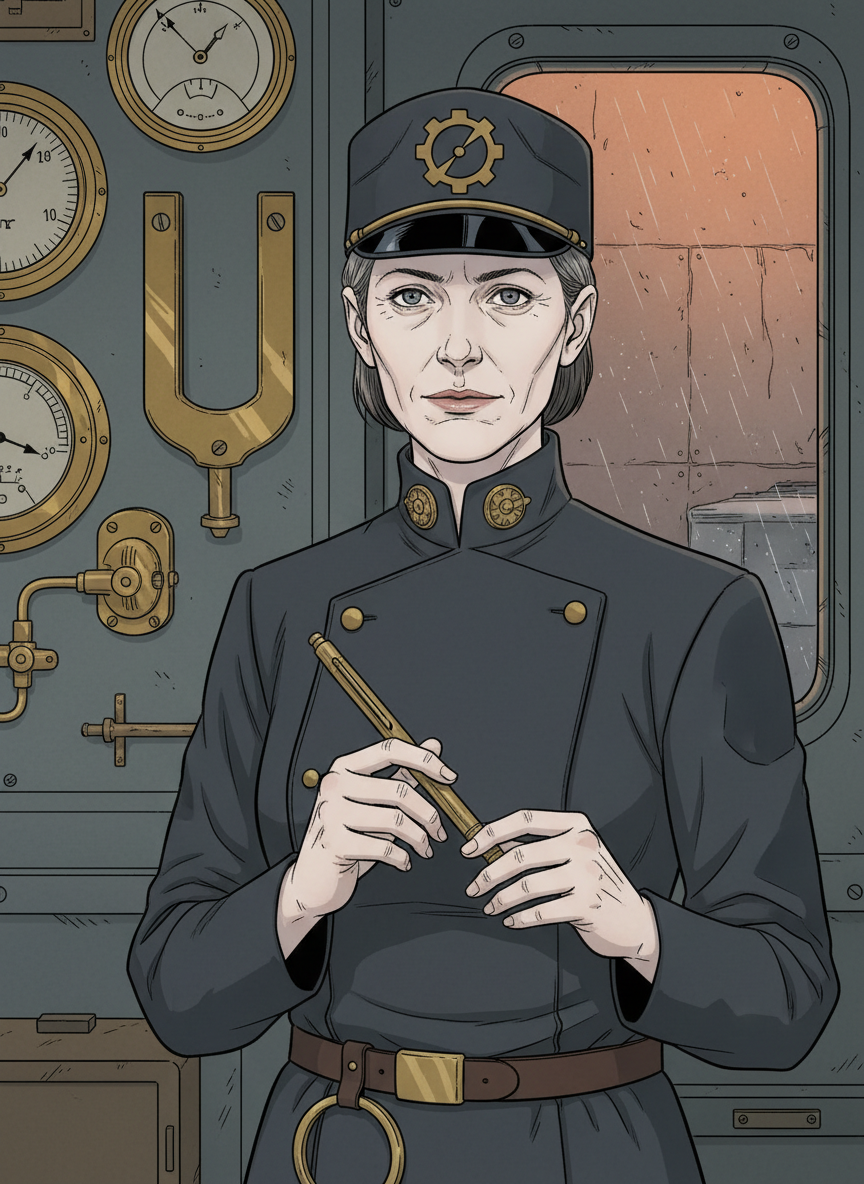
She laid out the sheet. Hand-ruled ledger paper, the good kind, rag-heavy and slightly furred at the deckle, because print went soft inside a decade and nobody had yet found a way to argue with a smudge. The city came up under her pen in strokes she could have made blindfolded: the old spine of the Coolsingel, the drowned cross-streets, Feijenoord-under in its cofferdam like a kettle sunk in a pond, Kralingen shoals, the four pontoon parishes chained off Delfshaven. Twelve districts above water, nine below, four hundred and eleven thousand souls, and one dawn rite a day.
That was the arithmetic, and it never got better by being looked at. A dawn rite in Rotterdam drew, on a good Sunday with the ferries running, eleven thousand two hundred voices. The threshold was ten thousand held to tolerance, which meant the city could cut one tick a morning and had nothing spare — no second congregation, no reserve, no way to hoard what could not be hoarded. So she did not allocate ticks. She allocated the hardness they bought, district by district, and the districts she left out went grainy the way a photograph left in sunlight goes: slowly, then all at once, and never in the places you expected.
She inked the first stamp. The brass was worn smooth at the shoulders from eighty years of thumbs, and the word HARD came up on the paper crisp and black over Kralingen-North: the hospital there, the milk plant, the archive annexe. Then Delfshaven pontoons, HARD, because pontoons that lost their phase-agreement did not fray gently, they simply stopped being the shape of a boat. Then she turned the stamp over in her hand, the way she always did, as if the other one might have changed its mind overnight, and pressed GRAINY across Oude Noorden, where the houses were brick and stubborn and had gone four weeks without and would go a fifth.
Her wrist ached. She flexed it, and looked, as she always did and hated doing, at the knuckles. Still sharp. Still describable.
The corridor woke at seven. She heard Feijenoord-under before she saw them — four of them, wet to the thigh, bringing the cofferdam smell of cold mud into the anteroom — and then their foreman was in the doorway holding out a caisson-bolt on a rag like a dead bird.
"Sub-Horologe."
"Mr. Okonkwo."
He set it on the corner of her map table, away from the ink, which she appreciated. It was a metre of forged steel, as thick as her forearm, and the threads at the near end had forgotten their pitch. They wandered. Two full turns of good honest helix and then a slurring, a hesitation, a place where the metal seemed to have lost track of the argument it was having with itself, and after that the threads simply lay down and became ribbing, grooves, decoration.
"It came out of number nine gate," Okonkwo said. "The nut went on and then it went on for ever. We have sixty of these holding back nine metres of river."
Anneke put her finger on the blurred part. It felt warm, which was nonsense; it felt warm anyway.
"Forged or fabbed?"
"Forged. Eighty years old. That's the point I'm making."
"I know the point you're making." She wrote it into the margin of the working sheet in her small upright hand: Feijenoord-under, gate 9, thread-slack in forged steel, sixty units. "You had the dawn rite three weeks ago."
"We had eight hundred people standing in the rain listening to a congregation in Kralingen on the relay," Okonkwo said. "Which is not the same and you know it isn't."
"It counts the same."
"Then the counting's wrong," he said, and had the decency to look tired rather than angry when he said it, and she had nothing to give him but the margin note and the promise it would be read out. He left the bolt. They always left the thing. The map room had a shelf of them: a doorknob nobody could describe, a spoon that had become approximately a spoon.
Duifje Krol came up at half past with her satchel and her wet felt hat and her extremely reasonable prices.
"Two seats in the Laurenskerk gallery, Thursday, front three rows, properly amplified," she said, without preamble. "For you, because we are friends, a family rate."
"I'm a Horologe, Duifje."
"You have a family."
"I have an aunt in Vlaardingen."
"An aunt is a family. An aunt at a family rate is practically a civic duty." Duifje put a card on the table, face down, the way she thought discreet people did it. "Third row. She'd hear the fork from there. She'd feel it in her teeth."
"My aunt burned her Attendances thirty years ago on a seawall and has nothing left to spend."
Duifje considered this with real sorrow, the sorrow of a woman watching a sale walk into the rain. "Then a seat for you, and you stand behind her, and you sing loud." She retrieved the card, kissed it for luck, and was gone before Anneke could decide whether to laugh.
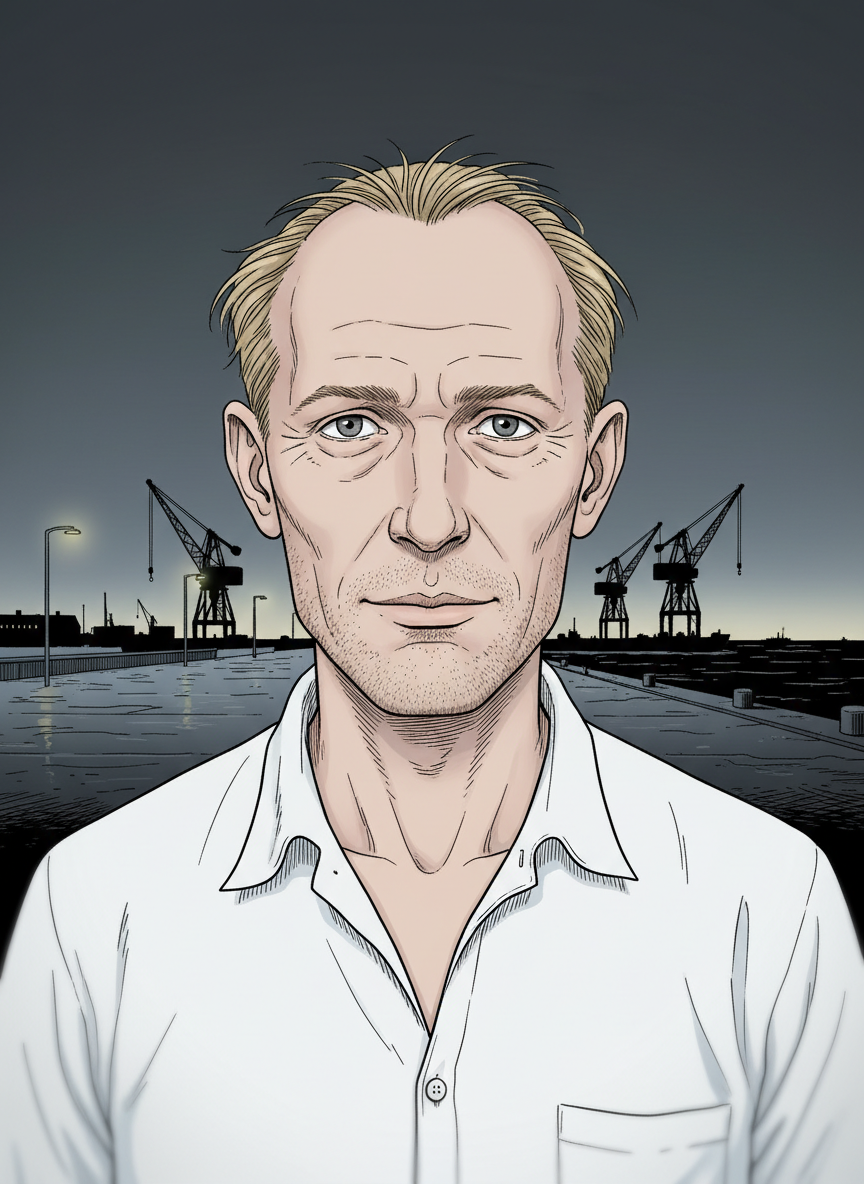
Pieter Loos came last, at nine, with the fair copy of last week's attendance sheets in both hands and rain still beaded on his sleeves. He set it down square. He did not sit. He turned the top sheet and laid his thumb flat on the third line — Kralingen-North, dawn, the eleventh — and left it there long enough that the paper took the shape of his thumb, and the number under it was ten thousand four hundred, and the number that had been there when she was standing in that gallery had been nine thousand two hundred.
Anneke looked at his thumb. She looked at his face, which was doing nothing at all, patiently.
"You've spelled unstinting with two t's in the second verse," she said. "Again."
Pieter took his thumb away and corrected it, and she countersigned the sheet at the bottom, and her hand was perfectly steady, and something in her stomach sat down heavily and folded its arms.
Then the harbour board across the water rang the arrival, four flat notes through the rain, and the duty runner put his head round the door and said that a Horologe-Inspector had come in on the morning packet, three days early, and that they had needed a handcart for his assay kit.
She sent the runner back across the water with a card that said Sub-Horologe Vries-Tal presents her compliments and will wait upon the Inspector at four, which bought her six hours and cost her nothing but the small dishonesty of writing wait upon when she meant put off. Then she took her coat and her case and went down to Feijenoord-under on the eleven o'clock tender, because low tide was at noon and because a woman who had just countersigned ten thousand four hundred voices she had not heard ought to go and look at what the difference bought. The cofferdam rose out of the slack water like a kettle sunk in a pond, just as it did on her map, except that the map did not have the streaks — rust bleeding down the concrete in long orange beards, and under the rust the grey going a particular way she did not like, the way a word goes when you say it forty times. Okonkwo met her at the head of the ladder with a lamp and no surprise at all.
"You'll want the galleries," he said. "Mind the fourth rung, it's honest but it's wet."
The inspection galleries ran behind the gates the whole length of the dam, nine metres below the Maas and eleven below God, a tunnel of arched brick with a duckboard floor and a smell of cold mud and iron that got into the back of her throat and stayed there. Every forty paces a lamp, every lamp a halo of damp. Anneke set her case on the boards at gate nine and opened it and took out the agreement-meter, brass and heavy as a good camera, the pillar-and-fork kind the Board still had made in Utrecht because the fabbed ones went vague in four years. She struck the fork against her thumbnail, set the pillar's foot flat to the caisson face, and watched the needle hunt. In a hard district it goes up smartly and sits, one point zero zero, with a small self-satisfied quiver. Here it climbed to something like eight-tenths and then sagged, and came back, and sagged again, as if the wall were being asked a question it had answered once and could no longer quite remember answering. Nought point seven one. She held it for the full thirty seconds the tolerance required, and in the thirtieth second it went to seventy and a half and she wrote 0.71↓ in the margin in her small upright hand because nought point seven and falling was a number you were allowed to write and 0.705 was a number that started an evacuation.
"Go on," said Okonkwo, not unkindly, from behind the lamp. "Say the part where it counts the same."
"It does count the same. That's not an opinion I hold, it's a schedule I publish."
"I know." He walked her down the gallery with the lamp swinging, showing her the things they had stopped mentioning in reports because nobody read the reports: a handrail bracket whose bolt-heads had all gone the same soft-cornered anonymous shape, like sweets sucked thin; a painted number 9 on the gate plate that was still legible and still, when she looked away and looked back, a slightly different nine. They came out through a door into the gate-side housing, six families in brick rooms built into the dam's own thickness, where the relay speakers hung in every ceiling corner like grey wasp nests and a stove was going and someone had put a cloth over the table because the Sub-Horologe was coming. Anneke sat where she was put. The chair took her weight perfectly well. It was only that the edge of its arm, under her palm, did not seem to end anywhere in particular; her hand knew where the wood stopped and her eye kept proposing somewhere else, and after a moment she stopped looking at it, which she understood was exactly how a district learned to live at seventy-one.
There was a boy. He brought her the tea himself, nine or ten years old, solemn as a verger, and he had been at the relay every dawn for five weeks because his mother sent him and he had a good voice, he said, everyone said so, and she said that was a credit to him and meant it. He stood at her elbow while she drank and told her the names of the six families in order and the number of bolts in gate nine, sixty, which he was proud to know, and she looked at him the whole time — she was careful about it afterwards, she went over it, she had looked at him the whole time — and when she was back up the ladder in the rain with the tender's diesel knocking under her feet she could not have told anyone what his face was like. Not vaguely. Precisely not. She had the tea, the count of sixty, the seriousness, the cowlick, and where the face went there was a sort of courteous absence, the way an archive gives you a card that says the item exists and is not available. She stood at the rail with her wet collar against her neck and tried four times, and the fourth time was worse than the first, and she understood with a flat cold clarity that she was not going to recover it and that there was a line on her working sheet where she would have to decide whether that was worth a dawn.
The runner was waiting on the Boompjes steps with a second card, stiff Reykjavik stock, the printing still sharp. Horologe-Inspector Bakar Ng presents his compliments. Four o'clock is agreeable. He has taken the liberty of requesting the attendance sheets for the eleventh.
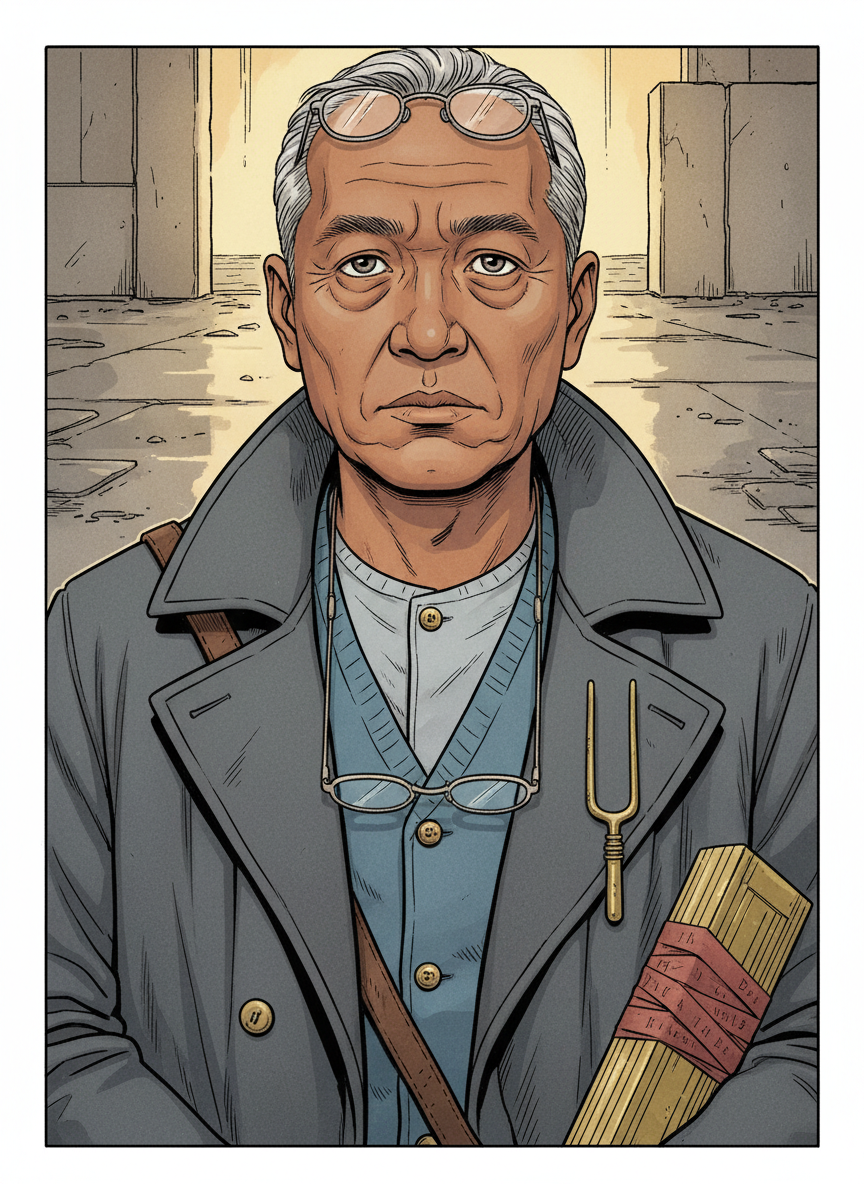
The assay room on the second floor smelled of wax and cold brass, which was the smell of the Horologes everywhere, in Utrecht and Reykjavik and in the little seawall chapels where a sub-deacon kept one fork in a drawer lined with felt because wax was dear. Inspector Bakar Ng had been given the room at ten and by four he had made it his. His kit stood open along the window wall, four cases unshipped into the Board's own wax-lined drawers as though he had been issued them in a former life: comparison masses in descending order, three pillar-and-fork meters of a pattern she had only seen in plates, a sealed reference bar under glass with a dated Reykjavik ribbon on it, and a row of small brass tuning forks graded by a system she did not recognise and wanted, absurdly, to ask about. He rose when she came in. He was sixty or so, round-shouldered, with reading spectacles pushed up into grey hair and a woollen cardigan under the grey coat, and he shook her hand with both of his.
"Sub-Horologe. You've been out on the water, they tell me; you'll want something hot." He had a tray on the map chest, canteen tea in Board cups and two plates of the Board's Thursday bread and herring, which meant he had eaten in the canteen at noon among the copyists and the tide clerks, and had probably been charming, and had certainly been listening. "I took a liberty with the tea an hour ago and it's gone cold, I'm afraid. Everything here goes cold at a rate. It's the river." He sat, and folded his hands, and said, pleasantly, "Reykjavik's had eleven days of horizontal sleet. My wife writes that the towers are singing with it, which sounds lovely on paper and is chiefly a matter of drains. Now. The attendance sheets for the eleventh — Kralingen-North, the dawn. Not the month. The eleventh."
Three storeys down, in the pier footing, the metronome knocked, and Anneke felt it come up through the chair legs and into the backs of her knees the way it always did, one beat every four seconds, patient as a man with all afternoon. She had come up the stairs carrying two things she did not put on the table: a margin note that said 0.71↓ in her own small upright hand, and a boy with a cowlick and a good voice and no face, who had counted sixty bolts for her while she looked straight at him. Against these the Inspector had set a date. Not the month. The eleventh. She heard herself say that the copyist would fetch them, and heard how long it took her to say it, and knew he had heard that too. Ng nodded and did not look pleased, which was worse; he looked sorry, and moved the tray aside to make room. "I should be straight with you, because you'll work it out by six and then you'll be angry that I let you. I have the sheets. I have six years of them, copies, properly attested, and I have a good deal besides that I'll show you when we get to it. What I have is a Board that returns eleven thousand two hundred on days when the ferries didn't run. That is an oddity. An oddity goes in a report, and a report goes into a drawer in Denver with four hundred others and softens quietly for a century. What I do not have —" and he tapped the empty green blotter in front of him, twice, gently, as if knocking at a door he already had the key to — "is the countersignature of the officer who stamped the tick map. You are the only person alive who can say I certified that figure and I knew what I had heard in the gallery. That sentence, over your name, is the difference between suspicion and a prosecution, and a prosecution is the only instrument I know of that gets a district its dawn back."
He let her drink the cold tea. He talked, kindly, about the packet crossing, about a Board in another delta he did not name where the arithmetic had also been generous and where the generosity had gone somewhere upstream and could not be followed past a certain office; he said not the only posting where the sums come out warm and then, like a man closing a door he had only meant to show her was there, went back to the sleet. Then he took out his pocket book and wrote a time in it and turned it round so she could read it. "The next beacon packet goes with your dawn. I should like the finding in it, because the one after that is another twenty-two hours of everybody's era and I'd rather not spend it on the post. So: tomorrow, before the fork sounds. If your name isn't on it I'll send it anyway, without you, and it will be a report, and it will go in the drawer, and your gate nine —" the first time he had said it, and he said it so mildly that she understood he had read her working sheet, or the margin, or her face on the stairs — "will go on reading whatever it reads."
Duifje Krol lived above a chandler's on the Schiedamsedijk, and at eleven that night she came down in a dressing gown and her wet felt hat, because she put the hat on for business the way other people put on shoes. Anneke did not sit. She said she wanted a place at the dawn, and Duifje said Thursday, and Anneke said tomorrow, and Duifje's face did an interesting thing then, a small commercial recalculation with something unhappy underneath it.
"The Laurenskerk's full to the beams and the gallery list closed at seven," Duifje said. "There's the Nachtegaal."
"The barge."
"The barge. Moored off Kralingen slip, amplified off the shore cable, sworn roll of twelve hundred, and it counts, Anneke, it counts exactly the same as sitting under the great fork with your knees against a bishop." She named a price that was not a family rate. "Eight guilders, and you're in the stern gallery where the wax doesn't drip on you."
"Who signs its roll?"
"Somebody signs everything."
"Before the rite or after?"
Duifje looked at her for four seconds, which in a woman who talked for a living was a long speech, and then said, "You'll want a coat. It's brass cold out there," and took the money without kissing it.
She was rowed out at half past four into a black river that smelled of iron and diesel and, under that, faintly, of wax. The Nachtegaal was a hundred and forty feet of old grain barge with a timber choir gallery bolted along both gunwales and a canvas roof, and she sat low and warm and yellow on the water, every port glowing, the amplifier hum coming off her like heat off a stove — a steady sixty-cycle breath that you felt in the fillings of your teeth before you heard it. Inside, the candles were the good beeswax kind, hundreds of them in tin sconces, and the air was the air of every choir gallery Anneke had known since she was seven: wax, wet wool, the sweetish iron of river damp. She took her seat in the stern and put Ng's deadline down beside her like a stone in her lap, and she began, because she did not know how else to be in a room, to survey. The cadence regulator stood on its brass tripod at the midships post where it ought to be, and its fork-line ran up to the master fork on the mast where it ought to, and its second lead — the correction lead, the one that tells each singer's collar when to pull — did not come from the fork at all. It came from the shore cable's junction box. The regulator was not correcting the barge against the fork. It was correcting the barge against the sound of Kralingen, which was itself a quarter-mile of cable and a half-beat late, and a body corrected to a late copy of the beat arrives late for ever, politely, in perfect agreement with everything except the universe.
She sat with that for a while and did not write it down. At five the wardens went along the gunwales with their tapers, and at ten past the fork sounded from the mast, a single clean note like a wire drawn through the fog, and twelve hundred people were supposed to stand. Anneke counted them. She did it the way she drew the tick map, which was the only competence she entirely trusted: she divided the barge into districts. Port gallery forward, port gallery aft, starboard the same, the four hold benches, the stern where she sat. She counted in tens, thumb against the ledger's edge in her pocket, re-counting each block twice against the candle sconces as fixed landmarks, discounting nobody for age or voice because the threshold did not discount either. It took her the whole of the first verse and half the second, and it was in the second verse that she noticed the mouths. Two-thirds of the barge sang on the fork. The rest — the hold benches mostly, men and women in oilskins who had come aboard together and sat together — were a half-beat behind, exactly and consistently behind, their jaws working in a round with themselves, and they were singing the words perfectly and they were not in the rite at all. She finished her count anyway. Nine hundred and forty-one bodies aboard the Nachtegaal, against a sworn roll of twelve hundred; and of the nine hundred and forty-one, perhaps six hundred in tolerance, which was a thing she had no instrument to prove and did not need one to know.
The rite closed. The lurch came, the small good lurch that everyone pretended not to feel, the world putting its weight on the other foot, and all along the gunwales people laughed and gripped each other's arms because the hardening still felt like being loved. Anneke sat in it with her hand over her pocket ledger. Protocol was four lines long and she had recited it at her examination at nineteen: an officer observing a discrepancy in a counted congregation shall report it to the nearest Horologe before the bell that follows the fork. The bell that followed the fork was the harbour board's, four flat notes across the water at six, and she heard it perfectly well through the canvas while the wardens were snuffing the candles and the tin smoked and the smell of hot wax went over to the smell of cold wax, which is a different smell entirely and the one she would remember. She did not stand up. The barge swung on its cable in the grey. Ng was three hundred yards away in a dry room with his sealed reference bar under its dated ribbon, and she had, at last, a number of her own that belonged to nobody upstream, and she had spent the only minute in which she could still have been a person who merely held it.
The tender put her ashore at the Boompjes steps in proper daylight, grey and wet and generous, the kind that made the river look like poured tin. She went up with the cold wax still in her clothes, and by the second landing the building had replaced it: boiled coffee from the tide clerks' urn, wet wool on the radiators, and over everything the flat mineral smell of ledger paper in quantity, which she had never once thought of as a smell until a man from Reykjavik took a room on her second floor. Ng had opened the window sash two inches. Rain ran down the outside of the glass in long unhurried lines and the light came through it broken, so that the sealed reference bar under its dated ribbon lay in a puddle of moving brightness on the blotter, and he had poured two cups before she reached the door, which meant he had watched the tender cross.
"You'll want to sit before you tell me," he said. "People stand up to make it shorter and then it takes an hour."
She sat and set her pocket ledger on the green blotter, squared to the edge, and did not open it. "I have a finding for you. It is fresh, it is mine, and it is provable by anyone who goes out there with a meter tonight." She gave him the Nachtegaal: the correction lead run off the shore junction instead of the mast fork, the permanent half-beat, nine hundred and forty-one bodies counted in districts against a sworn roll of twelve hundred, perhaps six hundred of them in tolerance and the rest singing every word correctly and standing entirely outside the rite. She gave him the eight guilders and Duifje's four seconds of silence. She did not give him the bell. "Sign that and you have a prosecution this week. Seat-sellers, a sworn roll, a wiring fraud you can photograph. It goes in your packet at dawn tomorrow with a name on it, and it will be my name on the observation, and the Board will have to re-survey every amplified congregation on the river, which is the thing Feijenoord-under actually needs. That is a real offer and it costs me my posting."
Ng turned his cup a quarter-turn on its saucer, the way a man does when he is deciding how much kindness a person can carry before breakfast. "It costs you Reykjavik," he agreed. "It costs the Nachtegaal's owner four years and twelve hundred people a place to sing, and next month the sworn rolls on this river will be honest and the Board's returns will not change by a single voice. Sub-Horologe — I have sat with that arithmetic for eleven days. Rotterdam declares one tick a morning. Rotterdam is allocated hardness for one tick a morning, and the allocation arrives from Reykjavik correct to the decimal, and the districts you stamp HARD go soft on the schedule of a city cutting rather fewer ticks than it says it cuts. Somebody has been receiving the difference for six years, and receiving it in a form that has to be granted, which means a warm figure leaves this building and is welcomed by an office that knows to expect it. A barge does not have that office. A tout does not have that office." He glanced at the window, at the moving light. "There was a delta in my last file where the same warmth ran up four desks and stopped at a room I was told had been reorganised. I am not going to be told that twice, and the only door I have is the one you signed."
The knock came then, two soft taps, and Pieter Loos brought in the day's fair copies on his forearms like a man carrying something hot. He had shaved badly. He set the stack down square, as he always did, and his hands were not steady, and he stood with them at his sides where Ng could see them, which Anneke understood was deliberate and hated understanding. "The eleventh, Inspector, and the ten days either side," he said, and to Anneke, in exactly his flat morning voice, "You'll find the second verse. Unstinting. I've corrected it in both." Then he looked at her for slightly too long, the way he had looked at the third line with his thumb on it, and went out, and his footsteps did not go down the stairs towards the copy room; they went up, towards the strongroom landing, and stopped there, and did not come back down while the coffee cooled.
Ng did not press her about the barge again. He asked instead, in the mild tone of a man enquiring after somebody's drains, whether there had been anything else in the gallery on the eleventh — anything she had seen and not written, any small thing she had decided at the time was not worth the ink. It was a narrow question, cut exactly to the width of the door he wanted, and it was courteous enough that she could have stepped through it in either direction. She said that she had written what she had. His cup sat where he had poured it, untouched, a skin coming on the surface, the steam long finished; he had drunk none of it and did not appear to have noticed, which told her more about the eleven days than anything he had said aloud. Then he tilted his head very slightly towards the ceiling, where the boards above the assay room carried the strongroom landing, and said, "Your copyist has been standing still for four minutes. Men who are about to be ill sit down, and men who are about to run go on going. Standing still is a third thing." He turned the reference bar a few degrees in its puddle of moving light, squaring the ribbon to the window. "Go up, Sub-Horologe. I'd rather you brought it to me than that I found it in a drawer at midnight with the Board's night clerk hanging off my elbow."
The stair to the third floor was the old grain-office stair, narrow, with a brass rail worn to the colour of butter, and the smell changed as she climbed. Wax fell away below her, wax and coffee and the radiators, and what came down to meet her was ledger paper in bulk and in the cold: that flat mineral breath of rag and iron-gall and mildew held just this side of harm, ten thousand hand-copied sheets exhaling at once. Under everything the metronome kept its four-second knock, and up here, three storeys from the pier footing, you did not hear it so much as feel the banister deliver it to your palm, one patient tap, and another, and another, the building being reminded what agreement sounded like. Pieter Loos stood on the landing with his back to the strongroom door and a ledger held against his chest with both forearms, the way he had carried the fair copies, the way a man carries something hot.
"You didn't look at the second verse," he said.
"You told me you'd corrected it."
"I told you I'd corrected it in both." He turned the book round without letting go of it and opened it on his own forearms so that she had to come to him to read, and there it was, the eleventh, Kralingen-North, the liturgy set out in his beautiful upright copperplate with the attendance ruled in beneath — and in the second verse, in the third line of it, unstinting, with two t's. "Every sheet where the figure was raised," he said. "Six years. That's the mark. I've never once misspelled a word in my life, Sub-Horologe, and you have written me a reprimand for it eleven times, and I kept every one of them, because a reprimand is dated and signed and it puts you in the room." He let her look a moment longer, and then closed the book and took it back against his chest. "There's a second set. Same hand, same paper, the true counts, and a column on the right that isn't on the fair copies — a receiving code, four characters, different every quarter, and a place for a countersign that isn't yours and isn't the Chairman's. I don't know whose it is. I've copied it nine hundred and forty times and I don't know whose it is." His hands had stopped shaking, which frightened her more than the shaking. "I'm not giving you the set. Not yet. You can have the eleventh, because you were there and it's half yours already, and then you and I will find out what you do with a thing you can't unsee before the fork sounds tomorrow."
"The countersign," she said. "You've copied it nine hundred and forty times. You must have an opinion."
"I have three." Loos did not move off the strongroom door, and he did not open the book again, and she understood that the book had been open for exactly as long as he had decided it would be. "First, it isn't a signature. A signature is a habit; it gets worse when a man is tired and better when he's being watched, and this one doesn't vary that way. It varies the other way — it's steady inside a quarter and then it shifts, a little, at the change, the same way a forgery shifts when the forger comes back to it cold. Somebody is copying it, Sub-Horologe. Possibly somebody like me. Second, it goes out of this building and comes back. The sheets with the right-hand column leave in the night dispatch and they are back on my desk countersigned before I've had my coffee, which means whoever grants that difference is inside an hour of the Maas and doesn't keep Reykjavik's hours. And third—" He stopped, and looked at the rail, and for the first time that morning he seemed to be choosing rather than reciting. "Third, the capital. The first letter of it. It's a tally-hand capital, the kind with the closed counter and the tick on the ascender. Board men don't write it. Copyists don't write it. It's taught in one place and I have spent six years trying to draw it properly and I can't, because I was never taught to, and every time I fail it I know a little more about who I'm failing to be."
She wanted the receiving code then, all twenty-four quarters of it, and she asked, and he said no, and the no had nothing pleading in it any more; it had set, the way a bolt sets in a hole that agrees with it. Only the eleventh, he said again. Only the day she had stood in the gallery herself, because that was the one day nobody could tell her she had misremembered. The rest stayed where the rest was, and he did not say where, and the not-saying was so deliberate that she heard the shape of it: somewhere in this building, somewhere he could reach in the time it took to walk a corridor, somewhere he had been able to get to every night for six years without a key being missed. And she thought of eleven reprimands in his drawer, dated, signed, Vries-Tal, Sub-Horologe, each one a small punctual stone laid down to prove that the officer in charge had looked at the mark, and had seen a misspelling, and had corrected the man who made it. Whatever ledger this ended in, she was in the room. She had been in the room longer than Ng had been in the country.
The banister gave her the metronome all the way down, one patient tap into the palm, and another, four seconds of stair between them, the building reminding her what agreement sounded like while she carried the strongroom out on her sleeves — that cold rag and iron-gall and mildew, which she could still smell when she sat down in the assay room and which Ng's nose registered without comment. His cup stood where it had stood, full to the same line, the skin on it gone matte now, and he saw her see it and turned it a quarter-turn on its saucer as though that were the point of it. "It's a discipline," he said. "If I drink it I'll want another and then I'll be a man having a pleasant morning." He drew the green blotter towards him and uncapped his pen, and she watched him rule two small boxes at the head of a fresh sheet, which took him four seconds and frightened her more than his kit had. "Before you tell me what you've been told, one procedural thing, because I have to enter you on the schedule tonight and there are only the two boxes. Witness, or person with an interest. They are not the same paper, Sub-Horologe, and they are not the same protection, and I can't move you from one to the other later without it looking like exactly what it would be." He looked up, mild as drains. "A witness saw the Board's arithmetic go warm. A person with an interest saw it and signed under it and heard a bell while she was counting. Tell me which one came down those stairs, and I'll write it, and then you can tell me about the capital letter."
"The second box," she said. "Person with an interest. Ink it now, before I make a speech about it." He did not move at once, so she took the remaining distance herself, because it occurred to her that if she waited she would find a way to be a witness by dinner. "I stood in the Kralingen gallery on the eleventh and counted nine thousand two hundred, and I countersigned ten thousand four hundred that morning and eleven times before that, and I wrote reprimands to the man who left me the mark, which puts my name in the room with a date on it. And there is one thing you asked me for an hour ago that I did not give you, so I will give it to you now rather than have you set it down in front of me at some convenient moment and watch what my face does. Yesterday's dawn, the Nachtegaal, off Kralingen slip. I counted nine hundred and forty-one against a sworn roll of twelve hundred. Protocol is four lines and I can still say it from my examination: report to the nearest Horologe before the bell that follows the fork. The harbour board rang six while the wardens were putting out the candles and I was sitting down, and I heard it, and I sat. You were three hundred yards away with the light on. That is not an omission, Inspector, it's an election, and it belongs in your second box with the rest of me."
Ng put the nib down in the second box and ruled the tick and then went on holding the pen, and she saw both things arrive in him at once, the way you see weather cross water: relief, which loosened something in his shoulders and made him ten years less careful, and alarm, which tightened the same shoulders a half-second later, because a person with an interest who volunteers her own bell is a person who has stopped calculating, and nobody sensible builds a case on somebody who has stopped calculating. "Thank you," he said. "That was expensively done and I'd rather you'd been cheaper about it." The tea stood between them with its matte skin, and she found she was using it as a clock: it had been hot when she came up from the tender, warm when Loos put down the fair copies, and it was room-cold now, which meant the morning had gone. Up here the metronome came faintly, fainter than on the stairs, one small knock in the floor and then four seconds in which the room seemed to hold its breath and the rain went on down the window in its unhurried lines. She told him the rest of it flatly, in the order Loos had given it, because the order was itself evidence: that the countersign was steady inside a quarter and shifted at the change, which made it a copy and not a habit; that the sheets with the right-hand column went out in the night dispatch and came back granted before the copyists had their coffee, so the office doing the granting kept Maas hours and sat within an hour of the river; and that the capital letter was a tally-hand capital, closed counter, tick on the ascender, which was taught in exactly one place and not to Board men, not to copyists, not to a clerk who had been failing to draw it for six years and had learned something about himself in every failure. Ng wrote steadily until the tally-hand capital, and at that he stopped writing, and looked at the sealed reference bar in its moving puddle of light with its dated Reykjavik ribbon, and said only, "Within an hour of the river," and then, after a while, "There is an office I would like to be wrong about," and did not say which.
"There's a second set," she said. "True counts, receiving codes, the countersign. It exists, it is complete to nine hundred and forty sheets, and it is not in Denver." She stopped there, and let him hear where she had stopped. "I'm not going to tell you this morning where it is, or give you the eleventh, and if you want the reason it is that the man holding them has kept himself alive for six years by being the only person who knows, and I have not yet worked out whether I would be handing you a ledger or handing you a copyist. Ask me again before the fork." Ng opened his mouth, and whatever he had decided to spend on that was never spent, because the stair below them filled with somebody taking it two at a time, which nobody did in that building, and the duty runner came in without knocking at all — soaked, hatless, holding a harbour-board slip with the ink already running — and said that the morning packet was not the morning packet, that a stride-liner had come down at the Hook on an unscheduled arrival gong at half past ten, and that a Deputy Allocator from Reykjavik, an Ozek, was already on the river road with two secretaries and a crate of Attendances and had sent ahead to say he would be pleased to address the Board at noon on an increase to Rotterdam's quota. Ng laid the pen down very gently across the two ruled boxes, one of them now inked, and said, "Four days early," in the voice of a man hearing a door he had been working towards open by itself.
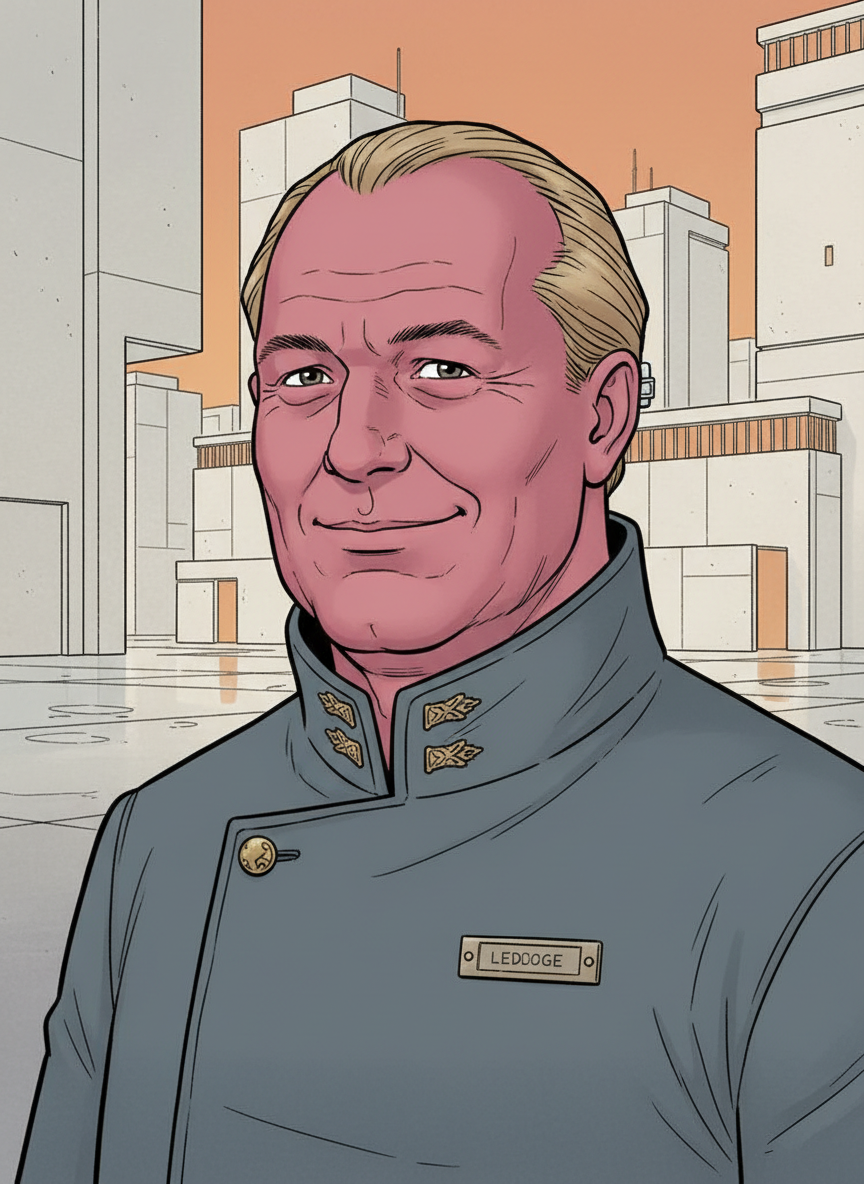
He came up the grain-office stair while the runner was still in the doorway dripping, and he came up talking, so that his voice arrived in the assay room a flight before he did — a warm, unhurried voice with the vowels of somewhere further east than Reykjavik, saying something to a secretary about the state of the river road and how a man could be forgiven for thinking the Federation had given up on tarmac. Then Deputy Allocator Ozek was in the room, filling the doorway, shaking rain off a coat that was too good for the weather, and he had Anneke's hand in both of his before she had got out of the chair. He was perhaps fifty, broad, with the flushed pleased face of a man who has just come indoors; behind him a secretary held a crate of Attendances against her hip with the lid already loose, ration books by the hundred, the red civic ones, and a second secretary was apologising to nobody for the puddle. "Sub-Horologe Vries-Tal," Ozek said. "No — don't stand, I've barged, I know I've barged, I'll be forgiven at noon or not at all. I wanted to see this room first. Eighty years of thumbs on that stamp and Reykjavik thinks hardness is a number that comes out of a machine." He looked around the assay room the way a man looks around a house he has been told about, and his eye stopped at the map chest, and he smiled. "Your Kralingen sheet last month. The four pontoon parishes taken out of the shoal block and ruled separately. That was a clever piece of drawing and I would like to know whose idea it was, because it wasn't in the manual."
It had not been in the manual, and it had gone out under seal in the night dispatch nine days ago, and Anneke had not yet had the flimsy back from the Board's own registry. She said that it had been hers and thanked him, and heard the thanks come out flat, and behind her Ng had already moved. He did it without hurry, in the middle of Ozek's sentence, the way a careful man tidies: he folded the sheet with the two ruled boxes on it once, cleanly, the inked tick shut inside, and laid the sealed reference bar down across the fold, and then he stood and offered his hand and said that the bar had been witnessed at eight and he was not permitted to lift it again until the assay closed, so Deputy Allocator, you'll excuse a man staying anchored to his own table. It was thin. It was also perfectly true and perfectly checkable, and it meant that for the rest of the conversation there was a small glass-and-brass object lying on the one piece of paper in Rotterdam that had Anneke's election on it. Ng shook hands. He said it was a pleasure. He said nothing else for ninety seconds together, which she had not seen him do since he arrived, and she understood that she was being shown something: the Inspector had gone quiet and correct the way a meter goes quiet when the needle has stopped hunting and settled somewhere you are not allowed to write down.
Ozek, meanwhile, was being generous, and the terrible thing was that it was real generosity. Rotterdam's quota had been an embarrassment for a decade, he said; one dawn a day for four hundred and eleven thousand people was a sum that should shame the committee that set it, and he had come with the committee's answer, which was two more ticks a week, ratified, funded, effective from the turn of the quarter — two dawns that Rotterdam did not have to find out of its own hoarse throat. The crate on the secretary's hip was the first tranche of Attendances, and there would be more, and he intended to announce it at noon in front of the Chairman and the tide clerks and anyone from the pontoons who could get up the stairs, because announcements were the only part of the job that paid. He spoke about the relay districts with something that sounded exactly like anger. He said that a man who listened to another parish's rite through a speaker in his ceiling was being told, politely, every morning, that he was a rounding error. Anneke found that her eyes had gone hot and was disgusted with herself, because none of it was wrong, and because a lid is a lid whatever is painted on it, and because somewhere under the warmth was a question she could not ask in front of a crate of ration books: how does a Deputy Allocator arrive cold off a stride-liner at half past ten knowing how a sub-officer ruled her shoals. Ng had turned his cup a quarter-turn on its saucer and left his hand on the table beside the reference bar. Ozek pulled his gloves through his fist, pleased with the room, pleased with the morning.
"And the first of the new dawns," he said, "I'd like to give to Feijenoord-under."
He took the stairs down at the same pace he had come up them, still talking — something to the first secretary about whether the Chairman would want the crate opened on the table or left by the door, because a lid standing open was worth two paragraphs of speech — and the building went after him. Anneke heard it go: chairs in the tide clerks' room, the copyists' door, a woman on the landing asking somebody to hold the lift gate, and then the long emptying hush of a Board that had found something to attend. Below the hush, unchanged, the pier footing knocked, one beat every four seconds, and the rain went on down the assay-room window in its unhurried lines. The puddle by the door had already begun to spread along a floorboard seam towards the map chest. Ng did not get up to deal with it. He sat with his hand where he had left it, an inch from the sealed reference bar and its dated ribbon, and the bar sat where he had put it, across the fold of a sheet of paper with two ruled boxes on it, one of them inked, and he said, without any run-up at all, in the voice he used for drains, "Sub-Horologe. Last month's Kralingen sheet. Who did you tell about the pontoon ruling?"
She began to answer and found that answering was a piece of arithmetic and not a piece of memory, and that she had to do it in front of him, in the room, the way she had counted the barge. "Nobody," she said. "I drew it on the twenty-ninth. I ruled the four parishes out of the shoal block because the pontoons fray differently and the block was lying to me. I didn't discuss it, because it wasn't in the manual and I wanted it stamped before anyone told me it wasn't in the manual. It went into the sealed packet on the thirtieth. The night dispatch took it at eleven." She stopped. Ng did not help her. "The registry clerk who filed it. The dispatch. That's the list." And then, because the list was four words long and one of them had been said to her yesterday morning on a landing three storeys up, by a man holding a ledger against his chest with both forearms: the sheets with the right-hand column leave in the night dispatch and they are back on my desk countersigned before I've had my coffee. Her own sealed drawing and the Board's warm figures had gone out of this building in the same canvas bag, on the same handcart, down the same wet ramp to the same boat, nine days ago and every night for six years; and one of them had come back granted by breakfast and the other had not come back at all, and this morning a man four days early off an unscheduled stride-liner had walked into her assay room with his gloves still wet and paid her a compliment about her draughtsmanship.
"Yes," Ng said, and she realised she had said some of it aloud, and that he had let her, and that he had known the shape of it before he asked and had wanted it built by her hands rather than his, because a thing you build yourself you cannot later be talked out of. He turned his cup a quarter-turn, the skin on the tea creasing and settling. "I told you there was an office I'd like to be wrong about. I'll go this far and no further, because I have been wrong before in a way that cost a clerk his posting and his nerve: it is not in Reykjavik. It is closer than Reykjavik, and it keeps river hours, and it reads the Board's own post before the Board does." He picked up his pen and did not write with it. "Now, the second set. You said before the fork. The fork is seventeen hours away and the quarter turns in nine days, and if your copyist's receiving code changes on the day the Deputy Allocator's generosity takes effect, then in nine days every code he has memorised becomes an interesting piece of old paper and he becomes a man who knows nothing anybody needs to buy." He looked up. "Which is the only reason he has been left alone for six years. Sit down a moment and let me think about how we do this without—"
Anneke was already standing. The chair went back over the floorboards with a noise like a fork drawn across a plate, and the cold tea shivered its matte skin, and she had her case in her hand and the smell of the strongroom still in her sleeves. "He's had the coffee cart go past him twice this morning," she said. "He'll be at his desk, and in twenty minutes the whole building will be downstairs listening to a crate being opened, and there will be nobody on the third floor at all." She was at the door before Ng had got his spectacles down out of his hair. "That's the first hour in six years nobody's been counting him, Inspector. I'd rather it was me at the top of those stairs than the dispatch."
The brass rail went from butter-cold to warm under her palm in three flights, and behind her Ng was coming up at the pace of a man who has decided not to shout in a public building — quick, flat-footed, his case knocking his knee, saying her name twice at conversational volume, which was worse than shouting because it meant he was still hoping to arrive as a colleague. Below them the whole Board was pouring downward and the stairwell carried it up: a crate lid, laughter, the Chairman's voice doing its committee-room baritone, somebody clapping too early. Then the second landing, then the third, and the noise cut off behind her as if a hand had been laid over it, and she came out onto the strongroom landing into a quiet that was wrong in a way her body understood before she did.
The copyists' room was dark and its door was shut, which was correct at noon. Loos's desk stood in the window light with his pen laid across the inkwell instead of in the tray, and his mug beside it, full, cold, with the matte skin on it that she had been using all morning as a clock in another room two floors down; the coffee cart had gone past him twice and he had let it. His chair was pushed back and turned a quarter to the left, the way a chair is when somebody stands up without deciding to. And the strongroom door, which she had never in six years seen anything but flush and locked, stood open the width of a ledger's spine, and out of that gap came the cold breath of ten thousand hand-copied sheets, rag and iron-gall and mildew held just this side of harm.
Twenty minutes, she had said, and the arithmetic of it went to pieces in her chest: the building had only been empty for four. The metronome knocked in the floor, one patient tap, and in the four seconds before the next one she heard, from inside, the small dry rasp of paper handled by somebody who knew how. She put her hand flat on the door and pushed it wide. The strongroom ran back forty feet between iron shelving, and at the far end, under the one bulb, was the wall nobody read: the discrepancy bales, sheets withdrawn over six decades because a copy had ceased to agree with its original, bundled in string and sealed and stacked to wait for an adjudication the Board had never once convened. Nine hundred and forty sheets of true count, filed for six years as a quarrel between a document and itself. It was, she thought with something close to admiration and something much colder underneath it, the only shelf in Rotterdam where a page that disagreed with the record was supposed to be.
Pieter Loos was on his knees in front of the fourth bale with the cut string looped over his wrist and both arms full of paper, and he was not hiding it. He was taking it out. He looked up at her with his face doing nothing at all, patiently, and said, "They've moved the quarter," and on the stair behind her Ng's tread came up onto the landing, four seconds away, maybe five, and the door was still in her hand.
Afterwards she could not honestly say she had decided anything. Her hand was already on the door and the door was already moving, and the part of her that drew maps for a living — the part that ruled pontoon parishes out of a shoal block because the block was lying to her — swung it wide instead of pulling it to, so that when Ng came off the last stair the whole forty feet of the strongroom was standing open in front of him with the one bulb at the end of it and Pieter Loos on his knees in the light, arms full, the cut string sliding down off his wrist and swinging. Nobody composed anything. Loos did not stand and Anneke did not speak and Ng stopped in the doorway with his case still in his hand and his spectacles still up in his hair, and she watched his eyes go, in order, to the things a trained man's eyes go to: not the clerk, not her, but the shelving, the bale, the cut ends of the string, the six inches of dust-free floor where the door had been swinging for longer than six minutes. Three storeys down the pier footing knocked once, and the four seconds after it were the longest she had spent in that building.
"What is this room on your inventory?" he said. Mild. The drains voice. "Not what it's called. What it's entered as." She heard herself answer: strongroom, third floor, withdrawn documents and discrepancy bales, Class Four, no assay value. "And bale four. What's its date?" She said the bales were dated by withdrawal, and that some of them went back sixty years, and that the adjudication had never been convened. Ng set his case down on the floorboards without looking at it, and walked the length of the shelving with his hands behind his back, reading the string-tags the way he had read his own graded forks, and she saw him see it — the whole wall of it, six decades of paper filed on the grounds that it had stopped agreeing with itself and would one day be asked about. "A hundred running feet," he said, "of documents that nobody is required to reconcile, in a building that hand-copies everything because print goes soft. Sub-Horologe, why was that door never flush?" And then, before she could find the shape of that, in exactly the same register: "Don't answer that in front of him."
He came back down the room and crouched, stiffly, at Loos's level, and Loos looked at him with his face doing nothing at all, patiently, and began to say his name, and Ng lifted one hand and stopped it at the first syllable. "No. I've been in this building since yesterday morning and the copy-room door has been shut every time I passed it." He took the cut string off Loos's wrist himself, unwound it, coiled it, and laid the coil in Loos's palm and closed the fingers over it. "Put them back. Every sheet in the order you took them out, and tie it the way it was tied, and if you cannot make the knot look sixty years old then make it look like a knot you have never touched." Anneke said his name — said Inspector — and Ng did not look up. "Bale four was closed when I entered this room," he said, to nobody, in the flat tone of a man dictating to himself, "and the door was flush, and I came up because the Sub-Horologe left an address and I wanted to know why. That is what goes in tonight's schedule, and I will write it in my own hand, and it is the first untrue sentence I have put in a file in thirty-one years." He stood, and his knees cracked, and he finally looked at her, and there was nothing kind in it at all. "You have until the fork to tell me where that bale is going to be by the time the quarter turns. Not to me. Not into my case. Somewhere I can be honestly ignorant of." The bulb hummed. The metronome knocked. "Because the moment I am not ignorant of it, Sub-Horologe, it becomes evidence, and evidence in my custody goes out in the dawn packet, and I have just realised I do not know who reads the packet before it leaves this river."
Anneke heard herself answer before she had anything to answer with, which was how she knew the last two days had used her up. "Kralingen-North," she said. "The archive annexe. It goes out on the pulping cart with the Class Fours on the twenty-third, it gets a withdrawal tag and a shelf in the north stack, and it sits there being paper nobody is required to reconcile, exactly as it sits here — except that I stamp Kralingen-North HARD every week and have done for six years, and I will go on stamping it, and the ink on those sheets will still be black when your adjudication is finally convened." She stopped, and the enormity of what she had just put her name to arrived a half-beat behind the words, in the way of a congregation corrected against a late copy of the beat. She had promised, out loud, in front of an Inspector, to keep four hundred thousand people's hardness schedule bent around a bale of string. Below them a crate lid came off with a shriek of nails and the tide clerks made the noise a room makes when it is given something free, and the Chairman's baritone rolled up the stairwell under it, and somewhere in all that Deputy Allocator Ozek was being generous about Feijenoord-under with his gloves still wet.
Loos did not look up from the bale. He had begun putting the sheets back in order, quickly, wrist-flicking them square the way a copyist does, and he said, "No," and then, "That's a good answer and it's the answer they'd write for you. A withdrawal tag is a date and a signature. You'd be the signature. In a year, when somebody wants a room reorganised, there'd be a cart, and a tag with your hand on it, and nine hundred and forty sheets that went soft on the north stack because Kralingen-North was re-ruled the week after you stopped being able to rule it." He set the last block flat and pressed it down with both palms. "Send them out."
"Out where?" said Ng, from the end of the shelving, not moving.
"In the dispatch. Tonight or tomorrow night, while the code is still alive. True counts, right-hand column ruled, receiving code entered, countersign slot empty." Loos's hands were steady and his voice was flat and patient and did not belong to a man kneeling on a floor. "They read the post before the Board does. They have never once looked at what's under the column; they look at the four characters and they grant it and it's back before my coffee. And then somewhere within an hour of this river a man who cannot help himself puts that capital — the closed counter, the tick on the ascender, the one I have failed to draw nine hundred and forty times — in ink, in his own hand, on a sheet that says nine thousand two hundred. Not my word against the Board's. Their hand on the truth, dated, granted, and back in this room before anybody's awake." The bulb hummed. Three storeys down the pier footing knocked once, and in the four seconds after it Anneke understood precisely what he was proposing to spend, and that he had been proposing it to himself, alone, on this landing, for longer than the quarter had left. Ng said, very quietly, that he had not heard any of that, and turned his back and began reading string-tags again, and the back of his neck was the colour of the ledger paper.
So they did the small things instead, because the small things were all that could be done before the stair filled again. Loos tied the bale with the old string, wetted between his lips and worked until the loops sat in their own sixty-year-old grooves, and then made the knot wrong on purpose — a slack reef with the ends cut unevenly, a bad knot, an untouched knot, because a beautiful one would have been a confession. The tag he wrote left-handed, in an ugly hand that was nobody's, and dated it to the second quarter of a year eleven years before he was born, and hung it so it faced the wall. Anneke crouched and lifted the eleventh out of the top of the block as he closed it, which was hers and half-promised, and under it, with two fingers, she took a second sheet she had no right to — a Thursday from the last quarter, the right-hand column ruled and filled, the capital sitting at the head of it with its little tick like a bird's claw — and folded both into her case while his back was turned, and said nothing about the second one, and would not later be able to say when exactly she had decided to take it. Out in the corridor the pulping handcart stood against the wall with its wheel chocked, and none of them touched it. Loos stood up, brushed his knees, and put out his hand; and Ng, still facing the shelving, said, "Don't," in the drains voice, and did not turn round, and so nobody shook anybody's hand, and the applause came up through the floor like weather over water.
She went down to the map room because it was hers and because the alternative was standing in a corridor with a case in her hand. The stamps lay where she had left them at seven, HARD face up, GRAINY face down, and the day's working sheet had gone slightly cockled at the top edge where the window let the weather in. Below, the address finished the way she had known it would: not applause so much as a long warm collapse of noise, four hundred people finding out at once that they had been given something. The runner came past the door and told her, without being asked, that the Inspector had gone out bare-headed with his pocket book to the harbour-board schedule office and had left his own room locked with the bar still witnessed on the table, and Anneke thanked him and did not say anything about a man walking a quarter-mile in the rain to put a false sentence into a file in his own hand rather than let a clerk carry it. She set her case on the floor beside her chair, against the leg, and squared the working sheet, and did not open either.
Ozek came up alone, which she had not expected; he had left the secretaries and the empty crate downstairs to be admired. He brought the weather in on him a second time and stood in the doorway with his hat in his hand, looking at the wall of it — the drowned cross-streets, the cofferdam like a kettle, the four pontoon parishes ruled out separate — with the expression of a man at an exhibition of somebody else's children. "They sang," he said. "Did you hear? The tide clerks sang, in an office, at noon, out of tune, for nothing. It's the only wage I get." He put the hat on the shelf of softened objects, next to the doorknob nobody could describe, and then noticed what he had done and moved it, and was briefly, genuinely embarrassed, which was the most disarming thing about him yet. Then he sat down uninvited in the chair opposite her map table and told her, warmly, unhurriedly, what he had come up to say. Feijenoord-under would have the first new dawn; he had already given the Chairman the date in front of witnesses so that no one could quietly lose it in committee. The second new rite would go to the pontoons, because she had been right to rule them out of the shoal block and someone ought to say so in writing. And there was a room in Reykjavik, third floor of the east tower, Allocation liaison, which was a title that meant nothing and a desk that meant a great deal; a flat that came with it, hard flat, ticked daily, in a building where the doorframes had been the same doorframes for ninety years. "You'd be sixty before anyone had to be tactful about your handwriting," he said. "Eighty, honestly. I've seen the women who retire out of that tower. They can still describe their own mothers."
He did not make her ask what it cost. He took a sheet of her own ledger paper, turned it towards himself, and wrote four lines at the head of it in a plain unremarkable hand — that the returns of the Rotterdam Solidity Board for the period had overstated attendance; that the deponent, as countersigning officer, had certified figures she had reason to know were high; that the practice was of local origin and local benefit; that she made the statement freely. "Narrow," he said. "It ends at the waterline. It's a Board matter, it was always a Board matter, and a Board is a thing a prosecutor can hold in one hand. Wide statements are how these go into a drawer in Denver and soften for a century while a cofferdam does what cofferdams do." He capped his pen, set it down on the sheet at a small precise angle, the way you leave a thing you mean somebody to pick up, and stood. "I'll not take it with me. Keep it; it writes better than Board issue and I've three more." At the door he said that he would be at the Chairman's table until the packet closed and that there was no hurry at all, and he said it exactly as a man says a thing he does not believe needs saying, and then the stair took him back down towards his crate and his singing clerks. The metronome knocked in the floor. Anneke sat looking at the four lines, all of them true, and her right hand went down past the arm of the chair to the case against the chair leg and rested on the catch, on the cold brass tongue of it, without opening it, and stayed there for what might have been three beats or twelve.
She folded Ozek's four lines in half and then in half again, which was two folds more than the paper needed, and put it into the case against the chair leg, where it lay across the corner of the Thursday sheet with its little tally-hand capital, so that the two of them touched at the edge like people pretending not to be at the same funeral. She did not sign it and she did not push it back across the table, and she noticed that she had not done either the way you notice you have not yet paid for something you are carrying. Then the building came back up the stairs. It came up talkative: tide clerks with red ration books in their fists, somebody counting out loud on the landing, the Chairman's baritone rolling along the second-floor corridor saying two a week, two a week as though he had thought of it. Duifje Krol was in the corridor by the lift gate before the crate had even gone into the registry, hat on, satchel open, doing business with a queue of men who had been made rich by three-quarters of an hour and did not yet know that the price of a gallery seat had gone up in the same three-quarters. "Not up," Duifje said, catching Anneke's eye without a flicker of shame, "adjusted. Feijenoord's getting a dawn of its own; do you know what that does to a Thursday? Everybody wants to be somewhere on the day nobody's anywhere." And under the brass of it, when the queue thinned, she leaned in and said quietly that the Nachtegaal's owner had been on the shore telephone since eleven trying to find out whether a new dawn came with a new roll, and that Anneke should take her aunt somewhere with stone walls, and then she was gone down the stair selling.
Loos came at two, with the afternoon's fair copies on his forearms and his shave still bad, and set them down square, and stood with his hands where she could see them. "The bag's made up at half nine and sealed at ten," he said, in his flat morning voice, as though reading a verse. "The cart goes down at ten to eleven, the wet ramp, two men, and the boat lies off the bottom of the ramp with her engine running because the master won't lie alongside in this state of tide. Lead seal, tag, the registry's docket wired through the eye. I have been making that bag up for six years, Sub-Horologe, and nobody has ever once asked me what's in it, because the docket is the thing they look at and I write the docket." He turned the top sheet a quarter-turn towards her, which was not a gesture he had ever made, and beneath it, folded under, she saw the edge of ledger paper ruled with a column that did not belong on a fair copy. "Three sheets. Code entered, countersign slot empty, true counts under it. If the quarter has moved, then this code is alive tonight and cold by Friday, and there is no second Thursday in this for anybody." He put his palms flat on the stack. "I'd like you to be on the ramp at ten to eleven. Not to help. To be a person who saw the bag go."
The runner brought Ng's note at four, folded once, pencil, written on the back of a harbour-board schedule flimsy with the rain stains still in it. It said: The eleven o'clock is booked in their book as Board post and one other. She does not go straight up to the registry. There is an intermediate mooring entered for 23.40 at a pontoon which the schedule clerk calls "the shoal office" and which is not a pontoon parish. She is back on the ramp at ten past five, which is forty minutes before your fork and an hour before anybody's coffee. The master's name I got badly — Sa-something, the clerk swallowed it and then decided he had never said it. Do not come here; they know my coat now. Lightly spent. B.N. Anneke read it twice, and set it on the map table beside the brass stamps, HARD face up, GRAINY face down, and looked from it to the case against the chair leg where Reykjavik lay folded four times on top of a capital letter she could not yet name. Three storeys down the pier footing knocked, one patient tap, and in the four seconds after it she got up and found her coat, because 23.40 was a time and a time was a thing you could stand beside and count.
The rain had gone fine and constant by half past ten, the kind that does not fall so much as hang and let you walk into it, and the wet ramp below the Board's river door was doing what the wet ramp always did, running a thin sheet of Maas water down its own slope into the Maas. Anneke stood at the top of it out of the lamp's throw with her case under her coat and heard the cart before she saw it: the chocked wheel coming off the chock, the iron rim on the corridor floor, then the changed note as it took the ramp and the two men leaned back against it, one swearing conversationally at the other about a dog. The bag was canvas and no bigger than a week's washing. Loos came down behind them bare-headed, in shirtsleeves, with the docket in a fold of oilcloth, and he did not look at her once, which she understood was the work; he stood at the ramp foot in the rain while the master's boy took the bag over the gunwale, and he wired the docket through the eye of the lead seal himself, and read it aloud to the boy in his flat morning voice — Board post, sixteen items, receipted — and the boy said right you are, Mr Loos, the way a boy says a thing he has said four hundred times. The boat lay off with her engine already running, as she always did at this state of tide, knocking over at an idle, her plume standing up into the sodium light and coming apart. Anneke walked down and said, loudly enough, that the Board was taking night readings on the shoals this quarter and she would want the eleven o'clock as far as her first station, and the master, who was a broad woman in a tarred coat with a name that began with a sound and then stopped, looked at the brass case and the meter's strap and said that she could sit under the canvas or she could sit in the rain, and that the tea was in the flask and was nobody's fault.
It took two hours to be an hour and fifty minutes. That was the part nobody wrote down: the river at night was not sinister, it was long. The diesel knocked, the wake went out flat and oily and orange under the wall lights, they passed the chained parishes with their choir galleries dark and a single stove-pipe smoking, and the master said nothing at all except once, to nobody, that the Hook had had a liner in. Anneke sat with the case on her knees and did not open it, and knew exactly what was in it: three sheets folded under the afternoon's copies, code entered, countersign slot empty, true counts beneath; one Thursday from the last quarter that she had taken with two fingers and no right at all; and, lying across the corner of it, Ozek's four true lines folded twice more than the paper needed, still unsigned, still warm as an open door. Twenty-three forty came up on the master's clock and the engine dropped to nothing and they came alongside a pontoon that was not on any parish list — sixty feet of it, freeboard low, a mooring dolphin either side, no name board, one window lit yellow behind a blind and a lamp over a hatch. It was moored, she noticed, in the deep channel off the Kralingen shoals where nothing was moored, because nothing could be: the ground there was wrong, the current was wrong, and a thing tied up in it for years would have worked its plating loose and its welds vague. This one sat as square as a bank.
A man in a cardigan took the bag at the hatch and signed the boy's book with the boat's pencil and said the weather was a disgrace, and Anneke said she was the Board's night survey and needed a fixed reading off something that wasn't moving, and he said suit yourself, mind the step, don't drip on the drawers. Then she was inside, and the smell got her before anything else did — not river, not oil. Wax, and cold brass. It was the smell of the assay room two floors above her own map table and of the seawall chapel at Vlaardingen and of every examination hall she had ever sat in, and she stood in it for four seconds with her hand still on the door frame. The room was eight feet by twenty: felt-lined drawers along one wall, a bench, graded forks on a rack, a duty desk under the lamp with a register open on it, and the canvas bag already unlaced and the sheets going into the drawers by code, four characters at a time, by a man who did not look at what was under the column. She set the meter's foot flat on the bench and struck the fork on her thumbnail and watched the needle go up smartly and sit, and quiver, self-satisfied, at one point zero zero — here, on a pontoon in the deep channel, nine miles from the nearest congregation, at midnight. And while it sat there, holding its thirty seconds, she turned the register round on the desk with one finger as though she wanted the date, and looked at the column of duty entries going back four years in six or eight different hands, different slopes, different pens, tired hands and fresh ones; and at the head of every line, without exception, every clerk who had ever stood this watch had written the same capital, closed counter, small tick on the ascender, drawn the same way by all of them, the way a thing is drawn by people who were taught it in the same room.
She worked, because working was the only posture the room would let her hold. She set the meter's foot on a new part of the bench and struck the fork again and let the needle sit, and while it sat she opened the case on her knee and brought out paper — the day's working sheet first, for the look of the thing, ruled with survey stations that did not exist, and then the eleventh, and then the Thursday she had taken with two fingers and no right, and then Loos's three, folded under, code entered, countersign slot empty. The cardigan man glanced over once at the spread of it and said only that if she wanted the bench she could have the end of the bench, and not to lean her elbow on the drawers, and went back to his codes. So she turned the register round again and walked it backwards. Four years came apart under her thumb in eight hands: the present one small and quick; before that a rounder hand that dotted its figures; before that a left-slant with a bad pen for one whole winter; and back and back, the entries getting fewer as the run thinned towards its beginning, three a week, then two, then one, until the ruled lines ran out on the second leaf and the front leaf was only a rubric and a stamp. The rubric said, in printing gone brown, that the register was kept in continuity of reference under standing instruction, that entries should be made in the hand taught, and that the standard was to be held and not discussed. The stamp was a small purple oval, its pad dry these forty years: a pillar and a fork crossed, the way they were crossed on the flank of the meter under her hand, and around them a legend she did not need to read, and at its head the capital. Closed counter. Tick on the ascender. She looked at the rack of graded forks on the wall and found the maker's plate, Utrecht, the same six letters stamped into the base of her own instrument, forged not fabbed, eighty years and still honest. And then, with the needle sitting at one point zero zero nine miles from any voice, she understood that she could draw it — that she had been drawing it since she was nineteen, at the head of every assay column she had ever ruled, taught in one afternoon in a hall that smelled of wax and cold brass, taught to everyone in that hall, and never once in twenty years asked to think about where else it might appear.
The drawers had cards on their fronts. She had taken them for filing marks and they were places: a mast on the Hook, an island station, a tower floor in Reykjavik with a number after it, and further along, in a hand older than any in the register, names she had only ever seen in the tolerance tables she was issued each year — the far instrument houses out along the lobe, the leased fragment, the approaches. Every one of them a room with a bar in it and a fork on a rack, every one of them holding at one point zero zero so that a meter in Rotterdam and a meter four hundred light years out could be trusted to mean the same thing by the same number. She did the arithmetic standing up, the way she counted a congregation, in districts. Thursday's sheet: true nine thousand four hundred and sixty, returned ten thousand four hundred, granted in the small hand at the foot of the column. Rotterdam declares a tick; Rotterdam is allocated against the tick, correct to the decimal; and before any of it comes down the river to be stamped HARD over a hospital and a milk plant, the difference between what was declared and what was cut is taken — not stolen, taken, first, as a charge that falls before distribution, because a reference that has gone soft cannot certify anything and then no world anywhere can be measured at all. Six years of her countersignatures footed the rooms that kept the standard that measured the districts she was signing away. The order that published the tolerances was paid in the shortfall, and could not be audited, because it was the audit. She did not write any of it down. She put her palm flat on the bench and looked at her knuckles, still sharp, still describable, and thought about sixty bolts and a boy with a good voice, and in her case, folded twice more than the paper needed, Ozek's four true lines lay untouched across the corner of the Thursday sheet: of local origin and local benefit, which was a lid, and which somebody four days early off an unscheduled liner had written out for her in a plain unremarkable hand.
The clerk came down the bench with the last of the post in his fist. She did not hand him the three sheets; she let them lie where the day's copies lay, squared to the edge, and he picked them up with the rest and read the four characters at the top right and said nothing, and his thumb never went below the column. The drawer took them on felt, without a sound, and shut. Outside, the diesel came up half a turn and steadied; the master would want her water. There was no metronome out here, she noticed — nothing knocking in the floor, nothing reminding the room what agreement sounded like — and the room read one point zero zero anyway, and would still be reading it at dawn when the sheets came back granted, dated, and countersigned in the hand she had been taught. They would be on the boat that touched the ramp at ten past five. She could be on the ramp to meet them, a person who had spent the night taking night readings on the shoals, or she could still be standing here in an hour when somebody sat down at that desk under the lamp and uncapped a pen and made, without thinking about it, the little tick on the ascender.
She did not stay to watch the next man sign. That was cowardice and she gave it its name while she was doing it, packing the meter's foot in its felt and closing the case over Ozek's four folded lines, and telling the cardigan man that the bench had done nicely and that the Board thanked him, which the Board did not. On deck the rain had gone off and left the sort of cold that gets in at the cuffs. The master put the engine astern, the shoal office swung away square and yellow-windowed into the dark with nothing holding it up but a first charge levied on a city nine miles off, and Anneke sat under the canvas with the flask between her boots and did not drink any of it, and understood somewhere around Kralingen slip that she had picked up Ng's discipline the way you pick up a stranger's cough.
She made herself work, because the alternative was arithmetic. She got out the survey sheet with its invented stations and ruled it properly, four columns, thirty-second holds, a margin for weather, the way she would want to find it if she were the one auditing it in a year; and when she came to head the assay column her pen stopped a quarter-inch above the paper. She had drawn that capital ten thousand times. She had been taught it in one afternoon at nineteen in a hall that smelled of wax and cold brass, taught it along with sixty other candidates, and had thought of it ever since as nothing at all — as the way one began, the way you square your feet before you lift. She looked at her hand holding the pen and at the knuckles, still sharp, still describable, and she thought about a boy with a cowlick and a good voice who had counted sixty bolts for her while she looked straight at him, and about the courteous nothing where his face should have been, and about where exactly, to the decimal, the hardness had gone that his dawn had not bought. Then she drew the capital, because a survey sheet headed any other way would be a survey sheet somebody asked about, and she watched her own wrist make the little tick on the ascender, neat as a bird's claw, and it was the worst four seconds of a long night. In the case by her foot lay a Thursday from the last quarter with that same letter at the head of it, taken with two fingers and no right, and Ozek's plain unremarkable hand folded across the corner of it: of local origin and local benefit, four lines, every one of them true. She found she was no longer angry about the lid. A lid was the only shape that fitted the hole he had been given to cover. She was angry that she could not yet tell whether declining to sign it would cost anybody anything but her.
They came up the river with the sky going the colour of wet tin behind the wall lights, and the master said, once, that the tide had made better than she'd thought, and touched the ramp foot at eight minutes past five with her plume standing straight up in the still air. Anneke was ashore before the boy had the bag on his shoulder, and stood aside in the dark at the top of the slope where she had stood at ten to eleven, and watched him carry sixteen items up the wet concrete into the sodium light — the canvas laced, the lead seal whole, the registry docket wired through the eye and swinging, and nothing whatever visible of what was inside it or whose hand had been at the foot of three columns in the small hours. That was the entire content of the moment: a bag going up a ramp. She had expected to feel it in her teeth and instead she felt the cold in her cuffs, and forty-two minutes to the fork, and Ng at the other end of them with two ruled boxes and a deadline. But Loos was not at the ramp. He had stood at that ramp foot in his shirtsleeves seven hours ago to see the bag go, and he had said I'd like you to be a person who saw the bag go, and he was not there now to receive it; the man taking the docket from the boy was a heavy young clerk from the registry whom Anneke knew by sight and not by name, who read it by lamp, and signed it, and said something about the weather, and went in through the river door with it under his arm.
The corridor at the top of the ramp smelled of wet wool and boiled coffee already, the urn having been lit for a Board that had been up half the night being pleased with itself, and she went along it to the copy room because she could not think of anywhere else a man could be at ten past five. The door stood open. The lamp was on over Loos's desk and the desk had been cleared to the wood — pen tray straightened, blotter changed, his mug gone and the ring it had left wiped away, which was the detail that made her put her hand on the frame. Pinned to the lamp arm was a Board transfer chit, the flimsy kind that softened in a year, filled out in a round hand she did not know: P. Loos, copyist gr. II, to Delfshaven pontoon registry, effective immediately, and, down in the corner where the time goes, 23.40. The night clerk came past with an armful of dockets and said, without being asked, that Mr Loos had come in at four as usual and been turned back at the river door with it, and had read it twice standing in the rain, and had said thank you, and had gone off up the Boompjes on foot. Not taken. Not run. Simply told, at the exact minute a canvas bag was being unlaced nine miles out in the deep channel, that he was no longer the man who wrote the docket — and the heavy young clerk was in his chair now with the returned bag on the desk beside him, slitting the lead seal with a pocket knife and setting out sixteen items in a row, one of which would come to three sheets granted, dated and countersigned in a hand taught in a single afternoon to sixty candidates in a hall that smelled of wax and cold brass.
She stood in the doorway and watched him sort. He did it badly and slowly, item by item, reading each docket line aloud under his breath the way a man does when he has not been shown the rhythm of a job, and she understood that she had perhaps four minutes in which the only person in Rotterdam who knew what those three sheets were was herself. Her hands were cold from the river and steady, and she looked at them because she had been looking at them for two days: still sharp at the knuckles, still describable, and still the hands that had drawn, six hours ago under a canvas roof with the diesel knocking, a closed counter and a neat little tick on the ascender, without hesitating, because a survey sheet headed any other way would be a survey sheet somebody asked about. Somewhere under all of this was a boy with a cowlick and a good voice counting sixty bolts at her elbow, and a courteous absence where his face had been, and she had worked out at midnight, standing at a bench that read one point zero zero with nothing singing for nine miles, exactly where that face had gone and who was keeping it. She did not say any of it. She went past the copy room without stopping, and she did not take the three sheets out of the row, and that too was a decision: they were Loos's throw, made by a man who had spent his own six years of cover to make it, and she was not going to be the officer who tidied it away for him. What she took out, in the stairwell, was Ozek's draft, folded twice more than the paper needed, all four lines true, and she put it back into her inside pocket unsigned, where it would go on being unsigned while the packet closed.
Ng had the sash open two inches and the witnessed bar on the blotter and his cup poured and untouched at exactly the same line, and he did not ask where she had been, which frightened her. He had a fresh sheet ruled at the head with boxes, and he capped his pen when she came in, and said: "Your copyist was stood down at twenty-three forty and the river door has him leaving at five past four. I have to enter him tonight as well, and there are the same two headings, and I do not think either of them fits a man who is nowhere." He looked up, mild as drains, spectacles still in his hair. "Before I write anything — do you know where Pieter Loos is?"
"No," she said, and it was true, and she heard how much work the truth was doing for her. "The night clerk had him at the river door at four, turned back with the chit, reading it twice in the rain. He said thank you and went up the Boompjes on foot. That's the whole of what I have and you'd have had it off the door book by six." She stood where she was with her hands at her sides because sitting down would have been an offer of conversation, and her hands were still cold from the river, the cold that comes up through a tarred gunwale and stays in the finger-joints; she looked at them without meaning to, the way she had been looking at them for two days, and they were sharp at the knuckles and perfectly describable and had drawn a closed counter and a neat little tick on the ascender at midnight without pausing. Ng waited. He was very good at waiting; he did it the way the pier footing did it, four seconds at a time, patiently, without any suggestion that the silence was hers to fill. She did not fill it. She did not say that there were sixteen items on a desk one floor down and that three of them had gone out blank in the slot and come back with a hand at the foot of them, and she did not say what she had stood over at a bench nine miles out in the deep channel while a needle sat at one point zero zero with nothing singing for miles in any direction. It was, she understood as she did it, the same act as the bell aboard the Nachtegaal: a thing not omitted but elected, and she elected it with the boy at gate nine in her head, his cowlick and his sixty bolts and the courteous nothing where his face should have been, because the one thing she was certain of at quarter past five was that whatever came out of this building in the next thirty-five minutes was going to be small, and she wanted the small thing to be Loos's throw and not her own rescue.
Ng put his spectacles down out of his hair, which she had never seen him do, and looked at her through them, and the mildness went out of the room without anything replacing it. "You've paid me in the coin I could have got from a doorman," he said. "That tells me there is other coin." He tapped the ruled sheet, once, over the box he had inked yesterday morning. "I want you to understand what that heading is, because I don't think you do. It is not a shelter. It is a statement that you are inside the thing and telling me so, and it holds up exactly as long as the second half of it is true. A person with an interest who withholds at a quarter past five becomes, when the packet closes, a person concealing, and the paper for that one I do not get to rule; it comes ruled from Reykjavik with your name printed on it. I have already written, in my own hand, in a public schedule office, across the river, in the rain, that a bale was closed and a door was flush. That is thirty-one years spent on a knot in a piece of string, and I spent it gladly, and I will not spend it on a Sub-Horologe who has decided she is a better custodian of the truth than the office that exists to hold it." He drew the fresh sheet towards him and capped his pen and set it across the top, the way a man sets down a tool he is not going to need. "Your copyist is nowhere. Your bale is somewhere you won't say. My finding goes with the dawn and I have twenty minutes to decide whether your name goes with it, and I would rather put it there than not, because a report with a name is a prosecution and a report without one is a drawer. Give me anything. Give me the shape of anything."
Below them the building was waking properly: the urn, chair legs, somebody on the second-floor landing complaining cheerfully about the hour, and under it all the heavy young clerk's voice from the copy room reading his dockets aloud to himself the way a man does when he has not been shown the rhythm of the job — item nine, Board post, receipted; item ten, Board post, receipted — working down a row of sixteen at the pace of a man who has never once been asked what was in the bag. Anneke's right hand went into her inside pocket and found Ozek's four lines folded twice more than the paper needed, all of them true, warm from her body, unsigned; she took her hand out again empty, and Ng watched her do it and did not ask. Then the fork went, out across the wet tin of the river from the Laurenskerk tower, one clean note drawn like a wire through the last of the dark, and the barges answered it, and the relays in six brick rooms in the thickness of a cofferdam answered it half a beat late, and four hundred and eleven thousand people spent a little more of the era; and the lurch came, small and good, the world putting its weight on the other foot, and the sash rattled two inches in its frame and the cold tea shivered its matte skin and somewhere down the corridor a woman laughed out loud from sheer animal relief. Anneke held the edge of the map chest until it passed. "Kralingen-North," she said. "You asked me where it would be by the turn of the quarter. It will not be in this building and it will not be in the annexe, and if you want to be honestly ignorant of it, Inspector, then stop asking me at twenty to six and ask me at noon, because at noon I will know and I do not know now." And downstairs the clerk read out item eleven, and stopped, and read it again.
The clerk came up at four minutes to six with item eleven held out in front of him in both hands like something he had found in the street. He had not thought to knock, and he had left the rest of the row spread on the desk downstairs, which Anneke noted and did not say. "Inspector, sir. Sub-Horologe. Sixteen out and sixteen back, that's right, only the docket says Board post for eleven and it's come back granted —" he turned it so they could both see the small hand at the foot of the column, and the date, and above it the capital with its closed counter and its neat little tick — "and there's a column on it I've no rule for in the returns book, and Mr Loos isn't here to say which book it goes in." Three storeys down the pier footing knocked once. Anneke stood up and crossed the room and took the three sheets out of his hands with the flat unhurried irritation of a woman being interrupted, and heard her own voice say, perfectly level, that it was the night survey, that the Board was taking shoal readings this quarter, that she had run them out on the eleven o'clock herself and sent them to the reference station to be countersigned, and that survey returns did not go in the returns book at all, they went to her, unnumbered, and always had. "Fetch your receipt book," she said. "I'll sign for them and you can go and have your coffee." He was so relieved that he thanked her. She wrote her name in his book in her small upright hand and put the time beside it, 5.58, and the date, and while she was doing it she understood exactly what she had built: a clerk, a dated signature, and a documentary record that Sub-Horologe Vries-Tal had taken possession of three sheets bearing true counts and a granting office's countersign, four minutes before the packet closed, and had described them to a junior officer as something else. It was the reprimands again, the eleven of them in Loos's drawer, dated and signed and putting her in the room; only this time she had drawn it herself, and knew she was drawing it, and did it anyway, because the alternative was those sheets going into a returns book that a man within an hour of the river read before the Board did.
Ng had not moved. He watched the door close behind the clerk and then he uncapped his pen and ruled the two boxes at the head of the fresh sheet, four seconds, and inked the second one, and Anneke, who had been braced for the other thing, felt the floor go slightly unreliable. "Person with an interest," he said, writing it. "Which as of ninety seconds ago is generous of me, and I want you to know I know that, because you have just told a lie to a twenty-two-year-old in front of an auditor and signed a book to make it stand up." He did not look at the sheets in her hand and he did not ask for them; his pen went on. "I am not taking those. If they are in my case at ten past six they go out with the packet, and I do not know who reads the packet before it leaves the river, and whatever those three pieces of paper are, they are worth more where nobody has thought to look for them yet than they are as an annexe to a report. That is not custody. That is the opposite of custody, and I have no heading for it, so I shall have no knowledge of it." He blotted the box, and then said, in exactly the same register, "You also have four lines in your inside pocket, written on your own ledger paper in a plain unremarkable hand. He asked me for a pen at the Chairman's table and did not need one. I am not going to tell you what to do with it. I will tell you that I have read three statements of that width in my life and all three were true and all three ended a matter." The harbour board rang six then, four flat notes coming in across the water through the two inches of open sash — the bell she had heard aboard the Nachtegaal while the wardens were putting out the candles and she was sitting down — and neither of them remarked on it, and the rain had stopped, and the light on the river was the colour of wet tin.
At eight minutes past, the runner took the packet down to the beacon house with his hat on for once, and what went out on it was this: the metrology, whole and unsoftened — gate nine at nought point seven one and falling, held for the thirty seconds, witnessed by a Horologe-Inspector with a sealed bar; the Nachtegaal's correction lead run off the shore junction, with the count of nine hundred and forty-one against a sworn roll of twelve hundred and the name of the officer who made the count; a finding that the Rotterdam Solidity Board's returns for six years were warm by a margin the Inspector set out to the voice; and a request, in Ng's own hand, for the examination of the countersigning officer to be adjourned to noon local, she being entered as a person with an interest and having undertaken to attend. What did not go out was the strongroom, and bale four, and the knot tied badly on purpose; the second set, its nine hundred and forty sheets and its receiving codes; the pontoon in the deep channel that Ng did not know about and Anneke had not told him; and the name Pieter Loos, which appeared nowhere in the packet at all, not as witness and not as anything, only as a Board staff movement, chit number and a time, 23.40, a number instead of a man — which Ng wrote out slowly, and then sat looking at, and then said, without any particular emphasis, was the sort of omission that hanged a person later if the person turned out to be in the river. The packet closed. Somewhere out beyond the Hook the beacon took its one low-bandwidth lump of the Federation's morning and the Federation went deaf again for twenty-two hours, and downstairs the urn was going and the second-floor corridor smelled of wet wool and boiled coffee and men being cheerful about two ticks a week. Anneke put the three sheets flat in the bottom of her case, under the meter's felt, with the eleventh and the stolen Thursday and Ozek's four true lines folded twice more than the paper needed, and shut it, and heard the catch. Six hours to noon. Somewhere up the Boompjes, on foot, bare-headed, was a man who had said thank you.
She went down to the tender store for oilskins because her own coat had been wet twice and had stopped pretending, and while the storeman found her a pair of waders that had belonged to a bigger woman she stood in the doorway with the case in her hand and did not open it, and did not think about four lines folded twice more than the paper needed, and was aware of not thinking about them in the way you are aware of a tooth. Then she walked up the Boompjes, because it was on the way to nothing and a man had gone up it bare-headed at five past four. The coffee stall by the third bollard was open and the woman in it remembered him — shirtsleeves, no hat, walking quickly, going east — and the ferry hand forty yards further on remembered a man in shirtsleeves going west at about that time and was very sure, and offered to be sworn. She got the Delfshaven pontoon registry on the shore telephone from the harbour-board box at the top of the steps: a cheerful voice said no Mr Loos had presented himself, that transfers were taken on Mondays, that he would want his chit, and did she want to leave a message. She said no message. That was twenty-two minutes spent, and she stood with the receiver in her hand looking down the wet length of the Boompjes, east and west equally grey, and understood that she could spend the whole six hours on it and buy nothing but two more people who were very sure; and that the one place in Rotterdam where she had an undertaking and a duty and a number was nine metres under the Maas. She took the seven o'clock tender.
The galleries were colder than they had been three days ago, or she was. Okonkwo met her at the ladder head with the lamp and did not ask why she had come back, which was its own kind of remark, and they went along the duckboards past the lamp-halos with the cold mud and iron sitting at the back of her throat. At gate nine somebody had chalked a tide table on the brick and somebody else had corrected it. She knelt, opened the case, took the meter out from under its felt — from under three sheets she did not look at — and struck the fork on her thumbnail, and set the pillar's foot flat on the caisson face at the same spot, marked in grease pencil, that she had used on the eleventh. The needle went up smartly to eight-tenths as it always did, as if the wall still remembered being a wall, and then sagged, and came back, and sagged, and settled lower than she wanted to watch it settle. She held the full thirty seconds. At the twelfth second it was hunting between seven hundred and nine and seven hundred and six; by the twenty-fifth it had stopped hunting and simply sat, patiently, the way Ng sat, at nought point seven nought six. She wrote it in the margin in her small upright hand, 0.706↓, and looked at the last figure for a while. She could not round it. One thousandth of agreement stood between that number and a number she was not permitted to write without ordering six families out of the brick rooms in the dam's thickness and shutting the district, and the next reading, whenever she took it, would either take that decision away from her or make her the officer who had gone back a third time hoping for better weather. Behind her Okonkwo said, quietly, that the seam at the fourth bolt had begun to weep since Tuesday, not fast, a bead every minute or so, and would she like to see it, and she said yes, and they went and looked at a bead of the Maas standing on old steel like sweat.
They were still there when the boy's mother came down the gallery from the housing end in her stockinged feet, holding a kettle she had brought for no reason either of them could work out, to ask whether it was true about the dawn. The crews had heard it off the relay at six and nobody had told them anything since, and she wanted to know the date, and whether she should have her sister take the boy up to Schiedam for a month, and whether taking him out of the district before the new rite would cost him his place on the roll, because he had been at the relay every morning for five weeks and everyone said he had a good voice. Anneke got as far as saying that the date had been given to the Chairman in front of witnesses, and stopped, because she could not remember the boy's face while his mother was standing in front of her with it. Okonkwo took the kettle out of the woman's hands and gave it to somebody. Then the tender's boy came along the duckboards at a run with his cap in his fist and two things: a card on Reykjavik stock, the Deputy Allocator's compliments, ten o'clock in the Chairman's room and he had kept the pen; and word from the tender master that high water was at eleven-forty, that the gate carried its greatest head forty minutes before noon, and that if the Sub-Horologe wanted to be on the eleven o'clock back to the Boompjes she would have to say so now, because the tender did not run again till one.
She gave Okonkwo the meter. It took four minutes of the seven she had: the grease-pencil mark, the foot flat, the fork struck on the thumbnail and not on anything else, thirty seconds held and no rounding, and then she tore the last leaf out of the survey sheet and wrote the order on it standing up against the brick — At high water, if the reading sits at or below nought point seven nought five, sound the gate and put the six families up the ladder; this on my authority as countersigning officer — and signed it, and dated it, and put the time beside it, which was the eleventh dated signature she had put her name to in three days and the first she had wanted. Okonkwo took the meter the way men take a baby. "You'll not be here," he said. "Eleven-forty is the head of it." She said she would not be there, that the eleven o'clock was the only boat and the Deputy Allocator had been waiting in the Chairman's room since ten, and that she was choosing this, and he should say so to anybody who asked. The mother was still at the gallery end with her hands empty since somebody had taken the kettle. Anneke told her that she did not have the date, that she would not invent one, and that it would come down the relay by six with her name on it; and then went up the ladder without her instrument, carrying a brass case with nothing in it but felt and four pieces of paper.
Duifje was at the Boompjes steps before the tender's rope was on the bollard, hat on, satchel open, doing business in the rain that was not falling. "The date's the nineteenth," she said. "Don't look at me like that, I've sold eleven seats on it since eight — the whole waterfront's had it since the Chairman's room emptied, it's only the district that hasn't." She said the pontoon parishes were up to twelve guilders and climbing, and that the Nachtegaal had gone quiet, which in an owner meant lawyers. Then she put her hand flat on Anneke's sleeve, which she had never done. "A man sold a ration book on the Schiedamsedijk at half past four this morning. Full one. Red civic, nothing spent. You don't sell a full book, Anneke, not for money, there isn't money for it — and my Toos says shirtsleeves, no hat, and she's a fool, and I'm telling you anyway." Anneke asked which way he went afterwards and Duifje said she would find out and would not charge her, and went off along the wet stone, selling the nineteenth.
Ozek had been waiting two hours and was not cross; that was the first thing, and the worst. He had the Chairman's room to himself and the crate's lid propped against the wall where it did two paragraphs of work, and he stood up with both hands out. "You look like a woman who has been on a boat all night," he said kindly. "The tea in those flasks is nobody's fault." He had read the packet. He did not pretend otherwise: he said nought point seven one and falling, held the thirty seconds, witnessed, and said nine hundred and forty-one against twelve hundred, and said that the Inspector wrote a clean sentence and it was a pleasure to read a man who could. "Now. The nineteenth is fixed, in front of the Chairman and four clerks, and you cannot unfix it — but an examination that goes wide takes the whole quota back to committee for review, and committee sits in the second week of the quarter, and Feijenoord-under gets its dawn in the spring, if the gate is still there in the spring." He turned the four lines round on the table with one finger. "You want to know where it went. I'll give you what I'm allowed to give you, and it isn't a confession, it's arithmetic. Nothing can be distributed until the yardstick is paid for. There are rooms — masts, towers, a bar under a ribbon — that have to read one point zero zero on a Tuesday in a bad year, or every number this Federation has is a rumour, including the one that says your gate is at nought point seven one. That is the first line of the accounts, Sub-Horologe. It was the first line before you were born. What happened in this building was a man ruling a column warm and a woman initialling it, and that is the only part of it that a prosecutor can hold in one hand." He laid the pen down across the sheet at its small precise angle. "Sign it before the examination opens and it stays that size."
The harbour board rang noon, four flat notes through the window, and the door went and Ng came in with his spectacles down out of his hair and the ruled sheet in his hand, second box inked, and behind him the Chairman apologising to nobody. Anneke picked the pen up. She uncapped it, and looked at the four true lines, and capped it again, and put it into her breast pocket alongside Ozek's draft, folded twice more than the paper needed, where the two of them lay together unspent; and said that she was ready to be examined, and that before anything else was entered she wished it minuted that at eleven-forty this morning, unwitnessed, without an instrument, gate nine had carried its greatest head.
The minute went in first, as she had required, and Ng wrote it himself: At 11.40 local, high water, gate nine of the Feijenoord-under cofferdam carried its greatest head. No instrument reading was taken. No Horologe officer was present. The countersigning officer had left a signed standing order with the district foreman. He read it back flat, asked whether she accepted it, and she said she did. Then the rest, in the order the paper wanted it: the second box inked, person with an interest; the first charge entered as the Deputy Allocator had stated it, an accepted and unprosecutable priority of the accounts, the yardstick paid for before anything is distributed, no allegation arising; and then the difficulty of Pieter Loos, copyist grade II, who was neither witness nor person with an interest but a man who was nowhere, and whom Ng in the end entered under a heading he ruled by hand and initialled — person whose attendance cannot be procured — with the chit number, and the time, and a line beneath it noting a rumour, unverified, of a full red civic ration book sold on the Schiedamsedijk at half past four, seller unidentified. The Chairman asked twice whether the examination could be kept to the returns. Anneke said it could not. Through the door, from the corridor, Ozek said, "Then it goes back to committee, and it sits in the second week, and you may explain the spring to Feijenoord yourself," and did not come in, and his footsteps went away along the second floor at the pace of a man with a boat to catch.
"Then explain it to me," Ng said. "On the record. What does one honest tick in this city require?" So she did the sum aloud, the way she counted a congregation, in districts, while the clerk wrote. Ten thousand minds, held to the published tolerance, without substitution. Rotterdam returns eleven thousand two hundred on a good Sunday. Take out the relay districts, because a body corrected against a shore cable sings a half-beat behind for ever and is not in the rite however perfectly it sings: Feijenoord-under, eight hundred; Oude Noorden, five weeks of them; the cofferdam housing; the two chained parishes on the long cable. Take out the barge's three hundred and forty. Take the eleventh at what she had counted in the gallery with her own thumb against the ledger's edge. "Nine thousand four hundred," she said. "On a good morning, with the ferries running. We are short by six hundred, and we have been short by six hundred for six years, and the shortfall is made of exactly the people we told it was cheaper to pipe." She was still saying it when the runner came in wet to the knees, and did not take his cap off, and delivered it in one flat sentence because he had been told to: Gate nine, eleven-forty, nought point seven nought four; the foreman sounded the gate and put them up the ladder; six families, all six, and the boy. Nobody spoke for four seconds, which is the length of a beat in the pier footing. Then Ng said, "Minute it," and turned the sheet round for her signature, and she signed it, and it was the twelfth dated signature in three days and the second she had wanted.
They adjourned at ten past one. She went down two floors to the relay room, where the shore cable came in and a duty man sat all day sending Kralingen's dawn out to people who were being told politely that they were a rounding error, and she asked him whether the thing ran the other way. He said it did; nobody ever asked. Ozek's draft was still folded twice more than the paper needed in her breast pocket, unsigned, with his pen beside it — and she found, feeling for the switch, that she had never capped it, and that the nib had dried, and that this was the smallest and most expensive damage she had done all week. Ink was drying on the minute upstairs too. She took one breath, which was all there was time for. Then she put her mouth to the brass and told the nine drowned districts, in her own voice and her own name, that the new dawn was fixed for the nineteenth and might be spring; that the gate had been sounded at eleven-forty and six families were up the ladder and dry; that the city stood six hundred short of an honest tick every morning of its life and had been buying the difference out of their faces; and that on the nineteenth, spring or not, she wanted them ashore, on foot, on the master fork, under one roof where the beat arrived on time — not to be given a rite, but because without them there was not a tick in Rotterdam worth the ledger it was written in. Then she asked Feijenoord-under to send up the boy with the good voice, and to bring his mother, and to tell her, please, what his face was like.
— End —