The dawn bell at Tamsin Quay rang at 05:40:00, which was correct, and the light came up copper over the brine at 05:41, which was also correct, and Imry Sorrel noted both facts with the sour satisfaction of a woman watching a debtor pay the small instalments while the large one rots.
She unbarred the glass-house door from the inside and had to lean on it. Eleven winters of forecast sheets had been pasted to the outer face, one atop the last, until the door was less wood than laminate; the damp had got into the bottom four hundred hours and the whole skin of the thing sagged away in a wet tongue, ink running down in grey tears, the words moderate and veering and hail, unpegged roofs advised dissolving into one another like gossip. She tore the tongue off and folded it for the stove. Nothing was wasted at Tamsin. Last century's weather made excellent kindling, being extremely dry in the middle.
Inside, she ate standing: black bread with salt in it, salt on it, and salt in her beard-line if she'd had one, and a swallow of kelp-tea gone cold overnight. Then she went to the glass.
It sat in its alcove of salt-fired brick, black, seamless, warm to the touch the way a sleeping animal is warm, and older than the word for it. The ritual was nine motions and took four minutes. Wipe with the dry cloth, never the wet. Three fingers to the left face, count eleven. Turn the ring a quarter, back an eighth. Speak the quay's name aloud, because her predecessor had spoken it aloud and had died with the glass still lit, which was the only evidence anybody had that any of it mattered. Imry had long ago accepted that she was a priest of a maintenance manual and did not mind. The manual worked.
The glass clicked, warming, and the Almanac came up in its patient copper script.
Year 97, Twelfth Hundred. Block 97:112. Tamsin Pan and approaches.
She sold hours by the sheet, and the queue formed while the engine was still knocking. Old Hask wanted four days for a kelp burn and got them at three coppers, printed on the engine that printed nothing but weather and had never in its life been asked to print anything else. A netman's boy wanted to know whether the northerlies held through the eighth; they did, and he paid in fish, which the Almanac did not price but Imry did.
Then the Vells, mother and son and the son's intended, all three scrubbed pink, wanting a wedding.
"A calm," said the mother. "A published calm, nothing cheap. His father married in a listed drizzle and I've heard about it for thirty years."
Imry ran the glass forward. The Almanac was generous that spring, or had been a hundred years ago when it was written. "There's a flat calm on the twenty-third of next block, holds four hours eleven minutes from 13:00. Wind drops to nothing at 12:58 exactly. Your guests will hear the canvas stop."
"Is it dear?"
"Calms are always dear. Everyone wants them and the gods made so few."
They took it. Imry cranked the engine, and the sheet came out warm and smelling of iodine, and the boy held it like a relic, which it was, and also like a contract, which it more nearly was. 13:00:00, 23rd. Calm, absolute, 4h11m. If he arrived at 13:04 the calm would still be there and his mother would not be.
Mid-forecast — mid-sentence, mid the word veering — the glass flickered. Twice. Two little swallows of dark, no longer than a blink, and the script came back exactly where it had been, patient, unbothered, kind.
Nobody in the queue noticed. Imry finished the forecast in a voice she was proud of, and inside her skull a small accountant wrote: third time this block, and underlined it, and wrote beneath it the thing she never said aloud, which was that the ritual was nine motions, and that she had no way on this drowned earth of knowing whether the ninth was turn the ring a quarter back an eighth or back a quarter turn an eighth, because the man who knew had died with his mouth shut and his glass lit and a hundred years of smugness about it. Perhaps the world was going dark. Perhaps she was rubbing it out with her own thumb, four minutes every morning, reverently.
She thought, briefly, of the pages she had read three weeks ago and told nobody about, and put them where she put them, which was somewhere behind her sternum with the lid on.
The door banged. Kesh Tamsin came in wearing most of the sea.
"Don't," said Imry.
"I haven't said anything."
"You're dripping on the tariff."
Kesh moved eight inches left and dripped on the floor instead, which at Tamsin was also the tariff, but never mind. He was broke in the specific, luminous way of a man who has recently been broke somewhere more expensive. "The Cawl Pan window. The arrears-window, the wide one, four days. I want it priced."
"It's priced. It's on the board."
"I want it priced on credit."
"Credit is a miracle," Imry said. "Untimetabled, uninsurable, and prosecuted only if witnessed."
"Then witness nothing and put me down for four days." He grinned at her with all the teeth of a man sailing next week on last year's printed wind, and Imry, who knew precisely why last year's wind was working for him and precisely what that meant, said nothing at all, and wrote him down for two.
Through the salt-scabbed window, at the end of the quay, Ottile Brack stood where she had stood since the third bell: black coat, stopwatch, bell unrung. The spring gale had been due at 03:12:00. It was now 06:51. Brack did not stamp her feet or blow on her hands. Latency Wardens were paid to be cold accurately.
The queue thinned. Nan Pell came last, as the old always did, and did not want hours. She put a paper on the counter and smoothed it twice.
"My Corry copied this out," she said. "Off your sheet, she says. Off your sheet, Tabulist."
It was a child's hand, laborious, the letters leaning east. 08:40:00. Gust, southerly, eleven seconds. Imry had never printed such an hour. There was no such hour to print; 08:40 that morning was listed calm and had been listed calm since before Nan Pell's grandmother.
And the paper was wrong. Too white. Too dry, in a room where nothing had been dry since the Eleventh Hundred, and smooth under the thumb as a machine's flank.
"It's a copy error," Imry said. "She's learning. Tell her the eights are good."
She folded it once and put it in her sleeve, and did not reach for the sighting-log, and heard herself not reaching.
The gale did not come that day at all. It did not come at noon, when the Vells' cousins were still telling the story of the calm they'd bought; it did not come at the sixth bell, or with the dark, or through any of the small cold hours in which Ottile Brack stood at the quay's end with her lamp hooded and her stopwatch running, because a count may not change hands. That was Warden law and older than the Wardens: sit down and the figure is spoiled. Tamsin sent her tea twice. She drank it standing, facing south-southwest, into which quarter the Almanac had promised a spring gale at 03:12:00 and into which quarter the sky lay flat and copper and utterly indifferent, like a clerk who has been asked for a document he knows perfectly well exists.
It arrived the next morning at eight o'clock exactly, out of the east.
That was the trouble, and everyone on the quay understood it in the first half-second, the way you understand a step that isn't there. Tamsin had been pegged for a southerly since the previous dawn: south faces battened, hulks moored bow-on to the south, the netting sheds shuttered on their south walls and left open on their east for the light, because a hundred years ago somebody had computed that the light would be safe. The wind came in over the open water on the wrong side of the town and got its fingers under four hundred metres of roofing at once. Canvas went up off the sheds like startled birds. The Coran Meddle, hulked and lashed into the western walkway since before Imry was born, took it broadside, groaned through every joint of her old body, and rolled — slowly, with tremendous dignity, in about eleven feet of brine — onto her beam ends across the walk, spilling forty years of somebody's family into three metres of water. Bells started up all along the quay, out of order and all at once, which was itself a small horror; Tamsin had not heard its bells disagree in living memory. Imry came out of the glass-house into flying salt with her forecast sheets peeling off the door behind her in wet grey ribbons, and thought, with the part of her mind that was always doing arithmetic and never doing anything useful: a day and a fifth. They will want a number.
Brack gave them one. She stopped the watch, and she rang her bell — one stroke, flat and personal, the sound of a woman closing a ledger — and then she did the thing that Latency Wardens do not do, which is speak. "Twenty-eight hours," she said, in a voice pitched to carry over a gale she had waited more than a day to hear, "forty-eight minutes, eleven seconds. Spring gale, Tamsin Pan, Block ninety-seven one-twelve. Arrived east." Nobody cheered and nobody argued. A drift figure is meant to go sealed to the Wardens' office at Sorrow Bell and come back three blocks later as a printed decimal that ruins somebody's bank; spoken aloud on a quay, in weather, it was not a measurement any more but an accusation, and it would be in four ports by evening because Tamsin had eighty witnesses and not one of them could keep anything. Imry stood in the spray with her hand in her sleeve, thumb moving over a folded scrap of paper too white and too dry for this world, and did not take it out, and did not think about the eleven, and thought about the eleven.
Brack came up the walk to her with the sheet already out, weighted flat on a board with her own frozen hand. "Tabulist. Witness's mark. You keep the glass; your signature makes it a reading and not a rumour." And then Kesh Tamsin arrived at Imry's elbow, streaming, radiant, entirely unhurt, in the manner of men whom the world declines to correct: "Two days," he said. "Two days at Cawl, and you wrote me down for two, and look what the sky's doing. That was the safe bet, that was. You'll want to remember, when they ask, that it was my two days." Behind him the Coran Meddle settled another handspan with a sound like a door shutting in a house nobody lived in, and Brack held out the pen.
She took the pen. That was the whole of the drama, and it took less time than the bell had. The pen was a Warden's pen, cold-weather stock, a nib like a fish-bone, and the board Brack held out was already spotted with spray, so Imry had to write into the wet and press hard and hope the ink took. Witnessed. I. Sorrel, Tabulist, glass of Tamsin. Eleven letters in the name of the instrument, and she felt every one of them go down. A witness's mark on a drift figure is not a courtesy; it is a Tabulist standing up in front of her own quay and saying my glass is sound, my reading is sound, therefore the sky is what is wrong — and behind her, in the brick alcove, sat a glass that had gone dark twice in a sentence three weeks ago and twice again yesterday morning and once more, though she had told nobody, while she was banking the stove at dusk. Eighty people watched her sign. Perhaps six of them had been in the queue when it flickered, and at least two had noticed and been polite about it, and politeness at Tamsin had a way of keeping. Old Hask said, not unkindly, "There now," in the voice of a man watching someone else pledge a boat he wasn't sure they owned. Imry's mouth opened. There was a sentence in it — before you seal that, the glass has been — and she shut it round the sentence like a fist, and handed the pen back nib-first, correctly, and said, "Your figure, Warden. My mark. Take it to Sorrow Bell before someone's cousin sails with it." Brack folded the sheet into oilcloth without reading what Imry had written, which was either enormous trust or enormous indifference, and a Latency Warden would call them the same discipline.
Behind them the Coran Meddle let go another handspan, and the water took her forward hatch with a slow swallowing sound, and Kesh Tamsin said, "Two days. You'll remember I said two," to nobody, since everyone had gone to look at the hulk. At the top of the walk, out of the spray, Nan Pell stood with the child Corry in front of her and both hands on the child's shoulders, the way you hold something in a crowd, and Corry was not looking at the Coran Meddle at all. She was looking east, into the wind, with her face wrinkled up — not frightened; puzzled, the specific offended puzzlement of a child watching an adult do arithmetic badly — and her lips were moving, and Imry, who was forty metres off and had salt in both eyes, was nonetheless quite certain the child was counting. Nan Pell caught Imry's look across the crowd and did not smile, and turned the girl around by the shoulders, and walked her home through the peeling grey ribbons of last week's forecast.
Imry sailed for Ost on the morning tide with four hundred hours of unsold sheet under waxcloth, a list of Tamsin's roofs, and the drift figure already three days ahead of her. She had known it would be; she had not expected it to have grown on the way. At Cawl landing they called down that it was thirty hours. At the Ost pontoon a netmender told her, with relish, that Tamsin's gale had come a day and a half late and out of the north, and that the Wardens had suppressed the true number, which was two days. The chapter-house of Ost sat up on its piles above the salt like a heron with its shoulders hunched, black stone at the footings that was not chapter stone and never had been, and Deacon Faull met her at the stair himself, which he had never once done in nine years, with a cloth for her face and both hands out. "Imry. Sit down, you're grey. No — sit, the roofs will keep, the roofs have kept since before either of us." He had tea going and honey in it, actual honey, an obscenity of a thing on Thole, and he poured for her before himself. "I've had four accounts of your quay and all of them wrong, so you'll tell me the true one and I'll write it, and then we'll see what the chapter can do about canvas." He said it warmly. He said everything warmly; it was his instrument, the way the glass was hers. He did not ask, then or for another half-hour, about the glass — and Imry, sitting with honey in her mouth and a school licence and a requisition folded in her sleeve against a scrap of paper too white for the world, noticed that he did not, and noted it, and said nothing, and drank.
The tea got cold in the way tea does when both parties are being careful, which is to say slowly and with great ceremony. Faull refilled it without being asked, and asked after the roofs, and then after Hask's kelp burn, and then after Imry's stove, which he remembered drew badly on an easterly, and which had drawn beautifully on this one, thank you, being the only thing in Tamsin that had. Below the floorboards the tide came and went through the piles with a sound like someone turning pages in another room. She could see a wedge of the footings through a gap by the stove — black, seamless, not chapter stone, warm-looking even in the copper half-light, the way the glass was warm — and she did not remark on it, because nobody at Ost ever had in nine years and she was not going to be the first over honey. The honey was the real obscenity. It had come through a sill at Cawl Pan four blocks ago, untaxed and uninsurable and legally a miracle, and the chapter had bought the lot, and Faull put it in tea for a Tabulist with salt in her eyebrows as though it were the most natural act of hospitality on Thole. It did not taste like anything she had a word for. She drank two cups of it and let him circle, and noted the circling, and waited to be asked about her glass, and was not.
When he did ask for the account he had a board and a pen ready to hand, which meant he had had them ready to hand since before she landed. She gave it flat, the way she would have given it to a quay council: gale due 03:12:00, south-southwest, Block 97:112; sky empty for a day and a fifth; arrival 08:00:00 exact, out of the east; four hundred metres of roofing off the north sheds; Coran Meddle on her beam ends across the western walk, no deaths, two broken arms and an old man's hip; Warden Brack's figure twenty-eight hours, forty-eight minutes, eleven seconds, spoken aloud on the quay before eighty people; her own mark witnessing it. Faull wrote while she talked, and he wrote beautifully, in a small level hand with the lines all one length, and Imry — who had spent her life watching ink go down on damp paper and knew what a man's pen did when it was taking dictation and what it did when it was tidying — watched him write twenty-eight hours, forty-eight minutes, and stop, and not write the eleven seconds, and go on to the next line without hurrying, and later put veering easterly where she had said out of the east. It was not a lie. It was a sort of grooming, the way you comb a sail flat before you fold it. "Poor Tamsin," he said. "Poor old Meddle. We'll have canvas to you inside the block — there's four bolts in the undercroft off the Ost sheds, only a little mildewed at the folds, and it'll take a stitch. We reissue canvas, we reissue hours, nothing here is wasted. It's chapter policy on old stock and it has saved three quays that I know of." He said it the way he said everything, warmly, and Imry thought about last century's weather burning excellently in her stove, and agreed that nothing should be wasted.
"There's a second thing," she said. "The glass at Tamsin. I want to ask the chapter for—"
"For yourself, I hope," said Faull, and set the pen down, and put both hands flat on the board, and beamed at her. "Because I've been waiting three days to get in ahead of you. Ost wants a second deacon. It has wanted one since Merrow died and I've been doing two men's correspondence and half a man's sleep, and when the chapter met last block your name went up before I could put it up, which I call a compliment and you may call an ambush. Warm bed, dry paper, honey in the tea, and a Tabulist under you at Tamsin to do the nine motions every morning while you do something larger with your life." He let that sit precisely as long as it needed to. "And about your drift — I've said nothing to anybody, and I'd advise the same. Not to bury it. Brack's figure will do what figures do at Sorrow Bell in its own time and its own order, and until then eighty frightened people don't want a number, they want a roof. That's not suppression, Imry. That's pastoral discretion. There's a difference and you'll learn to feel it."
She had the school licence in her sleeve and she took that out instead, and laid it on the wet ring her cup had made, and said four hundred children, and hand-copied Kalends, and a class of an hour after the dawn bell that cost the chapter nothing but ink. Faull read it with genuine pleasure, the way he did everything, and said of course, and bless the girl, and asked how much ink. And her other hand was already in the sleeve, on the folded scrap, too white and too dry and smooth as a machine's flank, and she had it half out — and there's a paper a child of mine copied off an hour I never printed — and stopped, with her thumb on the fold, as she had stopped on the quay with Brack's pen going cold in her fingers. It was a small thing. It was, she told herself, only that one did not put unlogged lateware down on a deacon's table between the honey and the licence. She pushed it back down into the cuff and asked for two pints of ink and a bolt of the mildewed canvas for the schoolroom wall, and Faull said she should have three, and wrote it down, neatly.
She came in on the evening tide with three bolts of canvas, two pints of ink, and a deaconship she had neither taken nor refused, and knew something was wrong before the mooring line was fast, because there were forty people on the western walk and none of them were working on the Coran Meddle. A quay that has lost a hulk does not leave it lying; it strips it within the block, plank by plank, name-board and all. But the Meddle lay on her beam ends with her ribs going green in the shallows and the whole population of Tamsin standing above her in two unequal parties, arguing, which at Tamsin is done sitting down, with tea, and had therefore been going on for some hours. Old Hask took her line without being asked, which he had never done in nine years, and said, "You'll want to hear it from somebody sober," in the voice of a man who was not, quite.
What had happened was that Kesh Tamsin had come back from Cawl a day early and entirely dry. He had gone out on his two days, and on the morning of the second, at forty minutes past eight, when the Almanac said calm and the sky agreed and the Cawl pontoon crew were mending nets in their shirtsleeves, he had been standing off the pan with his canvas up and sheeted home for a southerly, and he had got one: eleven seconds of it, hard, out of the south, long enough to take him across the shoal water that nobody crosses on a calm and put him in the Cawl channel three hours ahead of the tide, where he had loaded a cargo that was not his and sold it to somebody who thought it was. Four men from the pontoon had seen him do it. The wind was not in the book. It was not in anybody's book. Hask's party held that the man had had the luck of the drowned and would use it up; the other party, smaller and drinking less, held that no skipper sheets home for a wind that isn't printed unless he has been told, and that at Tamsin only one person tells anybody anything about wind. Kesh, standing on a bollard where the light was best, was being no help whatever. "Ask me how I knew," he was saying, delighted, to a ring of people who had already asked him six times. "Go on. Ask me." And when Nesser Vell asked him how he knew, he laid a hand over his heart and said that he had it off the Tabulist's sheets, third-hand, by way of a child who could copy better than he could read, and that he would swear to it anywhere they liked, since it was a compliment.
It was, too. That was the horror of it. Imry stood with her waxcloth under her arm and her ink in her other hand and felt the whole quay turn its face towards her with pleasure, eighty people who had watched her sign my glass is sound four days ago now being offered the natural and generous conclusion, which was that their Tabulist had known about an hour the gods had not printed and had let it out kindly among the children the way you let out bread. There was no accusation in it. It was nearly affection. It would be in four ports by evening and at Sorrow Bell by the block's end, and somewhere between here and there it would meet Brack's oilcloth packet coming the other way, and the two of them would get married and have offspring, and the offspring would be a chapter inquiry. She said, flatly, that she had printed no such hour, that 08:40 was listed calm and had been listed calm since before any of their grandmothers, and that anyone who wanted the page could come and read it over her shoulder for nothing; and the quay heard this exactly as a modest woman declining a compliment, and Hask patted her arm. It was then that she saw Nan Pell at the edge of the crowd, not in it — grey-faced, with both hands empty, which for Nan Pell was as near to panic as the old woman went in public. She came to Imry and said, low, "You'll tell them the child copies off your sheets." Imry said she had just told them she didn't, and Nan Pell said, "Then tell them she does," and for a moment neither of them said anything else. "She sits with the eights an hour at a time," Nan said at last. "Her mother was the same, she'd sit and count, and it never came to anything, and it's not to come to anything now. So it came off your sheet, Tabulist. That's the whole of it and that's the end of it, and I'd take it kindly." Which was not a woman proud of her granddaughter, and was not a woman who thought the paper was a copy error, and had got a very long way indeed without either of them putting a name to what it was. Imry said she would think about it. Her hand had gone into her cuff of its own accord, thumb on the fold, on the dry white paper that should not be dry in this country; and behind her sternum, with the lid still on, the small accountant who never did anything useful wrote eleven seconds under twenty-eight hours, forty-eight minutes, and eleven seconds, and then, because it was thorough, wrote three fingers to the left face, count eleven, and drew a line beneath all three and did not add them up, out loud, where anyone could hear.
She told the lie the next morning, in the glass-house doorway, to Old Hask, who had come for his kelp-burn sheet and stayed to be reassuring. It went out of her mouth easily, which was the worst of it. The child copies off my sheets; she's a good copier and a poor speller, and I'd rather she copied hours than didn't read at all. Every word of it true except the one that mattered, and arranged the way Faull arranged words, warmly, with a little joke at the end to give the listener somewhere to put his hands. Hask laughed and went away contented, and Imry stood in the doorway among the wet grey ribbons of eleven winters and thought: there. Pastoral discretion. You can feel the difference. She could not. It felt exactly like the other thing. Down the walk, Nan Pell had come out to hear it happen and had heard it, and she turned her face up to Imry with an expression the Tabulist had been braced against accusation for and was entirely undefended against, which was gratitude — the naked, unpayable kind, the look of a woman who has been given back a granddaughter and will never once mention the price. It settled on Imry like salt. She went in and shut the door and did the nine motions, and on the third — three fingers to the left face, count eleven — she counted eleven, and heard herself count it, and thought of eleven seconds of southerly out of a listed calm, and of the eleven seconds hanging off the end of twenty-eight hours and forty-eight minutes like a loose thread off a hem, and did not add them, and the glass came up copper and patient and did not flicker at all, which she took personally.
What she could not now do was teach the child. That was the specific cost and she totted it up honestly, being a woman who totted things: Corry Pell could not sit in the schoolroom copying Kalends beside four hundred others, because Imry had just told the quay that Corry copied off her sheets, and the first hour Corry wrote down that wasn't on one would hang round the Tabulist's neck by the evening tide. She had bought the child's safety with the child's letters. Nothing at Tamsin was wasted; everything at Tamsin was spent.
It was Hask, of all people, who gave her the door out, and he gave it to her the way men give away fortunes, as small talk. He came back at dusk for the sheet he'd forgotten and said, apropos of the Meddle and the insurers and whether a quay could claim on a wind that arrived from the wrong quarter, that she ought to just row out and put it to Attery direct. "You're entitled. You're a Tabulist. Merrow did it — went out to the buoy in a punt over a mis-scheduled tide that drowned his brother's nets, filed his complaint, got a sheet back three blocks later with a stamp on it and the whole thing written down proper. Didn't change the tide. Nothing changes the tide. But it's in, see." He tapped the counter twice with one horny finger, as though the counter were the world's ledger. "Anything that can file is a person, that's the clause, and a person's filing gets written. They don't tidy it. They can't. It's not in them." Imry looked at him for a long moment, and Hask, alarmed, said he'd only meant about the canvas.
She was on the water before the dawn bell, with the punt's oars muffled in rag, a lamp she did not light, Brack's figure in her head to the second, and in her cuff a piece of paper too white for this country. South-southwest of Tamsin Pan, four hours out across three metres of brine, Custodian Attery sat on its cables in the copper dark, humming the way a thing hums that has never once been asked to be kind and has been anyway.
Four hours is long enough to draft a complaint and discard nine of them, which she did, one to the mile, the oars going in muffled and coming up muffled and the brine slipping past with no more comment than brine ever makes. Her first draft was the drift, because the drift was the honest thing and the large thing: twenty-eight hours, forty-eight minutes, eleven seconds, a hulk on her beam ends and four hundred metres of roofing gone east. She let it sit in her mouth for a mile and then put it over the side. Brack's figure had a road of its own, sealed in oilcloth, with a whole cold profession to carry it; adding a Tabulist's voice to it would only put Imry in the middle of a thing that already had enough people in the middle. Her second draft was the glass, five darknesses and a ritual she could not verify, and she put that over the side too, because a complaint is not a confession and she was not going to hand the gods her own thumbprint for free. What was left, by the third hour, was small enough to hold in a cuff. An hour had been delivered at Tamsin Quay that was not published. A child had written it down before it happened. It had arrived on time, to the second, out of a listed calm, and it had lasted eleven seconds, and nothing in the Almanac owed anybody an explanation for it but something, somewhere, had gone to the trouble of setting it out in a child's hand on paper too dry for this country. She turned the words a quarter and back an eighth until they sat. Complaint: an hour occurred at Tamsin Pan without a clause. That was the whole of it. Everything else she wanted to say was weather of the human kind and therefore off-schedule, wild, and not the Custodians' business.
Attery came up out of the copper dark like an idea she had been having for some time: a black bell of a body, three times the height of the punt, seamless, riding low on its cables with the sea going in and out of the channel beneath it, and warm — she felt the warmth off it across two metres of water, the way you feel a banked stove through a wall. There was no door, no face, no lamp. There was a mooring ring at the waterline, iron, replaced God knew how many times by God knew whose quay council, and the black around the ring had been polished to a softer black by a hundred years of punt-rails knocking against it, which told Imry more about Thole than any hymn ever had. She made fast. She said, because Merrow had said it and had got his stamp, "Tabulist Imry Sorrel, glass of Tamsin, filing."
"Filing," Attery agreed, in a voice that came out of the water all round the boat rather than from any point of it, mild and unhurried and pitched, disconcertingly, to a woman sitting down. "Complainant's standing accepted. Time of receipt oh-four-fifty-one and six seconds. Proceed slowly; I take it as spoken."
She gave it slowly. She gave the hour, the quarter, the duration, the date, the listed calm, the four pontoon men at Cawl, and the paper, which she read aloud twice and then described — dimensions, weight, dryness, the letters leaning east — and did not say whose hand it was in, and heard herself not say it, and found that Attery did not ask.
"Recorded," it said. "Your complaint is entered as an unclaused occurrence, class three, Tamsin Pan and approaches, Block ninety-seven one-twelve. It cannot be remedied. The Almanac for this block is issued and is not amendable by filing, petition, or distress. Do you wish the entry to stand?"
"I do."
"It stands. You are entitled to a stamped copy in not more than three blocks." A pause, exactly as long as a pause needs to be, with the sea going through the cables underneath. "Advisory, which you may decline. An article answering your description is already in the record. First entry Block eleven one-oh-one, Tamsin Pan and approaches. Reference four-one-one, subsequent entries appended. Yours is the two hundred and sixth."
Imry sat in a punt in the dark with her hands on her knees and said nothing for rather a long time, and Attery, being kind, waited, and did not fill it, and did not ask whether she was all right, because that was not a thing anyone had ever filed.
She came back into Tamsin on the flood with the sun a hand above the brine and her palms in the state palms get after eight hours of muffled oars, and knew from four hundred metres out that the council had convened, because the netting shed's south door was open and there was tea going out to it in a bucket. Tamsin argued sitting down. Tamsin convened over tea. What Tamsin did not do, ordinarily, was convene without its Tabulist, who was the one who read the clauses aloud and was therefore, in theory, unskippable; but there was a punt at the guest rail with Ost's mark burned into the transom, tied off by somebody who had learned knots in a chapter-house, and that answered that. Imry made fast, put Corry's paper deeper into her cuff with one thumb, and went up the walk past the Coran Meddle, who had been begun on at last — two men were unbolting her name-board, which is always the first thing off a dead hulk and always taken by somebody who will not say what for — and thought, with the small accountant who never did anything useful: two hundred and six. Two hundred and five before me and every one of them stamped and filed and appended and nothing, nothing whatever, having happened afterward. It was not a comforting number. It was the number you get when you count something that is being kept rather than caused.
The clerk was about nineteen, dry to the ankles, and read Faull's letter aloud to the council in a clear carrying voice with all the commas in the right places, which is the surest sign a thing has been written to be read aloud. It was a beautiful letter. It grieved for the Meddle. It confirmed four bolts of canvas inside the block, mildewed only at the folds, and a fifth for the schoolroom wall, which Faull had raised from three unasked. It regretted the unpleasantness over the skipper Kesh Tamsin, which it declined to dignify, and then — warmly, gently, in the cadence of a man laying a coat over somebody asleep — it observed that the chapter had for some blocks been concerned about the condition of the Tamsin glass, that readers of that generation were known to dim before they failed, that a dimming glass will misprint an hour before it misprints a page, and that a hand-copied sheet taken off a misprinted hour by a child would look, to any reasonable person, exactly like a prophecy. The quay took this in the way a wet rope takes tar. Imry watched it go round the shed and saw the shoulders come down one row at a time. Course, said someone. Old glass. Because here was a story you could put your hands on: no unclaused hour, no gods reusing anything, no eighty people wrong about their own sky, only a tired black box in a brick alcove and a woman who had been keeping it alone for nine years and wanted a schoolroom more than she wanted sleep. It cost the quay nothing. It did not even require anyone to dislike her. Old Hask said, to the room, that she'd been at it too long and that anybody could see it, and meant it as a kindness, and it was one.
And the letter finished, of course, with the deaconship — a warm bed and dry paper and a Tabulist under her at Tamsin — set out as convalescence rather than promotion, so that the whole arrangement arrived in the shed as a mercy: the glass to Ost for maintenance, Imry to Ost for rest, a chapter man to the alcove, the drift figure quietly relegated to the class of readings taken on faulty instruments, and everybody home by the noon bell. Imry stood in the doorway with salt drying white on her forearms and did the arithmetic she had spent her life doing. If she defended the glass she defended Brack's figure, and if she defended Brack's figure then the eleven seconds stayed in the world, and if the eleven seconds stayed in the world then somebody at Sorrow Bell would eventually want to know how a child at Tamsin had come to write one down before it happened, and there was exactly one child at Tamsin, and her grandmother had asked for nothing in sixty years and had asked for this. Two hundred and five entries. None of them had saved anybody either. She found Nan Pell's face at the back of the shed and did not look at it long. "The glass," Imry said, and the whole room turned to her with the polite readiness of people who have already decided and would like to be told they are right, "has gone dark five times since the turn of the block. Twice in a forecast, twice at the dawn reading, once at dusk with nobody in the house but me. I have logged none of it." She heard the relief go through them like a scheduled wind, on time, to the second; heard Hask say there now; heard the clerk's pen start up, small and level, in a hand she recognised, taking it down exactly as spoken, because that was the one thing the boy had been sent to be sure of.
The relief did not stay relief for long; at Tamsin, relief becomes agenda inside a quarter of an hour. Before the noon bell the council had resolved, sitting down, with tea, that in the circumstances the schoolroom had better wait on the inspection — nobody said wait on what, and nobody had to — and that the four hundred children should go back to the nets in the meantime, which the netmen had been wanting anyway since the gale took the drying frames. The fifth bolt of canvas was reassigned to the north sheds by a show of hands, because a wall you cannot roof is only weather with paper on it, and Imry, who had asked for that bolt in a chapter-house with honey in her mouth, put her own hand up for it, since the sheds did need roofing and a woman who has just told a shed full of people that her instrument is failing does not then argue about canvas. The two pints of ink were allowed to stand. They would be used for forecast sheets. Nothing at Tamsin was wasted. Nesser Vell asked, kindly, whether the wedding calm was still good, and Imry said the calm was in the book and the book was not the glass, and heard how that sounded, and let it sound that way.
The clerk did the engine at half past eleven, and he did it beautifully. He asked her permission first, which he did not need; he asked where she would like him to stand, so as not to drip; he put the paper band round the crank-housing himself rather than making her hand it to him, and he pressed the chapter stamp into the wax with his thumb behind it and his breath held, the way you set a stitch in someone else's sail. Pending inspection. Then he said, with all the commas in the right places, that Ost would print Tamsin's hours in the interim and send them down by the canvas boat, weekly, and that they would be quite dry at the centre. He was sorry about the school. He said so twice, and the second time he added that the Deacon had written a private line at the foot of the letter which he had not read out, and gave it to her folded: I would have liked it to be the other way about. F. Small, level, all the lines one length, and not one word of it false, and Imry stood holding a sorrow she could not return to sender. Through the shed door she could see Kesh Tamsin at the far end of the walk, not coming in, which was new. The Cawl buyer had sent word and a lawyer's clause; the cargo's actual owner had sent worse; Kesh was owed forty coppers for carrying a thing he had no right to carry, and was therefore both broke and technically a creditor, which on Thole is a condition with its own weather. He had his hat in his hands. He was waiting for her the way men wait for the only other person in a story.
They walked up to the glass-house at a quarter to twelve, the clerk and Old Hask and Imry, to see the glass boxed for Ost, and because it was the last morning she would do it she did the nine motions in front of them, narrating, as she had meant to narrate them to four hundred children: dry cloth, never wet; three fingers to the left face, count eleven; the ring a quarter, back an eighth; the quay's name, aloud. The glass clicked and warmed and came up in its patient copper script, and Hask made the small noise men make when a thing they have been told is dying stands up and walks, and Imry, with a flatness she would examine later, began to read out the twenty-third of next block. Calm, absolute, four hours eleven minutes from thirteen hundred. Wind drops to nothing at twelve fifty-eight ex— and it went out. Not a flicker. Out, wholly, mid-word, and the warmth went out of it under her palm over about four seconds, the way it goes out of a fish. She did the nine motions again and got nothing, and again, slowly, with the clerk's pen going in the corner, and got nothing, and the third time Old Hask took his hat off, which at Tamsin is done for hulks and old men. Nobody in that room would ever doubt the tired-box story again, and she could not blame them, because she was standing there with her hand on the cold and doing arithmetic: two hundred and five entries before hers, stamped and appended and answered by nothing at all, and now one small, punctual, entirely convenient failure, arriving in front of exactly the two witnesses required, at exactly the hour that made everything she had said true. She did not say it. There was no clause to say it under. Behind her, in the doorway, Nan Pell had come up the walk with her hands empty again, and waited until the clerk had gone out to fetch the crate, and said, "You did right by her. I'll not forget it." Then, without any change of voice at all: "They'll send down to Sorrow Bell about the hour, and they'll ask who copied it. When they do, you'll tell them the child can't read."
The basket was on the glass-house step when she came out, which meant it had been put there while the clerk was fetching the crate and while three grown people stood inside with their hats off over a black box. Bread with salt in it, a twist of kelp-tea, four coppers she had not earned wrapped in a rag so they would not talk, and, folded twice under the loaf where a woman would put a thing she wanted neither kept nor found, a piece of paper too white and too dry for this country, with the eights leaning east. Imry stood with the basket on her hip and understood that she had been repaid and dismissed in one gesture, in the only currency Nan Pell had, and that the paper had come back to her because Nan Pell had decided it did not belong in a house with a child in it. Tell them she can't read. The sentence had taken up residence behind Imry's sternum next to the other things with lids on, and sat there being perfectly reasonable, and she carried it down the western walk past the Coran Meddle — down to her ribs now, four men on her with pry-bars, working the good planks off in the order the quay always worked them, because Tamsin wasted nothing and grieved efficiently.
Kesh put his hat on when he saw her coming, which was worse than holding it. They stood side by side at the walk's end and looked at the water, as Tamsin does when it is about to discuss money. He said the north sheds would want reroofing before the eighth. She said the northerlies held through the eighth, and then remembered she had no way of knowing that any more, and said it anyway. He said the Cawl buyer's lawyer had sent a clause down, a good long one, and that the cargo's actual owner had sent a shorter one. She said she was owed nothing by anybody, which was true, and that nobody could touch her for it, which was the first genuinely comfortable thought she'd had in four days. He said forty coppers was forty coppers and that a man with a debt and a credit and neither of them liquid was legally a kind of weather. And then he said, to the brine, in the tone of a man mentioning a thing he had been not-mentioning for two days: that Cawl Sill opened on the eleventh, and that it was going for reserve.
She knew what reserve meant. A crossing with a listed far side goes to auction and the insurers bid the price up out of any skipper's reach; a crossing whose far side nobody has walked since the sill last shifted goes to nobody, because no house will write a policy on an unlisted door, and so the pan council posts it at the floor fee — nine coppers, one tally-mark, and the wooden tag — and it sits there until it opens and shuts on an empty flat. Two signatures on the consent: the crosser's, and a chapter or quay officer's, attesting that the crosser goes informed, sober, and of his own weather. Imry was still, until an inspection nobody had scheduled, Tabulist of Tamsin. Her mark was worth nothing to Sorrow Bell and everything to a pan clerk with a form. The posted return window was forty minutes — the sill's own, the only figure anyone had — and the posting said, in the flat little formula they used at every pan on Thole, forty minutes stated; cost unknown, which meant forty minutes on one side and God's own arithmetic on the other, a heartbeat or fourteen years of sleep, and no way on this earth to find out but the one. She thought: if I am at Cawl on the eleventh I am not at Tamsin when Sorrow Bell sends down, and I do not have to decide what to say about the child, because a woman who is not asked tells no lie at all — and recognised the thought for exactly what it was, which was cowardice with a timetable, and did not put it down. She asked him what he was carrying. He said ballast and his own name. He had the manifest board under his arm, chalked in his big square capitals — K. TAMSIN, skipper; I. SORREL, Tabulist — and at the bottom, in the corner where a man wipes the board with his cuff, a smudge of something that had been written and rubbed, the letters laborious, leaning east.
Cawl Pan on the eleventh was the emptiest room Imry had ever stood in, and it had no walls at all. Ten thousand square metres of salt going pink in the low copper light, a trestle, a tally board, and eleven people, nine of whom had come to watch. Insured crossings drew crowds and brass; a reserve crossing drew the pan clerk, a boy to hold the board, and the kind of silence auctioneers get when they have opened the bidding on something nobody will bid on. The clerk did the formula anyway, because the formula is the job. "Cawl Sill, opening of the eleventh. Far side unwalked since the shift. Forty minutes stated; cost unknown. Floor fee, nine coppers." He waited the statutory count of twenty into a wind that was listed, punctual and indifferent, and then Kesh Tamsin put nine coppers on the trestle in four denominations and one of them a foreign piece, and the clerk cut the tally-mark and handed over a wooden tag on a string, worn shiny by other hands, and Imry understood that the tag was reused, and that whoever had carried it before her had not brought it back. The consent came out damp from the clerk's case: crosser, and officer attesting that the crosser goes informed, sober, and of his own weather. She signed I. Sorrel, Tabulist, glass of Tamsin under Kesh's big square capitals, and the ink sat up wet on the fibres of the paper the way it does at a pan, where nothing dries because everything is salt; and then the clerk looked past her, with the mild professional patience of a man who has counted the party twice, and said, "Third name, Tabulist?"
Corry Pell had come out from under the waxcloth in the punt at some point during the statutory twenty and was standing at Imry's hip with a hand-copied Kalend rolled in her fist, the eights leaning east even at that distance, and the expression of a child who has done a large sum in her head and is waiting to be told it is wrong. There was no time. That was the mercy and that was the crime: the sill was due in under two minutes, and Cawl Pan was four hours from Tamsin by water and a day by anybody's oars, and there was not one soul on that flat whose business it was to take a child home. Imry had a whole speech about lateware and provenance and a grandmother who had asked for nothing in sixty years, and the speech required eleven minutes, and she had ninety seconds. She thought: this is rescue. She thought: this is exactly the thing Nan Pell paid me not to do, and I am doing it for nothing, and I am doing it at a run. She put the child's name on the consent in her own hand, because the child could not be asked to write it in front of a clerk, and attested — in ink, in the box provided, before witnesses — that Corry Pell went informed, sober, and of her own weather, which was the third lie of the block and by a distance the largest. Kesh looked at the board under his arm, at the rubbed corner where he had written a name two days ago and wiped it with his cuff, and said nothing whatever, and put the tag's string over the child's head instead of his own, which Imry chose not to examine.
The frame stood two hundred paces out with salt blooming at its footings in little stiff white cauliflowers that grew, visibly, while you watched them, and it was warm — warm as the glass had been, warm as a sleeping animal, warm across a metre of air in a wind off a cold sea. There was no door in it. There was the pan on the other side of it, flat and pink and ordinary, right up until the clerk's watch said the hour, at which point the pan on the other side of it was still flat and pink and ordinary and Kesh walked into it and was not there. Imry took the child's hand and stepped over the black sill, one step, the salt crunching under her heel, and in the middle of the step the world stopped making any sound at all. No wind — and there was a wind, a listed one, she had been leaning on it. No bell. No sea, and a shallow sea is never quiet. She counted, because she was who she was, and she got to eleven, and the eleven took a long while, and somewhere off to her right in all that nothing something was dripping, patiently, at an interval that did not match itself. Then her other heel came down and the noise came back — but hand-made now, small, a bell rung by an arm somewhere and not by a tide, and a gull's cry, and four hundred metres of brine slapping at piles with no timetable in it at all, arriving as it pleased, any old how, like breathing.
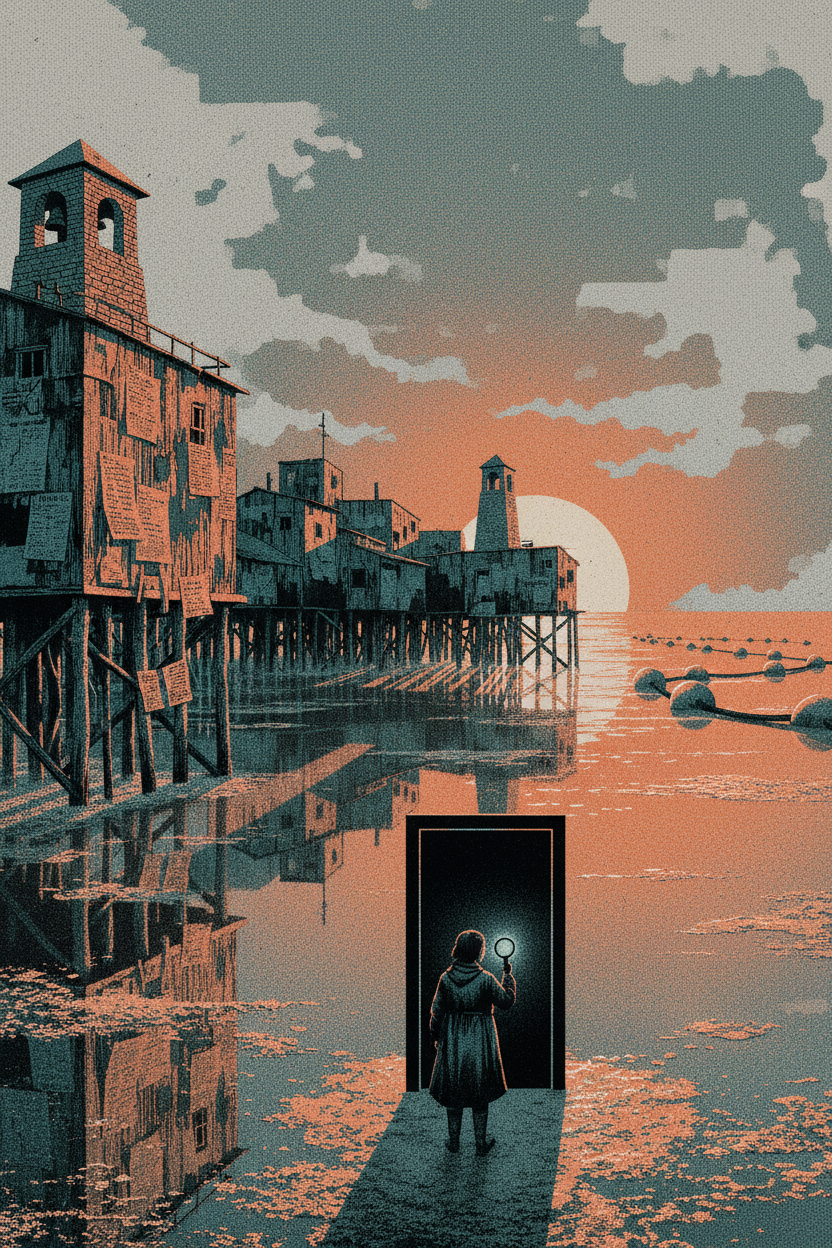
It was a quay. It was a stilt-quay standing in three metres of grey water under a sky that had grain in it, like cloth held up to a lamp, and it was laid out the way Tamsin was laid out because it was laid out the way every quay on Thole is laid out, netting sheds to the north, walk to the west, a hulk lashed in as a wall. Rain started while she stood there — started, with no minute of warning, no unpegging, nobody moving — and the people on the walk simply put their hoods up in the resigned way of people who have got used to a sky that does not announce itself. A woman came along ringing an ordinary hand-bell and calling the hour in her own voice, ten and a half by her own reckoning, and stopped calling when she saw them. Imry knew her face. Imry had seen that face at twenty-three, painted on the boards of the Tamsin hymn-house with eighty others, under the year of the last Turning, and the face had not moved a day since it was painted. Behind the woman, through the open south door of the shed, there were shelves: hundreds of Kalends, hand-copied, stacked to the roof-beam, and a long table, and children at it copying, and the scratch of it carried over the water like insects. And on the inner face of the black doorframe, at the height where a person stands to write, somebody had chalked a column of figures in a hand Imry did not know and would have hired on sight: 40 stated at the top, then 41, then 44, then 51, then 68, then 106, the marks going down and down the stone and the numbers going up, each one dated, each one witnessed with initials, ninety-odd of them, the last one fresh. She had been on the far side of that step for perhaps a minute. She turned to ask, and found she could not think of the question in a form anybody here would not already have asked, chalked, and filed.
The bell-woman got there first, which Imry would come to recognise as this place's single unvarying custom. She did not ask who they were or where from; she looked at Imry's hands — at the dry-cloth calluses along the outer edge of the right palm, the particular polish a ring-turn puts on the pad of a thumb — and said, "Black one? About so high, no seam on it anywhere, warm as a dog when it's reading?" She held her own hands apart to the width of the Tamsin alcove, near enough. "Quarter and back an eighth. That was always the one they got wrong." And then, kindly, in the voice you use for a bereavement you have been expecting for some while: "Has it gone out yet, or is it only flickering?" Imry, who had not said the word glass, nor Tabulist, nor anything at all except a swallowed noise at the sight of a face off a hymn-house board, found she had answered out before she had decided to, and heard the woman take that in with a small nod, the way a quay takes news of a hulk. The rain went on arriving unannounced, which Imry's skin had not stopped objecting to; it came down in gusts with no schedule in them, and nobody on the walk so much as looked up, and that, more than the unaged face, was the thing that kept putting the hair up on her arms. A sky that does not warn you is a sky that is not being kept.
They were taken into the shed, because of course they were; there was nowhere else to be taken, and this place's hospitality ran to dry benches and tea the colour of a bad bruise. The shelves went up to the roof-beam on all three inner walls, Kalends hand-copied and hand-sewn, spines outward, labelled along the top edge in a rolling clerkly hand that had not changed in whoever's lifetime: block and year, block and year, hundreds of them. Imry's eye did what it had done for nine years and read a shelf the way other people read a face, and stopped. 97:112. And below it, two shelves down, in the same hand, on paper no older: 01:113. She pulled one of each — nobody minded; a woman with a wet apron actually moved a lamp nearer for her — and opened them at the first page, and read down two identical columns of gusts, and closed them both, and put them back in their places with the spines squared, because her hands were the hands of a person who squared spines. She did not say anything. There was nothing to say that would not have been, at that moment, a very loud noise in a quiet room. Corry had not waited to be shown anything. The child had gone straight down the length of the long table, past nine copyists of assorted ages who made room for her without breaking stroke, to the far end where the fresh sheets were stacked and a pot of ink stood in a wooden collar so it could not go over; and she had pulled a sheet to her, and set the collar-pot at her left elbow rather than her right, which is what you do if you are copying from a hung exemplar and not from a book, and which nobody at Tamsin had ever taught her because nobody at Tamsin had ever done it that way. A woman at the table glanced at Imry with mild professional approval, as one does at a parent who has sent a child in already able to hold a pen.
It was the copyist nearest the door who dealt with the paper. Imry had brought it out — the white one, the dry one, from the cuff, eights leaning east — meaning to ask what it was, and got as far as holding it up before the man said, "Ah," without much interest, and, over his shoulder to the room, "One of ours, gone astray. That's the Tamsin lot again." Somebody further down the table said they always were, and somebody else said it was the damp on that side, and the subject was closed with the finality of a thing that has been closed two hundred and five times before. Kesh, meanwhile, had not sat down. He was standing at the shed's inner post where the roll hung on its nail — a muster, crossers and dates, the way any pan keeps one — with his hat in his hand again and his thumb under a line about a third of the way up, and when Imry came to him he said, quietly, for him, "I know that name. He's under the Cawl walkway with a stone on him, I helped carry it." He moved the thumb. The date beside the name was eleven years before the funeral. Out on the walk the bell-woman was calling somebody's attention to the doorframe and the fresh figure chalked at the bottom of the column, 106, with an air of mild housekeeping, and remarking to no one in particular that the last party through had been decent people, and had gone home all right in the end, only they'd taken the long way back.
Nobody minded her being left alone with the shelves; hospitality here ran to a dry bench, a lamp moved nearer, and no questions whatever, which Imry was beginning to find the most frightening manners she had ever met. She went down the wall the way she went down a tariff board, one finger under the labels, and pulled the oldest thing she could reach: 11:101. It came off the shelf light and sweet-smelling, hand-sewn, the paper no older than the paper in her own cuff, which was to say wrong — a century and a half of damp had not touched it and never would, in a country where a forecast sheet went grey in a fortnight. She opened it flat on her knee and read the first column, and it was the twenty-third of the second block: a calm, absolute, four hours and eleven minutes from thirteen hundred, the wind dropping to nothing at twelve fifty-eight. She had sold that calm eleven days ago to a woman who did not want a drizzle wedding. She put 11:101 down and took 97:112 and 01:113 off their shelves and laid all three open in a row on the bench, three blocks, a hundred and forty years between the outside pair, and three identical columns of gusts in one rolling clerkly hand, and sat looking at them with her hands flat on her knees like a woman at a Custodian's mooring ring.
Then she did what she had been trained from the age of six to do, which was check a known hour against the book. She turned 97:112 to the eleventh of the last block and ran her finger down to the morning, and there it was, unhurried, in the same unremarkable hand as everything else: 08:40:00. Gust, southerly, eleven seconds. Not an anomaly. Not a marginal note. An entry, sitting between a listed calm and a listed calm exactly where a gust would sit if somebody had sat down and written it in, which somebody plainly had. She looked along the shelf to her left, past 01:113, and the labels went on and on into paper that had no business existing yet — 05:113, 09:113, down and along and up the next wall — and the small accountant behind her sternum, who had never in its life been any use, lifted the lid off and started adding. Two hundred and five entries appended to Reference 411, and every one of them a Tamsin Tabulist rowing out with a scrap of too-white paper to report a thing gone astray. Not sightings. Receipts. Eleven seconds go uncomputed at Tamsin Pan; eleven seconds arrive here; here they are written down by hand, in ink, at a long table, by children, because nobody on this shore has a glass and nobody has ever needed one. She reached for a clause to put it under, because that was how she thought and she had no other tools — unclaused occurrence, class three would not stretch, lateware was a customs category and an insult, miracle was the box you tick when you mean we are not going to look — and found there was no clause on Thole under which a woman may file that the arrears is staffed.
The bell-woman came through with a lamp she did not need yet, and lit it anyway, and said the light went early on this side and always had, which was the first thing anyone had said about their sky in Imry's hearing. Passing Kesh at the muster nail she glanced up without stopping and remarked that he had the Tamsin nose and that there had been another — "Rence? Rencie. Came in off a reserve crossing, mended our east nets four seasons, lovely hands on him" — and that he'd have been, oh, a cousin's cousin, and went out to the walk still talking. Kesh stood with his thumb still under his dead man's name and did not turn round; Rence Tamsin was on a stone under the Cawl walkway too, and had been there since before Kesh was weaned, and there was no date in his family for four seasons of mending anybody's east nets. Outside, the grain in the sky was drawing closer together, like cloth folded twice. Imry went out to the frame with the three Kalends still open behind her on the bench and looked at the chalk column on the inner face, ninety-odd figures climbing patiently down the black, and the last one had been 106 when she came through, and the last one was not 106 now. It read 109, and beneath it, wet enough to smear, 114, and the bell-woman was standing at it with the chalk in her hand and her head tilted, in no hurry at all, the way you look at a tide mark that has always come in a little further each year and never yet come all the way up.
Kesh had his hat off again and was not looking at the sky, which was the first thing Imry noticed, because Kesh always looked at the sky. He was reading the chalk. He read it the way he read a tally board in a bad year, from the bottom up, lips moving, one thumb ticking the figures off against the joints of his fingers, and when he spoke it was not to her particularly. "Forty stated. Forty-one the first lot, and they'd have called that nothing, that's a man stopping to piss. Forty-four. Fifty-one." His thumb went up the black. "Sixty-eight. Hundred and six. Hundred and nine." He stopped at the wet one. "Hundred and fourteen, and that's gone on since we shook hands with the woman." He set his palm flat on the stone, and left it there, and Imry watched his face do the thing a skipper's face does when the numbers stop being numbers. "It's not slow here. Everyone says slow. Slow's when you're pulling and the shore comes up short — you're still going the right way, you're only tired. This isn't slow. We're set down-tide and the set's freshening. Every hour we stand here the gap's wider, and the gap's not ours, it's the door's. She's making leeway, Tabulist, and she's making it astern of us, and she's making more of it than she was an hour back." He took his hand off the stone and wiped it on his coat as though it had been wet. "Forty minutes, my arse. It'll cost what it costs and the price is going up while we argue it."
"It does that," the bell-woman agreed, comfortably, from four paces off with the chalk still in her fingers and a lamp on her arm she had lit far too early and had been right to. She did not come nearer. That was her whole manner: she met you and then let you be, like a woman putting out bread for something she had no intention of taming. "You'll want to be at the frame by the figure. If you're past it you're past it, and then it's the long way, and that's no worse than it sounds — the last party went the long way and they got home all right in the end. Decent people. They were only a good while about it." She said it to the child's benefit, brightly, the way you'd mention the weather if the weather were a thing anyone here could mention, and then she chalked a small neat mark beside the 114 and stood back to see whether it needed another. Imry found that her mouth was dry and that she had not asked the question, and that the not-asking had become, over the course of one afternoon, a skill. How long a while. She turned and went into the shed.
Corry did not want to come. That was the shape of it, and the shape was worse than a tantrum: the child had a sheet half down, a column of hours in a hand already steadier than it had been at Tamsin, and she looked up with ink on her knuckle and the polite bafflement of somebody being called away from the only correct activity in the world. "I'm on the eights," she said. Imry said they were going. Corry said she hadn't finished the eights. Nine copyists went on copying, not one of them looking up, and the woman who had moved the lamp nearer moved it back with no expression at all, and that was when Imry understood that this place would neither keep the child nor give her over; it would simply let the matter be settled by whoever settled it, and file the outcome afterwards. So she settled it. She put her hand round the small wrist and took the pen out of the fingers and set it in the collar of the ink-pot, and lifted the child bodily off the bench with the sheet coming up stuck to her forearm, and carried her out through the shed door into the failing grain-coloured light with the words of the consent going round in her head in her own writing — informed, sober, and of her own weather — three lies in one clause, attested by an officer of a quay, and every step down the walk was the cost of it. Corry cried at the frame, furiously, and said it wasn't hers to say, which was true and legally documented. At the black stone Kesh was standing with both palms on the inner face like a man gentling a horse, and he said, without turning, "It breathes. Warm, then warmer, then it lets go. Three of them since you went in." The posted instant, by the clerk's watch on the far side of everything, was not for another eleven minutes; Imry said so. "Aye," said Kesh. "The book says forty and the book's on the wrong side of the door, and I've sailed the book twice now and been right both times, which is once more than a man gets." He grinned at her, and it was a terrible grin, wholly without hope in it, the grin of somebody spending the last good coin on the last bad passage. "So I'll have my once here. Tag on the girl. Hold her hand and don't let go for anything, and if I say now you're already going." He waited. The stone warmed under his hands and went warmer, and the rain came on again unannounced, and behind them the bell-woman lifted her lamp to see better and said nothing whatsoever. "Now," said Kesh, and Imry stepped, and her heel came down on salt, and the sound went out of the world.
Her heel came down on salt, and the sound came back wrong. Not loud — ragged. Hail, unlisted hail, hitting ten thousand square metres of pan all at once with no pattern in it whatever, no bell ahead of it, no half-minute warning, no quay-side scramble of people unpegging roofs because the roofs had been unpegged an hour ago the way they always were; just a clatter arriving out of a flat copper sky like gravel thrown by somebody who had never been told when to throw it. The trestle was there. The tally board was there, bleached white and split down the middle, and the boy who had held it was not, and neither was the clerk, and neither was anybody else. Imry stood with her hand locked round a wrist and hail stinging the back of her neck and did the thing her body did in a crisis, which was look for a printed sheet to check, and there was no printed sheet, and the four coppers of ordinary daylight went out of the world. It was Corry who noticed first. She pulled her hand free — Imry let her, which she would think about later — and walked eleven paces to the sill's inner face and put her palm flat on the black where ninety-odd dated figures had climbed down the stone in a stranger's chalk, and the stone was bare. Washed. Not one mark on it. The child looked at her clean hand and then at Imry, and did not say anything, because there was not, as yet, anything to say.
Kesh got them to Tamsin in a stolen punt, and he did it badly, and that was the second horror and by some margin the smaller one. He kept looking up. He looked up the way a man puts his hand in his pocket for a knife that is not there — glance at the quarter, glance at the water, glance at the sky for the thing that tells you whether the sky is behaving, and there was nothing to compare it against, no hour in his head, no last year's sheet folded into his cap, nothing but a wind that was simply doing what it liked and would go on doing it. Twice he said the northerlies held through the eighth, and the second time he heard himself do it and shut up for an hour. At the Cawl landing he had tried, on principle, to give the tag back. He had stood in the hail with the worn wooden thing on its string and looked for somebody to hand it to and a book to have it written in, because a crossing is not finished until the return is entered against the tally-mark; and there was no clerk, and the pan-house door swung, and the muster book was on its nail with the pages gone to pulp at the bottom edge, and Kesh, who had committed one genuine fraud and was owed forty coppers for it, stood there for a full minute being unable to file a lawful return and looking, Imry thought, more truly frightened than he had at the frame.
Tamsin sounded wrong from four hundred metres out. Bells — but not in any order she knew, not tide, not hour, not warning: two strokes here, a pause, five somewhere off west, an arm-rung handbell answering from the north sheds, each of them somebody's best guess, all of them wrong together. The western walkway had a hulk in it that she had never seen in her life, lashed in green and raw with her name-board still on her, and where the Coran Meddle had gone down to her ribs there was a paved stretch of good reused planking, weathered grey. The glass-house door was bare wood. Eleven winters of forecast sheets, gone — not peeled, not burnt for kindling, simply not replaced for long enough that the grain had come up silver, and the chapter's paper band was still round the engine's crank-housing inside, the wax stamp furred with salt, Pending inspection, because the inspection had been scheduled. At the quay's end, in a black coat gone green at the shoulders, Ottile Brack was standing where she had always stood, facing south-southwest into a wind that was nobody's business, with her stopwatch in her bare hand and the hands of it stopped, and she was not counting, because there was nothing left in the world to be late.
Tamsin was holding itself together on rationed lies, and had got good at it. The north sheds ran a board by the door where a woman named Oller — whom Imry did not know, who had a Tamsin voice and Tamsin hands — chalked up tomorrow's weather in a round confident script, and everybody read it and nobody asked where it came from, because the alternative to a forecast is not the truth, it is people not going out. The Vell boy stopped Imry on the walk with his hat in his hand and a child on his hip, a solid, sullen, two-and-a-half-year-old article with its fist in his collar, and said they'd had the calm, they'd had every minute of it, and his mother had died in the Blank but at least she'd died having seen it, and he was so glad the Tabulist was back. Behind him Kesh was standing at the weighing trestle with eleven kilos of bad kelp-fish and nobody to book them in. He had tried the tally-house, which was a store now; he had tried Oller, who did weather and not catch; he had tried, with visible desperation, to pay a landing toll to a man who had never heard of one. He stood there holding fish for which no page existed, and looked at the sky twice for an hour to check it against, and got nothing back, and at last just put the fish down on the boards where anyone could take them, which on this quay was no longer theft and no longer charity and had no name at all.
Corry went the other way, which Imry only understood afterwards. She got a scrap and a charcoal end off the net-mender's bench and wrote four lines of neat hours in a hand three years steadier than the eights that had leaned east, and carried it along the walk and showed it to three grown people in turn: to Oller, who glanced and said very nice; to a netman, who said he couldn't read; and to Old Hask, who was thinner and slower and took a long while with it, and then said, kindly, that nobody minded that sort of thing now, and handed it back. The child folded it into her sleeve with an expression Imry had last seen on Ottile Brack. Nobody had asked her where the hours came from. That was the whole test and the whole result: the world had stopped being able to be alarmed.
She found Faull in the glass-house, with the shutters open and the stove drawing beautifully on an easterly, doing the day's sheets.
He was not older. That was the first thing, and she put it down and did not pick it up. He had a stack of paper at his left elbow, white, dry, smooth as a machine's flank, in a country where nothing had been dry since the Eleventh Hundred; he had a collared ink-pot at that same left elbow, set for copying from a hung exemplar; and he was working from a hand-sewn Kalend labelled along the top edge in a rolling clerkly script: 01:113. The chapter's wax band still lay unbroken round the engine's crank-housing, Pending inspection, and he had simply not needed the engine. "Imry," he said, without hurry and without surprise, warm as his own instrument. "Sit down, you're grey. There's tea. You'll want to see the ledger before you say anything, because you always did want the clause in your hand." He turned the book round to her: Tamsin's new roll of persons, everyone who had come through the Blank, name, age, quay, provenance, stamped and witnessed down the page in three years of somebody's careful ink — and at the head of it, in his own small level hand, all the lines one length, Faull, deacon, Ost, and the provenance column beside it blank, unstamped, unwitnessed, with a neat ruled line through the space where a thing is supposed to have come from. "We reissue canvas," he said. "We reissue hours. I did tell you nothing here is wasted."
She did not say any of the things she had drafted across four hours of muffled oars, because she had learned at Attery's mooring ring that a complaint is only the part that fits on the page. She asked Faull for a sheet of his white paper and he gave her three, and moved the lamp nearer, which on this world is what hospitality means. Then she sat down at her own counter in her own glass-house and wrote, in the flat formula, the way you write when the form is all you have left.
Complaint, entered at Tamsin Quay, undated, the block being unknown. Item: an hour occurred at Tamsin Pan without a clause, and was written down beforehand by a child. Item: the Kalend from which the day's sheets are presently copied is labelled for a block not yet issued, and its first year is the Twelfth's first year, gust for gust. Item: a person is entered at the head of this quay's roll with the provenance column ruled through, unstamped and unwitnessed. Item — and here her pen took its time, because it was her hand and she had spent nine years knowing precisely what that hand was worth — that the Tabulist of this quay lied three times in one block: once to the quay concerning a child, once to the council concerning her glass, and once on a consent at Cawl Pan concerning a child's own weather. She was not compelled. She had her reasons and they were good and she would like them recorded as insufficient.
"You'll want a witness's mark," said Faull, warmly, without the least alteration in him, and put his hand out for the pen; and Imry let him take it, because she had thought about that part on the water too. Anything that can file is a person. Nobody had ever said the clause ran only in one direction. He signed at the foot, small and level, all the lines one length, and she turned the sheet and made him sign again in the provenance column of the roll, on the ruled-through line, and wrote beside it filed and the hour as near as anybody could now guess it. Kesh put his mark under that, a skipper's cross with the cargo scratched beside it out of habit. Corry signed her whole name, slowly, and the letters did not lean. Three witnesses and no office to send it to, which meant it was worth exactly what any filing on Thole had ever been worth, which was the record, which was everything.
Then Imry broke the seal.
It came off easier than it had any right to: three years of salt had eaten the wax to a grey crumb, and the paper band parted under her thumbnail with a small dry sound like a hymn ending. Pending inspection. She put the band in the stove and it burned very well, being extremely dry in the middle. The crank was stiff and she was not as strong as she had been, and Kesh leaned on it with her for the first three turns until the engine remembered what it was and took up its own knocking, and the smell came — iodine and hot oil and wet fibre — and Old Hask, three doors down, came out onto the walk with his mouth open, because no one at Tamsin had heard that noise since before the child could write.
They set it from the Kalend. Not from Faull's, though his sat open at her left elbow with the ink-pot in its collar; she had the far quay's 11:101 under her hand, a century and a half old and sweet-smelling and dry as the day it was copied, and she set the hours off it one by one, first block of the Twelfth Hundred, and printed them as the first year of the Thirteenth. Reissue. Chapter policy. Nothing here is wasted. If the gods had decided to run last century's sky again, then last century's sky was what the quay needed pegging for, and whether that was prophecy or bookkeeping was a question for somebody with more paper. The first sheet came out warm. She read it aloud — northerlies, holding; hail on the fourth, roofs unpegged advised — and Kesh took it out to the north sheds to put beside Oller's chalk, and came back with ink to the second knuckle and stayed to feed the sheet-rack, and by the middle of the afternoon Faull was inking the plate himself, both hands black to the wrist, the only unwitnessed man in the roll of persons doing the one job he had never needed.
The children came because children come to a noise. There were not four hundred. There were nineteen, and two of them were too small to hold a pen and had to be given rag and shown the letters wet on the boards, and Corry sat them down at the long table Imry's father had sold nets off, and set the ink-pots at their left elbows, and hung her exemplar on a nail where all of them could see it, which nobody had taught her and which Imry did not correct.
At dusk Imry cut one more sheet and did not set it from any book. She wrote it herself, in her own hand, pressing hard into damp paper because the ink would want to run and she meant it to run only so far: Spring gale, Tamsin Pan, Block ninety-seven one-twelve. Due 03:12:00, south-southwest. Arrived 08:00:00, east. Twenty-eight hours, forty-eight minutes, and eleven seconds. Warden O. Brack, spoken aloud before eighty witnesses. Witnessed, I. Sorrel, Tabulist, glass of Tamsin. She went out and pasted it to the bare silver wood of the door, the first sheet on it in three years, and pressed the corners down with her thumbs while the rain arrived without asking anybody, and stood back.
Off west somebody rang five, which was wrong. Inside, nineteen pens went on scratching, and the child's hand was steady, and the paper took the water and held.
The sheet on the door lasted eleven days before the ink began to go, which was longer than Imry had expected and shorter than she had hoped, and she printed another and pasted it over the first, and then a third, and by the hail on the fourth — which came on the fourth, and which people had unpegged for, because the sheet had said so and a sheet is a sheet — the door had begun to acquire a skin again. She caught Ottile Brack reading it in the low copper morning, the stopped watch still in her bare hand, her lips moving through twenty-eight hours, forty-eight minutes, and eleven seconds the way a woman reads her own name on a stone. Brack did not say anything. She stood the length of a count of twenty, which was professional of her, and then she went back down to the quay's end and faced south-southwest, because a post is a post; but the next week she was at the glass-house at the hour the nineteen sat down, and took the smallest of them on her knee, and showed it, with great precision, how to make a figure that could be read at a distance in bad light.
Nothing here was wasted, and nothing here was caused. The northerlies held through the eighth because they had held through the eighth a hundred and forty years ago and Imry had printed it; the rain came when it liked and was sometimes in the book by accident, which Kesh called an honest wind and everyone else called a coincidence and Imry called nothing at all, having filed her one complaint. Oller kept her chalk board and Imry kept her press and the two of them agreed, without once discussing it, to disagree in public about the fifth of the block, on the grounds that a quay which has two forecasts has an argument, and a quay which has an argument is not yet a quay which has given up. Faull inked the plate. Kesh fed the rack and put his fish down on the boards for whoever wanted them and did not stop looking at the sky, being a man with a hole in his hand where a book had been. The bells went on disagreeing. Nobody could fix them, and after a while nobody wanted to, and children grew up at Tamsin who thought five strokes off west at an odd hour was simply what evening sounded like.
Imry Sorrel lived another eleven years, which was about right for the country, and spent most of them standing over a long table saying dry cloth, never wet, out of habit, to children who would never in their lives touch a glass. At the end of the first winter there were twenty-six of them. At the end of the third there were thirty-one, and two had gone to Cawl to start another table, and one had drowned, and the roll of persons had her name in it with the provenance column properly filled. What she had wanted was unfashionable and she got a little of it, which is the most anybody on Thole ever got. On the last evening she was able to stand she went out and pressed down the corners of a sheet in the rain, and behind her the pens went on scratching, and the hand at the head of the table was steady, and the paper took the water, and held.
— End —