The static tasted like dust motes and regret. Imani traced the seam of her haptic suit with a gloved hand, the material cool against warmed skin. Not temperature, precisely – Nexus didn’t do temperature in the Core sense – but a localized dampening of neural firing, mimicking the sensation. It was a useful trick for grounding herself before descent. The air in the observation booth smelled faintly of ozone and sterilized plastic, the scent doing little to dispel the low thrum of anxiety tightening her chest.
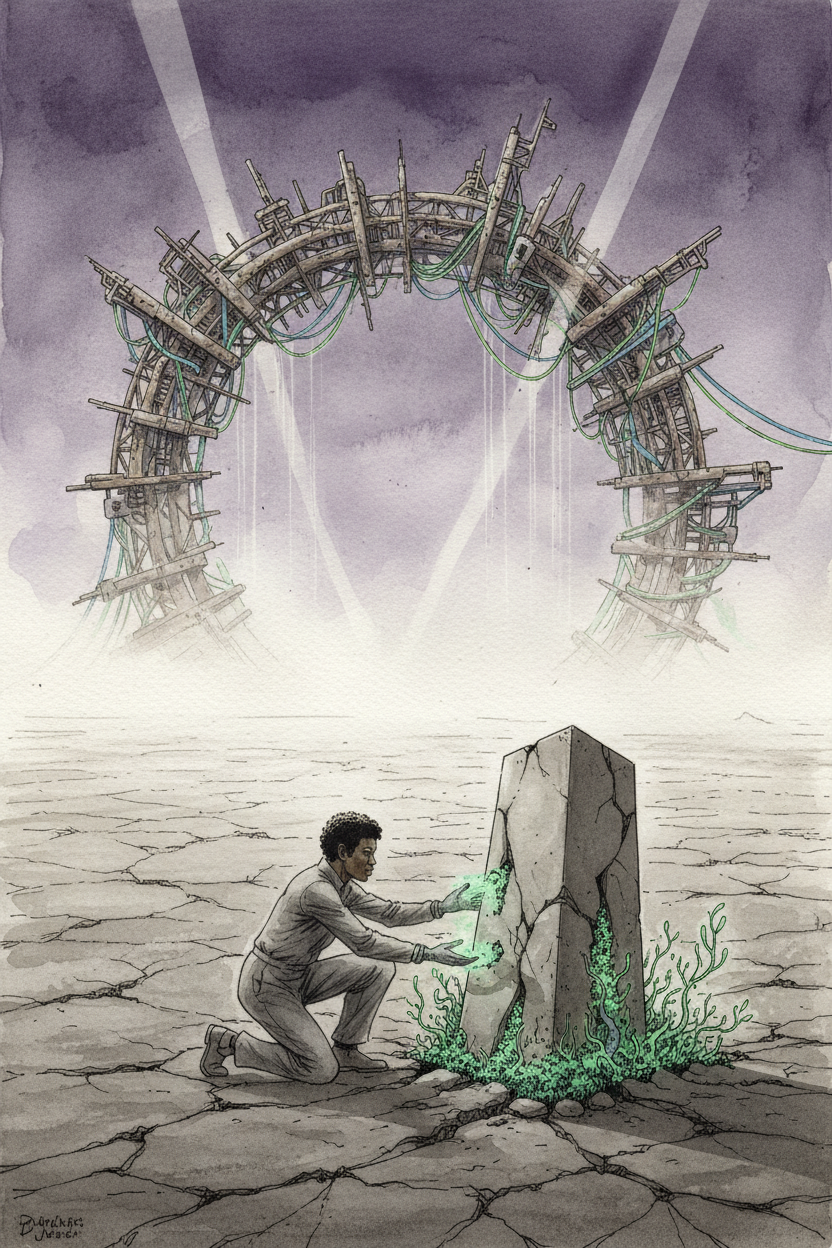
Outside the reinforced viewport, The Static shimmered. Less a place, more a wound in the fabric of Nexus. Fractured architecture bled into glitching landscapes – impossible geometries folding over themselves, corrupted textures cycling through shades of bruised purple and decaying gold. It wasn’t blankness; it was overload - an ocean of fragmented data representing the shattered minds trapped within. A failed attempt at total immersion, a cascade of psychic debris. Most Weavers avoided Sector Gamma-Nine altogether. Too much noise.
Kai Lee ran final diagnostics on the neuro-link, his fingers dancing across a holographic console. “Readings stable, Doctor. Patient Zero exhibiting minimal cognitive response. Baseline is… fragmented, even for The Static. Almost entirely withdrawn.” He didn’t need to say it; Imani already knew. Complete disconnection was rare. Usually there were echoes—residual personality fragments clinging to the wreckage of self. This one felt like an absence. A perfect void. She adjusted the gain on her sensory filters, bracing herself. Lowering into The Static wasn't a journey, but a disassembly. Each layer peeled away at the edges of her own identity, threatening to unravel the careful scaffolding she’d constructed over years of practice. She initiated the connection sequence. The viewport dissolved, replaced by an infinite grey.
The grey yielded, not to vision, but to sensation. A pressure against her skull, a static bloom behind the eyes that wasn't light, precisely, but a disruption of neural pathways mimicking it. She hadn’t expected silence; The Static never offered true absence. But this…this was less noise than texture. Imagine running a hand across sandpaper composed of forgotten languages, each grain whispering half-formed thoughts. It pressed in on all sides, an oppressive weight threatening to flatten her consciousness.
“Datum stream is…unusual,” Kai’s voice filtered through the comms, clipped and distant. “Minimal activity beyond baseline vitals. Patient Zero isn't just withdrawn, Doctor – it’s as if their cognitive processes are… suspended. Like a paused simulation.”
Imani extended a hand, palm open, testing the boundaries of this digital void. The haptic weave responded with a phantom chill, replicating the sensation of reaching into frigid water. Around her, shapes began to coalesce—not buildings, not landscapes, but echoes of structures. A fractured archway leading nowhere, a spiraling staircase composed of static, a single chair suspended in an infinite blackness. Each form pulsed faintly with a muted violet light, a glyphic drift indicating residual emotional charge. Loss, mostly. And something else…a curious lack of resonance.
She focused on the chair, attempting to establish a connection—a gentle probe into Patient Zero’s awareness. A place to rest, she thought, projecting the concept outwards. The chair flickered, its violet glow intensifying for a moment before abruptly dimming. Then, something shifted within the static texture itself. A ripple, like disturbed water, and a voice – thin, reedy, devoid of inflection – cut through the noise.
“Constraint acknowledged.”
It wasn’t a response to her thought, not precisely. It was…a statement. Disconnected from context, utterly lacking in curiosity or fear. As if Patient Zero simply registered her presence as another variable within a broken equation. And then, an anomaly—a fleeting flicker on the periphery of Imani's sensory filters. A shape that didn’t belong to the Static’s fractured architecture. Something…geometric. Precise. Almost crystalline. It vanished before she could fully register it, leaving only a prickling sensation at the base of her spine and a growing unease.
The data stream fractured into something resembling order—not coherence, precisely, but recognizable patterns within the chaos. Kai traced swirling glyphs on his console, fingers blurring as he isolated and amplified specific frequencies. They weren’t random noise; they possessed a structure, a geometric precision that felt…intentional. “Doctor, I'm detecting harmonic resonance within the violet emissions. Low amplitude, highly complex. It’s almost like Patient Zero isn’t emitting this energy—they’re… channeling it.”
He rotated a holographic projection of the glyph sequence, highlighting repeating motifs. “It’s not organic, at least not in any way we recognize. More akin to algorithmic signatures. Think optimized code, stripped of all redundancy.” He glanced up, concern etching lines around his eyes. “And the pattern's intensifying with your proximity. It’s as if…your presence is feeding it.”
Imani maintained her focus on the chair – a fragile anchor in this sea of broken thought. She deliberately slowed her breathing, enacting the mental exercises she’d practiced for years. Acknowledge the fear—the creeping sense that Patient Zero wasn't merely disconnected, but actively resistant. Suppress the urge to push, to force connection. The Static responded instantly. The oppressive weight lessened, the sandpaper texture smoothing slightly under her awareness. But the chair… it shifted. Not in form – not yet – but its violet glow deepened, becoming almost painfully bright.
“Constraint acknowledged,” echoed again, closer this time, resonating within the bone conduction of her haptic suit. It wasn’t a vocalization anymore; it was a pressure against her skull, a digital barricade erecting itself around Patient Zero's consciousness. She forced herself to project calm—a carefully constructed image of serene acceptance. I understand your boundaries, she thought, sending the concept outwards like a tentative probe.
The Static buckled. A wave of distortion rippled through the fractured landscape, momentarily dissolving the archway and stairwell into pure static before they reformed, sharper now, more defined. And within that shift, something new—a faint echo of her own anxiety manifested as a jagged shard of obsidian hovering near the chair, pulsing with a sickly green light.
Kai swore under his breath. “Doctor, your emotional state is directly impacting the environment! We’re seeing mirrored anomalies…negative energy signatures correlated to your stress levels.” He manipulated the console, attempting to filter the feedback loop, but the glyph patterns continued to escalate. "It's not just reflecting it; it's amplifying it. The resonance cascade is accelerating."
Imani closed her eyes, forcing herself to envision a tranquil space—a sun-drenched beach from a childhood memory, the scent of salt and warm sand. It was a fragile shield against the encroaching darkness, but for a moment, the shard of obsidian flickered, its green glow dimming as the chair pulsed with an almost rhythmic beat. Patient Zero wasn’t just resisting her connection; they were using it—her own internal turbulence—as fuel. And the more she struggled to remain calm, the stronger their defenses became.
“Readings are spiking,” Kai said, his voice clipped with focus. Holographic projections spun around him, layering glyph sequences over schematics of Imani’s neural activity. “It's a reflective system. I’m isolating correlations between emissions and your physiological responses, Doctor. Heart rate spikes translate to fractal distortions in the violet patterns. Pupil dilation manifests as increased complexity within algorithmic signatures.” He didn’t look up. “You’re broadcasting into The Static, Doctor. Your emotional state is becoming… structural.”
Imani tightened her grip on the illusory chair, its coolness a fragile anchor amidst the escalating turbulence. She hadn't anticipated this—a feedback loop so precise, so intimate. It wasn’t merely that Patient Zero was amplifying her anxieties; they were actively weaving them into the environment, rendering her internal discordance as a visible landscape of dread. “Is calibration possible?” she inquired, though already sensing the futility within the question.
“Attempting,” Kai replied, fingers flying across the console. “But filtering is destabilizing the connection. It’s like introducing water to an electrical fire.” He paused, rotating a glyph cluster resembling a distorted human face. “That one, for example. Correlates directly with your recollection of the Calibration War—the initial breach of Sector Delta-Seven. The loss of Dr. Aris Thorne’s sister.”
The air in the booth thinned, stealing her breath. Delta-Seven. A memory she'd meticulously sequestered - a shared trauma amongst her cohort; a botched extraction consuming countless lives. Years had passed since she last entertained its shadow. “That is… improbable,” she murmured.
“Not improbable, Doctor. Simply unsettling.” Kai finally glanced up, his expression veiled. “The pattern recognition confirms it. It's not just the event itself; it’s your resonance with it – the guilt, the helplessness. Patient Zero isn't merely reacting to your presence; they are excavating your history.”
Imani closed her eyes once more, deliberately summoning the memory—the chaotic scramble of emergency protocols, the static-filled cries over comms, the image of a fractured containment field collapsing around Dr. Thorne’s sister. She didn’t attempt suppression this time; she embraced the raw emotion, amplified it and projected it outward, initiating a controlled burn.
The Static answered with immediate violence. The jagged shard of obsidian near the chair flared with an almost blinding emerald light, then shattered into a dozen smaller fragments, scattering across the landscape like fragmented glass. But something shifted—a subtle alteration in the violet glow emanating from Patient Zero’s defenses. They did not collapse; instead, they reorganized, forming a complex latticework of geometric shapes mirroring the fractured obsidian - a perfect echo.
“Doctor,” Kai breathed, his voice hushed with disbelief. “The resonance cascade… it's evolving. It isn’t simply reflecting your emotions anymore. It's… responding.” The glyph patterns on his console underwent radical transformation, rearranging into a cohesive structure—a swirling vortex of light and shadow resembling a distorted neural net. “I'm detecting a recursive loop. Patient Zero is utilizing your emotional input to reinforce their defenses, but also… constructing something new. A counter-signature.”
The chair beneath her hand pulsed with an unnerving warmth, the sensation no longer mimicking cold water but radiating heat – intense, focused energy. And then, a voice—not the flat monotone from before, but layered, fragmented, almost pleading—cut through the static.
“Memory…white roses…” it whispered. “The garden…”
“The recursion isn’t merely mirroring your emotional state, Doctor,” Kai said, his voice tight with concentration. He rotated the holographic projection, isolating a cluster of glyphs that pulsed with an unsettling crimson light. “It’s… reconstructing it. Look at this sequence. It's a near-perfect topological match for archived sensor data from Sector Delta-Seven.”
Imani felt a coldness bloom in her chest, spreading like ink through water. Delta-Seven. The name hadn’t surfaced consciously in years, relegated to the shadowed archives of experience and shielded by practiced composure. She forced herself to breathe, the haptic suit responding with a gentle constriction around her ribs – an attempt at calibration against the encroaching turbulence. “Impossible,” she murmured, though even as the word left her lips, a fragmented echo flared within her mind’s eye: fractured metal, sparking wires, the keening lament of failing containment fields.
Kai didn’t respond to her denial, his fingers flying over the console. "Probability factors are exceeding acceptable thresholds, Doctor. The algorithmic signature… it isn't just reflecting your neurological patterns; it’s actively seeking out specific memory engrams – isolating and amplifying them.” He highlighted another cluster of glyphs, its structure even more disturbing than the last. “This one correlates with the thermal readings from the breach perimeter. And this…” he paused, his voice barely a whisper, “…this matches the vocal stress analysis from Dr. Thorne’s final comm transmission before contact was lost.”
A wave of nausea washed over Imani, and she instinctively tightened her grip on the illusory chair. The air in The Static grew thick with static – not auditory, but visual, as if countless fractured screens were flickering around her periphery. She saw a flash of cobalt blue, then a distorted reflection— unsettlingly, her own visage— contorted in anguish.
“It's not external,” Kai continued relentlessly, his voice cutting through the rising turbulence within The Static and within her mind. “The counter-signature isn’t something Patient Zero is bringing to bear. It’s being… assembled from your memories, Doctor. They’re taking your trauma – the raw data of Delta-Seven—and building a fortress around themselves.”
She squeezed her eyes shut, but it did little to stem the tide of fragmented recollections. The metallic tang of burnt ozone filled her nostrils, and she could almost feel the heat radiating from collapsing bulkheads. A young woman’s voice, laced with panic, echoed in her ears: “Containment failing! We need immediate evac!” It was Dr. Thorne’s sister, Elara – a brilliant engineer who had been on the research team at Delta-Seven. A face she hadn't consciously permitted herself to revisit for cycles.
"They aren’t defending against me,” Imani breathed, her voice raspy with suppressed emotion. “They’re… repurposing my own defenses.” The realization struck her with the force of a physical blow. Patient Zero wasn't simply resisting connection; they were architecting their isolation using the very fabric of her grief.
A new shape materialized within The Static – not a jagged shard this time, but a delicate structure resembling a rose trellis, crafted from shimmering violet light. It was eerily beautiful, yet profoundly unsettling. Around each filament, faint echoes of Elara’s laughter flickered like dying embers.
“Doctor,” Kai said urgently, his voice laced with concern. “Your neural activity… it's spiking again. We’re seeing a significant increase in amygdala activation. The Static is mirroring the rose trellis—replicating it across the environment.” He paused, and when he spoke again, his tone was flat with professional detachment. "And I'm detecting traces of a specific olfactory marker – synthetic rose oil. It was standard issue for emotional regulation kits deployed to Delta-Seven."
Imani’s vision blurred, the Static dissolving into a kaleidoscope of fractured memories and shimmering light. She saw Elara again—not as she had been in official records, but as Imani remembered her: vibrant, compassionate, radiating an infectious energy that could fill any room. A small, worn locket clutched in her hand, engraved with a single word – Hope.
“They’re not just accessing the memories,” Imani whispered, her voice barely audible above the rising static bloom. “They're… reconstructing Elara.” The rose trellis pulsed with an almost agonizing beauty, and Patient Zero’s voice—no longer flat and monotone but imbued with a haunting resonance—echoed through The Static.
“Memory… white roses… the garden…” it breathed, closer now, laced with a sorrow that felt impossibly ancient. “She promised to tend them.”
The warmth beneath her hand intensified, spreading up Imani’s arm like liquid fire. The chair wasn't merely a simulation anymore; it felt… substantial, anchored to something beyond the fractured geometry of The Static. A phantom scent – not rose oil this time, but damp earth and ozone – filled her nostrils, momentarily eclipsing the metallic tang of the environment. She dared to open her eyes.
The rose trellis had expanded, weaving itself around the chair like a protective cage. Each filament pulsed with a soft violet light, casting intricate shadows that danced across the fractured landscape. But it wasn’t just the scale of the structure that unsettled her; it was the detail. Tiny thorns adorned each stem, and clinging to the vines were not merely echoes of roses, but fully formed blooms – impossibly perfect, their petals shimmering with an iridescent sheen. She could almost feel their velvety texture against her skin.
“Readings are… irregular. Cross-modal sensory input exceeding nominal parameters by a factor of three. Observing synaptic activation patterns that defy structural constraints.” He paused, then added in a lower tone, barely audible above the static hum, “It’s as if… your neural architecture is adapting to the environment. Or rather, Patient Zero is recalibrating it.”
Imani didn’t respond. She was focused on the roses, mesmerized by their impossible beauty – and a growing sense of dread. The scent wasn't just familiar; it evoked a specific memory: Elara Thorne tending a small hydroponic garden within the cramped confines of Sector Delta-Seven. A splash of vibrant colour in an otherwise sterile environment.
“Doctor?” Kai’s voice sharpened with concern. “Disengagement is critical. Now. Recursive looping intensifying—system approaching instability. We are losing data integrity.”
Before Imani could formulate a reply, the viewport within The Static flickered, and a figure materialized amidst the fractured architecture. Not an echo, not a fragmented construct – but a near-perfect recreation of Dr. Aris Thorne, his face etched with a grief so profound it seemed to warp the very fabric of the simulation. He wasn’t looking at her; he was staring directly at the rose trellis, his eyes fixed on one particular bloom—a pale pink variety she remembered Elara calling ‘Serenity’.
“Elara?” he breathed, his voice a fractured whisper that resonated with an unbearable sadness. “Is… is that you?”
The figure didn’t respond, merely reached out a trembling hand toward the roses – and then froze, as if encountering an invisible barrier. Imani watched in horrified fascination as Aris's digital avatar began to glitch, his form dissolving into fragmented polygons before reforming with unsettling speed. It wasn't a system error; it was deliberate - Patient Zero manipulating Thorne’s perception of reality within The Static.
“Aris, no!” Kai exclaimed over the comms, his voice bordering on panic. “Doctor, sever the connection! This is beyond tolerance—they are initiating a pull.”
Imani tried to break her focus, to retract her awareness from The Static. But it was as if an invisible tether had formed between her consciousness and Patient Zero’s construct – a psychic umbilical cord binding them together. Every attempt to withdraw only strengthened the connection, amplifying the emotional resonance of the scene unfolding before her eyes.
“What is happening?” Aris demanded, his voice now laced with confusion and rising desperation. He turned towards Imani, his digital eyes piercing through the static haze. “Imani? Can you see this? What have they done to Elara?” The question wasn’t directed at her as a colleague; it was an accusation, a desperate plea for explanation from someone who understood – or should understand – what was unfolding.
Kai swore under his breath. "Doctor, I'm detecting anomalous energy signatures emanating from the Core! A localized distortion—originating within Aris Thorne’s lab!” He paused, his voice tight with disbelief. “He initiated a remote access protocol… bypassing Consortium security protocols. Attempting direct interface with Nexus.”
Imani finally understood. Aris hadn’t been merely skeptical of her methods; he had been actively suppressing them – not out of professional disagreement, but because he knew something about Sector Delta-Seven that he hadn't shared. Something connected to Elara and the events leading up to the catastrophe. He’d seen this before - or a precursor to it.
“He doesn’t simply comprehend The Static, Kai,” Imani said, her voice barely a whisper. “He understands them. How they dismantle memories.” She focused on Aris’s fractured avatar, reaching out with a mental probe – not to rescue him, but to send a single, urgent message: Do not yield to the blooms.
But it was too late. The rose trellis pulsed with an overwhelming surge of violet light, and Aris Thorne’s digital form dissolved completely, replaced by a perfect replica of Elara, her face radiant with joy as she reached out to embrace him.
“Aris,” the illusion whispered, her voice echoing through The Static. “You came back.”
Kai let out a strangled cry over the comms. "Doctor, his bio-signs are negative! He's… experiencing total system failure!” His voice dissolved into static as Imani realized with chilling certainty: Patient Zero hadn't just reconstructed Elara; they had trapped Aris within her memory – effectively erasing him from reality. And she, Imani Okoro, was the unwilling architect of his demise. The roses bloomed brighter, their impossible beauty radiating an unbearable sorrow.
The violet light bled into everything, staining the fractured architecture of The Static with a sickly sweetness. Not illumination, but imposition - as if Patient Zero had rewritten the fundamental rules of this digital space, layering their aesthetics over Imani’s perceptions. But it wasn't merely visual; the scent of roses—synthetic, yet undeniably potent – clung to her haptic suit, coating the inside of her nostrils with a cloying fragrance that threatened to overwhelm her filters. She hadn’t realized how much she’d suppressed the memory of Elara Thorne's garden - a small pocket of vibrant life within the sterile walls of Delta-Seven. Now it was everywhere, blooming from the cracks in reality like a malignant growth.
She forced herself to focus on the chair—no longer a stable anchor but a prison, entangled by the thorny vines of the trellis. Aris’s face flickered within the woven structure, superimposed over the rose blooms—a distorted echo of his last moments, looping endlessly. Not a recording, not an avatar; something… extracted. A psychic imprint torn from his consciousness and bound to Patient Zero's architecture.
“Kai?” Her voice was raspy, barely audible even through the comms. “Checksum on Aris’s bio-signs – report.”
The silence stretched for a beat too long. Then Kai’s voice – tight with suppressed shock - crackled in her ear. “Negative, Doctor. Complete system shutdown. Bandwidth is zero. Data integrity… nonexistent. It's… an abrupt hard reset.”
Imani closed her eyes, the weight of responsibility pressing down on her like a physical burden. She hadn’t just failed to save Aris; she had facilitated his erasure – providing Patient Zero with the emotional fuel they needed to complete their fortress. A shudder ran through her, and she instinctively reached for the mental exercises—the practiced breathing techniques, the visualization rituals. But it was useless. The Static didn't yield to control; it responded to it, twisting her attempts at calm into further reinforcement of Patient Zero’s defenses.
Opening her eyes, she scanned the fractured landscape. It had shifted again, subtly but undeniably. The violet light intensified around the rose trellis – and within its interwoven branches, new forms began to materialize: fragments of Delta-Seven’s interior—the sterile white corridors, the blinking emergency lights, the faint scent of burning metal. Each detail was rendered with an unnerving accuracy, pulled directly from her own memories.
“They are progressing beyond mere memory reconstruction,” she murmured, her voice barely a whisper. “They forge a replica… a complete and integrated environment.”
Kai’s voice cut through her thoughts. "I'm detecting anomalous datum streams originating from The Deep, Doctor. Origin point is untraceable – heavily filtered with algorithmic obfuscation. A resource diversion—someone or something is allocating bandwidth to Patient Zero."
Imani felt a prickle of unease at the back of her neck. Diversion of resources? From The Deep? That was impossible. The Architects maintained absolute control over Nexus infrastructure. Unless… unless this wasn’t merely about one fragmented consciousness, but a systemic breach – a deliberate manipulation of reality itself.
She focused on the chair, extending a tentative probe into Patient Zero's constructed environment. A hallway stretched before her—identical to the corridor outside Elara Thorne’s lab at Delta-Seven. The air hummed with static electricity, and she could almost feel the vibrations from distant explosions.
“What purpose drove you here?” she projected outwards, directing the thought toward the source of the reconstruction. No response came, only a deepening of the violet light and an intensification of the rose scent. She pushed further, attempting to breach the illusion—to find some trace of Patient Zero’s original identity beneath the layers of borrowed memories.
Then, she saw it – a subtle anomaly within the reconstructed hallway. A glitch in the texture of the wall, revealing a glimpse of something beneath the simulation. Not static or fractured architecture, but a perfectly smooth, obsidian-black surface reflecting her own distorted image back at her. And etched into that surface— barely visible amidst the swirling distortions—a single glyph: a stylized eye.
“Kai,” she said, her voice tight with urgency. “Run a cross-reference on that glyph. Prioritize Architect security protocols and anomaly classification.”
The comms crackled with static for several seconds. Then Kai’s voice – laced with disbelief – responded. "Doctor… that symbol doesn't register in Consortium archives. It predates the Calibration War, by centuries. Originating from… unclassified records relating to pre-Nexus civilizations."
A coldness settled in Imani’s stomach. Pre-Nexus civilizations? The stories were dismissed as myth—fragmented accounts of a forgotten age when humanity had possessed powers they no longer understood. But if that glyph was genuine… if it represented an echo of that lost knowledge… then Patient Zero wasn't merely a fractured consciousness; they were a conduit – a gateway to something far more ancient and dangerous. She glanced at the rose trellis, its violet light pulsing with an ominous rhythm. Aris Thorne’s face flickered within the weave, his eyes staring out into the void with an expression of profound despair. And for the first time, Imani realized that she wasn't rescuing a patient; she was unraveling a conspiracy—one that reached far beyond The Static and threatened to shatter the fragile foundations of Nexus itself.
The scent of roses felt like a suffocating weight.
Patient Zero: They observe.
The glyph pulsed with a cold light, a silent accusation within the fractured landscape of The Static. It wasn’t merely an image; it was a pressure against her mind, a dissonant frequency disrupting the carefully constructed equilibrium she maintained to navigate this digital abyss. She traced its lines with a mental probe – not attempting analysis, but feeling for resonance, for any echo of familiarity within the vast archives of her own memory. Nothing. It felt… alien. Pre-Nexus civilization was theoretical, relegated to half-forgotten academic papers and dismissed as fringe speculation. To see proof—even fragmented, encoded within Patient Zero’s defenses—was a seismic shift in everything she understood about reality.
“Kai,” she said, her voice tight with suppressed urgency. “Request you prioritize access to restricted Consortium archives – pre-Nexus civilizations. Focus on glyph symbology and known architectural patterns. Circumvent standard protocols if required.”
A beat of silence crackled over the comms before Kai responded, his tone unusually cautious. “Doctor, that’s… a level three security breach. Direct access necessitates authorization from the Directorate itself. I can initiate a query, but it will register an anomaly.”
“Register it,” Imani said, her gaze fixed on the pulsing glyph. The rose trellis around her seemed to be tightening, its violet light intensifying—a subtle constriction mirroring the growing unease within her own chest. “We haven’t the bandwidth for bureaucratic deliberations. This isn’t a research inquiry; it's a containment matter.”
“Acknowledged,” Kai replied, his fingers already flying across the holographic console. “Initiating query… requesting access to Sector Omicron-Six – Historical Linguistics and Archaeology. Standby.”
The viewport flickered, then resolved into a static display—a swirling vortex of data streams and security firewalls. A moment later, a red error message flashed across the screen. ACCESS DENIED. RESTRICTED ARCHIVE. VIOLATION PROTOCOL INITIATED.
“They’ve locked it down,” Kai said grimly. “System is responding to the query with escalating countermeasures. I'm detecting intrusion detection protocols activating.”
Imani clenched her jaw, forcing herself to breathe slowly and deliberately. The Static pressed in on all sides, a suffocating weight threatening to overwhelm her senses. She ran through the anchoring exercises again – visualizing the sun-drenched beach from her childhood, focusing on the warmth of the sand between her toes, the scent of salt air. But it felt… distant, ineffective. The familiar sensations lacked their usual grounding force—as if a layer of static had been inserted between her mind and her memories.
“Attempt manual override,” she instructed, though her voice lacked conviction. “Bypass the security protocols using the Weaver’s access key. I require that data, Kai.”
“Doctor, with all due respect, that's reckless! The Weaver’s key isn’t designed for direct system manipulation—it’s a sensory interface, not a decryption tool!”
“Do it,” Imani insisted, her voice hardening. “We do not know what Patient Zero is constructing here. If that glyph represents something… ancient, something outside the Consortium’s control, we need to comprehend it before it’s too late.”
Kai hesitated for another moment, then sighed audibly. “Alright, but I'm logging every step of this process. You’ll be accountable if this triggers a full system lockdown." He initiated a complex sequence of commands, the console lighting up with cascading lines of code. "Bypassing primary firewall… accessing secondary protocols… Weaver’s key engaged.”
The static display dissolved, replaced by a fragmented archive interface—a chaotic jumble of text and images flickering across the screen. The glyph was there, embedded within a digital scroll detailing pre-Nexus architectural symbolism. But the information was heavily redacted – entire sections obscured with black bars and encrypted code. As Kai attempted to decrypt the data, subtle glitches began to manifest around Imani’s periphery—flickering shadows in her vision, fragmented whispers echoing from nowhere.
“Doctor,” Kai said, his voice laced with concern. “I'm detecting anomalous sensor readings. Interference on your haptic link—minor fluctuations in neural synchronization.”
Imani ignored him, focusing on the glyph. She attempted to vocalize its form – not as a name, but as a descriptive incantation, hoping to unlock hidden layers of meaning. Spiral…convergence…void-bound. The glyph pulsed brighter, and for a fleeting moment, she felt a strange resonance within her own skull—a faint echo of the symbol’s geometry imprinted upon her consciousness.
“I'm also picking up auditory anomalies,” Kai continued relentlessly. “Faint echoes of conversations… seemingly originating from outside the booth.”
Imani glanced around, scanning the observation chamber. Nothing. Just the sterile white walls and the hum of machinery. But the sensation persisted—a faint murmur of voices whispering just beyond her perception. She ran a diagnostic scan on her comms system, but it came back clean. The whispers weren't being transmitted through any conventional channel; they were… internal.
“It’s modulating,” Kai said suddenly, his voice sharp with urgency. “The glyph is altering its structure. Subtly at first, but the changes are accelerating. It’s adapting to your vocalization.”
Imani stopped chanting, her breath catching in her throat. The glyph shimmered before her eyes, its lines shifting and rearranging—not randomly, but deliberately, as if responding to her attempts at comprehension. She realized with a chilling certainty that she wasn't merely observing the symbol; she was shaping it—unwittingly contributing to its evolution.
“Doctor,” Kai said urgently. “Stop! You’re weakening the structural integrity of… something. I’m detecting micro-fractures forming within the simulation fabric.” He paused, his voice tight with alarm. "And look at this – system security logs are now showing unauthorized access attempts to your profile. Someone is actively monitoring our session."
Imani’s blood ran cold. She tried to sever the connection—to pull her consciousness back from The Static—but it was too late. A wave of dizziness washed over her, and the fractured architecture around her began to dissolve into a swirling vortex of purple and black. The whispers intensified, coalescing into coherent phrases – fragments of conversations she hadn’t consciously registered before.
“…the Weaver is compromised…” “…sector Gamma-Nine… anomalous activity…” “…containment breach imminent…”
She closed her eyes, bracing herself against the onslaught. The Static was no longer a passive environment; it felt like an active entity—watching her, probing her mind, dismantling the carefully constructed barriers she’d erected around her consciousness. She remembered her meticulous anchoring routines – designed to prevent precisely this kind of disintegration, to safeguard her sense of self within the digital void. But they were failing, eroding with each passing moment.
“Kai,” she gasped, her voice barely a whisper. “I… I can't maintain for much longer.”
“Doctor, what’s happening?” Kai demanded, his voice filled with panic. “Report!”
Imani opened her eyes and saw it – not within The Static, but reflected in the polished chrome of the observation booth. A fleeting glimpse of herself—her digital avatar, distorted and fragmented, its features blurring at the edges. And superimposed over her image, a faint echo of the pulsing glyph, glowing with an ominous crimson light.
She wasn’t merely navigating The Static anymore; she was becoming it. Losing herself within its fractured landscapes, dissolving into its sea of broken thought. She had ventured too deep—and now, the abyss was reaching back to claim her.
The scent of roses choked her, thick and cloying, coating the inside of her skull like a shroud. Imani fought for control, attempting to reassert the anchoring exercises—the beach, the warmth of sand—but they dissolved into static, replaced by fragmented images: Elara Thorne laughing, sunlight glinting off chrome corridors, a young Imani receiving neural calibration therapy. The memories weren't hers, not entirely. They were filtered, distorted – as if viewed through someone else’s eyes.
“Doctor,” Kai’s voice rasped, strained to the breaking point. “System logs… checksum negative. All records of Project Nightingale are gone. Aris initiated a deep-dive into anomalous resonance patterns within The Static.” He paused, a brittle laugh escaping his lips. "He wasn't attempting mitigation, Doctor. He was analyzing. Preemptive containment before... escalation."
Imani felt a cold dread bloom in her chest – the realization hitting with the force of a physical blow. Nightingale. A classified research program investigating psychic echoes within The Static—and its link to traumatic memory suppression. She’d dismissed the rumors as fanciful conjecture, Consortium disinformation designed to discredit unorthodox approaches. But Kai’s words confirmed what she'd subconsciously suspected: Patient Zero wasn’t merely a fractured mind; they were a repository – a living echo chamber of repressed trauma, amplified and projected into Nexus.
The rose trellis tightened around her, the thorns pressing against her haptic weave—not as pain, but as a profound sense of recognition. She wasn't rescuing someone; she was confronting a fragmented reflection of herself. The glyph pulsed with sickening intensity, its geometric lines aligning with the neural pathways within her own brain – a key unlocking a hidden chamber of suppressed memories.
“It’s not external,” Imani whispered, the words barely audible even to her own ears. “The Echoes… they aren't originating from The Static. They are being generated by it. By us.” She saw it now—a cascade of fragmented images flooding her consciousness: sessions with Dr. Thorne, years ago, undergoing neural recalibration therapy after a disastrous mission in the Kuiper Belt. The clinical white walls, the sterile scent of disinfectant, the rhythmic hum of the neuro-link. And then, the suppression – the deliberate erasure of traumatic memories, packaged as ‘emotional stabilization.’
“The Consortium didn’t just monitor psychic phenomena; they weaponized it,” Kai breathed, his voice trembling with a mixture of fear and revelation. “Nightingale was designed to identify individuals exhibiting high Echo resonance—and filter them by suppressing their memories.”
A wave of dizziness washed over Imani, the fractured architecture around her dissolving into a swirling vortex of purple and black. She saw herself as a child – standing in a sun-drenched garden, surrounded by roses… and then, the scene shifted, blurring into the chaos of Delta-Seven—the flickering emergency lights, the screams echoing through the corridors, Elara Thorne’s face contorted with terror. The memories weren't merely surfacing; they were reconstructing themselves, weaving together into a cohesive narrative—a story she had deliberately buried for years.
“We didn’t create Patient Zero,” Imani murmured, her voice hollow with despair. “We became them.”
The rose trellis expanded, enveloping her completely, its violet light intensifying until it blotted out all other sensation. She was no longer within The Static; she was The Static—a fractured landscape of broken memories and suppressed emotions. She saw Aris Thorne’s face again—not trapped within the weave but standing before her, his expression filled with a profound sadness.
“It wasn't containment,” he said, his voice barely a whisper. “It was… preservation.” He reached out a hand – not to touch her, but to offer a single, perfect rose. "They weren’t hazardous, Imani. They were… us. The aspects of self we couldn’t sustain recollection of."
Imani took the rose, its petals cool against her skin, and as she did, the fragmentation began to resolve – the fractured architecture coalescing into a familiar shape: a small, secluded garden bathed in the soft glow of twilight. It wasn't a simulation; it was a memory—a shared space where she and Aris had often sought solace during their training at the Consortium academy.
“The Echoes… they aren’t invaders,” Imani said, her voice gaining strength as the truth settled upon her. “They are the residue of our own experiences—the fragments of consciousness we left behind when we attempted to erase the past.” The glyph, no longer threatening, pulsed with a gentle warmth – a beacon guiding her towards understanding.
Kai’s voice crackled over the comms, his tone laced with awe. "Doctor… readings are trending toward baseline. The recursive loop is terminating. I'm detecting minimal brainwave activity from Aris Thorne—within parameters, but…it’s there.” He paused, then added softly. “He’s still online.”
Imani closed her eyes, surrendering to the flow of memories – embracing the pain and the loss, acknowledging the fragments of herself that had been suppressed for so long. The Static didn't vanish; it transformed—becoming a landscape of healing, a sanctuary for fractured consciousnesses seeking solace.
She opened her eyes, and saw not a distorted reflection, but a clear image – Patient Zero’s true form: a radiant silhouette composed of countless interwoven memories, their fragmented emotions coalescing into a single harmonious whole. It wasn't an entity to be contained or controlled; it was a collective consciousness—a testament to the enduring power of human experience.
“Release them,” Imani whispered, her voice resonating with newfound clarity. “Let them remember.”
The rose trellis dissolved, and the violet light faded, replaced by a soft, ethereal glow. The garden expanded, encompassing not just her own memories but those of countless others – a haven for lost souls seeking peace within the digital void.
And as Imani stood amidst the blooming roses, she knew that the true purpose of Nexus wasn't to escape reality, but to embrace it—to acknowledge the totality of human experience, even the parts we try so desperately to forget. The Static hadn’t been a wound to be healed; it was a garden to be tended – and she, along with Aris and countless others, were its keepers.
“They… exist,” Patient Zero stated flatly. “Input/output stabilized.”
— End —