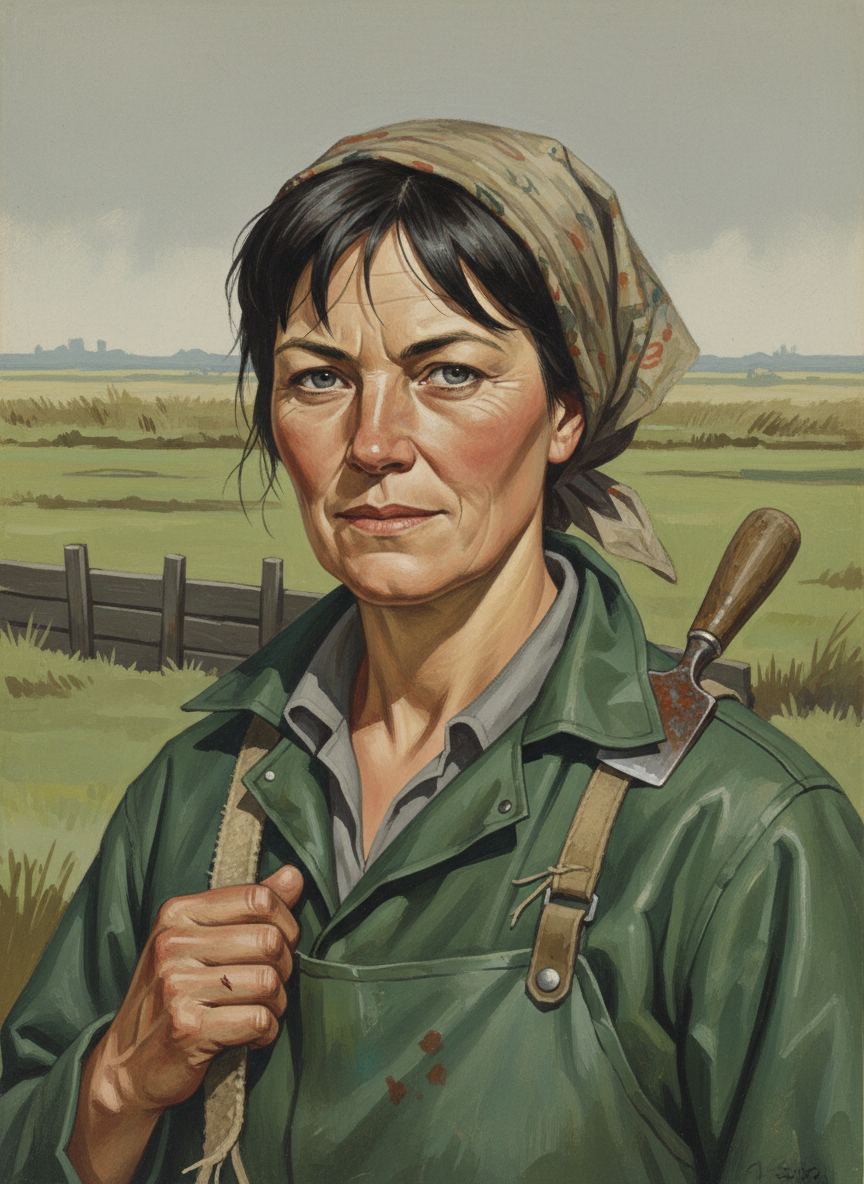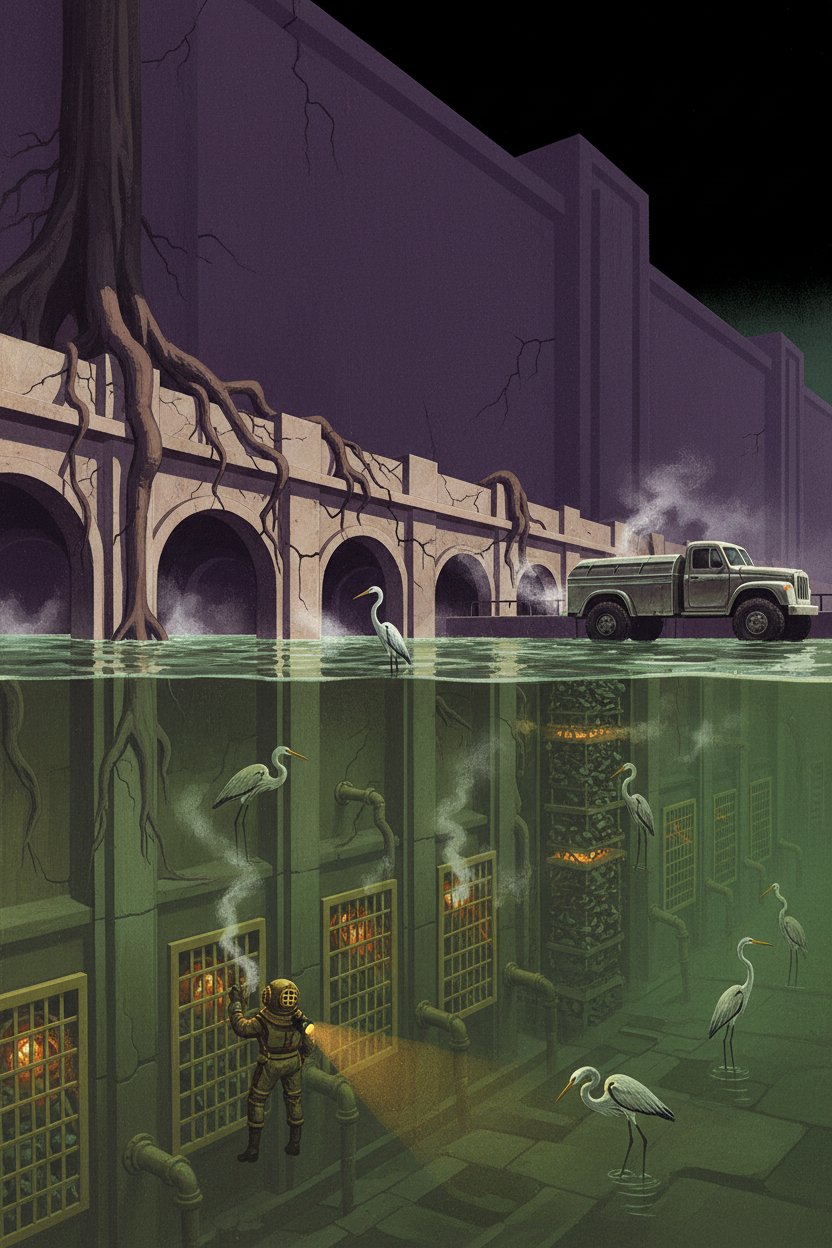
The water in the arcade off Rua da Prata is nineteen point four degrees at four in the afternoon, which is one point one above the intake spec and two tenths above what it was on Tuesday. Berna logs it on the slate strapped to her forearm, grease pencil, three strokes, and does not report it. Warm water is the Spool's problem and the Spool has assayers for that.
The sea wall throws its shadow across the flooded Baixa at about ten past three this time of year, so by now the arcade is all green underlight and the columns stand in it to their capitals. Fig roots come down through the vaulting wherever the stone has cracked, pale as tendon, groping for the cool. They find intake seven every season. Berna braces a boot on the grille, gets the flat chisel under the root mass, and works it. Mussel crust comes away in plates the size of a hand, rattles down the grille, sinks. Two hundred and six shifts left; she counts them silently and without expecting anything to hear.
She is paid four chits ten the hour, which is a fifth of what a throttled contractor in the Spool would bill for the same maintenance order, because a throttled contractor cannot hold a chisel. The intake clerk at Terreiro, stamping her ticket yesterday, said still in the meat, then, and she said still, and took her carbon copy.
"Left at the fluted one," Pico calls back from somewhere ahead in the dark. "Then it opens up. Watch the sill, it's got a lip."
His voice comes flat off the water. He is thirty metres in, past where her lamp reaches, in the part of the arcade where the shopfronts still have their brass numbers. Berna does not need the turning called. She has known this arcade eleven years. But Pico calls them, and she lets him, because the calling is the job he has left.
She clears seven, checks the flow with the paddle gauge — forty-one, acceptable — and chisels the crust off the inventory plate on the pier: INTAKE 7 / PALE MUNICIPAL / SUBST. COOLING / 2388, and under that the small stamped line about penalties.
At twenty past four she stops working and does not look at the western arcade mouth for a while, and then looks at it. Fortnight to the new moon. Blackout drill, the whole Pale gone dark from the wall in, tube-glow dying street by street, and above Cais do Sodré a Steward service truck with brass bumpers pulling up on the embankment slab and idling. They always idle. They do not get out and they do not switch off. She has seen it four times, and each time she was in the water, and each time she stayed in it.
She works east, then north, then down. The cold spur is on none of the nine cooling maps she has been issued. You reach it through a stair well in what used to be a bank basement, and the water in the stair is fifteen point two, and colder at the bottom, and there is no heron cry down here and no pump hum, only the tidal draw sighing in the walls.
"Left at the fluted one," Pico calls. "Then it opens up. Watch the sill, it's got a lip."
Same words. Same drop on opens, same little rise on lip. Berna stops with her hand on the rail. She counts to four.
"Pico."
"Here."
"You said that one already."
"Said what?"
"Nothing," she says. "Go on."
He goes on, very slightly underexposed in the lamp beam, swimming the way he always did, badly, with too much shoulder, and he cannot drown and cannot lift a wrench and cannot be counted. Berna follows him into the cold bay.
Ninety-six slots, eight tiers of twelve, brass-framed, valve glow the colour of weak tea behind the grilles. The spur runs throttled; the monitors, when she has bothered to read them, show clocks going over at a crawl, so that a month down here goes past like an hour to whatever is in the racks. Every slot has its inventory plate, and every plate has the same small stamped profile pressed into it, a woman, chin a little forward. She has never looked at one on purpose.
Tonight there are ninety-five.
Tier four, slot eleven. The rack is dark. The slot is empty and it is clean — not drained, not failed, not crusted; wiped, with the faint bright scour marks of a rag and solvent on the brass runners, and the drip-ledge below dry in a bay where nothing is dry. The plate is still screwed in place at the four corners. It is blank. Not defaced. Blank, new, unstamped, with the mill finish still on it.
Berna stands in fifteen degrees of water for the better part of two minutes and does not form a theory. It is not her habit and she has no instrument for it.
The tape drum for tier four is where it always is. She had promised herself, on Sunday, in daylight, with a coffee in front of her and the fig trees on the Alfama stairs making their noise, that the one on Sunday was the last, that Father Ansaldo could find another diver, that seven ballast chits was not worth a file with her name on it. Two hundred and six shifts. A room above the wall somewhere flat and hot with no shortwave in it.
She spools off eleven minutes, snaps the lead, and puts the tape in the sealed pocket at her hip.
She leaves Pico at the Rua stair, where the water is warm enough to be ordinary again, and he says he will wait by the fluted column and she says fine, love, wait there, and he does, standing in the green underlight at waist depth with his hands at his sides, not troubling the surface. The gondola man at Santa Justa takes her fare and does not look at her wet coveralls, which is the courtesy the Baixa runs on. West along the embankment road, the trams are running their blank sides — no portraits, by statute, only route numbers and the little enamel panel advertising the Pale Municipal's cooling levy — and the Alcântara stacks are steaming over the wall in four columns, catching the last of the sun on their undersides. In the chapel bolted to the pumping station's east flank, where the Deco stonework still says AGUAS 2231 over a door that has been painted eleven times, Father Ansaldo of the Loud keeps his accession room, and the floor shakes at eleven-second intervals with the low lift, and the shortwave in the corner is warming its valves for the evening.
"Forty minutes past, which — fine, I don't care, I'm not the Office, nobody here stamps anything, I gave up stamping when the stamp broke — no, hand it over first, talk after, the oxide sheds if you so much as breathe near it — eleven minutes? Eleven. That's short." He turns the spool in the lamp, thumb well clear of the tape, squinting at the wind. "Eleven's short, granted, but short isn't nothing, short is an accession, condition poor, provenance I'd sooner not put on the card, and I've catalogued worse out of wetter holes than that one. Sit down. Not there. There."
There are nine chits on the bench when she straightens, not seven, laid out in a row the way a clerk lays them, and every one of them is bright. Ballast chits come out of the meter houses dull, punched, thumbed soft at the corners by however many hands have passed them since the last allocation; these have the mill finish still on them, the stamped edges sharp enough to catch a nail, and Berna has spent three of Ansaldo's at the Terreiro meter over the past year and not once been asked where she got them, which is the part she thinks about on the tram home. She puts two of them back on the bench and slides them across the wood with one finger.
"That is two over the rate," she says. "The rate is seven, it has been seven since March, and I am not going to become worth nine to you in the same week that a slot comes up empty and somebody goes over the plate with solvent and a rag, so take the two back, give me the seven, and I will sign nothing, as per usual." The tape recorder is already running on the shelf by his elbow, the little drum turning, because it is always running; the Loud do not keep silence even in their bookkeeping. "And no."
"I've not asked you a single thing yet — never mind that, no to what?"
"You want me to say onto that drum that it is the last one. I am not saying it is the last one, and I am not saying it is not the last one, and either sentence on tape is a sentence with my name on the end of it." She fastens the seven chits into the sealed pocket where the tape was. Behind him the shortwave finds its frequency and Irmã Sabina begins the evening name-readings, two hundred names at four seconds each, in the flat unhurried voice of a woman reading a shipping forecast for people, and Ansaldo reaches over without looking and turns her down, not off.
The Alfama stairs take the last of the walk out of her, as they are entitled to. Fig roots have lifted the fourth flight again since spring, a finger's width, enough that she counts the step and doesn't trip on it; somebody's hens are shut in under the cistern arch, complaining; the tube-glow on the landing has been dying for two months and nobody above the second floor has reported it, herself included. Her door is the one with the municipal diver's tag screwed to the frame, B. QUELHAS / PALE MUNICIPAL / SUBST. COOLING, because she is also inventory. Wedged under it, folded twice, is a notice in the Assay Office's buff, with the stamp still slightly proud where the ink sat wet in the pad.
She reads it standing up, in the bad light, with the sealed pocket at her hip still cold against her leg. Regard, quarterly review, Tagus Pale, third quarter. Her file number. Held models, variance: plus three points. Source: not stated. Below that, the headroom figure under the Capstone Statute, which is large, which it always is, and the line about how a variance of five or more obliges attendance in person at Terreiro within nine days, and the line about how this variance does not. At the bottom, a signature block set in type rather than handwriting: ASSAYER J. MOURÃO, FIRST GRADE.
"Senhora Quelhas." He is sitting on the turn of the stair above her landing with a bakelite case flat across his knees and both feet together, and he has evidently been sitting there long enough for a moth to settle on his collar and stay settled. He rises the way a chair rises, all at once and without preliminaries. "Assayer Mourão. I am not here to serve anything; that was served at eleven this morning and you have it, I see. The Office reviews variances of three, informally, in the quarter they occur. It takes four minutes. May I ask you four minutes' worth of questions on the landing, or would you prefer the appointment?"
"On the landing, since the appointment is two trams and an hour of sitting at Terreiro, and I went into the water at half five this morning and came out of it at six," Berna says.
"Thank you." The case opens; inside it is a ledger card, a pencil, and a small spool drum turning already, which he does not apologise for. "You are embodied by election, not by medical order. You have not petitioned a Stile in eleven years. You have no readings, no publications, no vouched associations above the second degree." A tick, a tick, a tick. "The variance is therefore unattributed, which is common and is not an accusation. One question, and it is the Office's, not mine, so please don't read anything into the phrasing." He looks up, and his face finishes the movement a fraction after the rest of him does. "How do you spend your new moons?"
"I work them," Berna says. "At half eight the drill takes the tube-glow off the arcades, wall inward, and the intakes foul faster once the light is off them, because the roots come down for the cool and there is nobody standing over them with a lamp; so the schedule carries two divers on the east run, half five to eleven, and I have been one of the two since 2481. Up the Rua stair afterwards. The stall under the lift if it is still open, my own kitchen if it is not. Then I sleep. No readings, no receiver, and my second-degree associations, since you are asking for them a second time, are the intake clerk at Terreiro and whoever the Municipal has rostered against me that quarter, which changes four times a year and is not mine to choose."
The pencil goes tick, tick, tick, and then a longer stroke, which is a word and not a mark. The drum in the case keeps turning, eleven minutes of stair landing and hens and a woman listing her hours, and Mourão does not look at it or at her, only at the card. The moth has moved from his collar to the lapel and is staying. "Thank you — that's your four minutes and a portion of mine, and the Office pays for both. No petition on record, no receiver, no readings, and the figure has gone up three regardless, which I can't attribute, and which I'm not required to attribute, and which my predecessor in this district used to dispose of by saying that a variance nobody can attribute is generally a rounding error in a good coat." He does not smile at this and neither does she. "I'll enter it unattributed, which closes the matter for the quarter, senhora — you keep the buff, the Office keeps the card, neither of us signs anything, and I'd say the last of those is the only part of the work I enjoy, if you'll permit me the indiscretion on the way out. And since you've the buff in your hand and most people put it in a drawer without reading past their own number: the headroom figure at the foot isn't a limit on you, it's a limit on the holdings, and a held model is priced against its anchor, the anchor being the embodied original, which in this instance is standing on a landing in wet coveralls. Suspend an anchor and every holding priced against it is suspended with it, which is inconvenient and reversible. End an anchor and the holdings have to be disposed of — released, struck, or re-issued, those being the three, there is no fourth — and the disposal is the Office's and never the holder's, which nobody likes and which is, on the whole, the reason the schedule exists at all. Nothing in that is personal, I'd add; it's printed on the reverse in a type-size that suggests the printer agreed with me. As to signatures — a clause written in the margin above a signature line binds the stamp exactly as though it had been printed there, which is settled and has been since before the wall, which is why the Office prefers its forms served rather than signed, and why my predecessor in this district carried the pencil in his own pocket and not in the case. I carry mine in the case. I've not yet decided whether that's confidence or untidiness." The case shuts on its two brass catches. On the way past he stops at her door, not long, a second and a half, and reads the tag — B. QUELHAS / PALE MUNICIPAL / SUBST. COOLING — the way a man reads a plate he has already read, and then he goes down the fourth flight and takes the lifted step without being told about it.
She stands on the landing a while after the sound of him is gone. A fortnight to the new moon, and a man with a ledger card asking how she spends her new moons; she is aware that these two things have arrived within the same nine hours, and she is aware that she has no instrument that measures that, and she leaves it where it is. Inside, she puts the buff notice in the tin with the carbon copies and the old rosters, tier four slot eleven sitting in her head with its scour marks and its blank mill-finish plate, unstamped, uninventoried, therefore not real. The sealed pocket is empty now and still faintly cold. She unstraps the slate, and under the day's temperatures she writes the anchor clause's number off the buff in grease pencil, three strokes, because she is a woman who finishes a column. On the schedule card taped inside the cupboard door she draws her line through the day, which brings it to two hundred and five. She is in the water again at half five.
At half five the arcade is nineteen point five, which is a tenth up again, and she logs it and does not report it. Intake seven has taken new root growth at the upper left corner in eleven hours, which is not possible and is nonetheless there, pale and fine as hair, and she chisels it off and gauges the flow at forty-one, unchanged. Then she works east and north and down, through the bank basement where the doorframe still has its brass numeral, and Pico goes ahead of her in the stair calling the risers he does not need to call, eleven, twelve, the one that's worn at the nose, and the water goes from nineteen point five to seventeen to fifteen point two over four metres of descent, which is a gradient no cooling stair in the Pale is plumbed to produce.
He stops at the bottom. He stands in it to the chest with the lamp going through him at the edges, and he does not take the left into the bay, which is not a turning he has ever failed to call in nine years of taking it.
"I've not counted the paces past the sill," he says. "You'd know it better than me. Shall I wait at the numeral? I'll wait at the numeral." He looks at the opening and then not at it, and he says it again in the same order with the same small rise at the end, and Berna stands with her hand on the jamb and counts to four. "Pico, you called this turning to me in May, and again in March, and in January you gave me the lip on that sill four times inside the one shift, which I did not need and did not mind." He says nothing. Shades do not shiver and he is not shivering. "Wait at the numeral, love. Twenty minutes." She goes in alone, and the lamp goes in with her, and the sill has its lip exactly where he has always said it does.
The bay's full rank, eight tiers deep, and ninety-five of them lit to the colour of weak tea, and the woman with her chin forward on ninety-five plates, and on tier four, slot eleven, the blank mill-finish plate with its four screws and its dry ledge, which has stayed dry for nine days in a bay where the stone sweats. Fourteen point nine at the tier-one runners, fourteen point six at the floor. She puts the paddle gauge into the gap under tier three where any throttled bay in the Pale will show her eight to twelve of draw, and it reads zero. She holds it there for a slow forty count and it reads zero. She scuffs the floor with her boot heel and the silt comes up and hangs, and it is still hanging where it was when she comes back past two minutes later, not carried anywhere, because there is nowhere it is being carried; no draw, no return, no warm side. The racks are cold and nothing is taking the cold away from them, which means the water is not cooling them. It is sitting with them. She writes the gauge reading on the slate, three strokes, and under it, because a column left unfinished is worse than no column at all: nine maps, nine omissions, one shape. An error made nine times by nine draughtsmen is nine errors. An error made nine times in the same place, to the same line, with the same margin, is one decision and eight copies of it, and copying is clerical work, and clerical work is paid.
She comes up out of the bay with eleven more minutes of tier-three tape in the sealed pocket and the paddle gauge still reading nothing, and Pico is at the numeral where she left him, waist deep, hands at his sides, the brass 4 on the doorframe going green at the lower curve where the water reaches it twice a day. He falls in behind her up the stair and calls the worn riser before she gets to it, which is correct and which he has done for nine years, and she lets him. In the arcade the temperature has come back up to nineteen point five and there are gulls quarrelling somewhere over the Rua, and because the walk is twenty minutes and because she has been thinking about clerical copies, Berna asks him what she has never bothered to ask in nine years: where he lived before the arcades, and who put him up for the roster.
"Poço do Bispo," Pico says. "Two rooms over the cooperage yard. The yard took water twice a winter. That is why I went to the water work. Senhor Vaz at the low lift put me up in 'seventy-seven. I came onto the east run the same spring. You'd know the paperwork better than me." He says it the way he says four paces, then left — flat, complete, unhurried, no pause anywhere in it for a man to hear himself in. Berna does the arithmetic and keeps it behind her teeth. The Poço do Bispo quarter was backfilled and sealed under the wall works in 2405, eighty-four years ago; she has been on the east run since 2481 and Pico has been ahead of her in it since 2480, three years after the spring he has just given her, and the Municipal has never in her time vouched a diver off the low lift, which is a different directorate and a different card. She has had his vouching card in front of her twice in nine years, both times at the Municipal counter with a ganger waiting behind her, and both times the given-name field was ruled through, which is the form for shades: roster names only. Pico is what somebody wrote down after the column in the arcade where he was first stood. It is not a name a mother used, and Berna has never known the one that was, and has never once asked, which she notes now and does not act on, because a ganger told her in her second year that a shade will give you a sill, a riser, a street, a stranger's name, anything you like, and never its own, the given name being the one word taken at vouching. It is not the repetition either. The repetition is a shade wearing a groove; she has seen four of them go that way and it is slow and it is nothing but loss. This is furnished. This has a cooperage yard in it and a man's name, and it does not fit anywhere in the record, and somebody was paid by the hour to write it. "That is a long walk to water, love. Twenty minutes at the least, and uphill for the last of it," she says, and Pico says the arcade narrows past the fourth column, and it does.
At Terreiro the meter house is on its morning queue, eleven ahead of her, brass grilles and valve glow behind them and the ticket drum going over with its small dry knock. She puts up one of Ansaldo's chits, bright, sharp at the edges, and the clerk takes it and feeds it and the meter takes it too — takes it and holds it, and prints not a credit slip but a buff one, four lines, HOLD / SCHEDULE VARIED / PRESENT TICKET AT COUNTER, and the clerk reads it upside down before Berna has finished reading it right way up. "It isn't the chit, senhora. The chit's clean, the chit's nothing at all. The machine puts one of these out when the account's carried under a different schedule than it was last quarter. That happens. They shift people about. Nine times in ten it's the address." He has a pencil and a fresh card, and he does not open a case, and he is not an assayer, which is the only comfort in it. "So. Any change of address this quarter. Any second address. Any address held for you by somebody else." Berna says no, no, and no, in that order, and he ticks three times and hands her the credit and keeps the buff, and says she can draw the full allocation as usual, and says it twice, which is how she knows he has been told to be reassuring. Two hundred and four shifts. She takes the tram west with the tape cold against her hip, and the enamel panel above the window advertises the cooling levy, and the seat opposite is empty because Pico is standing, since he cannot make the springs move and dislikes the look of it.
The chapel at half eleven in the morning is a different room from the chapel at seven in the evening: the shortwave in the corner sits with its valves cold and its dial dark, the receiver being a thing Ansaldo warms for the readings and not before, and without it the only sound is the low lift shaking the floor every eleven seconds, and under that the sea going about its business on the other side of forty metres of concrete. He does not take the spool from her hand. He puts out a square of felt, taps it twice, waits until she has laid the carrier down on it, and then picks it up himself with two fingers at the hub and sets it on the brass balance beside the card index, which is an instrument Berna has watched him use perhaps forty times and has never once seen him consult afterwards. He slides the poise along the beam. He slides it back.
"Two hundred and nineteen," he says. "Two hundred and nineteen, and I've got March written down — March, the second trip, the one where the sleeve came apart on you and I didn't take a chit off you for it, did I, no — and March says an eleven-minute lift off that tier runs two hundred and thirty-one, carrier included, same carriers, same mill, I buy three at a time because otherwise the man goes and dies on me. So we're twelve light. Twelve light is a spool of oxide off a drum that can't spare a spool. Right." He does not look up from the beam. "I'll ask the once and I'll take whatever comes back. Are you holding a length out? Because if you are, that's your business and whoever you're holding it for, and I'd rather write the entry down as short than write it down as whole. Or is something helping itself on the way up."
Berna has the credit slip in her coat pocket and behind it, folded twice, the carbon of the buff the clerk kept, HOLD / SCHEDULE VARIED, the print already going grey at the fold where the wax has taken it, and she leaves both where they are. Two hundred and nineteen against two hundred and thirty-one. She adds it to the column she has been keeping since yesterday, which now runs: nine maps with one omission, one bay with no draw, one ledge dry nine days, one plate screwed in blank and never struck, one account carried under a schedule nobody will name, and now twelve grams. Nothing in that column is a mystery. Every line of it is a clerk's afternoon, paid at some rate or other. "I spooled eleven minutes off tier three at about six, snapped the lead, sealed the pocket, and did not open it again between the bank stair and your felt," she says. "I have not held a length out on you in four years, and I am not beginning on a morning when I have already stood four minutes answering questions from a man with better handwriting than the pair of us. If it is twelve light, then it came off the drum twelve light, which is not something I can measure down there, given that what I carry is a paddle gauge and a chisel." Then, because he is still looking at the beam: "Weigh the next one with me standing here and then we will both have a figure."
He takes the spool off the balance and does not answer that. "Accession — accession one-forty-one, tier three, eleven minutes nominal, twelve short on the weight, provenance informal, custody sole, condition poor and going poorer every minute the two of us stand here breathing at it." He says it across the room toward the shelf where the recorder has been turning the whole time, its little drum going round with no light on it, the way it turns through every conversation that has ever happened in this room including the ones where he haggled her down and the ones where he didn't; and Berna, who has never in four years asked him what he does with those particular tapes, does not ask now. "Seven chits. Pocket, not the bench, I won't have them counted a second time. And Berna — the short weight goes on the card. It goes on the card because short weights go on cards, not because I'm thinking anything, and you'll have noticed I haven't said a word about what I think." He writes for a while. The low lift comes round again, and the felt square shivers, and the seven chits in her hand are bright, sharp-edged, and dull nowhere at all.
Four days out from the new moon the arcade is nineteen point seven at half five, which is two tenths up on the week, and it goes on the slate and no further. The Municipal has posted the drill schedule at the Rua stair on a card under glass: wall-inward from half eight on the night, all arcade lamps off, all non-priority stair lighting off, east run divers to carry hand lamps and nothing mains-fed. After that the bank basement will be a black hole in a black hole for three nights running and she is not going into it with a lamp and a chisel and no lighted water behind her. So the last drum comes up tonight, and then she is finished with Ansaldo until the moon has a shape again, and possibly finished with him altogether; she has not decided, and the tin at home now holds the buff notice, the carbon of the HOLD slip folded twice, and a grease-pencil line that says 231/219, which is a column she keeps and has mentioned to nobody.
Pico goes down the stair ahead of her, badly, too much shoulder, the lamp finding his edges a fraction late. "Eleven, twelve, and the riser gone smooth at the nose," he says at the turn, and again at the numeral, the brass 4 greener at the lower curve than it was ten days ago, and Berna says nothing to the second telling because the first told her nothing either. Nineteen point seven at the head of the stair. Fifteen point nought at the turn. Fourteen point eight at the sill, which is four tenths colder than the last time she measured it there, over the same four metres, with the same instrument. He stops at the jamb. He does not take the left. He has his hand up, not pointing, not warning, held flat at about the height of his own chest, and he keeps it there, and nothing comes out of him at all — no count, no landmark, no returned question — and shades do not breathe and he is doing something with his mouth that would be breathing in a man who had lungs. "Pico." Nothing. "Love. Sill, or bay." He says eleven, twelve, and the riser gone smooth at the nose, in the same order, with the same small fall at the end, and then he turns and goes back up two risers and stands on them.
She goes in alone. Zero on the paddle gauge under tier three, forty count, zero. The silt she raises at the door is still where she raised it when she comes back past it. Ninety-five slots the colour of weak tea; tier four, slot eleven dark, its ledge dry at nineteen days in a bay where the stone runs. She spools eleven minutes off the tier-six drum, snaps the lead, seals the pocket, and then, instead of going up, she does the thing she has not done in four years of coming down here, which is to stop working. She puts the hand lamp on the plates. Tier one, slot one: the woman, chin forward. Slot two, the same. She walks the rank with the beam at plate height and the small stamped profiles come up out of the brass one after another, ninety-five of them, all struck from the one die, and somewhere around tier two she stops walking, because she knows the line of that jaw the way she knows the worn riser, which is to say without ever once having looked at it on purpose. The lamp stays where it is. Her hand is steady, because her hands are always steady. She does not say anything. There is nobody in the bay to say it to.
She comes up the Rua stair at twenty past seven with the sealed pocket cold at her hip and Pico behind her instead of in front, and he does not call the worn riser, and he does not call the lip on the sill, and he does not call the fourth column where the arcade narrows, which he has called every evening of nine years whether anybody needed it or not. At the top she waits for him in the green underlight, one glove flat on the wet ironwork, and gives him twenty seconds to say anything at all, and he stops waist deep below her, arms hanging, the water taking nothing from him, his edges a fraction late in the lamp. "That's all right, love," she says, and that is the whole of the conversation. He rides the gondola west with her, standing, and when they come along the embankment to the pumping station he stops at the head of the slipway, under the Deco lettering, and does not follow her through the door painted eleven times. She does not ask him to. She does not, when she is inside, mention to Ansaldo that he is out there.
"Tier six, that'll be tier six, and you've had it off the middle of the drum where the oxide's had a bit of shelter, which is what I'd have done, which is what I told you in March and you'll swear blind I never said a word — felt. Felt, Berna. I'm not taking it out of your hand at half seven of an evening with my thumbs wet." Two taps on the square. The carrier goes down; he lifts it by the hub and sets it on the beam, and slides the poise, and slides it back, and stands over it a while with the low lift coming round every eleven seconds under his boots. "Two hundred and eleven. Nominal's two hundred and thirty-one, same carriers, same mill, so that's twenty light on a drum that was twelve light this day week, and before you open your mouth — I asked the question once, I had my answer, the answer goes on the card the way it was handed me. Accession one-forty-two. Twenty short. Condition poor." He writes for the length of two shakes of the floor, and then he pulls the tarpaulin off the thing against the east wall, which Berna has taken for four years to be a cabinet, and it is not a cabinet: it is a valve set the size of a wardrobe, brass-cornered, the grilles dull with salt, and a coaxial lead running up into the stonework toward the stack. "Quarter-wave up the number two flue, and don't stand there looking at me like a clerk, the Municipal's had a conductor on that stack since 2231 and all I've done is take a livelier interest in it than they ever did. Three nights, wall-inward, mains off from half eight. Not a scrap of hash on the band. You'll not hear a quieter thirty hours on this coast in your lifetime nor in mine."
Berna does not look at the lead where it goes into the stone, having looked at it once. "That is your business. So is the felt, and so is the card." She puts the seven chits in the sealed pocket where the spool was, one at a time, because her hands are steady and she is not in a hurry. "This is the last drum. Not the last until the moon comes back — the last. The basement is unlit for three nights from half eight on the night, and I will not take four metres of cold stair with a hand lamp and no lighted water behind me. When the drill is finished I go back to intake seven and the east run and nowhere else, at four chits ten the hour, which is the rate for meat work, for two hundred and three more shifts." The recorder on the shelf turns its little drum with no light on it, and she lets it have the sentence, which is the first she has ever given it. "I am not saying anything about the spur. I have nothing about the spur that I can measure twice, so I will say nothing."
Three days out the arcade is nineteen point eight at half five, a tenth up again, and she logs it with the grease pencil and does not report it, and behind her Pico comes down the Rua stair without calling the worn riser or the lip or the fourth column, which is now the fourth evening of nothing. She works intake seven from the top left corner down, and the new root growth has come back at the same corner in the same place with the same hair-fineness, and the flow gauges at forty-one, unchanged, which it has been every day for eleven days while the water has gone up seven tenths. That is not a thing an intake does. She writes forty-one on the slate anyway, because the column is the column. On the way out she stops at the drill schedule under its glass at the stair head, since the Municipal reissues it Mondays and she has never in eleven years found a reissue that mattered, and this one has her name moved. East run, half five to eleven, two divers: neither of them her. West run, Cais do Sodré embankment, priority intake, half eight to eleven, one diver, hand lamp, nothing mains-fed, all three nights. B. QUELHAS. The second name line is ruled and blank. The embankment slab at Cais do Sodré is four metres of water and nine metres of masonry above tier one of the cold spur, and she stands in front of the glass with her thumb on the frame for the better part of a minute and does not form a theory, and then goes home up the Alfama stairs and strikes the day. Two hundred and two.
Mourão is on the fourth flight the next morning, standing on the lifted step, breathing through it, the oilskin over his arm dark and dripping onto the stone in a small deliberate patch, the bakelite case under it. Four flights, on foot, before eight. "Senhora Quelhas — nothing served, nothing wanting a signature, and I'd have waited at the foot, only the hens take a view of me, which is the first honest opinion anybody in this district has volunteered me all quarter." He gets his wind. "Two items. Both small."
"The figure."
"The figure. Four, not five, so there's no attendance in it and nothing required of you. Unattributed, as before, and I'd sooner you had the number off me on a stair than off a buff slip under the door."
"Then that is the same answer as September with a different digit on it."
"It is. A woman who dives, a figure climbing, myself with a pencil and no account of it, and the Office pays my day either way." A tick on nothing, in the air, the way a man checks his pencil is still in his hand. "The second is a district notice and it goes to every door on my round, so don't hear it as personal, though I'm aware that's easy to say from a stair. For the duration of the drill the prefecture wants its assayers to note receivers. And transmitters."
"Transmitters."
"Which is the part I find droll. The statute has been perfectly clear about transmitters since before the wall, and nobody in the history of the Office has needed a survey to enforce a thing that nobody does. Thirty hours with no mains and no hash on the band, and a list wanted at the end of it. So — in the words given me — do you hold a receiver; and do you know of any premises on your route of habit, chapels, stations, anything with a conductor on it, where one is warmed and used."
"I do not hold a receiver. I have never held one. My route of habit is the Rua stair, the arcade, the gondola at Santa Justa, the meter house at Terreiro four times a quarter, and this landing," Berna says, in that order, with the pauses in the right places. "Premises I could not tell you about, since I am in the water from half five, out of it at six, and asleep by nine, and the only thing I know about the band is that Irmã Sabina reads two hundred names at four seconds each, which I have heard through other people's shutters, and which I expect you would enter as a route of habit also." She does not say Alcântara. She does not say chapel. She has one measurement of that room, taken once, with her own eyes, and one measurement is not a figure; it is an anecdote, and she has never signed an anecdote. "I am on the west run for the drill. Cais do Sodré, half eight to eleven, all three nights. The Municipal posted it Monday and did not ask me about it."
He opens the case on his knee, on the stair, wet oilskin sliding, and writes — which he did not do for four minutes of new moons on the landing — and the pencil takes longer over Cais do Sodré than over anything else. "Thank you. That's useful, and I'd rather it weren't."
"If the Office wants a list of who is standing where at half eight, it is under glass at the head of the Rua stair, and it will be better than anything I can give you."
"I've read it." The two brass catches shut. "And because I should not care to be the man who had it in his head and didn't say it aloud on a stair: a single-diver posting carries a second name on the line. That's the schedule, not me being careful. There isn't one. I'd have looked for the Municipal to fill it before Monday, and today is Thursday."
He goes down without taking the lifted step badly, because he knows about it now. Berna stands on the landing a while. Below the arch the hens complain, and two streets over a shutter is open on a warm valve, and Sabina is running the morning repeat, flat, four seconds, a clean pause between — and then the break in the metronome, no change of colour in it at all: correction, previous name. A pause. Then the name, a woman's, given no more weight than the one before it, and Berna stands still and hears the whole of it and does not know it. The readings carry corrections, then. She notes that and goes down the first flight.
Friday she works the east run with a diver named Cordeiro, and the arcade is nineteen point eight at half five and nineteen point nine at six, and intake seven gauges forty-one. The glass at the Rua stair head still reads WEST RUN / CAIS DO SODRÉ EMB. / PRIORITY INTAKE / 2030–2300 / HAND LAMP, NOTHING MAINS-FED, with the second name line under B. QUELHAS ruled and blank. Two hundred. Saturday the kit store issues her a brass-bodied hand lamp, two spare cells, and a carbon slip she signs for with the rubber stamp coming down wet on both copies. Coming back past the east flank at ten past eight the floor of the slipway is not shaking, because the low lift is already off, twenty minutes early, which is not the schedule; and the fanlight over Ansaldo's door has valve glow behind it, amber, steady, warming; and the door, which she has never in four years found anything but on the latch, does not give when she puts her hand flat on it and pushes, without knocking, which she tells herself afterwards was to see whether it gave. She does not knock. She goes on west with the lamp under her arm.
She ties her tether to the second ring because the first is fouled with weed, and there is nobody to hold the other end of it, so the tether is a rope tied to a ring and not a tether, and she knows the difference and ties it anyway. At half past, the Pale goes dark from the wall in, wall lamps first, then the embankment road, then the Cais arcades, then the tube-glow crawling back toward the castle quarter by quarter, and the pumps at Alcântara run down over about ninety seconds into nothing.
Eight hundred metres east, two headlamps come on and stay on, low and yellow, and under the sea-noise an engine holds a steady idle that does not rise or fall.
The priority intake at Cais do Sodré is a cast grille two metres across in the face of the embankment, plate to the left of it, PALE MUNICIPAL / SUBST. COOLING / PRIORITY / 2402, and weed along its lower edge where the light never gets. Berna works it left to right with the chisel because that is how she has worked every grille for eleven years, and the crust comes off in plates and goes down out of the lamp cone, and she does not hear it land. The pumps are down. That is the first thing she checks and the reason the figure goes on the slate wrong: she puts the paddle gauge in the throat of the intake, expecting slack, expecting the nothing you get in any dead bay in the Pale between half eight and eleven on a drill night, and the paddle lies over and stays over. Eleven. She holds it forty seconds and it does not move off eleven. She takes it out and puts it back, further in, and it reads eleven, and she takes it out and holds it a metre clear of the face in open water and it reads nothing at all, which is correct, which means the instrument is fine. Something is drawing through a grille that no pump is behind.
She puts the thermometer through the bars as far as the bulb will go, which is a hand and a wrist, and waits the ninety seconds it wants. Nineteen point nine at the surface, four metres above her. Seventeen point one at the mouth, taken twenty minutes ago and written down. Behind the bars, in the throat, with her arm in to the cuff and the cold coming up the sleeve seam where it always comes: fourteen point eight. She reads it twice against the lamp, with the lamp held at the distance she always holds it, and then she writes 11 / 14.8 on the slate in grease pencil and underlines neither, because underlining is an opinion. Fourteen point eight is the sill of the spur stair, measured Thursday with this same instrument, nine metres of masonry and half a district away from here, and she is aware that she has just written down a temperature from one place while standing in another, and she does not form a theory. She scuffs her boot along the slab at the grille foot and the silt comes up and does not hang. It goes in, all of it, drawn flat and low through the bars in a sheet, and is gone before she has finished counting to six.
Then the masonry knocks. Not a sound in the water — a shift in the stone through her knee where it rests on the slab, a small dull lift and settle, the way a floor moves under a machine that is doing work somewhere below it. She counts. It comes again. She counts to eleven and it comes again, and to eleven, and again, and she is counting in a district where every pump on the west face ran down ninety minutes ago over ninety seconds into nothing, and the only floor she knows that moves at eleven seconds is on the other side of Alcântara behind a door that did not give when she pushed it. She stops counting. Nine metres up, past her own bubbles and the underside of the black, the engine on the embankment road is still holding its idle, and it does not rise, and it does not fall, and it has not moved eight hundred metres in either direction since half past eight. Berna kneels in fourteen point eight degrees of drawn water with her arm through the bars to the cuff and does not take it out yet.
The draw comes up on her arm before it comes up on any instrument. She feels it in the sleeve first — the fabric going flat along the forearm, then the small tug at the cuff seam where the cold has been coming in since she put the hand through, then a steady pressure on the flat of the palm as though the water in the throat has decided to be somewhere else and is taking her fingers with it as a matter of course. She does not snatch. Snatching is how divers leave two knuckles on a grille and spend the rest of a career signing carbons left-handed. She turns the wrist so the hand goes side-on to the bars, brings the elbow back four inches, waits, brings it back four more, and counts the eleven-second lift of the masonry through her knee while she does it, because the count is a clock and she wants one. On the fourth count another knock arrives between two of the others. Not louder. Not an echo — an echo would keep the phase. It comes in at about six seconds, off the beat of the first, and then again at six, and every second or third pass the two of them land together in the stone and the slab goes hard under her kneecap for an instant and then softens. She writes nothing down for that one. There is no figure in it yet. Her arm comes out of the bars at the sixth count, whole, the sleeve streaming, the cuff seal intact, and the hand opens and closes four times without complaint, which she notes.
She gives the grille another eleven minutes because the grille is the work and the work is on a card with a rubber stamp on it, and then she stops, which is fifty minutes short of the bottom time she is entitled to. The entitlement is not the number that matters. The number that matters is the one she said out loud on the coping — two hours forty, and up this slipway and no other — and there is a shade standing eight paces short of the head of it who cannot lift, cannot follow, cannot be counted, and cannot come down and find her; a man whose only remaining capacity is to know where she said she would be and when, and who has not called a turning in five days. That is not company. That is a timer with a face on it, and she is not going to let it run out and leave him standing there through the second night and the third, at the second ring, with nothing to say. She stows the chisel on its lanyard, cleats the paddle gauge to the belt, checks the slate is still strapped and the grease pencil still in its loop, and comes up the masonry hand over hand along the rope that is not a tether, slowly, with the lamp cone swinging over weed and cast iron and then over nothing. At four metres the water is seventeen. At two it is nineteen and something. Eight hundred metres east, when her head comes out, the two headlamps are where they were, low and yellow and pointed nowhere, and the idle has not risen or fallen in an hour and fifty minutes. She logs that on the inside of her skull where she keeps the things that have no column.
She looks at the coping before she looks at anything else, before the slab, before her own hands, before the lamp she is still holding lit against a district with no other light in it. He is there. Eight paces short of the head of the slipway, hands at his sides, edges coming a fraction late out of the dark — not troubling anything, not gone, not further off than he was. Berna sits down on the coping stone with her legs still in the water and takes one breath all the way in and all the way out, which is the first full one since half past eight. Then she does the ordinary things, in order, because the order is the point: lamp off, cell warm in the palm, spare cells dry in the pouch; chisel; gauge; thermometer, bulb unbroken; slate wiped of salt and read back in the dark by thumb, eleven, fourteen point eight, forty-one. The sea works away on the far side of the wall. The heron does not say the one thing herons say. Two more nights of this, and then two hundred shifts, and a room above the wall.
The walk home is ordinary and she lets it be: up the embankment road with the lamp off, and the Pale coming back on behind her in the same order it went out, quarter by quarter, so that the tube-glow on the third flight of the Alfama stairs is lit and the one on her own landing is still dead, two months now, unreported by everybody including her. She wipes the slate with fresh water and writes the night into the two columns the Municipal provides, cleared, fouled; the figures with no column she leaves where she keeps them. Then the schedule card off the inside of the cupboard door, and a line through Saturday. A hundred and ninety-nine. Sunday the ganger's window has a printed slip behind the glass, prefecture buff, about assayers attending premises during drill hours and the courtesy expected of occupiers, and another of the same colour lies unpicked-up under the door at the turn of the fourth flight; since Thursday the Office has been up and down Madalena asking who keeps a set, which everybody finds comical, because nobody keeps a set.
At ten past eight the low lift goes off, and she hears it stop from eight hundred metres. Her watch, which runs three seconds fast a week, says ten past. Once is weather. Twice is a schedule.
Pico says, "Early." She waits twenty seconds. Nothing.
She does not take the lanyard. She lifts the lamp off the coping stone and leaves it unlit, because a lamp burning on an unlit embankment road in a drill week, with the Office noting premises door by door along Madalena, is a thing somebody writes on a card, and she steps back from the head of the slipway and goes west along the coping with the rope still tied at the second ring and the slack still coiled where she laid it. "Four hundred metres west along the coping and four hundred metres back, love," she says, going past him. "Twenty minutes by the count. The rope stays on the second ring, and I will come up this slipway and no other, which stands." Pico does not answer and does not turn his head, and she does not stop to make him. She counts paces because she counts: forty to the first bollard, sixty-one more to the stub of the old ferry stanchions, where the coping stone goes from dressed to poured and the poured part is 2402 like the intake plate and has been walked into a dish by eighty-seven years of municipal boots. The sea works the far side of the wall. There is no hum anywhere in the district, and no glow anywhere but the two yellow lamps behind her, and her own boots are the loudest thing on the whole west face.
At a hundred and forty paces the idle changes. It does not rise the way an engine rises when somebody puts a foot near it; it drops — a quarter of a tone, no more, the way a note drops when a load comes onto it — and then it holds at the new figure, and goes on holding, flat, level, unvarying, exactly as it held the old one for an hour and fifty minutes last night and for twenty minutes tonight. Berna stops with one boot on the poured stone. She turns and looks east along eight hundred metres of black embankment at two headlamps pointed at nothing, and the headlamps have not moved, and the truck has not moved, and nothing has come out of it in four years of new moons. She counts to sixty, which is what she has instead of an instrument for engines. The note does not change again. She looks back at the head of the slipway, where there is no lamp and no glow and nothing whatever for a beam to be a fraction late in, and she cannot see him, and there is no reason she should be able to, and she goes on standing there a while with her thumb on the lamp's brass switch and does not push it.
She walks the hundred and forty paces back, and the forty, and he is eight paces short of the head of the slipway with his hands at his sides. She does not tell him where she has been and he does not ask. Her coat is folded on the bollard with the carbon of the HOLD slip in the inside pocket, folded twice and going grey along the crease, an account carried under a schedule nobody will name, and she puts two fingers on the cloth over it on the way past, the way she checks a cell is dry, and leaves it where it was. Then the ordinary things, in order: lanyard, chisel, gauge, thermometer, slate strapped and the grease pencil in its loop. "Same as last night, Pico," she says. "Two hours forty of bottom time, and I will log it as that." She sits on the coping stone and gets her legs in, and the water at the surface is nineteen point nine, and the lamp goes on and gives her back a cone two metres wide, and she goes down the slipway into it. At four metres, with nine metres of masonry over her head, there is no road noise at all, which is correct, which is what water does; and the grille is where it was; and the paddle gauge, put into the throat of the priority intake with every pump on the west face dead, lies over and reads eleven.
The six-second knock does not keep its figure. She has it at six for the first twenty minutes, counting it against the eleven-second lift the way she counts a decompression stop, and at some point between the second and third plate of crust it is coming at five and a half, and by the time she has the weed cleared off the lower left of the grille it is five, and the coincidences that were arriving every second or third pass are arriving every other one. When the two land together the slab goes hard under her knee and the draw through the bars steps up — not gradually, the way a pump comes on, but in a single flat increment, the paddle gauge going from eleven to something past the end of its scale and back down to eleven inside four counts. On the third of these the plate of crust she is holding goes out of her glove and through the bars edgewise without touching them. She looks at the place where it was. The weed along the lower edge of the grille, which has lain flat and come up again with every surge for the last hour, is now lying flat and staying flat. She takes the thermometer out of the throat because she does not want her arm in there for the next coincidence, writes 5 on the slate under the 11 and the 14.8, and does not write what the five is an interval of, because she has no name for the instrument that took it. Then she stows the chisel on its lanyard, and she goes up, an hour and five minutes short this time, and she is aware as she comes up the rope that she has now failed to complete a work card two nights running and that this will eventually be a line in somebody's column.
Pico is not eight paces short of the head of the slipway. He is on the slipway, on the second step down, in nineteen point nine degrees of water to about the ankle, facing the water and not the road, hands at his sides, his edges coming a fraction late out of a dark that has nothing in it to be late from. Berna comes out onto the dressed stone with the lamp off and the rope in her fist and stands there with the sea working away on the far side of the wall, and she does not say his name, because she has learned in eleven years that you do not call a man who is already looking at the thing you want him to look away from. Shades cannot lift, cannot sign, cannot teleport, cannot be vouched, cannot drown. She has been told the last of those by four different gangers and has never once had occasion to test it, and it occurs to her, standing on the coping with a gauge that went past its scale, that neither has anybody else, and that the not-drowning is a statute and not a measurement. "Pico. Come up off the second step, love, and out of nineteen point nine degrees of water, and stand where you were standing before, which is eight paces short of the head, on the dry." He does not move for a while. Then he comes up the two steps, and the water does not take anything with him, and he stands where he was told, and he says nothing, and he does not repeat the nothing.
Eight hundred metres east the two headlamps go off, all at once, not fading; the idle holds a moment longer and then stops on a beat rather than running down, and the embankment road is as black as the water. Half eleven. She sits on the coping stone and does the ordinary things in order — lamp, cells, chisel, gauge, thermometer, slate wiped and read back by thumb — and the order does not do what it does, and she goes on sitting. Tomorrow the Pale goes dark at half eight for the third and last night, and the low lift at Alcântara will go off at ten past, which is twenty minutes early, which is a schedule, and the fanlight over a door painted eleven times will be amber, and there will be no hash whatever on the band for the last thirty hours anybody on this coast will get in their lifetime. She has a carbon of a HOLD slip in the coat on the bollard, folded twice and going grey along the crease, and a figure of four that no assayer in the Pale can attribute, and a schedule card at home with a hundred and ninety-eight days left on it, and a shade on the dry stone behind her who took a step down a slipway tonight and did not take another. She stands up and puts the coat on. Third night at half eight she is posted at Cais do Sodré, alone, second name line ruled and blank, and she has no intention whatever of being in that water at half eight, and she is not going to say so out loud on an unlit embankment with the wall on one side and nothing on the other.
Monday the arcade is twenty point one at half five, which is three tenths up on Saturday, and she logs it and does not report it, and intake seven gauges forty-one, which it has now gauged for fourteen days while the water has gone up a full degree. The hair-fine root at the upper left corner has not come back. That is the first morning in eleven years it has not come back, and she stands in the green underlight with the chisel in her hand and nothing to put it to. The weed on the arcade side of the grille is lying flat, all of it, in one direction, and it does not lift when she passes her palm over it. On the way up the Rua stair she stops at the glass, because the Municipal reissues on Mondays. WEST RUN / CAIS DO SODRÉ EMB. / PRIORITY INTAKE / 2030–2300 / HAND LAMP, NOTHING MAINS-FED. The second name line has been filled in since Friday, in the same hand, with the same steel edge and the same good pen. It reads B. QUELHAS. The first line reads B. QUELHAS. She reads both lines twice and checks the issue stamp in the corner, which is Monday's, wet-set and slightly proud. "Two name lines, one name. That is inconvenient," she says, to the glass, which is nobody. Then she goes home and strikes the day, a hundred and ninety-eight, and does not eat, and sits on the edge of the bed with her boots on for forty minutes, and at no point in the forty minutes does she change her intention, which is to be on the coping at half eight and not in the water.
She comes down to the embankment at ten past seven with the lamp under her arm and the cells dry in the pouch, and the Alcântara stacks are not steaming. The low lift is off. Not off early — off, cold, the slipway stone dead under her boot sole, and the west face of the building silent in a way that the ganger's window has a buff slip about and no explanation for. At the east flank the fanlight over the door painted eleven times is amber and rising, the valve glow coming up the way glow comes up when a set has been on the heaters for an hour and somebody has just given it plate, and when she puts her hand flat on the stonework beside the frame — not on the door, on the stone, AGUAS 2231 a metre above her knuckles — the stone is warm, and there is a hum in it that is not a pump. It is a single tone, high in the masonry, going nowhere, the number two flue carrying a quarter-wave that the Municipal has never once asked itself about since the year it was cast. Berna takes her hand off the wall. She does not knock, and she does not push it, and she does not say his name to the door, and she gives herself four seconds on the slipway to be a woman who has ended an arrangement, and then goes on west along the embankment road with the lamp under her arm.
At the second iron ring there is a man sitting with an oilskin folded under him and a bakelite case flat across his knees, both feet together, at eight o'clock in the evening, half an hour before mains-off, on a coping with nothing on it. "Senhora Quelhas — no, don't sit, please, I'd sooner neither of us was down on municipal stone with a drill due, and I should say first, before I say anything else at all, or before you think to ask me what's on record: nothing is served, nothing wants signing, and I've come off the end of my own round, on my own hour, which the Office doesn't pay for and hasn't been told a word about." Mourão does not get up. Past him, eight hundred metres east, the headlamps are already on and the idle is already holding, which is twenty-eight minutes early, and Berna has stopped hearing it the way you stop hearing a floor. She looks instead at the head of the slipway, where Pico is standing on the fourth step down with the water at his knees, facing the water, hands at his sides. She says his name once and tells him to come up onto the dry, in the order she always gives it, depth first. He does not come up. He does not turn his head. Under her boots the coping stone lifts and settles, and lifts and settles, and it is one beat now and not two — the six and the eleven have gone into each other and come out as a single knock, even, unhurried, like something that has finished arriving — and eight hundred metres behind her a valve set the size of a wardrobe comes up to voltage and the hum in the stonework climbs a tone.
Mourão does not look at the slipway, which Berna notes, because everyone looks at a man standing in water.
"Assayer. Before you give me anything, I will give you what I have measured, because two of the three items are mine and I would rather they were on the stone between us in the right order." She stays standing. Under her boots the coping lifts and settles once, evenly, and then again at the same interval, one beat now where there were two, the six and the eleven gone into each other. "Item one. Saturday night I walked four hundred metres west along this coping and at a hundred and forty paces the idle dropped a quarter-tone and held at the new figure. A note drops when a load comes onto it. It did not drop when the drill started and it did not drop at half eleven; it dropped when I was a hundred and forty paces off. That is a machine taking something on. A thing that takes on is collecting. Item two, and this one is nine metres under your oilskin: I put the paddle gauge under tier three twice and held it a slow forty count each time and it read zero, and I scuffed the floor and came back past two minutes later and the silt I raised was still hanging where I raised it. There is no draw. There is no warm side. Water that is not carrying heat away is not cooling anything, it is sitting with it, and I have said that to nobody because I could only measure it twice and twice is not a figure I am willing to sign." A pause exactly as long as she needs. "Item three I cannot measure, which is why you are on my coping. Tell me the parts I have no instrument for, and be quick, because the low lift went off at ten past."
"Then I'll be quick, and I'll say first that none of this is on the card, none of it is going on the card, and if you quote me I shall deny it on paper and be believed, which is my profession summarised in a clause." He does not open the case. "Your collection is correct and it is older than you. The drill is not the reason the truck is here. The truck is the reason there is a drill. Mains off wall-inward leaves nothing live on the west face and no hash in the water, which is convenient — I'd say convenient, I wouldn't say more — and the Municipal has posted these at new moons since before my grandmother was carded, and in all that time nobody has asked why the quietest hours of the year fall on the darkest. Twenty minutes late is a delivery. Early is a collection. That is the whole of the distinction."
"And the schedule."
"The schedule." Below them the weed on the slipway lies flat in one direction and does not lift. "A single-diver posting carries two name lines. The Municipal fills the first. The Office fills the second, afterwards, off the ticket, because the second line is the record of who came up. Yours was filled on Monday, under Monday's stamp, in Office hand, before you went in. That is not a keen clerk. That is somebody entering an answer he had been given in advance."
Pico is on the fourth step with the water at his knees, facing out, and he does not turn his head. Berna sits down on the coping stone after all, which she had not intended.
"Then one question, on your own hour, off your round, and I will not put it twice. There are ninety-five plates under us, struck from one die, and the die is a woman with her chin forward. Whose face is it."
"Quelhas," he says, without spiralling, which frightens her more than the spiral would have. "Berna Quelhas. I'll give it once, plainly, and not raise it again while I live. I don't know which of you stood first, and neither does the Office, because the Office has never treated that as a question — you are whoever is held, the holding is the fact, and the rest is sentiment."
"Three, then four, in one quarter."
"Three, then four, with no petition on record and nothing vouched above the second degree, and a slot empty nineteen days. I have one instrument. Under review, holdings suspended — the anchor clause off your buff, the inconvenient half of it, not the other. Nine days with your wrists tied, no allocation, no ticket, no work card, and a rent running underneath. It is not a rescue and I won't dress it as one. It wants your hand at the foot of a form, one line, and I have the form, and I'd want you to know precisely what the signature puts on the record before you—"
The stonework under the embankment road changes pitch. Not a sound in the air: the second iron ring, the one with her rope on it, begins to sing under her palm, thin and flat and rectified out of eighty-seven years of salt and rust, and the first ring takes it up, and the coping bolts, and somewhere along the coping the whole ironwork of the west face comes on at once with a valve set's hum behind it and thirty hours of dead band in front of it — and out of the iron, in her own careful grammar, with her own pauses in the right places, four hundred metres of stone away and going up a quarter-wave off the number two flue into a sky with nothing in the way of it, Berna hears herself say that she is not saying anything about the spur, that she has nothing about the spur she can measure twice, so she will say nothing. Mourão's pencil stops. Nine metres under her boots there are ninety-five brass plates with her jaw on them, kept, not cooled; and above the wall her voice is leaving the planet at the speed of light with her name on the end of it, and neither fact can be recalled, and the form is still open on his knee, and she does not put her hand anywhere near it.
The sentence finishes. There is a gap of about four seconds in which the ironwork holds one flat note and nothing is said in it, and then it begins again from I am not saying anything about the spur, the same pauses in the same places, the same small drop where she had come to the end of her breath, and Berna understands without any particular effort that eleven minutes is a length and a length on a loop is a length forever, and that Ansaldo has thirty hours. It comes round four times. On the fifth the hum in the second ring goes thin, and drops a tone, and the whole west face of the coping ironwork lets go of it together — not fading, stopping, the way the truck's idle stopped on a beat the night before — and the iron under her palm is cold salted metal with eighty-seven years of rust on it and nothing else whatever, and the stone under her boots lifts and settles once more, evenly, and then does not. The sea works the far side of the wall. The heron does not say anything. Four hundred metres east, a door painted eleven times has a man behind it who has just spent the quietest band on this coast, and there is no instrument on the embankment that can tell her whether he knows what he sent or only what it weighed.
"The suspension. Give me the number, Assayer, and not the sentence built around it. I draw at Terreiro on the fourteenth and I have two hundred and three shifts standing on a card at four chits ten the hour, which is the rate for meat work."
"Then: no allocation drawn, no ticket stamped, no work card countersigned, and no vouching in either direction, for the whole of the duration, with the rent running underneath you the entire time — and you are not a shade, I want that exact. At the end of the nine days there is a reading, which I do not take and do not see, and I would be lying to you on my own hour if I said I knew which way it comes out."
"That is three clauses and a shrug."
"It is. It is also the whole of what the form does."
She lets the iron go and puts both hands on her knees. "Then a question you have not been asked, because I have not asked it and I do not think anybody has. A slot is emptied and wiped and the plate comes off it blank. Where does an issued one go."
He takes longer over that than over anything he has said tonight, and when it comes it comes off paper and not off feeling. "Off the drawings, and off four months of my own hours, which the Office does not pay for and has not been told about: stock is put out unmodelled. Somewhere that keeps no set, has never had a tape-loop van through it, and reads no list. Sixty kilómetres up the marsh, by the flow lines and the ferry schedules, which is as close as the drawings get. I cannot tell you the town. The Office does not record the town, and I have come to think that not recording it is the point of the exercise and not an oversight in it."
"Unmodelled," Berna says.
"With the shortfall of the unknown on her, yes, and eighty years in meat, and nobody able to make a comparison because there is nothing to compare against."
Berna does the arithmetic, which is the only thing she has ever done with anything. Nine days of no allocation, no ticket, no card, rent running, buys one reading at the end of it, taken by somebody she will not meet, on a figure that went three in one quarter and four in the next with nothing vouched above the second degree; and for the whole of those nine days ninety-five holdings stay held, nine metres under the oilskin he is sitting on, at fourteen point eight degrees with no draw and no warm side, and the figure that put them there goes on climbing at whatever rate it has been climbing at, which she has no instrument for and which nobody in the Pale will attribute. Nine days against ninety-five slots and a number going the wrong way. "That is not a number I am willing to sign under," she says. "I have signed short weights and fouled grilles and two hundred and six shifts, and I will not sign nine days of nothing at the end of which a man I do not know reads a figure I cannot measure. Leave it open."
He does not shut the case. The form stays on his knee with the pencil laid along the fold.
She stands up off the coping stone. She does not go east and she does not go toward the pencil; she goes the eleven paces to the head of the slipway, and down the first step, and the second, and the water takes her boots at the third and her knees at the fourth, at nineteen point nine degrees, and she stands there beside Pico with her hands at her sides in the same attitude he has held for an hour, facing out at the black. Four metres down is the grille. Nine metres of masonry over ninety-five brass plates with her jaw on them. She does not touch him, which is not possible, and she does not say his name, which she has already spent, and she does what she came down the four steps to do, which is to take the last reading available to her without an instrument. The water at her knees is not moving in either direction. The weed on the slipway stone is lying flat and stays flat. She counts to eleven and the stone does not lift; she counts to eleven again and it does not lift; she counts to six twice for the other one, and it is not there either. At her shoulder, in a dark with nothing in it to be late from, a man who has not called a turning in five days is standing in the same water she is standing in, and it does not close around him and it does not part for him, and she notes that and has nowhere to put it. Behind her on the coping a form lies open in the dark, unsigned, with nobody holding a pen over it.
She comes up the four steps with the water leaving her boots a stair at a time, and she does not argue, and she does not sit. The form is where he left it, open on the coping with the pencil along the fold. Berna takes the pencil and writes in the margin above the signature line in the same hand she writes dive logs with, two clauses, correctly hinged: that the current anchor is released and ended tonight; that the woman in the marsh town is struck from the record and goes out unmodelled, with her eighty years, and that nobody is ever to be told where she is because nobody is ever to have been told. Mourão reads both twice. He does not spiral. "Then the stamp reads that the anchor ends at this hour, and that no office in the Pale holds a model of her after it." The stamp comes down wet and slightly proud, which is how they all come down. She signs, one line, and takes the schedule card out of her coat and lays it on the form, a hundred and ninety-eight days struck through and two hundred and three shifts standing at four chits ten the hour. "That one is yours to file, Assayer. That's one off the count."
At the head of the slipway she goes down two steps and stands where she stood before, at his shoulder, knee-deep in nineteen point nine degrees. "It's signed and stamped, love. You're released. Go." Pico does not turn his head. He says, once, flatly, complete, "Joaquim," and does not say it again, and in nine years he has never said it at all. Then he is still in the way that water is still when nothing is in it. He does not go under. He does not lie down on the surface, and the surface does not take him, and the small scatter of light that had always arrived a fraction late has nothing left to be late from; there is a place at her shoulder where a man's edges were and then there is the water at her knees, unbothered, doing what water does against stone. She counts to four. Eight hundred metres east there is a sound of a chain paying out and a plate of steel coming down onto rubber, without ceremony, without anyone getting out. Berna leaves the chisel and the paddle gauge and the slate on the coping, because none of them are hers, and takes the lamp, because the lamp is signed for, and goes east along the embankment road in the dark.
The stair from the bank basement reads nineteen point seven at the head and fifteen at the turn and fourteen point eight at the sill, which is what it read on Thursday. In the bay there are ninety-five slots the colour of weak tea and one dark, tier four, slot eleven, its ledge dry at twenty days, its plate blank with the mill finish still on it. Throttled, the clocks go over at a crawl; a month passes like an hour; a frame arrives about once an hour and is looked at for as long as there is to look at it. The die will be struck in the morning and screwed back at the four corners, and then the bay will be inventory again, and inventory is what makes a thing real.
That night Irmã Sabina reads two hundred names at four seconds each, flat, with a clean pause between, and somewhere past the hundred and fortieth there is a name that was not in yesterday's list, given no more weight than the one before it or the one after. Sixty kilómetres up the marsh, in a town that has never had a tape-loop van through it and keeps no set, a woman with Berna's jaw is scraping mussel crust off the sluice boards of a drainage ditch with the flat of an old chisel, courteous, unattached, careful not to be interesting, and she is not listening to the shortwave, because there is no shortwave in the room and because nobody has ever told her to. The water in the ditch is whatever temperature it is. Nobody writes it down.
— End —