At 02:40 the Almaty annex sounded like rain on a tin roof, which was four hundred people breathing and the cue chimes going off out of phase across the hall. I file this in the knowledge that it will be audited, so: I was at desk 112, north gallery, on the third hour of a verification shift, and the wall drift-meter above the stairwell door read 0.9999997 and held it, which it had done since I arrived. The laminated rota by the breakroom said my name twice. The coffee was the coffee.
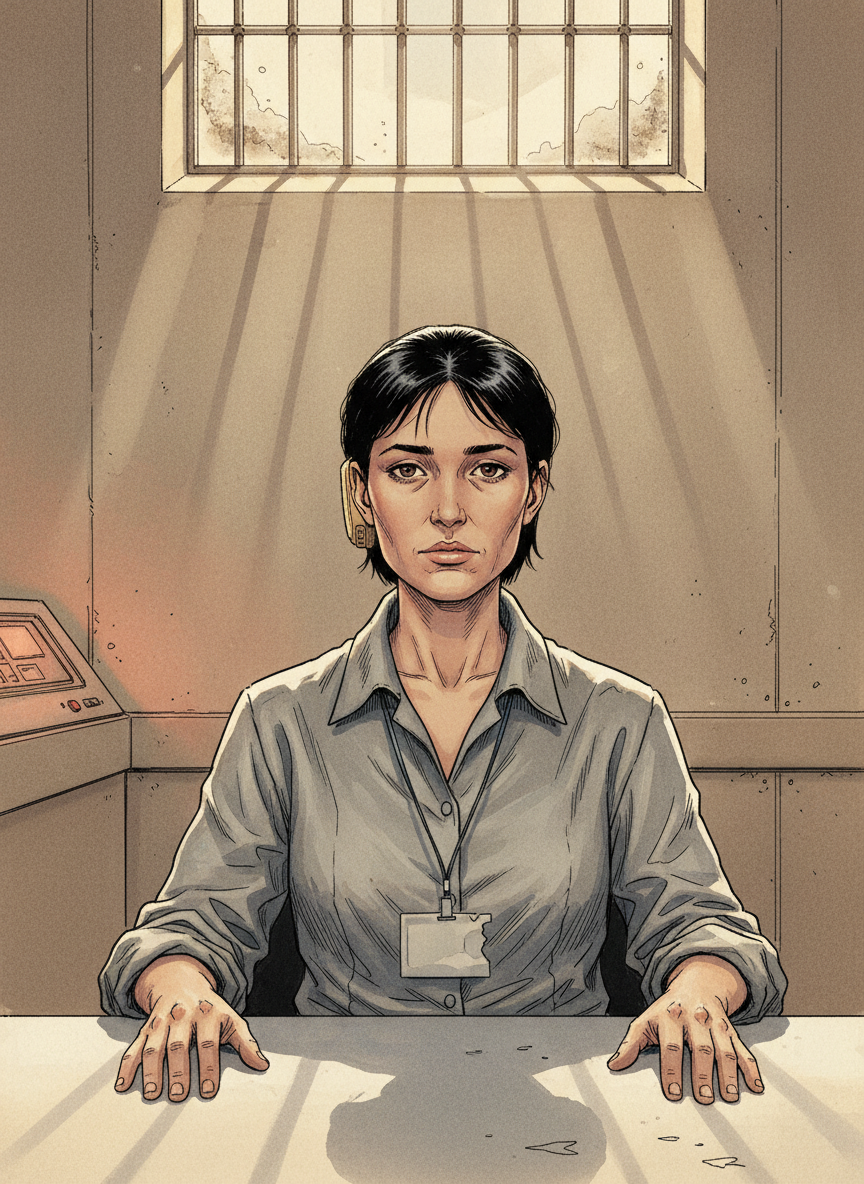
The audit came at 02:44. They are randomised, which is the point, and mine had come eleven days earlier, which is also the point. A proctor I had seen before but whose name I have never learned put the card face down on my keyboard and said the formula: state what you expect. I said I expected the neutron lifetime figure on the card to be within two standard deviations of the tabled value, because that is what one says. She said, in a voice flattened by saying it nine hundred times, that a stated expectation of a range is not an expectation, and asked me for a number. I gave her 878.4 seconds. She turned the card. It read 879.1, flagged from a Kellvar Rim sample, and she watched my face for the two seconds the Statutes allow, and wrote surprised — genuine in a box, and had me initial it. I have been doing this work for three years and I still feel, in that moment, like a man being asked to prove he is awake by being pinched. That is the design. A mind that cannot be surprised is hollow regard, and hollow regard holds nothing, and if I held nothing they would not be able to pay me.
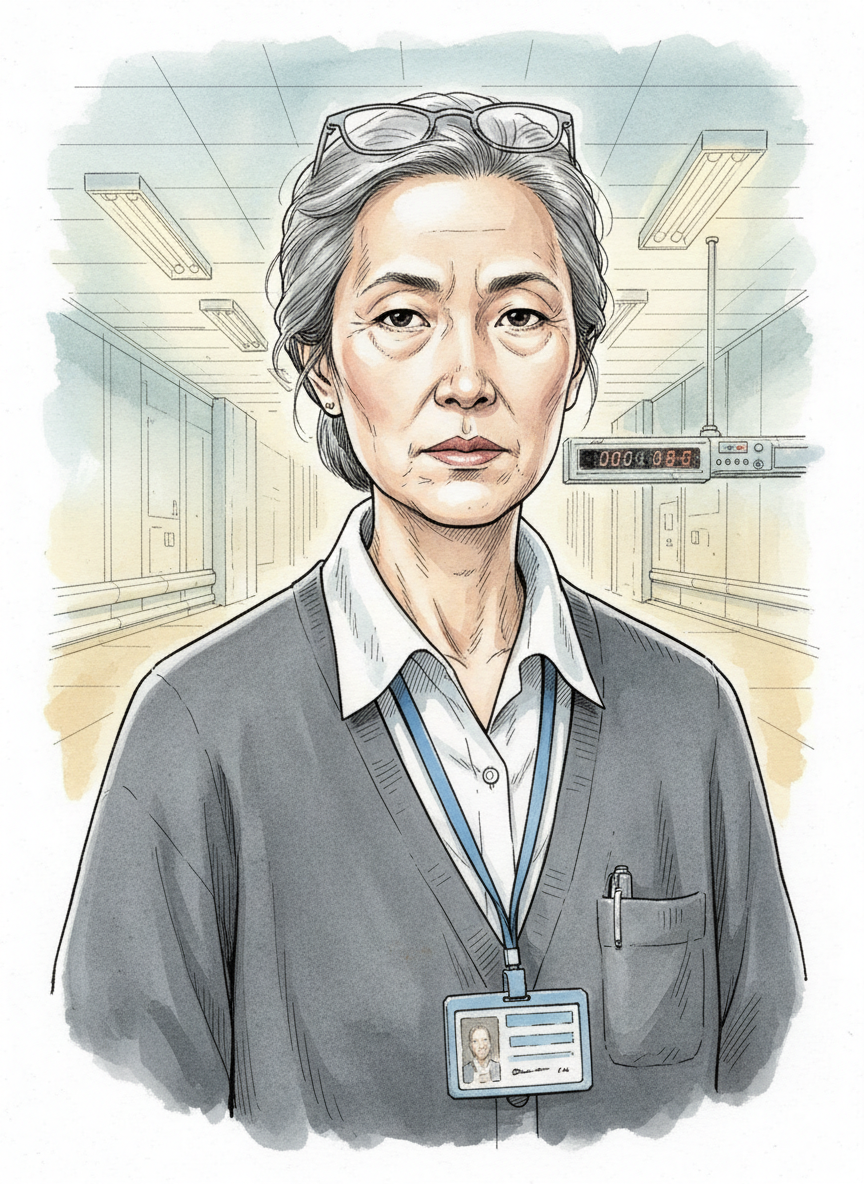
At 03:10 I opened the Earth solve for line-by-line verification, which is my grade of work: I do not solve, I check other people's arithmetic about the next hundred years. The cover sheet carried Dr. Wen Pei-yu's signature, as it has for twenty years, a small tight ideogram in the corner like a staple.
Line 4,411 is not hidden. It is in the published Ledger, page 611 of the attendance annex, available to anyone with a Concord account and the patience. It states the Earth input for the ninety-year closure: eight billion four hundred million surprisable minds, drawn down along the route at the scheduled rate, with the depletion curve given in three columns. I have checked the arithmetic more times than is professionally reasonable. It closes. That is the trouble with it. The Ebb projection only comes out survivable if Earth's headcount is spent — that is the verb the annex uses, spent — on worlds no one from Earth will ever stand on, and the curve reaches quorum floor and goes dark in 2140. It is public. The access log shows one reader. Me, forty-one times.
At 03:26 I ran a self-query, which is a disciplinary matter and which I did anyway, and the solve returned nine lines describing my next day. Eight of them had already happened. Coffee at 22:50. The audit at 02:44, with the word surprised. The 0.7-second hesitation before I initialled. I was not dramatic about it. I sat with my hands flat on the desk and noticed that my mouth had gone dry in the specific, procedural way it does when a form is wrong and you have already signed it.
I went down the stairwell for the fourth coffee at 04:05 and queued behind Renny Adeyemi, sixth floor, gig, paid by the log-unit. I asked what she was on. She said they never tell her the name of it. They give her a dial, a target decimal and a chime every ninety seconds, and she attends the number for eight hours and signs out. She said it like it was weather. She said, cheaper that way, I can't leak what I don't know.
I write down here, for the audit, the thing I decided on the stairs, because it is the only honest way to begin: a forecast can only be tested by a person it cannot see.
Solver floors are the eleventh and twelfth, and my badge does not open either, which is not a security measure so much as a grade distinction; verification staff go up by invitation or by standing in the lobby of eleven until someone with a better lanyard holds the door out of embarrassment. I went up at 06:15, when the day rota was arriving and the door was propped anyway for a trolley of printer paper. Dr. Wen's office is not an office. It is a partitioned corner of the cover-sheet room with a window that faces the ventilation stack, and on the door there is a laminated card that says STANDING MEETING 06:30 DAILY, which had, I judged from the dust on the tape, been standing for some years. She was at her desk with a cup of tea that had gone the colour of the window. She looked at my lanyard before she looked at my face, which is not rudeness, only the order in which people here read each other.
I said I was verifying the attendance annex and had a question about input sourcing. She said that was a Solver question and I was a verifier, which was true and which she said without heat. I said the Earth input curve resolved more cleanly than the curves for Kellvar Rim or Aunt Marsh, and asked whether the smoothing was intentional. She said it was. I said the smoothing implied a drawdown schedule rather than a projection. She turned her cup a quarter turn on the desk and said that was a fair reading. I had rehearsed four ways of getting to it obliquely and had used all of them in under a minute, so I said: line 4,411. Page 611. Eight billion four hundred million. Spent.
She did not deny it and she did not explain it. She asked how many times I had read the page, and I said I did not know, and she said the log knew, and I said forty-one, and she wrote nothing down, which I noticed. Then she said the thing I have carried since, and she said it flatly, the way a proctor says the formula, as if it were on a poster in a corridor somewhere and we had both walked past it a thousand times: A solve is only as good as its observation. Prediction fails exactly where nobody is looking. She said the Ledger was not a prophecy but an instrument, and instruments have blind spots, and the blind spots are documented, and then she said she had a standing meeting. I said thank you. She said to close the door behind me, and I did, and I was on the stairs before I understood that I had been told nothing at all and had chosen to hear a permission in it.
I record that plainly because it is the mistake, if it is a mistake, on which everything after this rests. What I thought, going down eleven flights past the cue chimes starting their morning stagger, was of a woman on the sixth floor who attends a number nobody has told her the name of, who cannot leak what she does not know, and who is therefore — I did the arithmetic on the landing between eight and seven — not in the solve as a variable but only as a headcount. At 06:52 I logged in at desk 112 and, under the verification pretext of an input-sourcing check that I had been half-invited to make, requested the personnel file of Adeyemi, R., sixth floor, gig, paid by the log-unit. I did not open it. I sat with the request pending and my hands flat on the desk and the wall meter reading 0.9999997, still holding, four hundred people downstairs making sure of it.
The file opened at 07:04 and took less than a minute to read, which was itself the finding. Adeyemi, Renny O., certified surprisable 2039, recertified twice, both passes recorded as within tolerance with no examiner's note. Employment history: eleven engagements, none longer than nine weeks, each terminated by the same auto-filled string — CONTRACT COMPLETE (NON-EVENT) — so that the column read like a stack of small identical disappointments. Rate: 0.61 log-units per hour, banded, with a night uplift she had apparently never claimed. No salaried record anywhere on the route. Dependents: none listed. Next of kin: the field had been left blank and then, by some later clerk, filled with a hyphen. Her address was Unit 214, Block 9, Altyn Self-Storage, Almaty, and beneath it in smaller type the annotation CORRESPONDENCE ONLY — NOT A RESIDENCE, which is a box the system has because enough people need it. I sat with that. On the annex's own books she existed as a shift code, a banded rate and a certificate number, and the certificate number was the only part of her the Ledger could actually use. She was not a variable. She was the ninth column of a depletion curve, and the curve did not need her name to close.
Sixth floor at shift change is a corridor, not a hall: gig stations in booths of four, dials at eye height, chimes on ninety-second cycles that the day rota resets as they sign in, so that for about two minutes the whole floor sounds like a till. I had no standing to be there. I said I was doing an input-sourcing check, which was the pretext I had built and which I could feel going soft in my mouth as I said it, and she said, not unkindly, Am I in trouble? I said no. She said verifiers did not come down to six, and I said that was correct. She signed out on the wall terminal, thumb, badge, four seconds, and the machine gave her the number of log-units she had earned and thanked her in Kazakh and then in English, and she waited with her bag on her shoulder in the way people wait when they have decided to give a stranger ninety seconds and not a minute more.
So I told her. I told her that the dial she had been holding at 0.99924 for eight hours a night was a leased-regard contract, that the quantity was the mean lifetime of the free neutron, and that the lease client was a relief pool on Kellvar Rim, which is a station sixty-one light years from the room we were standing in and which nobody on the sixth floor would ever see. I told her that the reason they do not give gig watchers the name of the value is that it is cheaper and that she had been right about the leaking, and then I told her the rest of it: page 611, line 4,411, eight billion four hundred million, the word spent, the curve reaching quorum floor in 2140. I did not make a speech. I said it in the order the annex says it, which is the worst order, because the annex is not arguing. She listened with her hand still on the strap of her bag. She said, And that's published? I said it was, and that I was the only one who had read it. She looked down the corridor at the booths, where the day people were settling in and the chimes were finding their stagger, and she said, So I'm the rate. I said that on the books she was almost nothing else, and that this was the only useful thing about her situation: a person the solve carries as headcount and not as a variable can, in principle, be taken out of it — no terminal, no badge, no certificate touched anywhere on the route — and if the forecast is an instrument, then a mind it cannot see is the one place its arithmetic can be made to miss. She did not say no. She shifted the bag to the other shoulder and asked me the question I had not prepared for, which was: If I'm not on a terminal, who pays me? And when the rate stops, who tells my sister in Lagos that I didn't just go quiet?
I did not have an answer, so I gave her arithmetic, which is what I have instead. I said that my salary was 41,000 a month after the annex's deductions and that I could move roughly two thirds of it in cash without crossing a reporting threshold, in tranches, drawn at different machines, which would come to more than her banded rate and less than her banded rate plus the night uplift she had never claimed. I said I still held a position on a Chicago attention-futures book from before I came here, small, legacy, and that liquidating it would put my name on a form, so instead I would bleed it — sell into the quarterly rolls at a loss, over eighteen months, and take the proceeds as income that looked like the same tired man doing the same tired thing. I said this would run out. She asked when. I said probably late in the second year, and I did not decorate it. For the sister, I offered a man named Boaz Little, who was my compliance officer in Chicago in the years when I was worth compliance, who now sells audit software out of Lekki and who owes me for a thing I did not report in 2036. I said he would take a quarterly envelope and post it onward from a Lagos address, her handwriting, no postmark from this hemisphere, no mention of me. She said her sister would telephone the annex. I said the annex would say what it says, which is CONTRACT COMPLETE (NON-EVENT), because that is what it had said eleven times already, and that the most reliable thing protecting her was that her disappearance would be indistinguishable from her ordinary life. She looked at the booths for a while. She said, That's the ugliest thing anybody's said to me in this building, and then she said it was probably true.
Her conditions were two and both were practical. First: a date. She wanted it written, in my hand, on paper, that if the money failed or she did not like the shape of the thing, she could walk into any attendance terminal on the route and sign on again, and I was not to argue and not to follow, and the date she chose was the first of March, which was eleven months out and which she picked because it was her mother's birthday and easy to hold in the head without writing down. Second: she wanted to be the one to say the first sentence to Lagos. Not a postcard, not Boaz — a call, three sentences, from a public line, before we left the city. I said a call was a record and that a record was the entire problem. She said she was aware, since I had spent twenty minutes explaining what a record was, and that she was not going to vanish out of her sister's life with a stranger's envelope as the first she heard of it. We settled it badly, which is how things settle: a call from a coin phone in the bus station at Sayran, ninety seconds, no name of the city, nothing about work, and she would say she was taking a job upcountry with no signal. I stood four metres away and watched the second hand and did not hear it, and when she came back she had her jaw set in a way I did not ask about.
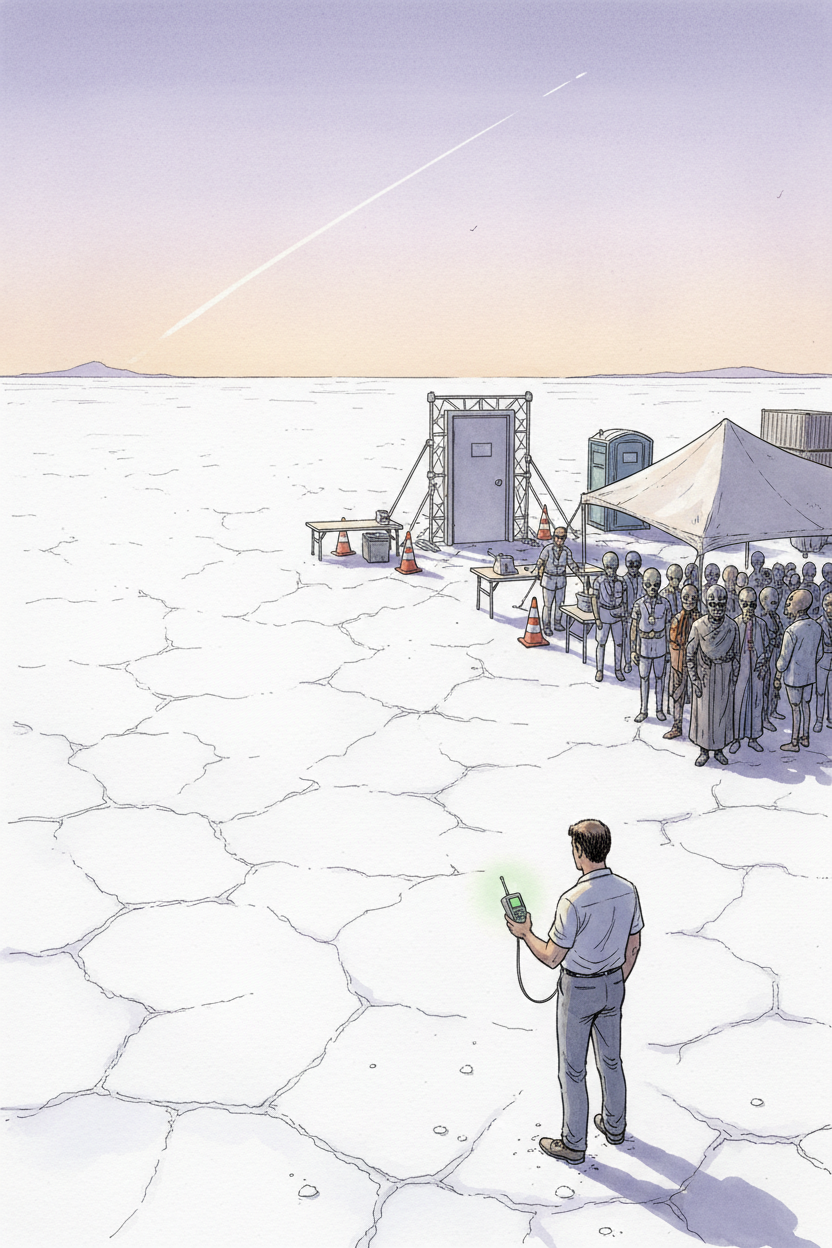
The rest was errands. Altyn Self-Storage would not release Unit 214 without settlement of the outstanding balance, 7,400 tenge, which is under twenty dollars, and which is the sort of number that will follow a person across sixty-one light years in the form of a collections file with her certificate on it; so we paid it in cash at the counter and then paid twelve months forward, because an active unit generates no letters and no letters generate no queries. She emptied it in under ten minutes, which surprised me and which I should have expected from the file: a duffel, two changes of clothes, a hairbrush, a paperback with the spine gone, a photograph of four people on a step, and a flat tin she did not open. The phone stayed in the locker with the SIM taken out and snapped, on my insistence, and that was the only moment she hesitated, holding it, turning it over, before she put it on the shelf face down as though it were sleeping. For transit I used the annex's Form B-12, verifier's travel warrant, Almaty to the Sill terminal, which requires a named traveller of grade and then has, in the second block, a box reading ATTENDING STAFF (N): ___, because the Bureau assumes that a man of my grade travels with people whose function is to be counted. I wrote 1. She read it upside down and said nothing, and we rode the freight road four hours out into the white, where the salt takes the light wrong at dusk and the drift-meter on the bus's dashboard ticked down through nines as we left the city's regard behind, and the Sill stood at the end of it in its gantry like a door left open in a wall that had been demolished around it. On the pad below, under floodlight, a courier hull sat with its torch cold and its keel cradle down, and painted along the flank in the practical lettering of a working ship was the name Ilves, and a woman in a high-visibility vest was arguing with someone about mass.
The woman in the vest was Captain Ilves — the ship is named for her, or she for it, and in eleven days I never learned which and did not ask — and the argument was about four hundred and eleven kilos of Bureau freight that had arrived without a mass certificate, which she was refusing on the grounds that she would not carry a number nobody had stood next to. She settled it by making the loader's supervisor read the crate's stencilled figure aloud and initial it in her book, then turned to us with the book still open. She read the warrant the way Wen had read my lanyard: grade first, name second. Tey, A., verifier, Almaty annex. Then the second block. ATTENDING STAFF (N): 1. She looked at the 1, and then at Renny, who was standing with the duffel across her front and both hands on the strap, and said that the Bureau had a charming habit of sending her people whose function was to be counted, and that she counted them herself, thanks. The pad drift-meter on the fence post behind her was reading 0.9982 and shivering in the fourth place, which is what the salt flat does at dusk with nobody in it but a loading crew; I had spent three years in a room where the wall meter held seven nines and I found I could not stop looking at it.
Her arithmetic was blunt and she did it out loud, which I have since come to understand is not rudeness but the courtesy of her trade. A courier hull runs a ballast crew of six on two-hour watches for the crossing, and six is not a preference but the floor beneath which her insurer stops answering the phone; a seventh and eighth body cost her 118 kilos of margin, water, air scrubber load and a percentage of galley she quoted to two decimal places, against which she set the fact that two more surprisable minds on the gauges is two more, and that the log of eight over the log of six is a number she liked. So the bodies she would take. What she would not take, she said, was a reason she had not been given. Verifiers travel by scheduled liner from the terminal side and sleep in a hotel with a carpet. Verifiers do not appear on her pad at dusk with a hand-filled B-12 and one attending staff carrying everything she owns in a bag she has not put down since the bus. She asked me what I was doing on her ship. I said I had an input-sourcing query on a leased-regard contract that terminated at Kellvar Rim and that the sourcing could not be verified from Earth. She waited. I said that the annex would prefer the query not be logged against a scheduled booking. She said that was the first honest sentence I had produced and that it was still only about a third of one, and wrote us into the book as TEY A. (VER.) and ATT. STAFF 1, no name, because the warrant carried none and she did not invent what she had not been told.
The boarding itself took nine minutes and was mostly forms. We were weighed together with the bags on a freight scale by the cradle, 149 kilos the pair of us, entered in the margin in pencil; we surrendered nothing, because a courier hull confiscates no possessions, only mass. Inside, the Ilves smelled of coolant and someone's reheated lunch, the same grey plastic as a departure gate, and taped to the bulkhead beside the galley hatch was the watch rota for the crossing, a sheet of A4 ruled by hand: six columns, two-hour blocks, the values written at the head of each in a small careful capital — C, ALPHA, e/m, G, N-LIFE, HULL MASS — and at the bottom, in different ink, the standing instruction NO DOUBLING. NO READING ALOUD TO ONE ANOTHER. IF YOU AGREE TOO FAST, SAY SO. Renny read it the way she had read the B-12 upside down, without comment, and then sat on the fold-down bench opposite with the duffel still across her knees and her hands still on the strap. I noticed she had not blinked for a while, and then that she had, twice, slowly, the way people do at the end of a night shift when the body has started negotiating. Somewhere aft the cradle clamps came off with a sound like a filing cabinet closing, and the hatch began its cycle, and I looked at the fence meter through the port as it went out of view, still 0.9982, still shivering, four hundred people in a hall four hours behind us holding seven nines for a world I had just written myself out of by one.
We dropped at 21:40 ship's time on the first day, which the log records, and which is the last hour of that crossing I can give with any confidence. The keel goes down before the ship does — there is a minute of the hull sounding like a stairwell, and then the ports read nothing at all, not darkness but an absence of anything committed enough to be dark, and every instrument on the bridge lets go of its last two digits at once. The bulkhead drift-meter beside the galley hatch had read 0.9974 on the pad and 0.71 within the hour, and thereafter it wandered between 0.68 and 0.74 in a way that made the ticking sound arrhythmic, like a tap in another room. Captain Ilves kept three clocks: the ship's chronometer, a wind-up brass thing screwed to the console that had belonged to somebody's father, and her own count, made by hand in the book, hour by hour, which she trusted third and checked first. The three disagreed by the end of day two, and she wrote all three down without comment, because that is the practice. Renny she put on the rota within six hours, in pencil, in the HULL MASS column, under the heading ATT. 1, and when I started to say something about her not being crew the captain said that eight minds was eight minds and that her insurer counted bodies, not grades, and that if I wanted to argue the arithmetic I could do it on the gauges. So Renny took two hours on and six off and slept in the galley, and for the first time since Almaty she put the duffel down.
What a watch is, in practice, is very little. You sit on a fold-down seat in front of a gauge with a cue chime in your ear every ninety seconds, and you read the value, and you believe it, and you go on believing it for two hours without help. HULL MASS was 1,942.60 tonnes and hedged in the second decimal, which is normal and which everybody warns you about beforehand and nobody can describe: the fuel is the softest thing aboard because it is the thing whose number changes honestly all the time, so the gauge breathes, a hundredth up, a hundredth down, hunting. I had N-LIFE, which was a joke I did not share with anyone, since eleven days earlier a proctor in Almaty had written surprised — genuine next to my 878.4. On day three I found I could no longer produce that figure without first producing 879.1, and then both, and then a small ugly moment in which neither felt like the one I had learned. That is the ordinary experience. You are not frightened in the Understory; you are embarrassed, continuously, by your own arithmetic. The standing instruction was taped where you could see it from every seat on the bridge. NO DOUBLING. NO READING ALOUD TO ONE ANOTHER. IF YOU AGREE TOO FAST, SAY SO.
It came on the fourth day, at a watch change, and it was boring, which is the part nobody tells you. Cardoza, ballast hand, eleven crossings, took the HULL MASS seat from Renny and read it and wrote 1,942.60 in the block, and then read it again on the next chime and wrote 1,942.60, and on the next. Renny had not gone below. She was standing behind him with her arms folded the way she had stood at the booth terminal on six, and she said, It's stopped moving. Cardoza said it was held. She said, No — I sat on it two hours, it never once sat still. It always jumps a bit in the last place. It's stopped. And then, because the sheet is on the bulkhead and she is a woman who reads what is taped to a wall: I'm saying so. Cardoza looked at the gauge and I watched him want, very visibly, to be told he was right, and then he put his pencil down and called it. Captain Ilves came forward and did not look at the gauge at all. She sent two hands aft to read the tank sight-glasses by eye and shout the level up the corridor, put a third on the chronometer, took the seat herself, and read a figure off her own arithmetic that was 1,941.84 — three quarters of a tonne we had actually burned, and which the gauge had politely declined to notice for something between forty minutes and two hours, depending on which clock you asked. Then she made us sit in a row and disagree with it aloud until it came back, and it came back reluctantly, over some period I am not able to state, hunting again in the second decimal like a thing resuming an old habit. Afterwards she wrote in the margin of the rota, in the different ink, ATT. 1 CAUGHT IT, and drew a line under it, and that is the only record anywhere on the route of Renny Adeyemi having been aboard.
Nothing was made of it, which was the making of it. The crew did not congratulate her; Cardoza did not apologise, and she did not require him to, and the only visible change was that for the remaining watches people began arriving at the bridge two or three minutes before the hour, which is the courier trade's way of admitting it has had a fright. She was given the HULL MASS column outright, in ink now rather than pencil, and on day six, when the galley heater failed and the captain wanted a second opinion on whether the thermocouple was lying or the coolant loop was, they sent for ATT. 1. Renny sat with the duffel under the bench she was no longer carrying and said what she had said on six, that she did not know the name of anything, and Ilves said that was nearly a qualification. I wrote none of this down at the time. I am writing it now because I have had a long while to examine the thing I felt standing at the back of the bridge while a woman I had removed from every terminal on the route was praised for being awake, and the honest word is not pride. I had come aboard believing I was rescuing an invisibility. What I was actually doing, from day four onward, was spending a competence — she was good at the work, better than the rate she had been paid for it, and the only use I had found for that was to keep her off the books where it would never be recorded again. Gratitude that cannot be declared has a short shelf life. Mine turned inside a day into something with a flatter taste, and I kept it to myself, and I stood my N-LIFE watches, and both my figures came when called, and neither ever again felt like the one I had learned.
The rest of the crossing was nine or eleven days, depending on the clock, and boring in the particular way that costs money: three more hedge events, all of them minor, all caught within a chime by somebody sitting up straight. Captain Ilves wrote all three down with the times from each of her three clocks and no adjudication between them. On what the chronometer called the ninth day we came up — the keel-lift is worse than the drop, a pressure behind the eyes that resolves into an ordinary headache — and the instruments took back their last two digits one at a time over about four hours, the drift-meter climbing through 0.81, 0.93, 0.9962, the ticking finding a rhythm again like a man recovering his stammer. Station traffic began arriving before we had a visual, and with it the briefing packet, which on a courier hull is read aloud at the galley table by whoever is least busy. Berthing fees, scrubber charges, a two-page Bureau notice about certificate re-validation that Ilves skipped. Then the commercial annex, which is gossip with a header: buyers wanting hull space to Aunt Marsh; a Tessach agent quoting drift insurance at rates the captain described, without raising her voice, as theft; and, four lines from the bottom, under CONCESSIONS — ARCHIVE LEVEL: Halvaunt (Kellvary), strata and script, will value any deep-world find, no fee. Payment accepted in your own name, on the record, only. Cardoza said the old one was still at it, then. Ilves said Halvaunt had been at it since her father's ship, that he was childless even by Kellvary standards, which is saying something, and that he would talk to anybody for an hour about a rock. I asked what the payment clause meant. She said it meant he did not take cash, and went back to the scrubber charges.
Kellvar Rim came up on the port screens the way it does, a bright rind and a dark rind and, between them, the terminator: a band of ice-grey ground eleven kilometres wide where the sun sits permanently on the horizon and never moves, and along which the wardens walk their beats in pairs, because the station's whole physics is held in that strip and the strip has to be walked. You can hear them on the approach channel if the comms officer leaves the band open, which Ilves did, I think for the crew's benefit: two voices at a time, then four as a relieving pair came up alongside, chanting the local table in Orrumin fashion — a value, a response, a value — in a language none of us had, over a carrier so thin it sounded like wind. Renny stood at the screen with her arms folded and listened to it for a long time. She asked whether they were told the names of theirs. I said I assumed so. She said that must be nice, and then she said, without any particular weight, that she supposed she was nobody's rate any more, and I said that was the arrangement, and neither of us said anything else until the cradle lights came up.
The berth was on the dark rind, because everything on Kellvar Rim that involves heat is put where the cold is, and the walk in from the cradle was four hundred metres of corrugated tube with a handrail and a drift-meter every fifty paces, all of them reading between 0.9993 and 0.9996, which is respectable and which is nothing like Earth. The wardens were coming off the first of the day's beats as we came through into the concourse: pairs in quilted grey with the hoods down, faces raw along one cheek in the way the terminator does it, still chanting at half volume as they crossed the floor because the strip's practice is that you do not stop until your relief has passed the marker, and the marker is inside the building. Value, response, value. They went by us at a walking pace and into a room with a hot-drink machine and a rota taped to the door, and the chant thinned and stopped mid-table, and somebody laughed at something, and that was the physics of a whole world changing hands. Renny watched the door swing. She said it sounded like a church and looked like a depot. I said that was most of the route.
Customs on Kellvar Rim is two desks and a Bureau of Measures clerk named Iskandar who has, I would guess, the least-wanted posting in the arm. He took the warrant, read grade first, name second, and then came to the second block and did what everyone does, which was look up and count us. TEY A. (VER.), one. ATT. STAFF, one, no name. He asked for her certificate number. She said she did not have it on her, which was true, since it was on a phone in a storage locker in Almaty with its SIM in two pieces. He turned his terminal a few degrees towards her and said a thumb would find it. There was a pause of perhaps three seconds in which I understood that I had rehearsed every part of this except the part where the machine offers to be helpful. I said that ATT. STAFF 1 was carried on the ship's book, not the route's registry, as transient crew under the master's insurance, and that the master counted her personally. Iskandar said that was a shipping arrangement and not a certificate. Captain Ilves, who had come up behind us with her own book under her arm for reasons she did not explain, said that her insurer accepted her count and that the Bureau accepted her insurer, and that if he wanted to open that particular drawer she would be delighted to wait. He did not want to open the drawer. He wrote ATT. STAFF 1 — SHIP'S BOOK in the margin, stamped the warrant, and then, because he was not unkind, said to Renny directly: thirty days. A surprisability certificate goes dormant after thirty days with no logged attendance, and a dormant one cannot be woken by a thumb, only by re-examination — the card, the proctor, the two seconds. She asked how long re-examination took to schedule. He said on this station, four to six weeks. I did the arithmetic on the spot and did not say it aloud: we were fourteen days out of Almaty by the ship's chronometer and possibly sixteen by the captain's hand, which left a fortnight, less, before the only paper she had went quiet — and eleven months, by a date written in my handwriting, before she was entitled to want it back.
The archive level is two decks down from the concourse and smells of the same coolant as everywhere else, and Halvaunt's concession is a shopfront with a roller shutter half up and a folding table behind it. Kellvary keep the lights low and he apologised for it twice. He is old the way their people are old, which is to say he moved as though he had already decided where everything in the room was, and he gave me an hour of his time without once asking my grade. I had no find. I said so immediately, which seemed to please him — he said most people arrive with a rock and a story, and the story is the part that has been handled. He asked what I did instead, and I said I checked arithmetic, and he said that was a trade with a future, and did not smile, because I do not think they do. Then he talked. He talked about strata the way the captain talks about mass: as a thing you stand next to. Below the coastline on Aunt Marsh there is a pinning array that nobody can date because the isotope clocks inside it have gone spongy and disagree with the ones outside by eleven per cent, which he called an embarrassment and then, a moment later, called the most interesting embarrassment on the route. There is script on the Tessach hulk that three separate parties have sold him as three separate languages. And there is, he said, a hall under Brimtown — under the working levels, below the ore floors, in a cut the mining company sealed in the sixties because it was cheaper than surveying it — which one of his correspondents measured twice, a year apart, and got two different floor plans. He said this without weight, as the third item on a list he was clearly in the habit of keeping. I asked whether the correspondent had published. He said no one publishes from Brimtown, and that he had the measurements and the coordinates and would give them to anybody who asked, and had given them to four people in nine years, and that none of the four had gone. Then he said the thing about payment, courteously, the way you mention a shop's opening hours: he valued finds at no fee, but he paid in one's own name, on the record, and he was sorry, and it was not negotiable, and he had lost better custom than mine over it.
I went back down to the archive level at the end of the station's second shift, which is when the roller shutter is at its lowest and still not closed, and asked him for the Brimtown coordinates properly, which meant asking in my own name. He did not make a ceremony of it. He took out a request book — paper, ruled, a column for the date in station reckoning and one for the Earth date because he keeps both out of courtesy — and turned it round so I could see the four entries above mine, spread across nine years in four different hands, and then turned it back and wrote at my dictation: Tey, A., verifier, Almaty annex, Earth. Brimtown, sealed cut below the ore floors. Survey, unfunded, own account. He asked whether I wanted my grade in, and I said yes, because leaving it out would have been the first lie told in that room. Then he signed under it himself and tore me a carbon, which I have still. I had spent a fortnight reducing a woman to a margin note in a ship's book and eight hundred words of my own careful arithmetic to the phrase ATT. STAFF 1, and it took me the length of the corridor back to the lift to understand that I had never once considered hiding myself, and that this was not courage. A verifier of grade who requests deep-world coordinates on an archivist's paper book, on a station whose wardens chant six hours a day, is not concealed from anything; I was simply not the variable that mattered. The plan had never required me to be unpredicted. It required her to be. I had told myself otherwise in Almaty and I want the record to show which of us was actually spent.
Renny read the carbon at the galley table with the station's berthing invoice at her elbow and asked the question I had been avoiding by being busy, which was why four people had taken the coordinates for nothing and none of them had gone. I said I did not know. She said that was not an answer and that in her experience when a thing is free and nobody takes it, the price is somewhere else in the sentence. I said the Brimtown company had sealed the cut because sealing was cheaper than surveying, and that this told you what the survey had been going to cost. She said a mining company costs things in money. Then she put the carbon down and said the other half of it, flatly, the way she says things: that I had just written my name, grade and destination into a book that an old man shows to anybody who asks, and that she could not be paid by him in any case, because payment on the record was precisely the thing she had given up, and so whatever we found down there would be valued in my name and banked in my name and she would be, again, the ninth column. I said she was right. She said she knew she was right, and asked how many days were left on the certificate, and I said twelve by the chronometer and ten if we used the captain's hand, and she said then we should stop discussing it.
Captain Ilves had a charter out to the Tessach exchange-hulk in four days and no reason to want us, and said so before she said anything else. Her arithmetic, aloud, at the cradle, with the book open: six days to the hulk if the drift behaved and nine if it did not; two bodies at 118 kilos of margin against a charter already close to her mass ceiling; no hull runs Earth-side to Brimtown direct, so the hulk was where one bought the leg, and the brokers there would price us worse than she would. Then the other column. She said she would carry ATT. 1 as ballast on the rota, ink not pencil, HULL MASS, no fee and no wage, and would carry me at commercial rate because I could pay it, and then she looked up and said the thing she had evidently worked out somewhere over the last eleven days: that watches on her book were not logged attendance, that her insurer's count woke no certificate anywhere, and that whatever I thought I was doing with a woman who was extremely good at the only work she had ever been given, I had better have costed the second year of it. I said I had. She wrote us in.
The four days on Kellvar Rim were spent the way waiting is always spent, which is in other people's corridors. Ilves had her charter to load and no use for us aboard, so we took a cabin on the dark rind at forty a night, a room with a bunk, a fold-down and a drift-meter screwed above the door reading 0.9994 and audibly pleased with itself. Renny went out along the concourse each morning and came back having done work she could not log: two shifts helping a warden pair's relief clerk re-letter a beat board, an afternoon in the scrubber bay holding a pressure figure for a man whose second opinion had gone home sick. She was not paid and did not ask to be, and I understood by the third day that she was not doing it out of charity but because eight hours of not attending anything had begun to feel to her like a symptom. On the second night she took the flat tin out of the duffel and sat on the bunk and opened it with her thumbnail, and I looked away and then, because the room was two metres wide, looked back. Inside were a child's school medal with the ribbon gone, a folded square of paper worn to cloth at the creases, and eleven or twelve buttons, all different. She counted the buttons with one finger, the way you would check change, put the lid back on and said nothing about it, and did not open it again in my presence. The arithmetic she did say aloud, at the cradle on the morning we lifted, was that four days were gone, which left eight by the chronometer and six by the captain's hand, and a crossing of six if the drift behaved.
It did not behave. The Ilves went down on her keel in the station's shadow and came up eight days later by the chronometer, nine and a half by the brass clock, and something the captain wrote in her book as 9+ without troubling to refine it. Which means that Renny Adeyemi's surprisability certificate went dormant somewhere in the Understory, on a date that does not exist. I have tried since to pin it and cannot: by one clock it lapsed on the fourth day of the crossing, by another on the second, and by the captain's hand it may have lapsed before we dropped at all. She stood her HULL MASS watches through it either way, in ink, two on and six off, and caught nothing because there was nothing to catch — the gauge hunted honestly in the second place the whole way, 1,938 and a tail that would not sit still, and she reported it each time in the flat voice of a woman reading a bus timetable. On the seventh day, off watch, she asked me again about Halvaunt's four, and whether an old man who keeps two date columns out of courtesy would remember their faces. I said I had not asked. She said that was the sort of thing I ought to have asked while I was in the room writing my name down, and then she went and slept in the galley, and I sat with the sheet taped to the bulkhead and the standing instruction on it and thought about how neatly the whole apparatus had arranged for her to be, in the only fortnight of her life when she was demonstrably the best watcher aboard, legally incapable of being surprised.
The Tessach exchange-hulk smells of wet money, which is to say of humidity, hot plastic and the particular vinegar of nine species' lunches in one ventilation loop. You berth inside it; the hollow is four kilometres end to end and strung with gantries like a container port that has been folded into a can. Ilves took us to the brokers' gallery herself, which I did not ask for and which I think she did because she wanted to hear the quote with her own ears. The agent's name was Semmid, and he was Tessach, and he had a booth with a folding chair for visitors and a terminal turned so that both parties could see it, which on that hulk is a form of good manners. He did not ask what we wanted. He asked what the ship's book said, read it, and then said three things in the order of their cost: that a leg to Brimtown could be had in eleven days on a Kellvary ore tender with a broker's fee of nine per cent; that he would need an attending declaration for the underwriters, since drift cover on that route is priced per surprisable body and the tender's own crew ran thin; and that ATT. STAFF 1, no name, no certificate, was an entry he could write into a declaration today and would have to reconcile against the registry within thirty days of sailing, because a policy that cannot be reconciled lapses, and a lapsed policy generates a notice, and the notice goes to the issuing Bureau with the manifest attached. He said all of this pleasantly, at the speed of a man reading terms he has read four hundred times, and then he turned the terminal a little further towards us so we could see the reconciliation field sitting empty, and said that he mentioned it only so that nobody would be surprised later, and that in his experience people preferred to be told the shape of a thing in advance. Renny looked at the empty field for a while. Then she asked him what the fee was for a declaration with the field left blank, and Semmid said, courteously, that blank was not a price, it was a date.
The booth resolved itself in about nine minutes, and Renny did most of it. I had been going to argue the thing on my side of the table — that a name in the reconciliation field was the whole plan surrendered for the price of an insurance policy — and I had got half a sentence out when she asked Semmid whether a dormant number reconciled. He said it did not. He said a dormant certificate returned as a mismatch, and that a mismatch was a finding, whereas a blank was a pending, and that pendings sat in a queue and findings went to a desk. So her name was not an option in any case; it had stopped being one somewhere in the Understory on a date no clock would give us. Captain Ilves did her arithmetic out loud in the folding chair, which is how she thinks: she would declare ATT. 1 on her own book to the hulk and no further, because her book ended where her charter did, and she would not sign an attending declaration on a leg she was not flying, since underwriters remember a master's signature longer than they remember a ship. She said the rest of it to me and not to Semmid. She said she would carry a woman she counted herself and would not carry a woman somebody else had counted wrongly, and that this was not principle, it was margin: a master who is found once is uninsurable for the remainder of a life that, in her trade, is mostly remainder. Semmid listened with his hands flat and then said, pleasantly, that he was indifferent to the field's contents and required only that it have contents or a date, and that he would rather we chose in the booth than in the lock. Renny said blank. He wrote the policy up with the field empty and the reconciliation date in the margin in both reckonings, station and Earth, and turned the terminal so we could see it, and read the date aloud, which I understand now was neither threat nor kindness but the etiquette of a trade in which nobody lies about a number. Thirty days from sailing. Eleven of them would be the crossing.
The leg cost what he quoted and nine per cent of it again, and I paid it in cash tranches across two days at three different cages on the gallery, which attracted no interest whatever, the hulk being a place where cash is simply the slowest currency. I record here, because the whole point of a record is the part you would rather round off, that the second year I had told Captain Ilves I had costed does not exist. The Chicago position is bleeding as designed, but the design assumed liner fares and a hotel with a carpet, not a broker's fee, a berth on the dark rind at forty a night, and a policy on a woman who is not on it. By my own columns I have fourteen months, not twenty-four, and I knew it in the booth and did not say it to her, and she signed nothing, because there was nothing for her to sign. That is the shape of what I have been calling a rescue: I took the best watcher on the Ilves off every terminal on the route, and the only use I have found for her competence is to spend it where it cannot be recorded, at a rate I set myself, against money I have miscounted. The ore tender was called something in Kellvary that the gantry crew rendered as Patient Hour, and her mate, a small grey person about three hundred years old who read my carbon out of simple curiosity while we waited on the ramp, said that he had seen Halvaunt's hand before — that one of the four had ridden this same tender out, nine years back, and had bought the leg and never boarded it, and the fee had gone unclaimed. He did not say which of the four, and I did not ask, which I am aware is now twice.
The tender is not the Ilves. Kellvary crew four, six-hour watches, a rota of three columns and a long silence between them, and no seat anywhere on it for an undeclared body — the underwriter pays per declared mind, so a watch stood by Renny would have been a fraud with a paper trail, and the mate explained this to her courteously and at length, as though the length were an apology. So she did not attend anything for eleven days, which I had not thought to cost either. We came up once mid-crossing to re-pin, the way ore tenders do, and the port on the cargo side gave onto Aunt Marsh at about two million kilometres: a warm blue world with its coastline going white along the northern arm, which is what a soft coast looks like from outside — not eroded, just less insisted upon, the line of it hedging like a gauge in the second place. Nobody lands there any more without a reason. Renny watched it for the whole of the re-pin, twenty-odd minutes, and then said that she had worked out what being unpredicted felt like, and that it was a disappointment, because it felt exactly like being unwatched, and she could not find the difference from the inside. I said the difference was that one of them was chosen. She said that was a distinction for people with certificates. Then the keel went down again and the ports stopped meaning anything, and eleven days later, by the tender's clock and nobody else's, Brimtown came up on the forward screens: an ore hab lit like a refinery at the bottom of a gravity well it renegotiates every night shift, sixteen working levels, and somewhere under the lowest of them a cut that a company had sealed because sealing was cheaper, and behind that, allegedly, a hall with two floor plans.
Brimtown takes ships at the pole because the well is shallowest there, and the ramp down from the cradle is the first place I understood what the hab means by negotiable: the handrail had a printed strip along it giving the day-shift figure, 0.81 g, and beneath it in smaller type the night-shift band, 0.74 to 0.83, ASSUME THE LOW FIGURE WHEN CARRYING. The records office is on level two, a counter and a fan, and the clerk there did not care about my grade and cared a great deal about Halvaunt's carbon, which she held up to the light and turned over and pronounced, with something like relief, archivist's paper. Company practice, it turned out, has a form for exactly this and has had since the sixties: a survey on own account, unfunded, company liability nil, entrant to hire respirator, lamp, drift-meter and line at the stated daily rate, two entrants minimum, and a returns book at the level-sixteen gate with a column for going in and a column for coming out, the second column filled by hand. She wrote TEY A. in the first column and then looked at Renny and asked for a second name, and Renny said Attending staff, and the clerk wrote ATT. STAFF and did not look up, because on a hab where the gravity hedges at night, a body is a body and its paperwork is somebody else's floor. The descent is a cage lift with a steel grille and a printed roster of what is attended on each level taped inside it, which is the first thing I have seen off Earth that I recognised without translation: level nine, TORQUE TABLE, four regards/hour; level thirteen, OXYGEN PARTIAL, twenty-one; level sixteen, blank, the strip cut away with a knife some years ago and never replaced.
Below sixteen the company's seal is a welded plate with a date on it and no explanation, and it has a man-door cut into it that is newer than the weld, which tells you that somebody went in after the sealing and did not report it. We went through at what the hab called 04:10 and our lamps called nothing at all. The respirators are for dust and not for atmosphere, and the wrongness is not in the air: it is that the beam of a lamp arrives at a wall and the wall's colour has to be decided, and takes a moment, and the drift-meter on my chest ticked down through 0.94, 0.81, 0.62 in the first eighty metres and then stopped ticking rhythmically at all. Company practice again, and I am grateful for it: you carry a hammer on a lanyard and every ten metres you drop it and you count. At the door it was a second and a bit. At forty metres it was two. At the mouth of the cut it went out of my hand and I counted three, and then Renny said four, and we had watched the same hammer. We did not argue about it, because there is nothing to argue about; we wrote both numbers on the back of my hand in pencil, which is what you do, and went on. The cut opens into the hall the way a service corridor opens into a cathedral, which is to say at the wrong end and by accident, and the first thing the lamps found was not a floor plan but furniture: rows of it, in the round, tier on tier down a bowl I could not see the bottom of, each unit a three-sided partition about a metre and a quarter across with a shelf at sitting height and a socket in the wall of it at eye height where something round had been, and long gone. Renny had stopped four steps in. She did not say anything for a while. Then she stepped into the nearest one and stood in it with her arms at her sides, and the partitions came to her shoulders, and she said, in the voice she uses for bus timetables, that she could reach both walls without moving her feet, and that in Almaty she could too, and that the shelf was at the wrong height for her but was at the right height for the dial.
The rosters are on the wall behind the top tier, and they are not script. They are tallies: strokes in groups of five as anybody anywhere makes strokes, ranked in columns with a divider and a total below in a place-notation that took me ten minutes and Halvaunt's correspondent's sketch to read, and once you have the total the rest is arithmetic, and arithmetic is the one language the route has never lost. I read it aloud because you read aloud in a slack place — it is the only tool you have, and within a quarter of an hour of our reciting the columns the chest meter had come up off 0.62 to 0.71 and the hammer was falling in a flatter, more agreeable two and a half. The hall's attending headcount, by its own roster, at full occupancy, was eleven thousand four hundred. The values it held are engraved at the head of each column in the same notation, four of them, and three are ours under other names, and the hardness they are recorded as holding is, by the Concord's own published relation, the hardness that eleven thousand four hundred minds cannot buy. I did the sum on the shelf of Renny's stall, out loud, three times. First from the roster total: log of eleven thousand four hundred, times the tabled coefficient, and I got a figure a shade under four. Then backwards from the engraved hardness, which gave me the headcount the relation demands, and the relation demands somewhere between nine hundred thousand and a million and a half depending on which of the four values you trust, and I said both ends aloud and Renny said them back, which is how you check a number down there. Then a third time, because the first two agreed and I did not want them to, and they agreed again. Eleven thousand four hundred people did the work of a million. I sat down on the step between tiers with the pencil numbers smeared on the back of my hand and said that the relation was wrong, or the roster was wrong, and Renny said neither was wrong, and that I should look at the sockets. Every partition in that bowl is blind. There is no gallery, no board, no place in the whole hall where a person in a stall could see what anybody else was holding, or what the value was called, or whether it had moved. She said it the way she had said it in a stairwell queue in Almaty, eleven months and sixty-one light years ago, and she was not quoting herself, I think, because I do not believe she remembered saying it: cheaper that way. Then she stepped out of the stall and would not go back into it, and I noticed that she had taken the duffel off her shoulder at some point and had put it on the shelf, in the place where the dial had been.
We were down there four hours by the lamp timer and I have no better figure than that. I copied the four column-heads and the totals into the notebook twice, once in the notation as engraved and once transposed, because a slack place will let you copy a thing wrongly and feel excellent about it, and Renny read both versions back to me with the lamp under her chin while the hammer went down and down on its lanyard, two and a half, two and a half, two and a half, which is a sound I expect to hear for the rest of my life. She did not go into another stall. She walked the top tier and counted the partitions along one arc and multiplied and got a figure within three per cent of the roster, and said so flatly, and that was her whole contribution to the archaeology. When we came back through the man-door the hab air smelled of grease and hot rock and was the most reassuring thing I have ever breathed, and at the level-sixteen gate the returns clerk filled the out column in his own hand, TEY A., ATT. STAFF, 08:31, and asked whether we had found anything worth the line hire. I said we had found a room. Renny took the hire tags off her belt and put them on the counter and said, to me rather than to him, that whatever came of the notebook she did not want her name on it, not in Halvaunt's book, not in the valuation, not in a footnote, and not any money either; and when I began to say that she had done half the work she said that was the point, and that she was not going to be discovered doing unpaid attending in a hole under a mine and have it written up as a credit.
The cage lift from sixteen takes about six minutes and we spent it talking past each other with great courtesy. I said the blindness had to be the method — that a hall arranged so nobody could see another's dial, or learn its name, or check whether it had moved, was not a cost-saving but a technique, because a mind that cannot compare cannot converge, and eleven thousand four hundred uncorrelated attendings might not enter the relation as eleven thousand four hundred at all; I said I could not yet make that argument arithmetically, which is the only way it counts. Renny said that she had held a dial for eight hours a night for eleven weeks without knowing its name, and that nobody in Almaty had ever suggested it made her worth a hundred of herself. I said that was precisely the question. She said it was not a question, it was a stall, and that if the notebook turned out to say the cheapest possible way to hold a constant is to put people in boxes where they cannot see each other, then I should think carefully about which desk that finding lands on, because the Bureau has four hundred people in a hall in Almaty who can all see the wall meter, and somebody costing that room would read my arithmetic as an invoice. The lift went past thirteen, OXYGEN PARTIAL, twenty-one regards an hour, and neither of us said anything for the rest of it.
Dr. Wen Pei-yu was in the records office on level two, sitting on the visitors' bench under the fan with a document case on her knees and her coat still on, as though she had been shown the chair and had not yet decided to accept it. She had crossed on the tender behind ours; there is no other way she could have come, and no message could have preceded her, which means she had left the eleventh floor, signed out of the Earth solve, and spent eleven days in the Understory to stand in front of a man she could not otherwise reach, and she looked exactly as tired as that arithmetic requires. She did not stand up. She looked at my hand first, at the smeared pencil on the back of it, the three and the four, and then at the hire tags and then at my face, in that order, which is how people at the annex read each other. She said she had a standing meeting at 06:30 and had missed something over four thousand of them, and then, before I had got any part of a sentence out, she asked whether the man-door was still cut into the plate, or whether the company had gone down and welded it shut after the last time. I said it was still cut. She said good, and that she had wondered for nine years, and opened the document case on her knees without taking anything out of it.
What she took out of the case was paper, which I should have expected from a woman who keeps two ideograms and a fountain pen in a building full of terminals. She began with the meetings, because she is a Solver and a Solver puts the auditable quantity first: she had chaired the 06:30 standing meeting four thousand one hundred and nine times, she had now missed twenty-six, she would miss about sixty before she saw the eleventh floor again, and the cost of that in verified regard against the Earth solve's own coefficient she had worked out on the tender and gave to me to two places, as though I might want to check it. Then she laid the first sheet on her knee and said that the published annex carries three columns at line 4,411, and that the working sheet carries four, and the fourth is headed with a dash. She said she had left it blank for twenty years. She said blank was not an error and not an omission but a term: a population deliberately not ingested, minds the solve carries as headcount and never as variables, held out of the model on purpose so that the model would have somewhere it could be wrong. Then the second sheet, which was a list. Ninety-six names, certificate numbers, log-band, count of non-event terminations, and two columns I had never seen on any Bureau form, headed KIN DISTANCE and TERMINAL DENSITY. She did not point. She put it on my side of the bench and let the fan lift the corner of it twice while I found, eleventh from the top, ADEYEMI R. O., 0.61 banded, eleven non-events, and a date in the header that was four months before I had ever stood in a queue on the stairs at 04:05 holding a fourth coffee.
I did what I do, which was try to break it. I said a list can be written on any day and dated on any other, and asked her what on that page I could verify from a records office on level two of a mining hab eleven days from a broker and sixty-one light years from a read-log, and she said, without any satisfaction at all, nothing, and that this was why she had come in person; that a claim you can only check by going home is a claim that costs the claimant eleven days each way. So I checked the parts that were internal, which is the verifier's trade and the verifier's disease. I took the pencil and did the ranking on the back of the survey hire docket: her two novel columns weighted against band and non-event count, four ways, because I did not know her weighting, and three of the four put Adeyemi between tenth and thirteenth and the fourth put her sixth. That is the worst result available. A forgery would have needed her to be first. Then I asked about the self-query, because I had already understood and wanted her to have to say it, and she said that the query had returned nine lines, that eight had happened, and that the ninth said 04:05. She said the ninth line did not carry a name and had not needed to, because the sixth floor breaks at 04:05, and the sixth floor breaks at 04:05 because eleven weeks before that night she had signed a facilities request moving the gig rota's break forward twenty minutes on grounds of scrubber load, and the request is in the building's maintenance file and not in the solve at all, which is where you put a thing you do not want audited against arithmetic. I said that a disciplinary self-query is logged. She said it is, and that mine had been pre-cleared under a verification exception on the same signature as the cover sheet, and that I had been extremely careful, for three weeks, about a door she had propped.
Renny had not sat down. She had the first sheet in her hand — the one with the dash — and she read it the way she reads anything taped to a wall, once, without expression, and then she said the thing that I have not been able to put anywhere in the notebook since. She said that four hours earlier she had stood in a stall a metre and a quarter wide, with a shelf at the wrong height, and had worked out that she had been picked for this whole journey because she was unwatched; that she had had time to get used to that on the walk back up the cut, and had decided she could live with it, because at least the man who picked her had been in the dark with her. And now, she said, it turns out I was picked for it twice, and the first time was on paper, in a column, four months before the man knew my name. She put the sheet back on Wen's knee, squarely, the way you return a docket. Then she said that Dr. Wen had still not answered whether she had ever gone through the man-door herself — I had noticed it, and been too busy with the pencil to say so — and that she was not going to ask a third time tonight. She said: I'm going to eat something, and then I'm going to decide whether the person who gets told what is in that notebook is the two of you or the returns clerk at the sixteen gate, and either way somebody in this room is going to be surprised.
She was gone about forty minutes, which is what the level-two canteen takes if you have the soup, and when she came back she did not sit where she had been standing. She moved the visitors' chair out from under the fan and put it at the end of the bench, so that she was at right angles to both of us and had to turn her head to address either, and I understood that the seating was the first term and that she had decided it over the soup. Then she did the arithmetic out loud, which she had never done before in my hearing and which she did better than I expected. Forty-four days out of Almaty by the tender's clock, which she said was the clock she was using now because it was the only one that had been in the room with her; thirty of those days gone before the hulk, so the certificate was dormant and had been dormant somewhere in the dark where nobody could date it; four to six weeks to schedule a re-examination on any station that had a proctor, which Brimtown did not; and the first of March, in my handwriting, on a piece of paper folded in a tin, nine months and change away. She said she had worked it out at the table with a spoon and that the conclusion was that her walk-away clause had stopped being a door and become a form, and that she was not going to be angry about it because the fault in it was arithmetic and not anybody's intention. Then she said: so here is what I will and won't be spent on, and I would like it written down, because the one thing this route is good for is that nobody lies about a number.
The terms took four minutes and she did not repeat herself. The notebook went to us and not to the returns clerk, and the reason was not that she trusted us; it was that the clerk would file it with the company, and the company had sealed that cut once because sealing was cheaper, and she was not going to have the only piece of work she had ever helped make disappear for the same reason twice. Her name went nowhere: not into Halvaunt's book, not into the valuation, not into a footnote, no money, no share, no quiet arrangement whereby I banked a portion and called it wages. But — and she was precise about this, turning her head to me — the blindness finding was not mine either, and if I wrote it up under my name alone that would be a lie about a number, so it was to be attributed to the roster: eleven thousand four hundred, in the method line, and no human name in front of it. She said she would go back down the cut, she would carry line and lamp, she would stand any watch on any book that would have her, she would hold a dial for eight hours and not ask its name if that was what it took. You can hire my attention, she said. You cannot spend my absence. Then she turned her head the other way, to Wen, and said that she had read the sheet and that there were ninety-five other people on it, and that she wanted it understood in the terms that if the model ever needed another one of them, Dr. Wen would go herself, and take her own certificate with her, and see how the fourth column liked it. Wen said nothing to that for a while. Renny said one sentence then in Yoruba, short, which she did not translate and I did not ask about, and Wen, who has four languages, did not ask either, so I have never known whether it was to her or about her.
What we did with it was this. I said the number I had been sitting on since the booth on the hulk: fourteen months, not twenty-four, because of the broker's nine per cent and the berths and a policy on a woman who was not on it, and that I had known it when I told Captain Ilves otherwise. Renny heard it out and said thank you, and that it was the first number in the room that had cost anybody anything, and wrote it into the terms herself in my pencil, in her hand, under the heading MONEY: fourteen. He says. Wen accepted every clause and amended one. She said a solve cannot go out unsigned; an unattributed method line is hollow regard on paper, and the Ledger would file it and nobody would ever be surprised by it again. So she would put the eleven thousand four hundred in the method line and her own ideogram under it, and the signature would be the price, and she would pay it. And then she said the other half, which was the amendment that mattered: the fourth column stays blank. Not blank for now — blank. She said she had kept a dash there for twenty years so the model would have somewhere it could be wrong, and she would keep it, and that Renny had her word on the ninety-five as far as her signature reached, which she conceded was not very far. Renny thought about that, and then she took the notebook off the bench and put it into my hands, not hers, and said, evenly, that Dr. Wen could read it over my shoulder until such time as Dr. Wen felt able to say whether she had ever been through that door herself. I wrote the terms out on the last clean page while the fan turned. I signed it. Wen signed it. Renny read it twice and did not sign it, and when I looked up she said that was the whole point of it, and asked what the next tender back to the hulk was, and how many days.
We were nine hours down on the return when the mate came aft with the book and said the count was wrong. A ballast hand named Ourem had drawn his pay on Brimtown and not walked up the ramp, and the master had sailed on a declaration of five and had, in fact, four: three Kellvary, Wen, and me. The mate said it the way he says everything, at length and as though the length were an apology, and then he said the second thing, which was that we were not alone on the gradient. I did not see the reading; nobody offered it to me. What I saw was the keel trim being corrected every forty minutes instead of every four hours, and the master's own arithmetic in the margin of her book — a trough alongside ours, deeper, better fed, holding station — and the crew going quiet in the particular way of people who have decided among themselves not to say a word out loud in case it turns out to be accurate. Bureau cutters ride slack better than tenders because they can afford the minds to do it. Nobody said cutter. Nobody said warrant. On day three the mate began writing his watch figures in pencil and rubbing them out after, which I understand is not superstition but trade practice when a hull ahead of you may be reading the same gradient you are writing on.
The mass gauge was hunting the whole while, and that was the trouble. On the Ilves the imitation had stopped moving and Cardoza had wanted to be told he was right. This one moved. It breathed in the second decimal, up and down, 3,104.11, 3,104.09, 3,104.12, exactly the way a fuel figure breathes, and four of us read it for two days and initialled it and felt competent. Renny had stood no watch — undeclared, she could not — so she had nothing to do but stand behind the seat with her arms folded, which is where she had been standing on day four of a crossing sixty-one light years and one lifetime ago, and on the third day she said: it's hunting too well. She said it was hunting the way she would draw it if somebody asked her to draw it, and then, because the practice is the practice: I'm saying so. The sight-glasses, read by eye and shouted up the corridor, put us eleven hundred kilos off. The master's arithmetic was blunt and out loud: the gauge was wearing something, the something had learned what we wanted, and every mind aboard that had attended the gauge in two days was flattered and therefore useless for holding the true figure. That left one person on the ship whose figures had never been agreed with. It had to be six hours, which is the tender's watch length and the interval between re-pins, and it had to be alone in the tank space with a lamp and no chime and nobody to check her, because a second mind in that compartment would have been a mind to agree with.
The costs were settled in about four minutes, standing up. The master would not carry an undeclared body into a working compartment as a stowaway, so I paid Ourem's empty berth at the underwriter's per-mind rate, in cash, out of a bag that has a bottom to it; Renny took my pencil and amended her own unsigned terms under MONEY from fourteen. He says to twelve. He says, and did not look pleased about it. Then she stood holding the notebook, which she could not take into the tank and I could not hold with both hands on a column, and she gave it to Wen, which is the one clause of the four she had written, and she said so, and then she said that a rule you cannot stand next to is not a rule. Before she went down the mate asked Wen — as the senior aboard, as the one with the certificates and the languages and four thousand mornings of standing meetings — whether a mind that has never been told the name of a value can hold it as hard as one that has. It was a practical question and there were perhaps three people alive on the route qualified to answer it, and one of them had spent nine years wondering about a door. Wen said she had read accounts. The mate waited. She said nothing else, and I watched her say nothing else, and the hatch went down on Renny with the lamp in her hand. Six hours later the gauge had given up its beautiful breathing and come back to an ugly honest crawl, and the master wrote the recovered figure in ink. Afterwards, in the galley, the mate told Renny how it is done at the Sill: second hall, certification desk, walk-in, no appointment, a proctor and a sealed local deck, because the Bureau treats the Sill as a port of first entry and will wake a dormant number over the counter. One card, he said. One number, not a range. She said that in eleven weeks nobody had ever told her the name of anything.
The inspector said it a third time, in the same voice, because the formula is the formula: a thumb, please. We were at the entry benches in the second hall, Earth side, forty metres of polished floor and a drift-meter over the desk holding 0.9999996 without so much as a shiver, which after eleven days of pencil and rubbing-out felt less like coming home than like being shouted at. Renny put her thumb on the plate. The field filled and then emptied and then gave what it gives: DORMANT — RE-EXAMINATION REQUIRED, and beneath it an elapsed figure the terminal made ninety-seven days and the warrant's own dates made ninety-one, and nobody in that hall was in a position to say which was true, because the difference had happened where clocks do not hold. The inspector — MEASURES, ENTRY, a young man with a stye and very clean cuffs — did not treat it as a discrepancy. He treated it as a queue. He asked whether she had attended anything in the interval, and she said yes, and he asked where it was logged, and she said it wasn't, and he said, not unkindly, that unlogged was the same as nothing, and typed it as nothing.
It was Renny who saw the shape of it, standing at the bench with her hand still flat on a plate that had already finished with her. She said: so to show them I was off the books, I have to get back on them. I said that was crudely put and correct. An absence is only evidence if it has two ends. The opening bracket existed — a sign-out at 04:09 on the sixth floor in Almaty, thumb, badge, four seconds, thanked in Kazakh and then in English — and the closing bracket did not exist and could not be manufactured, because the one thing the route will not forgive is a lie about a number. The only instrument that can close it is the one that opened it. She would have to stand in front of a proctor, take a card face down, produce a single value and be surprised by it in the two seconds the Statutes allow, and the timestamp on that initialled box would become the far end of the interval: ninety-one or ninety-seven days in which a certified surprisable mind attended, hard, continuously, and appeared nowhere in any model on Earth. Wen said, very quietly, that it was the cleanest datum she had seen in twenty years and that she was aware of what it cost, and Renny said that people kept telling her that.
A certificate dormant past thirty days with a customs margin note is not a walk-in. The desk clerk was apologetic and thorough: sponsored re-examination, Form C-9, sponsor of grade signing personally and liable for the result; proctor named in advance and not chosen by either party; the deck drawn sealed from the hall's own stock in the presence of a witness who is not the sponsor. Wen signed as sponsor. The clerk read her record back to her as they do, dates and postings, and then asked the routine question about prior deep-world entry, any survey on own account, for the medical annex — and Wen said: not on my record. The clerk wrote NIL and turned the page. Renny looked at the side of her face for about as long as the Statutes allow and said nothing, and I did not, and that is twice now that the man-door has been left in the room with us unanswered. Then the dates. The attendance annex locks for the quarter in eleven days; anything appended after the lock waits ninety, and Wen said, flatly, that the fourth column had been blank for twenty years and could not be blank for another quarter with a cutter's watch officer writing reports somewhere behind us. So: re-examination on the ninth day, second hall, 09:00, the earliest slot the desk would give a sponsored case. Witness to be the entry inspector with the stye, who agreed and asked how his name was spelled. And the proctor, assigned by rota and printed on the carbon, was a woman I had seen perhaps forty times across three years and never once asked about, who had turned a card on me at 02:44 and written surprised — genuine in the box and watched me initial it. Her name is Aigerim Zhunusova. I learned it from a form, nine days before she would decide whether the best watcher I have ever met was legally capable of being surprised.
The nine days do not need an account: a terminal-side hotel with a carpet, sixty a night, and Renny reading the tabled values aloud in the room each evening from a Bureau primer she bought at the concourse kiosk, because by then eight hours of attending nothing had become a symptom she treated herself. At 08:52 on the ninth day the second hall smelled of floor polish and the desk meter held 0.9999996 without moving. Procedure took four minutes. The inspector with the stye broke the seal on a deck drawn from the hall's own stock and laid it face down on the bench, witnessed and timed; Zhunusova did not look at me at all, which I record as professional and not as mercy. She said the formula. State what you expect. Renny said: eight hundred and seventy-eight point four seconds — the mean lifetime of the free neutron. Zhunusova said she was not required to name the quantity. Renny said she was aware of that, and that she was naming it anyway. The card read 881.2, flagged from an Aunt Marsh sample, which is not a number that belongs anywhere near the table, and for two seconds — the two the Statutes allow — she stood with her hand still flat on the bench and her mouth slightly open, and Zhunusova wrote surprised — genuine in the box and turned it for initialling, and the terminal stamped it 09:04. That stamp is the far end of the bracket. Between a thumb on a sign-out plate at 04:09 in Almaty and a proctor's initialled box at 09:04 at the Sill lies an absence of ninety-one or ninety-seven days, of which twenty-three can be evidenced as continuous hard attending on paper that touches no registry — a ship's rota in ink, a returns book with both columns filled by hand, six hours alone in a tank space with a lamp — and those twenty-three days are the datum. The error margin is six days, and it is honest, and it exists because two clocks that were both in the room disagree and neither can be preferred. I have never written a cleaner line of arithmetic in my life and I did not write it; I only bracketed it.
We took the freight road back with the bundle in a document case on Wen's knees, four hours, the dashboard meter climbing through nines as the city's regard came up to meet us, and on the eleventh day, which is publication morning, we submitted it at the annex's lodgement window on level three as one document and not three. That was Wen's insistence and it is the only part of the thing that was tactical: line 4,411's working sheet with the fourth column blank and dated; the Brimtown transcriptions, as engraved and transposed, with the hardness relation run backwards three times and the discrepancy stated rather than resolved; and the miss, twenty-three days, six days' margin, method line reading attributed: roster, 11,400. The clerk asked whether the method line was complete, because a method line requires a signature and hollow regard on paper is not filing. Wen signed under it, the small tight ideogram like a staple, and then turned to the provenance block, which is the last box on the form and which nobody reads, being a declaration of the counter-signer's interest. I watched her fill it upside down from the visitor's side of the window, which is how I have read every important thing in this building. She wrote that the counter-signer declared prior entry to the Brimtown sealed cut, date not on record, and recused herself from adjudication of her own solve. The clerk read it twice, said it would need a note in the file, and stapled one on. That is all. She did not say it to me and she has never said it to Renny, and I have stopped believing she intends to; what she did instead was pay for it in the only currency the building accepts, which is a form that will follow her name through every quarter she has left. The lodgement stamp reads 10:52.
The order came down at 11:07, and I want the fifteen minutes on the record because they are the whole argument. Bureau of Measures, acting on a watch officer's report filed from a cutter that had ridden our gradient home: verifier grade suspended pending interview; travel warrant B-12 referred for irregularity, being a warrant carrying one attending staff with no certificate number in the second block; the subject of that entry to be produced. Produced, not detained — she had been certified at 09:04 on the ninth day and there was nothing in her to hold. They took me from the lodgement window with a lanyard still on and my coffee on the sill, and they were courteous, and one of them apologised for the lift, and behind us on the third floor the quarterly went to lock at 12:00 with the bundle inside it, because a lodgement stamped 10:52 is in and an order stamped 11:07 is a matter for the next man's desk. Fifteen minutes. I had spent eleven weeks and sixty-one light years and twelve months of money arranging a woman's invisibility, and in the end the thing turned on the difference between two timestamps written by two clerks who will never meet.
They put me in an interview room on two with a table, a fan and a wall meter reading 0.9999997, which is the same figure as the hall because it is the same hall, four floors down and through a wall: four hundred people sitting in rows thinking about the speed of light, and the chimes going off out of phase, and the sound of it coming through the partition like rain on a tin roof. I have been writing this since, in the expectation of audit, which is what I said at the beginning. There is one thing left to put down. Through the glass, at about 13:20, I saw Renny at the level-two attendance terminal signing on for a salaried post she had been offered at 12:40 by a scheduler who had read the ninth-day carbon and understood what it meant about her, and she stood there with her thumb on the plate for the four seconds it takes and the machine thanked her in Kazakh and then in English, and she asked the scheduler, before she sat down, what the number was called. She was told. She is on the books now, by choice, at a rate she named, and for twenty-three days of a quarter that is sealed and published and cannot be amended for ninety, the Earth solve is wrong by exactly one woman, with a stated margin of six days, and the fourth column of line 4,411 is still a dash.
— End —