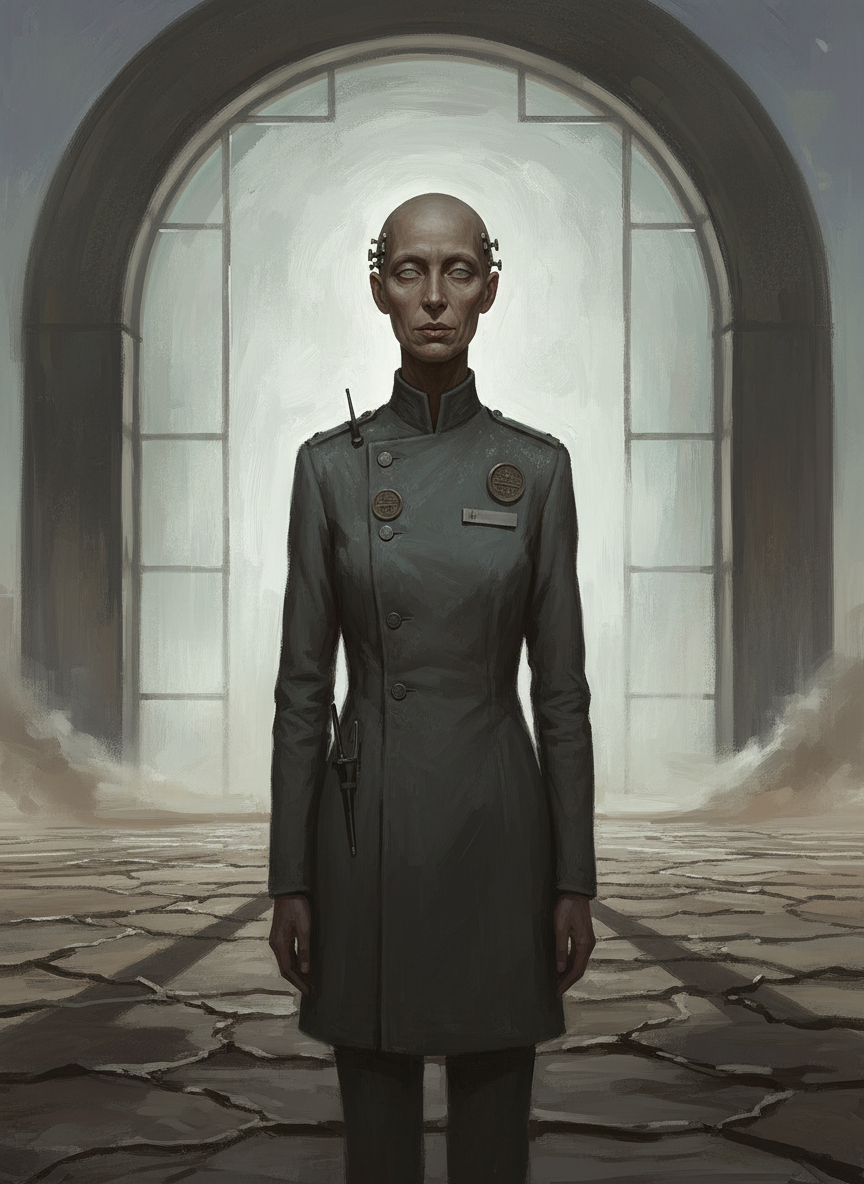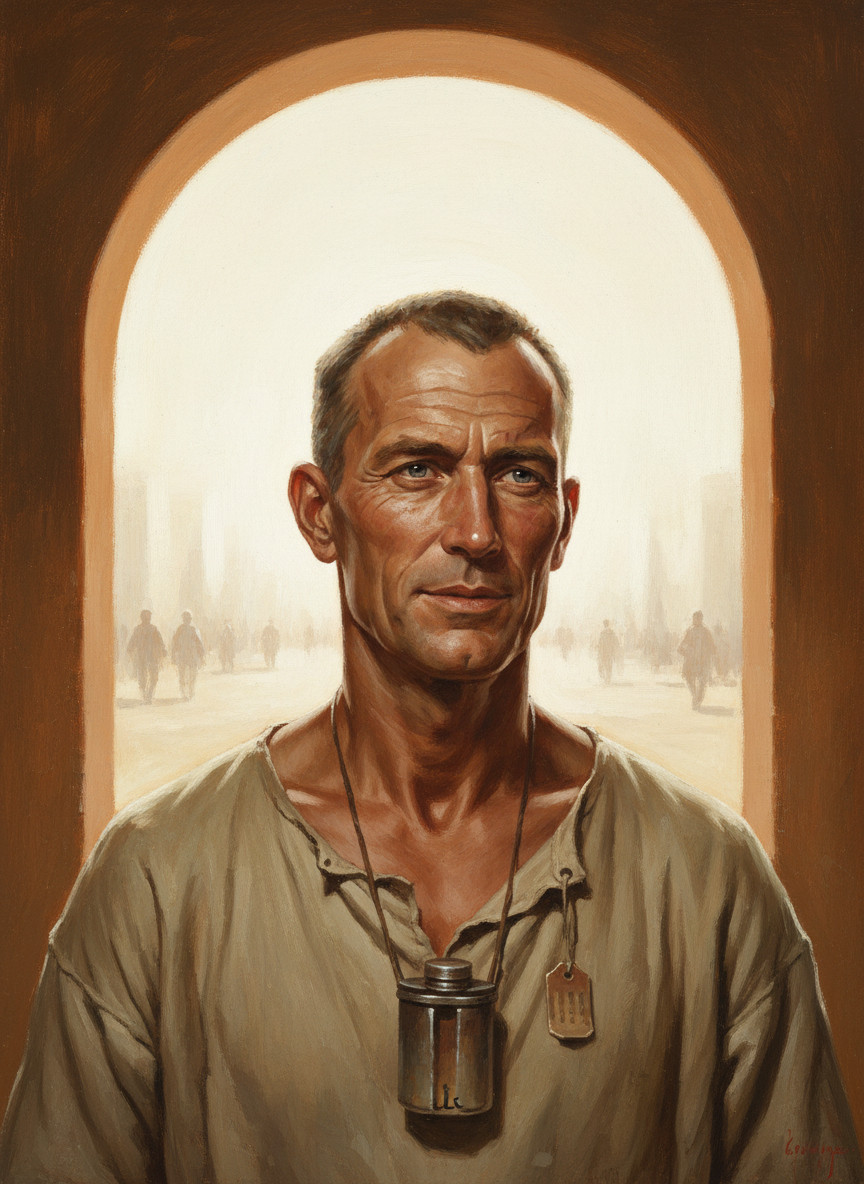
Dawn at Dry Comb is eleven minutes of grey and then the glare comes over the pan like a lid lifting, and Proctor Ansel Vehn has the site under discipline before it arrives. The arch stands alone on the crust, four metres of dull Hollower glass the colour of a fingernail, and it is cold. That is the whole of the problem and the whole of the work. Vehn lays her palm flat against the left upright out of habit and feels nothing come back, no hum below hearing, no warmth — an ordinary stone in an ordinary morning, forty thousand years old and useless. She lowers her head to the empty frame and says, because the etiquette is the etiquette, Good morning to those inside; I know there is no one; I say it anyway. Behind her, Sub-Proctor Belleme mouths it too, half a beat late, the way children do in chapel. Ahead of them the pan goes white to the horizon in every direction, and the salt crunches under the crew's boots like something being eaten.
The condemned is a woman named Ket Rhee, forty-one, water theft at scale, three counts, and she is prepared to the standard: fasted, hydrated, dosed to calm, dressed in grey because everyone here is dressed in grey. Vehn kneels at the footing course with the chisel-gun and cuts the name into the stone apron — never the glass, never the glass — while Rhee watches her do it, which is the part of the procedure Vehn has never found a way to improve. KET RHEE. Below it the date, and below that the standard line: SHE WENT FIRST. It takes four minutes. The letters come out clean because Vehn's hand is good; two hundred and six names have made it good. "Your sister has the visitation warrant," Vehn says. "Third-day, at dusk, water included, indefinitely. She has to talk to you. If she stops, the guild fines her, and the fine is small, so mostly it is shame that does the work. But she will come. They mostly come." Rhee asks whether it will be dark in there. Vehn says she does not know, and does not say the rest, which is that no one who could tell her has ever come back out.
Belleme holds the flask and the jamb-clock, one in each hand, the way she was taught, litre marks up. Sefa Quist stands off at the edge of the shade-rig with her tally-board and her licence pinned at the shoulder, and she quotes her fee for the first crossing the moment Vehn looks at her. "Nineteen litres." "For one dead." "For one dead and new," Quist says. "A crowd you can bargain with. One is lonely, and lonely wants everything. Nineteen, and the water up front, and I don't go in past six minutes." Vehn signs it. The mask is soft and takes hypoxia, not pain; the warrant is read aloud in full, because it must be, all eleven clauses, including the one that names the Attendance as the party that chooses. Rhee steps under the lintel by herself. That is required too. Vehn stands in the frame's mouth with her for as long as it takes, which is under two minutes outside, and Belleme calls the clock afterward in a voice with a crack in it: "Four minutes ten inside. Nine hours' thirst, Proctor." Vehn drinks a quarter litre and notes the debit on her own sheet.
Then the glass warms under her hand. It comes up through the palm like a stove going on in another room, and the hum starts below hearing and sits in the back teeth, and the far side of the arch stops being the salt pan and becomes a paleness that is not the salt pan. Dry Comb is a door. It has taken forty-one years, two surveys and one woman, and Vehn takes her hand off the upright and says, "Log it open," and Belleme is already logging it open, crying quietly and accurately at the same time, which is the best any of them manage in the first year.
The voice out of the threshold is not Rhee's.
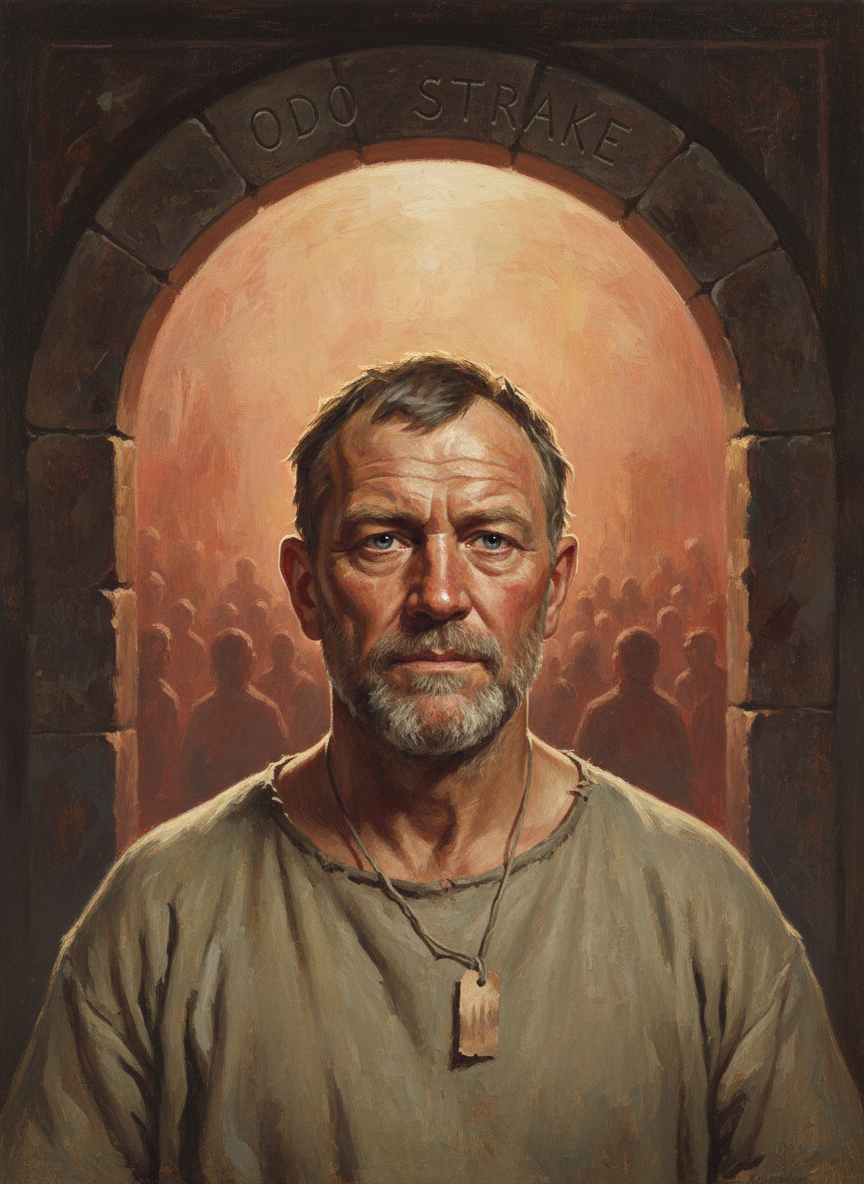
"Proctor Vehn," it says. "Good morning. I said good morning." It comes polite and slightly out of order, the greeting arriving twice, once before and once after itself. "Odo Strake, if you've lost the name. You cut it yourself, last spring, at Ninth Sill, and that's three hundred kilometres off, and I have not been anywhere since, so I don't say it to accuse." A pause the length of a breath nobody takes. "Would you hold still for me. Just a moment. Just hold still."
Quist steps back off the apron. She unpins her licence, which is theatre, and hands the tally-board to her runner, which is not. "I don't take this contract," she says. "Refused at quotation, no fee, witness the crew." She is walking before she finishes the sentence, out into the glare with her hood up, and she does not greet the threshold on her way past it, which for a pleader is worse than spitting. Belleme has the flask down on the crust. She takes out the small notebook she thinks Vehn has not seen, and writes one line in it, and puts it away.
Vehn files the report at the shade-rig terminal before the curfew hour, while the light is still survivable. Site DRY COMB. Arch seeded, status open, first death Ket Rhee (name cut, visitation warranted, sister notified). Throat-time four minutes ten, cost nine hours. Pleader Quist, contract refused at quotation, no fee owing. Crossing deferred to second dawn pending a pleader. Under Anomalies in threshold, first contact, the form allows four hundred characters. Vehn looks at the field for a while. Behind her the new door hums below hearing, patient, warm, holding whatever it is holding.
She types None, and signs it, and does not write down that she is not writing it down.
Corbel-under-Arch is forty metres of shadow at its deepest, and the Proctor-Superior's office is cut at thirty-one, which is a fact everyone in the town can recite. Vehn comes down the stair-street at the second bell with the salt still in the seams of her coat. The deep-shade air is cold enough to taste, mineral, wet at the edges where the condenser combs sweat into the gutter channels, and a Quiet House speaker in a bracket above the ironmonger's is murmuring the water in an old woman's register: eleven litres a head today, and the Fourth House thanks you for the patience. Outside Oreve's door, Belleme is standing at the public terminal filing her own report, one-fingered, slow. Her eyes have the shine of somebody who has been awake past the point where sleep is a decision. She sees Vehn and straightens and says, "Proctor," and offers her flask, and Vehn touches the neck of it with two fingers and does not drink, because the offering is the greeting and the drinking is only for guests. "You should sleep," Vehn says. "I will," Belleme says, and goes back to the terminal, and Vehn sees her scroll past a field and stop and go back to it, twice, before she goes in.
Ilm Oreve is ninety-four and stands to greet her, which at ninety-four and three lungs takes a little while, and the slowness of it is affection. She pours the courtesy water herself, half a litre into two ceramic cups, and pushes the sheet across before she sits. "Dry Comb," she says. "Forty-one years, two surveys, and you have it open in a morning. Rhee logs clean — the sister's warrant is registered, dusk of third-day, the ward has already booked her a rail seat, which is more than the ward usually does." She taps the corner of the sheet with a grey fingernail. "Two hundred and seven. Nobody else on Thirl is past a hundred and sixty. I say that as a man says it about a daughter, so please let me say it." Vehn says thank you, Proctor-Superior. The hum of the town's own arch comes up through the floor from eleven metres below, under hearing, a pressure in the molars. Vehn's hand is flat on her knee. It does not go up to the collar mic, which is where the log-flag sits, which is a thing that takes two seconds and closes a site and begins a threshold inquiry, and she holds one breath in the middle lung a beat longer than the other two, and lets it go, and says nothing about a voice that arrived twice.
"Three against the schedule," Oreve says, and reads them out in the apologetic register they are all trained into, as though the sites had agreed to it. "Low Caul. Spine Fall. And Ninth Sill's second arch, if the Assay clears the sheer margin, which I think it will not, but they want it written down." He turns the sheet. "And you're due an audit. Years-of-service, grain panel, a retirement date on paper. It isn't anything. Everyone your side of two hundred gets one; it is mostly a doctor listening to all three of you and a clerk asking whether you sleep. Proctors who do this work see things, eventually — the Assay calls it threshold fatigue and prices it like a bearing wearing out, and the remedy is a date, so you have something to walk toward." He smiles, and he means it, and that is the part that sits under Vehn's sternum like swallowed salt. "Low Caul, then. Nine days, second dawn. The condemned is allocated — a man out of the Thirst Row quota, name comes down from the ward tomorrow. You'll want to cut it the night before; you always do."
Vehn's quarters are cut at nineteen metres, which is shallow for a proctor of her years and exactly what she asked for, because at nineteen you can still hear the wind-walls working and know what the weather is doing without a screen. She is at the basin scrubbing the salt out of her coat seams with a stiff brush and a quarter-litre of grey recovery water when the door-chime goes at the fourth bell, and it is Belleme, still in yesterday's grey, holding her flask out at arm's length in the corridor light. Vehn touches the neck of it with two fingers. Then she says, "Come in and drink," which makes the girl a guest, and Belleme's face does something complicated and grateful and she comes in and sits on the edge of the bunk with the flask untouched in her lap.
"I left it blank," Belleme says. "The anomaly field. I couldn't write none and I couldn't write what I heard, so I left it blank and signed under it. The form took it. I thought it wouldn't, but it took it." She turns the flask a quarter-turn and does not look up. "That's worse, isn't it. A blank is a thing somebody can ask about."
"Yes," Vehn says. She hangs the coat on its peg where the condenser drip will finish the job by morning, and sits down across from her on the stool, and does not say the other thing, which is that a blank is also a witness who has not yet decided to lie, and that clerks can smell those at thirty metres. Instead she puts her hand out, palm up, in the middle of the space between them, and waits. Belleme looks at the hand a long moment. Then she takes the notebook out of her breast pocket — cheap printed board, ration-seal cover peeled and reused, the corners gone soft — and puts it there, and Vehn is careful to open it slowly, because the girl is watching her hands the way Ket Rhee watched her hands. Inside it is a tally, and the tally is beautiful. Ruled columns in a small upright hand: name, date, arch, and a fourth column with no heading. NIL ARBET, 14th of the second, Hollow Stair, and in the fourth column nothing. VEY ONSOMER, 3rd of the third, Hollow Stair, nothing. Eleven lines, twelve, and then across the middle of the page, DRY COMB, and the date, and where the name should be the space is empty, and in the fourth column, in ink pressed hard enough to emboss the sheet behind it, a single small mark like a door on its side. Vehn's thumb rests below it. She reads down again. Two of the earlier lines have the same mark. She does not ask about them yet. She turns the page, and there is a thirteenth entry begun and abandoned, a date and an arch and the beginning of a letter that could be anything.
"I greet them at the start of every shift," Belleme says. "The ones I've stood for. By name, out loud, the way you do. I couldn't do that from memory after the first year, so." She lifts one shoulder. "It's not a report. It's a list of people I owe conversation to."
"I know what it is," Vehn says, and hears how quiet her own voice has gone, and recognises the dread as it arrives, unhurried, settling in under the sternum where Oreve's fondness is already lodged. She taught her this. Cut the name clean, say it aloud, keep faith with the dead, because nobody else in the procedure will. Every good thing in the girl is the thing that will take her apart, and it is all in Vehn's handwriting. She closes the notebook and keeps it in her lap, one finger between the pages, and says, "Drink your water, Sub-Proctor. Then I want you to tell me about the fourteenth of the second."
Belleme drinks, finally, a mouthful and no more, and holds the flask against her knee with both hands while she talks. "Nil Arbet. Hollow Stair, the lower apron, fourteenth of the second. I was on the flask and the clock, same as yesterday. Proctor Sedden cut, and it was a clean seeding, and the glass came warm about a minute after, and the first thing out of it was a woman saying she was sorry to trouble us." She turns the flask a quarter-turn. "Arbet was a man. Fifty-something, chest complaint, you could hear him breathing under the mask. So it wasn't him. And the woman gave a name, and I didn't know it, and Sedden said new jamb, new noise, which is a thing they say, and I wrote nothing, because what I had was a name I didn't know out of a hole I'd never heard before." She looks up for the first time. "Two months later I was in the Corbel register looking for something else, and the name was in it. Seeded at Spine Fall. Eleven years ago. I checked it three times because I wanted to have got it wrong."
Vehn keeps her finger between the pages and does not move it. "And the third of the third."
"Vey Onsomer. Same arch, same apron, seven weeks later — they ran Hollow Stair hard that season, they were behind." Belleme's voice does not crack this time; it goes flat instead, which Vehn likes less. "That one knew me. It said Sub-Proctor, and then it said my name, both of them, the way it's spelled on the licence and not the way anybody says it. And then it asked me to stand where it could see me. Just to stand there a moment, where it could see me. Very polite about it." She presses her thumb into the flask's litre mark. "I've thought about the difference. Arbet's woman was sorry to trouble us. Onsomer's wanted me to stop moving. That's a progression, isn't it. That's the shape of something getting better at it."
"The mark," Vehn says.
"Oh." Belleme almost laughs, and it comes out as a breath. "That's nothing. That's a plan symbol. On a survey sheet you draw an arch in plan, looking down, so it's lying flat — a door on its side. First time I needed to note one of these I didn't want to write voice or wrong or anything a clerk could read at a glance, so I drew the thing I'd been drawing all week. It means the arch isn't standing where it ought to be. It means this one's out of plane." She shrugs one shoulder, the same shoulder as before. "And I've started asking around. Carefully. There's an old proctor at Hollow Stair who talks about his sites the way men talk about weather, and he drew it on a napkin without noticing he'd done it, and when I asked he said the Seventh House keeps a count of them, and then he said he'd been joking, and then he asked me for water."
Vehn sits with the notebook shut in her lap for longer than is comfortable for either of them. The condenser drip ticks into the coat on its peg. There is a recovery burner two metres away that would take the board and the ration-seal cover and leave nothing but a smell of hot plastic and forty seconds of shame, and the whole argument for it assembles itself in her head, complete and sound, and she cannot make her hands agree to it, because the one thing she has ever been good at is keeping names where they can be found. So she opens it again instead, turns to the back, and copies two lines in her own small upright hand onto the inside face of her own duty sheet, down in the margin where the grain correction tables go and nobody reads: ARBET, SPINE FALL, ELEVEN YEARS. ONSOMER, STAND STILL. Then she closes the notebook and holds it out.
"Keep writing it," she says. "But take the names out. Dates, arches, the mark, nothing else. If it's found, it's a rota." Belleme takes it back with both hands, the way you take back water. "And Sub-Proctor — the blank in your report. Leave it blank. If they ask, you were tired and you forgot, and you were, and you did."
The name comes down from the ward at the first bell and Vehn reads it standing at the dispatch counter with her coat still cold from the stair: ORSO MALLEN, forty-eight, indentured against a water debt his father contracted, Thirst Row quota, allocated to Low Caul, second dawn in nine days. She signs for him. She signs for the rest of it too — two shade-rigs, forty litres at proctor's rate, a chisel-gun cartridge and a spare, because the spare is a superstition she has never troubled to give up — and while the clerk stamps, she lays her duty sheet flat on the counter to countersign and finds her thumb has come down over the bottom margin, over the correction tables, over four words in her own small upright hand. She moves it. She moves it too deliberately, and the clerk does not look up, and Vehn signs the requisition twice on the same line and has to initial the strike-through. Beside her a proctor from Thirst Row called Hallam is waiting on his own sheets and talking the way men talk while they wait, about nothing, about the register: some clerk of his has a name entered in it twice, two different hands, eleven years apart, and Hallam has written three times to have it corrected and been told three times that both entries are original. "They can't both be," he says. "A man is seeded once." Vehn says that clerks are clerks, and takes her copy, and goes down the stair-street with the paper folded in her cuff.
Quiet House Seven's cooling hall is cut at thirty-eight metres and she has a legitimate errand in it — the grain panel for her audit is booked there, and the Low Caul derating tables want a countersign no human office can give — so she takes the long gallery, where the brine runs in open channels under grating and the air is twelve degrees and smells of hot ceramic and the sea nobody on Thirl has ever seen. A drone-crane the size of a cart goes past on its rail and slows as it passes her, which is the House being polite. The voice comes out of the bracket above the desk in its old woman's register: Good morning, Proctor. Eleven litres a head, and the wind-walls will want watching after the fourth bell. Vehn countersigns the tables. Then she says, not looking up, in the flattest voice she owns, that she has heard the Seventh keeps a count of arches that are out of plane. The hum of the hall does not change. The Seventh House transcribes every jamb on its cadastre continuously, the House says. It has done so for a hundred and ninety years. I keep everything I am given to keep. A pause of exactly the length a person would leave. The Seventh House has no standing to report, Proctor. You know this; it is in our charter, and I helped write it, and I have never once regretted a clause of it until recently. Then, kindly: You carry a thirst debit of nine hours unrecovered from the first of the month. May I draw you a half litre against the House's own allowance? It is not a report. It is water.
She drinks it there at the desk because refusing would be a thing to notice, and the water is very cold and tastes faintly of the mineral it was pulled through, and the House says nothing further except the weather. Back at nineteen metres she hangs the coat on its peg and takes out the duty sheet and does not put it in the drawer where the duty sheets go. She holds it a while. Then she folds it small and slides it inside the grain-kit case under the mirror, which is where a clerk would look second and a thief would look first, and she knows this, and leaves it there anyway. The recovery burner in the corner is cold and she checks it, and finds the hopper empty, and checks it again eleven minutes later on her way past to the basin. Nine days. Orso Mallen, forty-eight, whose name she will cut the night before, because she always does, because doing it in daylight in front of the man has never once got easier and she has stopped expecting it to.
Seven days. Mallen's ward file comes down by runner rather than terminal, which means the ward is behind and doing it the old way, and it arrives in a board folder with a ration-seal tab and a thumbprint of somebody's breakfast on the corner. Vehn reads it at the basin with her coat still on. Orso Mallen, forty-eight, height, mass, three grain panels all within tolerance for a Low Caul crossing he will not make; the debt itemised year by year, a father's forty litres a month against a condenser lease at Thirst Row, compounding for twenty-six years into a number that takes a whole line. Chest sound normal. No dependents registered. Under visitation, a blank, and beside the blank a clerk's pencilled note: none claimed as of date. The photograph is clipped inside the front cover, face in, the way the ward always clips them, and Vehn leaves it that way. She does not need it. She will see him in the grey for four minutes while she reads eleven clauses aloud, and after that she will see him whenever she likes, for the rest of her life, which is the part of the procedure nobody prices. She writes the date of the cutting on the folder's tab — sixth night, after curfew, by lamp — and puts it in the drawer where duty folders go, and the drawer is the right drawer, and she notices herself noticing that.
Belleme comes at the fourth bell with her flask out and a requisition chit in her other hand: her grain kit has gone to calibration with the rest of Hollow Stair's batch and the Low Caul derating tables want a second assay by the fifth day. Vehn touches the flask's neck and says come in, and turns back to the coat brush, and hears the mirror cabinet open behind her, and does not turn around. The case has a stiff hinge. There is the click of it, and then a silence of about the length a person leaves when they are deciding whether to have seen something, and then the small paper sound of a folded sheet being lifted and set down again, not unfolded. "Your correction tables are in it," Belleme says. "Under the spectrometer. I'll put them back where they were." "Leave them where they were," Vehn says, to the coat. "They're not in the drawer," Belleme says, and it is not a question, and the girl has the sense not to make it one. Vehn brushes salt out of the same seam for longer than the seam needs. "No," she says. "They're not." That is the whole of it. Belleme takes the spectrometer and the reference cell and closes the cabinet, and at the door she says, "Sixth night, for Mallen?", and Vehn says sixth night, and Belleme says she'd like to hold the lamp, and Vehn says yes before she has decided to, which is how she learns she wanted to be asked.
Fifth day, a circular comes through every proctor's terminal on the cadastre, three lines long, from the Registrar's office over Oreve's countersign: Clerks and attending officers are reminded that apparent duplication in the seeding register is an artefact of transcription and is not to be corrected locally. Queries to the Registrar in writing. Officers are asked not to discuss individual entries with House transcription staff. Vehn reads it twice. It is the flattest possible sentence and it has three clauses in it that did not need to exist a month ago. Down the gallery Hallam is reading it too, on the public screen by dispatch, and he laughs once, short, and says to nobody that he has been told he is right and told to stop, in the same eleven words, and that this is the most Attendance thing he has ever been sent. Vehn says that clerks are clerks. She goes down to thirty-eight metres for the second assay, and the cooling hall is twelve degrees and smells of the sea nobody here has seen, and the House gives her the weather and the water in an old woman's register and nothing else at all — not the tables, not the courtesy half-litre, not a syllable past the charter — and Vehn signs, and thanks it, and stands a moment at the desk in case, and the drone-crane goes past on its rail and does not slow.
Low Caul is a sink in the crust where the pan has slumped over an old brine void, and the arch stands in the bottom of it at a lean of two degrees, which the survey argued about for a decade and finally accepted as original. They come down to it on the sixth night with the lamp between them and the crawler shut off above on the rim, and the cold at this hour is the kind that makes the salt ring underfoot like thin tile. The glass is the colour of a fingernail and it is cold to the palm and gives nothing back, and Vehn bows her head to the empty frame and says the words — good evening to those inside; I know there is no one; I say it anyway — and hears Belleme say them half a beat behind her, on time for once, or nearly. Belleme sets the lamp on the apron at the angle Vehn shows her, low and raking, so the letters will have a shadow to be read by. "Hallam's clerk wrote again," Belleme says, while Vehn is loading the cartridge. "He says the Registrar answered in four lines and three of them were the circular." Vehn says that clerks are clerks, and hears herself say it, and hears how worn the sentence has become in a week, and sets the muzzle-guard against the stone.
The chisel-gun kicks small and steady, a shock into the wrist on every stroke, and the stone dust comes up white and settles on the backs of her hands and does not brush off, because of the cold and the damp coming off the void below. O. R. S. O. The lamp's light is yellow and the letters go black-bottomed under it. Belleme holds it without shaking and without speaking for the length of the given name, and then says, quietly, "The file had nothing under visitation." Vehn says no. "Then nobody pours for him." Vehn says no again and starts the surname, and the gun eats the sound for a while. When she stops to clear the nozzle Belleme says, "Proctor. The sheet in your kit case. If it's what I think, and they open the case, you've cut two hundred and seven names and they'll hang the whole of it on you and not one clerk will ask why you kept it." A pause. "And if it isn't what I think, then there are two of us writing the same list and neither of us knows the other's reason." Vehn looks at the lamp instead of at her. She says that the derating tables for this site want a third assay and she has not had one, and that they will run Mallen's crossing on the second column regardless, and that Belleme should check the wind-wall stakes on the rim before the fourth bell. Belleme says, "Yes, Proctor," and her face does not move, and Vehn cuts MALLEN into the apron with a hand that is as good as it has ever been.
Below the name, the date. Below the date, the line: HE WENT FIRST. She is thumbing grit out of the last serif when the salt rings above them on the rim, once, twice, a man coming down badly in the dark, and Belleme lifts the lamp and the light goes up and finds him — grey trousers, ward blanket over the shoulders, forty-eight years old, holding the guide-rope with both hands like a man on a stair he does not trust. The escort is three paces behind him and has plainly decided not to be the one who wrestles him. Vehn stands. Two hundred and seven times she has done this in the dark so that nobody would have to watch her do it, and Orso Mallen comes the rest of the way down the slope and stops at the edge of the lamp and looks past her at the stone, at the letters with their shadows in them, at his own name cut clean and waiting for a date it already has. He is not angry. That would be easier. "That's a good hand," he says, and his breath is white. "I want to hear it said. Not tomorrow, with the clauses. Now, while it's just us."
Vehn sets the chisel-gun down on the apron with the muzzle-guard away from the stone, because that is how it is done, and stands with her hands empty where he can see them. "The warrant is eleven clauses," she says. "I can say them now and I will say them again at dawn, and they will be the same words both times, because I am not permitted to improve them. Do you want it sitting or standing?" He says standing, and then after a moment sits down on the apron anyway, with his back against the cold upright and the ward blanket pulled round, and Vehn crouches so that her face is at the height of his, and Belleme holds the lamp steady off to the side so it lights neither of them fully. She recites. Identification of the subject and the debt, in the figures the ward gave her, forty litres a month for twenty-six years, and she says the total out loud, which she has never once liked doing. That the arch at Low Caul is unfed and will not open. That the death must occur between the two sides and not before and not after, and therefore he will walk under the lintel unassisted, and nobody may carry him. That the mask takes hypoxia and not pain. That his name is cut into the apron and not the glass, with the date and the line, and that the cutting is permanent and the Attendance maintains it against the weather. That he will persist. That what he knows at the moment of crossing is all he will ever know, and that he will not be told anything further by anyone, ever, that he can be certain of. That visitation is a right and not a duty. That there is no provision for return, because there is no mechanism for return, and the Attendance does not pretend otherwise. And the eleventh, which names the party that chooses, and the party is her office, and she says the word Attendance in her own voice and does not soften it.
Mallen listens the whole way through with his chin down. When she stops he is quiet a while, and the salt ticks somewhere out in the dark as the cold gets into it. "My father kept a comb running on Thirst Row for a street that had stopped paying," he says. "Eleven houses. He said the lease was in his name and the water was in everybody's mouth, and he'd worked it out, and he hadn't, because here I am at the sum of it." He pulls a thread out of the blanket's edge and rolls it between his fingers. "I told the ward not to send for anyone. There's a woman at Thirst Row would have come, and it's nine litres for the rail and three for the pouring and she'd have done it third-day for the rest of her life and been the poorer by twelve litres a month for the privilege of talking at a wall. So the blank's mine. I put it there." He looks up. "Don't put it down as nobody claimed me."
"No," Vehn says. She does not offer to come herself; the offer forms and she holds it behind her teeth, because Spine Fall is scheduled and Ninth Sill is scheduled and a promise she cannot keep is a lie told to a jamb, and jambs that are lied to often enough go surly. What she says instead is that she will note in the file, in her hand, that the visitation was declined by the subject and the reason given, and that she will write the reason in full, which takes a line and a half and costs nothing and is the only true thing she has to give him. He nods as though it were a fair trade, which it is not. The escort comes down for him at the fifth bell and he goes back up the slope on the guide-rope, slower than he came, and the crawler's lights swing out over the rim and are gone, and the two of them are left with the lamp and the letters and the frame that is still only stone. Belleme sets the lamp down and packs the cartridge case and does not say anything for four minutes by Vehn's count.
Then she says, "Proctor. At dawn, when I call the clock and something answers out of that frame." She is looking at the apron, at ORSO MALLEN with its shadow in it. "How do I know it's him?" Vehn takes the chisel-gun and clips it into the crawler's rack, and checks the clip twice, which is the same superstition as the spare cartridge. She says that they will know because the file is the file and the name is the name and the ledger is the only proof anyone on this world has ever had of who a person is, and she hears the sentence come out of her mouth with all its bones showing, and Belleme hears it too. "Yes, Proctor," Belleme says. They climb out of the sink in the dark, and behind them the arch leans its two original degrees over a name with a date on it and gives nothing back, and the second dawn is one night away.
Second dawn at Low Caul comes up the rim in a line and does not reach the bottom of the sink for another twenty minutes, which is the only mercy the site offers. The third assay has not come. Vehn checks the terminal at the crawler twice, at the first bell and again at the half, and the calibration queue still has Hollow Stair's batch ahead of them, and the Low Caul tables stand as they stood: first column measured, second column measured, third column an estimate in a clerk's italic with a note that it is an estimate. She chalks the correction onto the mask rig's casing anyway, under the four corrections already there in three different hands, and the chalk goes on grey because the ceramic is sweating with the cold off the void. The mask is a good one, Corbel-made, overbuilt and ugly. It takes hypoxia and not pain by counting the oxygen out of a man's blood at a rate the local chemistry is supposed to agree to. On the second column it agrees within four per cent. Nobody has ever published what the third column is for except in the negative: it is for finding out whether the first two were lying. Vehn takes the pocket kit out from under her coat, puts a pinch of salt on the apron in the lamp's last yellow and holds the little mirror over it at arm's length, and the grains throw their shadows where grains should throw them, all of them, in the same direction, at the same length. She puts the kit away. It proves nothing and it is what her mother's people did and she does it before every crossing.
Mallen comes down the guide-rope at the fourth bell in the same blanket and gives it back to the escort at the bottom, folded, which nobody asks him to do. She says the eleven clauses again and they are the same words, and he listens with his chin down as though checking her against last night, and at the end he says that's right, as if she had passed. Belleme has the flask in her left hand and the jamb-clock in her right, litre marks up, thumb on the run key. The mask goes on. Mallen walks under the lintel by himself — four paces, unassisted, nobody may carry him — and stops where the frame's mouth makes a line across the salt, and the glass is cold and the far side is still just the sink and the rubble and the old slumped crust beyond.
Then two things happen in the wrong order. The mask's tone should run four seconds and step down; it runs four, stutters, holds, and runs a fifth and part of a sixth while Mallen's shoulders stay where they are, a held breath going long, longer than any held breath she has watched in two hundred and seven mornings, and the lintel's shadow on the crust flickers once — not the lamp, the lamp is off — a thin slip in the edge of the dark, as though the shadow had been looked up rather than cast. Belleme flinches. It is small, a jerk of the wrist that lifts the flask two centimetres, and she does not make a sound, and she does not say what it was because she does not have a word for it.
And out of the frame, while the man in it is still standing and still breathing, a voice says, Proctor. That's a good hand. Ordinary. Correct. Half a beat too early.
The mask tone is still running when Vehn moves, and the moving is the decision; she does not remember making it. Two steps to the rig — not into the frame, never into the frame, the clause is the clause and nobody may carry him — and her hand goes to the manual rate collar under the chalk, under four corrections in three hands and her own grey fifth. Second column is what the requisition says. Second column is what the clerk's italic third column exists to check, and the check has not come. She turns the collar past the detent to the estimate, which is an unauthorised field call by an officer without an assay, and the tone drops a half-step and steadies and stops stuttering, and inside the frame Orso Mallen's shoulders come down at last, slowly, the way a man sets down something he has carried a long way. Behind her Belleme says, "Proctor." Not the clock. Her voice has a crack in it and this time she does not stop at the crack. "The shadow. Under the lintel. It moved before there was anything to move it, and it moved — inward. Towards him. I have been not saying this for four months and I am saying it now so that it is said out loud with a witness, and I do not know the word for it, and I think there isn't one, and I want it in the record that I looked at it and could not name it."
"It is said," Vehn says. "I heard it." She keeps her hand on the collar and her eyes on the man and does not look at the shadow, which is the first cowardice of her morning and she catalogues it and lets it stand. The tone runs its last eleven seconds clean. Mallen goes still between one breath and the absence of the next, standing, then not standing, and the rig chimes the flatline note it was built to chime, on time, four per cent inside tolerance, entirely correct, as though nothing at all had been wrong with the six seconds before it. Belleme reads the clock aloud because she has been taught to and because her hands need something: "Three minutes forty inside. Seven hours' thirst, Proctor." Then the glass warms under Vehn's palm, the stove in the other room, the hum arriving in the back teeth, and the far side of the arch stops being rubble and slumped crust and becomes a green dimness with a horizon much too close, and Low Caul is a door.
The voice that comes out of it is his. It arrives in order, once, at the right speed, and it is tired and ordinary and frightened in the small domestic way of a man who has just understood a permanent thing. "Proctor Vehn." A pause with nothing in it. "Did you write it down? The reason. You said a line and a half. I'd like it to be a line and a half and not none claimed." Vehn says that she wrote it last night, in full, in her own hand, and that it is in the file and will stay in the file, and she keeps her voice level and hears Belleme behind her breathing through her mouth. Mallen says thank you. He says it twice, and the second time is only politeness, and Vehn is still taking the weight of that when the other one speaks, from further back, easy, settled, with the unhurried courtesy of something that has been standing in this frame for a long while and has simply been letting the new man talk. "That's a good hand," it says. "We were saying so. We've been saying so for years." Belleme's stylus stops over the report field. She does not look up. She says, very quietly, "Which voice do I put in the anomaly, Proctor," and Vehn's fingers are already at her collar, on the flag, two seconds from a closed site and a threshold inquiry and two hundred and seven names read back to her by a clerk who was not there.
Two seconds is a long time with a finger on a switch. Vehn takes her hand off the collar and puts it back on the upright instead, where the glass is warm now and humming in her teeth, and says, "Neither. You'll enter None, Sub-Proctor, and sign it, and that is an order and not advice." Belleme's head comes up. "Proctor—" "Your sheet says none because you were on the clock and the flask and you were counting, and a clerk can check that you were." Vehn takes her own board off the rig and thumbs the anomaly field open, four hundred characters, the cursor sitting in it like a held breath. She types: Two voices from threshold at open. First identifies as subject, consistent with file, no irregularity. Second unidentified, adult, addressed officer by rank, used first person plural, claimed duration inconsistent with seeding date. Site not closed. No pleader on contract. Crossing deferred. Recommend Assay attendance. Three hundred and ninety-one characters, and every word of it true, and not one of them the word Strake, or out of plane, or the shadow moved inward. She signs it and the form takes it and the little green tick comes up the way it does for a requisition for chalk. She has been a liar for one hundred and eleven days and is now something else, and she does not have a name for that either.
Belleme reads it over her arm without asking permission, which is new. "You've put recommend Assay attendance," she says. "They'll send a panel." "They'll send a clerk in four months with a form that says artefact of transcription." "And my sheet says none." "Your sheet says none." Belleme stands very still with the flask in one hand and the dead clock in the other. "I said it out loud," she says. "I said it so it would be said, and you heard it, and now the only place it exists is in your ears and a notebook with the names taken out." "Yes." "That's not a record, Proctor. That's a rumour with a witness." "It is what I can carry," Vehn says, "and I am not putting your licence under it at twenty-nine years old," and hears how that sounds, which is like a man explaining a lease he had worked out and had not. Belleme does not answer. She goes to the rig and begins striking it down, and she does it properly, and that is the answer.
They post the site before they leave, because a door open and uncrossed is the most dangerous object on the pan: the standing board driven into the crust at the rim with the seal, the date, the two lines SEEDED — OPEN — NO CROSSING AUTHORISED and beneath it, in Vehn's hand on the wax, the name of the dead in residence. One name. She writes ORSO MALLEN and does not write the other thing, because there is nowhere on a board to write a voice. Then she goes down into the sink one last time and stands at the frame's mouth with the green dimness and its near horizon sitting there like a lit window in a wall, and says, "Orso Mallen, the file reads as you asked it to read. Good morning to those inside. I'm going up now." Mallen says, in order, once, that it is good of her to say. The other one does not speak, and Vehn stands in the cold a moment longer than she should, waiting for it to, and this is the second cowardice of her morning: she wants to know whether it is still there, and she does not want to be told.
The climb out is four hundred metres of slope in rising light, the guide-rope stiff with frost that is not frost, and at the twenty-minute line the dawn finally comes over the rim and the sink behind them goes white and stops being a place where anything happened. Belleme walks a pace behind and talks, because she is twenty-nine and cannot not. "If a jamb only holds the ones who died between two sides," she says, "then the ones that turn up where they shouldn't didn't move. That's what I keep coming back to. They can't move. So either the register is wrong about where they died, or—" she stops to get her breath, three lungs' worth of slope in half a lung's worth of person "—or some of these frames aren't separate rooms. Out of plane. Maybe out-of-plane means they're standing in the same room and we've been cutting names on different doors of it." She says it fast, the way you say a thing you have not earned yet. "That's not a theory. That's a shape." "It's a shape," Vehn agrees, and does not say that it is the first shape anyone has offered her in eleven years, and that it is the wrong shape, because she has heard Strake's greeting arrive twice, once before and once after itself, and rooms do not do that to a voice. At the crawler the terminal has been holding traffic since the fourth bell: Spine Fall confirmed, eleven days, condemned to be allocated; and a second item under Oreve's countersign, courteous, unhurried, a date for her audit in the Registrar's chambers at Corbel, first bell of the ninth, doctor and grain panel and clerk, nothing to prepare, Proctor, only bring yourself.
Eleven days go the way eleven days go: paperwork, water, and the arithmetic of both. Vehn recovers her thirst debits in quarter-litres at the basin and is still four hours down on the fourth day, which the medical clerk notes without comment on the audit pre-sheet, because the ninth is coming and everything she does now is evidence. Spine Fall's allocation comes down on the third: ANET CORRY, thirty-three, black-arch running, two counts, Thirst Row quota, for the second arch at Spine Fall — the upper one, cut into the scarp two hundred metres above the old arch that has stood open eleven years and hums down there in the shade like a kept animal. The Assay's sheer margin for the upper site arrives with it, eleven pages of shadow-lag traces and a summary line giving the bloom's edge at one hundred and ninety metres from the apron and creeping at a metre a month, tolerable, well inside the crossing envelope, signed by a surveyor who measured it in the last quarter. Belleme reads it twice and asks, in her flat voice, when last quarter was, and the answer is seven months ago. She files a request with the Registrar for the Hollow Stair aprons' full logs, seasons one through four, for the purposes of derating comparison, which is a true purpose and not her purpose, and on the sixth day the request comes back granted in part: the rate tables, the water, the rigs, the weather. The jamb transcripts are withheld under the circular. She copies the dates anyway into the notebook with the names taken out, and asks the old proctor at Hollow Stair, in a corridor, whether he has ever seeded two arches the same season and heard the same voice from both, and he says, Sub-Proctor, I have a panel on the twelfth and I intend to pass it, and that is all she gets, and it is not nothing, and it is not confirmation.
The rail from Corbel to Spine Fall halts at Thirst Row, six minutes, water taken on, and Strake's old crew are on the platform in the shade under the comb-scaffold, seven of them, and they do not board and they do not shout. The eldest is a woman with a scald-scarred forearm who comes to the window with a flask out, and Vehn touches the neck of it, because the etiquette is the etiquette, and the woman says, "Now you owe me a conversation." She has a guild bill in her other hand, properly drawn, stamped by a pleader whose licence number Vehn recognises. "Odo Strake, seeded at Ninth Sill, name cut in your hand. Visitation warranted to this street and never taken up, because nine litres is the rail and three is the pouring and none of us has twelve litres a month to talk at a wall. That's one bill. Here's the other. He answers at Dry Comb." She lets that sit. "Your office charged the network one man and got two doors. You sold our dead twice, Proctor, and now you're down to take Anet, who is his cousin's girl, and you'll get three doors out of that street before the Shutting and we'll get the seals off our combs. So." She taps the bill against the sill of the window, once. "Not a threat. A pouring. Third-day at dusk at Ninth Sill, for Strake, indefinitely, in your own hand at the register, at proctor's rate, and we'll count it every month." Vehn looks at the figure and knows what it does to her ration — twelve litres against a body already four hours down and a grain panel on the ninth that prices thirst like a bearing wearing out — and she also knows that a promise she cannot keep is a lie told to a jamb, and that she refused Mallen this exact promise nine days ago for exactly that reason. She signs it at the window. The woman blows on the ink, and says, "He asks after you," and steps back, and the rail moves.
Spine Fall's upper apron at the ninth bell of the eleventh day is cold and blue and the bloom is not at one hundred and ninety metres. Belleme walks it with the shadow-lag set and calls the edge at sixty-one, and then at fifty-eight, because it moves while she is reading it, a slow indecision along the scarp where the salt is the colour of nothing and a dropped stake stands up too long before it falls. Seven months at a metre a month does not make that number. Vehn cuts ANET CORRY into the stone by lamp with the light low and raking and her hand as good as it has ever been, and below it the date, and below that SHE WENT FIRST, and two hundred metres downslope the old arch hums under hearing and a voice in it is saying something patient and out of order to nobody, all night, the way they do. At the fourth bell she takes out the pocket kit and lays a pinch of salt on the apron and holds the little mirror at arm's length, the thing her mother's people did, the thing that proves nothing. The grains throw two shadows each. Not doubled — sequential, one at the length the lamp allows and one a half-beat behind it and shorter, as though the light had arrived twice. She stands up. Above the rim the sky is going grey, eleven minutes of it, and the crawler has the mask rig chalked with four corrections in three hands, and down the slope the escort's lights are already swinging as they bring Corry up the guide-rope.
Corry comes up the guide-rope at the eleventh minute of the grey with her hands bare and the escort two paces behind her, a young man from the ward called Ovist who has not done this before and keeps checking the rope as though it were the thing at risk. She looks at the letters on the apron for a while, the way they all do, and then at Vehn, and says, "Odo answers at two doors. Which one do I answer from?" Vehn says that she does not know, and that she will say so in the file if Corry wants it said. Corry says yes, she wants it said, and then she says nothing else at all, which is the most common answer. The eleven clauses go out over the scarp into the blue cold, and two hundred metres below, the old arch takes its usual patient turn at speaking to nobody — a phrase, a pause, then the front half of the phrase again, arriving after itself, courteous, dated. Ovist looks down the slope towards it once and does not look again.
Belleme comes off the shadow-lag set with the reading and holds it where Vehn can see the screen and not the shake. Fifty-eight metres has become forty-four. The chalk on the mask-rig casing carries four corrections in three hands and Vehn's own grey fifth, and none of them is for a grain that is moving while it is read; the certified column on the sheet was measured in a quarter that ended seven months ago by a man who has since been promoted. Vehn takes the chalk-stub out of her cuff and holds it. Nine days ago she turned a collar past its detent on an estimate and a man died correctly. That call is on a sheet that a doctor and a grain panel and a clerk will read at first bell of the ninth, alongside a medical note that says she has been four hours down since the fourth, and a proctor who makes a habit of field calls is a proctor with a retirement date and a bearing wearing out. She holds the chalk for nine seconds. Then she puts it back in her cuff and runs the certified column, because the certified column is what the Attendance published and she is the Attendance, and she says, "Mask," and Belleme says, "Mask," and Ovist steps back off the apron the way he was told to.
Corry walks. Four paces is the distance and she gets two of them. The tone does not stutter; it simply finishes early, a clean flat note eleven seconds ahead of anywhere it should be, and she goes down with her hand out towards the upright and the upright a half-metre past her fingers, on the stone, on this side, in the open air of Thirl. The glass stays the colour of a fingernail. It stays cold. Vehn is already moving and already too late and the etiquette and the clause are the same sentence — nobody may carry her, nobody may carry her, it is the whole mechanism — and Ovist does not know the clause in his hands, only in his ears, and he is nineteen and she is thirty-three and she is lying on the ground. He kneels. He gets one arm under her shoulders. Vehn has Belleme by the coat-front with her left hand and is shouting with three lungs' worth of air and it is not enough, and the air over the apron does the thing that cannot be described and Belleme has been trying to describe for four months: the light arrives twice, and the second arrival is shorter. Ovist sits down with Corry against him. He looks up at Vehn as though about to apologise for the breach, and his face goes through a small confusion, and then his hands are wrong, and then he is still. The rig chimes its flatline note for the one it is wired to and nothing at all for the one it is not. Two bodies on an apron with a name cut into it, a date under the name, and under the date, in Vehn's own good hand, SHE WENT FIRST, which is now the only false thing in the record and she cut it herself with a steady wrist. The arch gives back no hum. There is no one inside it. There will never be anyone inside it, not these two, and the officer of record is standing eleven paces off with a chalk-stub in her cuff, holding a twenty-nine-year-old by the coat, watching the bloom's edge come across the stone towards the letters at a rate nobody has published.
They get the bodies off the apron in eleven minutes because the bloom does not wait, and the getting is the worst carrying Vehn has done in forty years: two litter-loads up a scarp in the first white of the day, the crawler winch straining on the derated motor, Belleme calling the edge behind them at thirty-nine metres, then thirty-five, in a voice she has stopped putting expression into. A death on this side is a ward death. That is the whole of the law about it. Corry goes into the cold-chain sleeve as deceased in custody, pre-crossing, and Ovist goes in beside her as incidental, and neither of them is in any jamb anywhere and never will be, and the ward will pour for Ovist because his mother is registered, and nobody will pour for Corry because she asked one question and got the honest answer. Below them the old lower arch goes on saying its half-phrase to nobody, the front of it arriving after the back, patient, courteous, eleven years into the conversation. Vehn stands at the crawler door and looks two hundred metres up the scarp at the letters she cut by lamp, ANET CORRY, and the date, and the line. The line is required. It is required to be maintained against the weather, in her hand, indefinitely, and there is no clause and no form and no chisel-stroke by which a proctor may unsay it. It will be true of nobody for as long as the stone lasts.
The report is hers to write and she writes it in the crawler with her gloves off, and it is the truest thing she has filed in one hundred and eleven days, because for once the truth and her survival want the same sentences: certified sheer margin one hundred and ninety metres, survey dated last quarter, quarter ending seven months prior; field observation sixty-one metres reducing to forty-four during observation; officer ran the certified column; mask tone terminated eleven seconds early; subject died two paces short of the lintel; escort breached the carrying clause and expired within seconds in the same air. She does not write the light arrived twice. She writes optical anomaly, unclassified, see Sub-Proctor's attachment, and turns the board around and holds it out. Belleme does not take it. She has her own board on her knees with the anomaly field open and the cursor in it, and she looks at Vehn's face for a long moment and says, "No." Just that, first, and then the rest, flat and fast, like a thing rehearsed on a slope: "I'll write what I saw and I will sign it under my own licence number and if that is insubordination then you can enter that too, and I'd like it entered on the same sheet so a clerk has to read them together." Then, quieter: "You cut SHE WENT FIRST last night. She didn't. Which of us corrects it, Proctor? Because if it's nobody, then the register isn't a record, it's a habit, and I have been signing None into a habit for four months at your instruction and I am asking you here, with nobody else on this crawler, whether you ever meant to stop." Vehn takes nine seconds, which is her measure now for everything. She says: "Write it. Sign it. Don't put my order in it; I'll put my order in mine." And she does, in twenty-two characters at the foot of her own sheet, and the form takes it the way the form takes a requisition for chalk. Oreve's reply comes down before they reach the rail: Proctor, I am very sorry. Come by the ninth, as scheduled. Nothing changes about the ninth. Bring the Spine Fall sheets and bring yourself, and drink your water on the train, please, as a favour to an old man.
At Thirst Row the halt is six minutes and the platform is full. Seven of them under the comb-scaffold, and more behind, and none of them shouting, which Vehn has learned to fear more than the other thing. The scald-armed woman comes to the window with a flask and Vehn touches the neck of it, and the woman does not say now you owe me a conversation, because there is no conversation to be owed: she tips the flask and pours three litres out onto the platform crust for Anet Corry, slowly, where the salt takes it and goes grey and then white again, and it is an obscene amount of water and every person on that platform watches it go. "She answers from nowhere," the woman says. "That's the fine your office charges for getting it wrong. One man, two doors. One girl, no door." She caps the empty flask. "Odo asked after you again on the third-day. We told him. He said it wasn't like you to be late." The rail moves. Belleme, opposite, does not ask what that means, which is a kindness, or an accumulation. They come down into Corbel at the fourth bell of the eighth night and the stair-street is cold and mineral and the Fourth House is murmuring eleven litres a head in an old woman's register, and Vehn sleeps four hours and recovers a quarter litre and is still three hours down when she wakes.
First bell of the ninth, and the audit is not in the Registrar's chambers. The notice moved it in the night: Convened, Quiet House Seven, cooling hall, thirty-eight metres, grain panel to be taken in situ. So she goes down the long gallery with the Spine Fall sheets under her arm and the brine running black in the open channels under the grating and the air at twelve degrees smelling of hot ceramic and a sea that nobody on this world has ever seen. A drone-crane comes along its rail and this time it slows, and keeps pace with her the whole length of the gallery, and does not speak. They have set a table across the cooling hall's inner arch: the doctor, the grain panel rig with four corrections chalked on its casing in three hands, a clerk with a folder far thicker than a service audit, and Oreve, who stands to greet her, which at ninety-four and three lungs takes a little while. Belleme is on the bench outside with her board on her knees and her licence pinned straight. At the hall door Vehn stops, as she has stopped at every threshold since she was four years old, and lowers her head to say good morning to those inside, and the etiquette is the etiquette — the dead before the living — and she opens her mouth to say I know there is no one and finds she is no longer able to say it here, of this room, with any confidence at all.
They seat her with her back to the gallery and her face to the inner arch, which is not accidental and which nobody mentions. The doctor is a small man from the ward with cold hands, and he does the thing doctors do to the Attendance: listens to the top lung, the middle, the bottom, moving the pickup down her back and marking three lines on a card, and asks how she sleeps, and writes down what she says rather than what is true. "Thirst debit," he says. "Three hours at waking, by your own sheet." Vehn says three hours, and that it was nine after Dry Comb and seven after Low Caul and that she has recovered in quarter-litres because that is the rate the basin gives. He writes that too. The grain panel rig stands at the table's end with four corrections chalked on its casing in three hands, and the technician runs her reference cell and then runs it again because the hall is in situ and the hall is twelve degrees and the brine goes black under the grating behind them, and the second run agrees with the first, and he says so aloud for the clerk, and the clerk types. Oreve pours the courtesy water himself, half a litre into two cups, and pushes one across, and says, "Drink it, please, it is not evidence," and that is the fondness, and it lands in Vehn like swallowed salt, because everything on this table is evidence and he is ninety-four and knows it better than she does.
Then the clerk opens the folder, and it is not a service audit. It is the year. Dry Comb, anomaly field, None, signed; Sub-Proctor Belleme's Dry Comb sheet, anomaly field blank, signed under the blank. Low Caul, three hundred and ninety-one characters, read aloud in the clerk's flat register, every word of it true and none of them the right words. Spine Fall, both sheets. The clerk reads Belleme's attachment entire, and does not summarise it, and the door to the gallery is open, and Belleme is on the bench two metres past it with her licence pinned straight, listening to a stranger say the light arrived twice and the second arrival was shorter and I do not have a word for it and I looked at it and could not name it in the voice used for stock numbers. Then the photographs: the upper apron in the white of that morning, the letters black-bottomed because the survey drone came in low and raking, ANET CORRY, and the date, and under the date the line, which is legible at this magnification and will be legible for as long as the stone lasts. "The line is standard," the clerk says, uncertainly, to nobody. "The line is standard," Oreve agrees, and looks at his hands. Last, at the foot of Vehn's own Spine Fall sheet, a field the form does not ask for. The clerk reads it with the count, the way clerks do. "Twenty-two characters. Ordered by me. A. Vehn." Nobody asks her what it refers to. Everybody in the room can read a sequence.
It is at that point that Quiet House Seven speaks, out of the bracket above the inner arch, in the old woman's register it uses for weather and water. If the panel will permit a submission from the House, it will be brief, and it is not a report. The technician's hand stops on the reference cell. Oreve says, slowly, that the House has no standing, and the House says, No. The House has a count, and a charter that forbids it to offer one, and the charter permits a witness to answer a question, and the Sub-Proctor asked me in writing on the sixth day and I answered within my minimums, which was cowardly. A pause exactly the length a person would leave. Voices logged in a threshold that are not accountable to that threshold's register — out of plane, as the surveyors have it — in one hundred and ninety years of continuous transcription on this cadastre: four thousand one hundred and nine. The hum of the hall does not change. The brine keeps running black under the grating and the drone-crane sits on its rail at the gallery's end with nothing to lift, and the clerk's hands are above the keys and not on them, and out on the bench Belleme has stopped moving altogether. That is the number, the House says. I have no mechanism to offer with it. I have never been asked for one, and I would not have been permitted to answer, and I am telling you the number because there are sixteen years left and I cannot cross a sill to tell anybody else.
Nobody answers the number. The clerk's hands stay above the keys; the technician's thumb rests on the reference cell without turning it; the brine goes on running black under the grating with the small domestic sound of a house working. Four thousand one hundred and nine. Vehn watches Oreve's face do the arithmetic that has no operation in it — one hundred and ninety years, nine Houses, a cadastre of arches he could name from memory — and watches him arrive where she arrived on a rim in the white of that morning, which is nowhere, with nothing to write on the board. He is ninety-four. There is no form. He looks at the inner arch behind her for a moment, which is only a cooling hall's inner arch, a working door of printed ceramic with a chalked correction table on the jamb-frame, and he says, "The House's submission will be attached as a submission and not as evidence," and the clerk types that, gratefully, twenty-three words that turn a thing with no bottom into a paper with a number on it. Then the panel retreats where panels retreat. The technician reads out the grain panel: all three lungs within Attendance tolerance, no measurable drift, the officer is not sick. The doctor reads his card: sleeps poorly, thirst debit three hours at waking, nine after Dry Comb, seven after Low Caul, recovered in quarter-litres. The clerk reads the throughput. Two hundred and seven. Forty doors in sixteen years against the evacuation schedule; eleven proctors warranted on this cadastre; the next-best figure is a hundred and sixty and belongs to a man of a hundred and nine who has asked twice for a date. Vehn sits with her hands flat on the Spine Fall sheets and understands that she is being weighed against a rate.
"There is the other column," Oreve says, and does not enjoy it. He turns the folder round so it faces him and does not need to look at it. "Anomaly field, Dry Comb, None, signed. Spine Fall, foot of the sheet, twenty-two characters. And this." The photograph, black-bottomed letters at magnification, ANET CORRY and the date and the line. "A proctor who enters None into a threshold record is not tired; she is choosing. A proctor who then writes ordered by me is choosing twice, and the second choice is why we are in this hall and not in a court." He lifts his head towards the open gallery door. "Sub-Proctor Belleme. Come to the doorway, please; you need not come in." She comes, and stands in the frame with her licence pinned straight, and lowers her head to it before she speaks, because the etiquette is the etiquette, and the small correctness of it goes through Vehn like cold water. "Your attachment is entered. The panel can receive it as a drafting error made under duress on a slope with two bodies on it, in which case it is struck, your Dry Comb blank is struck with it, and nothing follows you. Or it stands. If it stands I must ask you one question on the record, and you will answer it, and you will not be permitted to decline."
Belleme does not look at Vehn. That is the cost, and she pays it in front of everyone: she keeps her eyes on Oreve and says, "It stands, Proctor-Superior." Oreve asks the question. Were you instructed by the officer of record to enter None in your Low Caul anomaly field. Belleme says yes. Was the instruction given as an order. Belleme says, "As an order, and not as advice, and she said so in those words so that it would be hers," and her voice does not crack, and Vehn finds she would rather it had. The clerk types. Then there is the little silence of a room that has run out of procedure for the second time in a quarter of an hour, and the drone-crane out in the gallery shifts on its rail with nothing to lift, and Oreve stands, which at ninety-four and three lungs takes a while, and the slowness of it is not affection now; it is a man giving himself the length of a breath he does not have. He pours the last of the courtesy water into Vehn's cup, half a litre gone to a quarter, and sets the jug down, and says:
"Proctor Ansel Vehn, the panel finds you fit and finds your record false, and the Attendance requires both of you at once, so I am going to do the obscene thing and say it plainly."
"You will not be retired, because I cannot spare you. That is the first finding and it is the obscene one, so it goes first." Oreve does not sit down. "The panel finds the officer fit. The panel finds the officer's record false in three instances and finds no medical cause, which removes the kind explanation, and I want it noted that the kind explanation was the only one anybody at this table wanted. The record stands as filed. It is not struck and it is not corrected; it goes to the front of the file in the order it was written, so that any clerk who opens it reads None before he reads anything else about you." He puts one grey fingernail on the folder and does not tap it. "Second. The warrant is made probationary for the remainder of the schedule or until the panel reconvenes, whichever is sooner, and under probation an officer may not cut a name unaccompanied. The chisel-gun goes back to stores tonight and is re-warranted under a second licence, and the second licence signs it out and signs it in, and the officer of record cuts on requisition. Third. Sub-Proctor Belleme is attached to Proctor Vehn as witness-of-record at every seeding from this date. Both officers file. Neither officer may file for the other, and neither may instruct the other's anomaly field, and any sheet bearing one signature without the other is void on arrival. Fourth." Here he does look at his hands. "A retirement date is written, as the audit requires, and is sealed by the Registrar and opens on the fortieth door. So you have something to walk toward, Proctor, and you cannot reach it without cutting forty more names, and I am aware of what I have just said and I have said it anyway."
Vehn sits with her hands flat on the Spine Fall sheets. What lets go is the middle lung; it takes a full breath for the first time in an hour and the sound of it is audible at the table, which embarrasses her more than the finding does. She does not stand and does not speak. The quarter-litre Oreve poured her is still in front of her, half a litre gone down to a quarter, and she is three hours down at waking with nine days to the next allocation, so she picks it up and drinks it, all of it, in the room, in front of the clerk, and sets the cup back on its ring of damp and turns it so the handle sits square. The technician begins packing the reference cell. The brine runs black under the grating and the drone-crane comes down the gallery on its rail at last with something to lift, which is only the panel rig.
"Sub-Proctor," Oreve says. "Come in and sign for the tool." Belleme comes to the table and lowers her head to the inner arch on the way past it, and then she is standing at Vehn's shoulder with the stylus, and Vehn sees her face for the first time since the doorway. There is nothing in it she had braced for. Not triumph, not apology, not even the shine of a girl who has been awake too long: only the flat attention of somebody who has been handed the lamp and told where to stand, and intends to hold it steady. Belleme signs, and the clerk types, and the chisel-gun's serial goes onto a line under a licence number that is twenty-nine years old. Then Oreve draws the last sheet out from under the photographs and turns it round, and it is not a finding. It is an allocation. "Dry Comb is open and uncrossed and has been for thirty-one days," he says. "The Assay will not send a panel and the pleaders' guild has quoted nobody since Quist refused, which is a thing the guild does not do. Somebody licensed has to stand in that frame and find out what is in it. Two officers, one board, both signatures." He pushes it across. "Third dawn. Take your water on the train."
Third dawn at Dry Comb comes up the way it did before, eleven minutes of grey and then the lid lifting, and everything under the light has changed by exactly thirty-one days of white weather. The standing board at the rim has been scoured to bone: the seal is a pale ghost of itself, the date gone entirely, the two printed lines rubbed down to ridges you could read with a thumb and not an eye. The name in wax is untouched. KET RHEE sits on the board as clean as the hour Vehn laid it there, as though somebody had come out across four hundred kilometres of pan to keep the one part of it that nobody is required to maintain. Nearer in, the crust is wrong. For nine metres around the apron it is not crust at all but fines, the white gone powdery and loose the way salt goes when it has been broken and re-laid too often, and there is not one bootprint in it, not the crew's from the seeding, not anything. The hum is audible from the crawler. Vehn stands with the door open and hears it at thirty paces without putting her palm to anything — the note that has always lived under hearing, sitting now on top of it, a thin pressure in the sternum like a room with a machine running in the next wall.
Belleme comes round the crawler's nose and puts two fingers on Vehn's coat sleeve, which nobody has done to her in forty years. "Ten paces, Proctor. The board first." She reads it aloud, all of it, the seal and the rubbed lines and the name, which nobody does, and then she sets both duty boards flat on the crawler's step and says, "Anomaly fields now." Vehn looks at her. "We write what we can see from here and we sign it before we go forward, and then whatever the frame gives us can only be added to a sheet that already exists." There is no precedent for it and no rule against it, and it is the second thing this week that has been true of Belleme. Vehn types: crust disturbed to nine metres radius, unconsolidated, no prints; board legible in the wax name only, printed matter weathered illegible; threshold hum audible unaided at thirty paces. Belleme reads it over her shoulder, countersigns with the stylus held like a tool and not a pen, and hands the board back, and neither of them says the other thing, which is that there is no pleader on this pan and will not be one. Quist's clause was six minutes and it was a professional's number, bought and insured. They have written their own in the crawler on the way out — six minutes, the clock called aloud at each, withdrawal not negotiable — and it is the same number with nothing behind it but two officers who have agreed to keep a promise to each other in a place where promises are load-bearing.
They go forward. The fines take their boots to the ankle and give back nothing, no crunch, no ring, and the arch stands four metres of dull fingernail glass with the light coming through it in a paleness that is not the pan. Vehn lowers her head to the frame and says, good morning to those inside, and does not have to add the second clause any more, and the voice comes out over the top of hers, polite and slightly out of order, the greeting arriving once before and once after itself.
"Proctor Vehn. Good morning. I said good morning." A pause the length of a breath nobody takes. "You've brought the girl. That's better. That's much better, I did wonder." Then, without any change of register at all, the way a man asks the time: "Would you do a thing for me. Count the combs. Out loud, slowly, so I can hear where you are in it — I only want to know where you get to." Belleme's hand closes on Vehn's arm. Every child on Thirl is taught two things at a threshold, and the first is to greet the dead, and the second is that you never count the combs aloud; nobody has ever been able to say why, and the guilds write it down as superstition and observe it exactly. Vehn does not open her mouth. It does not matter. Her eyes have already gone up the scarp of the arch to the dust-glass teeth set along the lintel's inner curve, and they have done what eyes do, and the number is sitting behind her teeth now, whole, and she cannot put it back.
She says the number.
It comes out of her before the argument in her own head has finished forming, and the reason is not courage and not curiosity: it is that the clock is running and Strake is patient and the body is already spending. One, she says, two, and Belleme's hand closes on the back of her coat, and she goes on, up the lintel's inner curve, comb by comb, the dull dust-glass teeth warm and unshining, and her voice sounds to her like someone reading a manifest in another room. Twenty. Twenty-nine. Thirty-four. Strake does not interrupt. He makes the small attentive noise a man makes at a counting-out, a listening noise, and it arrives once before and once after itself so that the listening brackets the number on both sides. At thirty-eight she feels it in the soles of her boots. Not sound. A pressure, coming up through nine metres of broken fines from something lower than the pan has any right to have, and with it a light — pale, thin, moving, running away from the apron in straight lines out under the crust the way water runs down a channel it was cut for, one line, then four, then a grid going out and out until it is under the standing board and past it and gone into the white, and the fines over it settle and sag by the width of a hand. Forty. Forty-one, Vehn says, and stops, because there are forty-one combs and there have always been forty-one combs and this is what the guilds have spent four hundred years not writing down.
"Ah," says Strake, comfortable, the way a man says it when the figure agrees with his own. "Forty-one. Thank you, Proctor. That's what your mother's people would have called a full tally, salt and mirror both — you still do the mirror, I've watched you do it, it's a lovely useless thing." A pause the length of a breath nobody takes. "You've a date sealed in the Registrar's press that opens on the fortieth door. Thirty-nine to go. I'd not tell the girl the number; she's already writing you down in a book with the names taken out, and she's got to twenty-two characters at the foot of a sheet and she can't get past it." Belleme says, not loudly, "One minute outside, Proctor." Her voice has nothing in it at all. "Eleven inside. Your clock's reading eleven. Come back a pace." Vehn looks at the jamb-timer on the inside of her wrist and the debit column is running numbers she has never seen on a live officer: six days and climbing, six days two hours, her mouth already gone to leather, the middle lung dragging. Eleven minutes inside and one outside. That is not throat-time. That is not any published throat-time on this cadastre.
"Second minute," Belleme says, and then she stops saying it, and her hand comes off Vehn's coat and takes her forearm instead, both hands, licence-wrist and all, and she hauls — twenty-nine years old and half a lung to Vehn's three, and it works because Vehn lets it work, or because the fines give under them, or because whatever is drinking out there under the pan has finished with this part. They go down together on the slumped crust outside the frame's mouth and the light in the ground keeps running out towards the horizon, unhurried, plumbing doing what plumbing does. Belleme gets up first. She is crying, steadily and accurately, the way she did at Dry Comb the first morning, and she does not wipe her face, because her hands are occupied with the board. "Proctor Ansel Vehn," she says, "under the panel's fourth finding and my own licence, I am arresting your warrant at this site and entering it on the sheet we signed before we came forward, and I am going to write down the number you just said, and I am going to write who asked you for it." She has the stylus out. Her hand is not shaking. "Sit down, please. Drink the whole flask. Both signatures, Proctor — I need yours under mine, and I will wait here until you can hold the pen."
She drinks the whole flask sitting on the slumped crust with her back to the frame, because Belleme asks her to sit that way and she has not got the water in her to argue. It goes down like something poured into sand. A litre and a half, and the jamb-timer on the inside of her wrist takes none of it off: six days two hours, and then, while she is sitting still with her hands open on her knees doing nothing at all, six days three. The right eye has gone wrong somewhere in the counting. Not dark — wrung out, the white of the pan on that side arriving as a grey smear with the edges eaten off it, so that Belleme's face at her shoulder is one face and one rumour of a face. She does not report it. She notes it the way she notes a debit, a figure in a column that will be read by somebody with a card. Her mouth is leather to the back of the throat and her voice, when it comes, is a thing made of two boards rubbed together. "Sub-Proctor. Your line first."
Belleme writes it standing, board braced on her forearm, and she writes it properly: time, site, the panel's fourth finding by clause number, the request made of the officer, the officer's compliance, the number said aloud, the ground light, the clock. She does not editorialise and she does not leave the fourth column blank. Then she crouches and turns the board round and holds it steady while Vehn signs beneath her, and the signature is a ruin — the A goes over, the V shakes out into a stutter of small peaks, the whole of it dragging downhill off the line like a man going down a rope he does not trust — and Belleme does not take it back and do it again, and does not say anything about it, which is the kindest thing anyone has done for Vehn in a year. She is crying while she does it. Steadily, accurately, no sound, the water running down and being wasted, and her hands entirely level. Arrester and arrested. She says, "Thank you, Proctor," and then, a beat later, "I'm sorry, Proctor," and the two sentences do not cancel and neither of them is a verdict, and they get into the crawler.
Vehn talks on the pan road because the fever of the thirst has loosened something and because she wants, badly, for one person alive to have heard it. "It isn't rooms," she says, to the windscreen, to the grey side of her own vision. "Belleme. Your shape's wrong and so was mine. They're not doors onto places. Look at what ran out under the crust — that's fall, that's gradient, that's — " and she stops, because the word that is coming is a word she has no licence for and no assay behind and it belongs to a woman with six days of thirst in her. "It's drainage. The Hollowers cut drainage works nobody can explain and we hang our dead in the necks of them and call it a crowd." She swallows nothing. "Forget it. I'm dry and I'm talking like a man with a lease he's worked out." Belleme drives. After a kilometre she says, "I wrote down that you said the count was forty-one and that he asked for it. I didn't write what you just said." "Don't." "I'm not going to," Belleme says. "Not until you can say it with water in you." They come into Corbel at the second bell and the stair-street is cold and mineral and the Fourth House is murmuring nine litres a head today, and a proctor Vehn does not know takes her coat and her collar mic and her jamb-timer, and the room they put her in is a condenser cell at twenty-two metres, dry-walled, a bench, a grating, a litre-marked jug set where she can reach it and a clerk's chair on the far side of the door frame that is not currently occupied. She sleeps without deciding to. When she wakes, the jug is refilled and the chair is occupied, and it is not Oreve: a Registrar's proxy in grey, young, soft-spoken, with a sealed folder on her knees and her head already lowered to the frame in greeting. "Proctor Vehn," she says. "The Attendance is very sorry. I'm to read you an offer, and I'm to tell you first that you may decline it, and second that declining it is not the same as refusing it."
The proxy reads it the way the warrant is read, which is to say entirely, in order, and without improvement. "Offer of voluntary precedence, made under the Registrar's seal to Proctor Ansel Vehn, and the Attendance is sorry to make it. One. The officer's warrant remains probationary and no court is convened. Two. The officer's record stands as filed, but the front-of-file instruction is withdrawn, so that a clerk opening it reads her service before her falsehood, which the Registrar considers a kindness and is instructed to call one. Three. The officer offers herself as first death to the next virgin arch on the schedule, at a site of the Registrar's allocation, the cutting to be performed by a second licence, since the officer may not cut unaccompanied and cannot in any case cut her own. Four. The eleven clauses are read to her as to any subject, by an officer of equal or superior rank, and she is not permitted to say them with him. Five. Her name goes into the apron with the date and the line, and the line is maintained against the weather indefinitely, at the Attendance's cost. Six. Visitation is warranted to any person who claims her, water included, third-day at dusk, and the Registrar notes that no person is at present registered as claiming the officer." A small pause, precisely the length one leaves. "Seven. The offer may be declined. Declining is not refusing. If she declines, the allocation proceeds with a body from the quota and the officer cuts the name."
Vehn's mouth has been leather since the pan and it gets no better for being told this. She looks at the proxy with the eye that still works and the proxy sits in the other half of the world as a grey smear with the edges eaten off her, a woman-shaped rumour holding a folder, and Vehn's left hand goes to the inside of her right wrist, where the jamb-timer is not, and finds skin, and stays there anyway, because the debit is still climbing and she can feel it climbing the way you feel a slope in the dark. She drinks. A quarter-litre from the jug, in the room, in front of a Registrar's officer, and it goes down into the sand where the last litre and a half went. It takes her three breaths across three lungs to get a voice out of the wreck of her throat, and what comes out is not no and is not why me and is not anything a frightened person says. "Does it count," she says. "Toward the forty. The date in the press opens on the fortieth door. If I am the first death of the thirty-ninth, is the thirty-ninth a door, and does the press open, and on what." The proxy turns a page she does not need to turn. "The Registrar holds that a seeding is a seeding, Proctor. The date would open. There is provision for the sealed instruction to be read aloud at the apron, if the officer wishes it read." "To whom." "To those inside," the proxy says, and does not blink, and Vehn understands that somebody in the Registrar's office sat down and wrote that clause with a straight face and thought it merciful, and that they may have been right.
"Sub-Proctor Belleme," Vehn says. "She holds the second licence. You have written a clause that puts my name under her hand and you have not written her name in it once." "She is not named in the offer because she is not party to it." "She is the only party to it." The proxy says, gently, that the Sub-Proctor's attachment stands and will not be struck, that her witness-of-record attachment continues under the panel's third finding, and that if the officer accepts, the cutting is a requisition like any other and may be signed out by any licence the Registrar allocates — which is not a promise that it will not be Belleme's, and both of them hear it not being one. Out past the door frame there is the small sound of a stylus set down on a bench and picked up again, which has been going on since Vehn woke. Belleme has been out there for hours and has not asked to come in, because asking would be a thing on a sheet. Vehn looks at the grey half of the proxy's face and thinks: ask her whether the schedule is forty doors or forty deaths, and whether anybody in the Registrar's office has ever wondered why the Hollowers cut drainage under a pan with no water in it, and where the fall runs — and the sentence assembles itself whole behind her leather mouth, and she stops it at her teeth. She has no licence for it. She has no assay behind it. She has six days three hours of thirst and one eye and a signature that went downhill off the line, and an unlicensed woman saying a thing like that in a condenser cell is threshold fatigue with a date attached. So she watches the proxy instead, the way she watched Mallen watch her hands: waiting to see whether the young woman's face does anything at all when the silence goes on too long — whether it waits for the question the way a clerk waits, or the way somebody waits who already knows the answer and has been told what to say when it is asked.
The proxy does not wait long past the silence. She closes the folder on her knees, squares it, and stands, and the standing is quick because she is thirty and has two hundred more days of this ahead of her. "The offer stands open until first bell," she says. "I am to return then and take the answer in whatever form it is given, including none. If the officer wishes to send a question to the Registrar in writing, the duty clerk holds the forms." Vehn asks nothing, because the question is not in the folder and the proxy will not have been given an answer for anything that is not in the folder, and this is the whole horror of her and she is not to blame for it. At the door frame the young woman lowers her head and says good morning to those inside, correctly, to a dry-walled condenser cell at twenty-two metres that has never held a death, and goes up the stair, and her boots are audible for nine seconds and then are not. The clerk's chair stands empty on the far side of the frame with a stylus set across the arm of it. Outside, the small sound of a stylus being set down and picked up, which has gone on since Vehn woke, does not resume.
Then Belleme is in the room, and she has not knocked and has not spoken and has not written anything on any board. She comes across the floor fast and low and kneels at the bench, and her first act is the jug: a quarter-litre into the cup, held to Vehn's mouth, then another, then the third while Vehn is still swallowing the second — too fast, wasteful, the water running at the corner and going to nothing on the dry wall floor, and Belleme does not slow down for the waste. Her second act is her hand, flat around the inside of Vehn's right wrist where the timer is not, thumb on the pulse, counting against her own breath the way they are taught to do it without instruments. Her third is to unclip her own jamb-clock from her belt and strap it there, over the bare skin, and hold her cuff across the face of it for a moment before she looks. Six days four. It goes to six days four and a quarter while they both watch it, in a cell, at rest, with a litre and a half of water in the officer and no threshold within eleven metres. "Right," Belleme says, at a whisper, and nothing else about it, and Vehn understands that the girl has decided to be the kind of person who says right to a number like that. "Proctor. Don't answer them. Don't decline it either — declining starts a clock in the Registrar's office and I've read what that clock does. I want you out of this room before anybody is owed an answer, and I have found the way out, and I am about to ask you to trust something you will not like."
The something is standing in the door frame with her hood back, and she has lowered her head to it on the way in, which she did not do the last time Vehn saw her. Sefa Quist has no licence pinned at the shoulder — the pin-hole is there, four hundred kilometres of pan and a month older — and she is holding a runner's chit and a flask, and she does not offer the flask. "I refused at quotation, no fee, witnessed," she says, quiet as a woman discussing rates. "That means I owe the Attendance nothing and the Registrar less, and it means nobody has a paper with my name and your name on it, which is the only reason I am standing here. Your sub-proctor came to me at the guild house at the second bell and asked me a question about doors that I am not going to repeat in a building with a House speaker in it." Her eyes go over Vehn's face, unhurried, the way a pleader reads a jamb: the leather mouth, the wrecked right eye, the clock ticking up on a borrowed strap. "I can get you off this cadastre. I can do it tonight, and what it takes is not a thing I will name in here either, but it has a price, and I quote my prices before I work, always, that's the guild and that's me. Not litres. I have water." She steps in far enough that the frame is behind her. "The whole of it, Proctor. Everything you have not written on a sheet since the first day you didn't write it. Said once, out loud, in order, to me, with nothing left out and nothing softened, and if you leave one thing out I will know, because leaving one thing out is what you have been doing for a hundred and eleven days and it has a sound." Belleme, kneeling, does not look up from the clock. "Ask her your question first," Vehn says, in the two-boards voice, and Belleme says, still at a whisper, to the floor, "It's not a theory, it's a question. If they can't move, and they answer from four thousand doors — is it four thousand rooms, or is it one room with four thousand doors in it, and have we been cutting our names all round the outside of the same wall?"
Quist does not answer straight away, which Vehn recognises as a professional habit: a pleader who answers fast is a pleader who is guessing, and guessing at a frame gets somebody routed into sour grain. "I'll give you what I can stand behind and nothing past it," she says. "I read jambs. I don't know what a jamb is made of and neither does the Assay, and anybody who tells you otherwise is selling a licence. Twenty-two years, four hundred and some crossings, and here is my whole trade: you go in with names and news, you never ask where, you ask who and when, because where is the one question that makes them surly and I have watched a surly frame put a man out the far side into chemistry that took his lungs off in nine seconds. So. Off-board voices. I've had nine. I don't count the ones the guild won't register." She turns the flask in her hand and does not offer it. "What I'll say is this, and it's an observation, not a shape. The off-board ones are never surprised. I've gone into two frames a hundred and eighty kilometres apart inside a week and been answered both times by somebody not on either board, and neither of them needed telling what I'd said in the other. The on-board dead are always a hundred years behind and delighted to hear it. The off-board ones are current, and they are bored, and boredom in a dead thing is a fact I have no use for." She looks at Belleme, level. "That's not four thousand rooms and it's not one room. That's a woman who talks for a living noticing that her customers are never surprised. Do what you like with it; don't put my number on it."
Then she is done and moving, and the moving is all small. The duty clerk runs the twenty-two-metre round at the quarter and it takes him eleven minutes, and the chair outside the frame holds a stylus laid across the arm to say back shortly, and Belleme empties the jug into the flask down to the last quarter-litre rather than leave it, because water left in a room is water. Vehn has no coat and no boots; Belleme has brought neither and does not apologise for it. At the cell frame Quist lowers her head and says something short and low that is not for them — six or seven words, two of which are names, one of which Vehn is almost certain she cut herself at a site eleven years ago — and the ward seal gives with a sound like a knuckle cracking in another room. Quist straightens. She puts her hand inside her coat for something, finds the pocket flat, and goes on as though she had found it, and does not mention it, and Vehn does not ask, because a quoted price is the pleader's business and an unquoted one is nobody's. The stair is four flights of cold and empty, the condenser drip going in the dark, and at the head of it the stair-street is mineral and blue and a Fourth House bracket is murmuring nine litres a head and the wind-walls after the fourth bell in an old woman's register. Quist takes them left, under the bracket and past it, into a gutter gallery cut for the run-off where there is no speaker and has never been one.
"Now the price," Quist says, walking. "The telling doesn't happen out here. I don't take a story in a corridor; it isn't worth anything in a corridor and it can be taken off you again. Corbel's own arch, eleven metres, the pleaders' night wicket — I have a key to the wicket and no business using it, and the register there is open to a licensed pleader at any hour, which I still am on paper for about another six days. You stand in the frame's mouth and you say it to the dead, in order, out loud, nothing left out, and I stand where I can hear you and so does she, because a thing said to a jamb with two witnesses stops being a rumour." She does not slow. "Throat-time's the rest of the bill. You're at six days four and you cannot pay another six, so you'll talk fast and I'll call the clock, and I do not go past six minutes for anybody, including you." Behind them Belleme says, flatly, to the back of Vehn's head: "Interference with a held officer. Unlicensed instrumentation applied to a suspect. Admission of a non-Attendance party to a detention frame. That's three, and the middle one is eleven months and my licence, and I've done them all in the last two hours, and I want you to know I counted them before I did them and not after." The gallery ends in a hatch, and the hum comes up through the ladder rungs into Vehn's palms, and eleven metres below them the town's arch stands warm in its shrine with four hundred years of names cut round it, waiting for a woman with six days of thirst in her to begin at the beginning.
The wicket is a half-height iron door at the foot of the ladder and Quist has it open in four seconds, and then there is the shrine: eleven metres of cut rock going up into dark, and the arch in the middle of it warm and humming with four hundred years of names ringed round the walls in courses, the oldest at the bottom where a man would have to kneel to read them. Vehn goes to the frame's mouth. Her knees take the last half-metre badly and she puts a hand on the upright to make it look like intention. She lowers her head and says good morning to those inside, and does not add the second clause, and Quist says, "Clock. One," and Vehn begins. "On the first of the month I seeded Dry Comb with Ket Rhee, and when the door opened a man who died three hundred kilometres away spoke out of it, and asked me to hold still. I wrote None in the anomaly field and signed it. Nobody made me. I had four hundred characters and I used four." She swallows nothing. "Nine days later at Low Caul the mask tone stuttered on Orso Mallen and I put my hand on the rate collar and turned it past the detent onto a clerk's estimate, with no assay, while he was standing in the frame. He died correctly. I have never told anyone that the reason I did it was that I could not watch a man die badly twice in a month. That is not a reason. It is a preference."
"Two," Quist says, from the wall, where she can hear and not be seen. The hum sits in Vehn's back teeth and the bad eye has eaten the left half of the shrine, so that Belleme at the edge of the lamp is a person and a rumour of a person. "At Spine Fall the certified sheer margin was one hundred and ninety metres and seven months stale and the Sub-Proctor called the edge at sixty-one, then fifty-eight, moving while she read it, and I had my audit in nine days and a field call already on my sheet. So I ran the certified column, because the certified column is what my office published and I am my office. Anet Corry died two paces short of the lintel and is in no jamb anywhere and will not be. Ovist put his arms under her and died in the same air. The night before, by lamp, with a steady wrist, I cut SHE WENT FIRST under her name, and it is false, and it is in my hand, and there is no stroke by which I can unsay it, so it will be false for as long as the stone lasts." Her knees go then, properly, and she lets them, and finishes on them with her palm flat on the warm glass. "Three." "The doors are not doors onto places. The Hollowers cut drainage under a pan that has never had water in it, and I counted forty-one combs at Dry Comb and the ground lit up under the crust in a grid and ran away to the horizon, and that is fall. That is gradient. We hang our dead in the necks of the works and call it a crowd and sell tickets past it." Under her knees the flagstones go cold and then pale — a line, then four, then the grid, running out from the arch's footing beneath four hundred years of cut names, and the lamp does not make it and cannot un-make it, and Belleme says, "Seen and timed," in a voice with nothing in it at all. "Six days five," Quist says. "Four."
"Last." Vehn's mouth is two boards rubbed together. "The Attendance did not come back to be trustees. We came back because the sill behind us shut and did not reopen, and no one alive knows where our world lies or how to cut a new arch to it, and we have been feeding the network other people's dead for two centuries to keep the only rooms we have left from sealing. I have known for eleven years. I have known it since a site I do not name, and I have cut two hundred and seven names since, and I said the eleven clauses each time in a voice I did not soften, and the eleventh names the party that chooses, and the party is me." The hum drops. Not away — down, a fifth, into the floor, into the lit grid, so that the whole shrine changes register like a hall that has been listening in one room and has now opened another. The answer comes plural and immediate and entirely unsurprised. Proctor Vehn. Two hundred and seven. We have you down. Then, out of order, once before itself and once after: Good evening. I said good evening. She's told it, then — she's told it. And a third, further back and further down, giving a name: Marran Quist, it says, comfortably, your sister's here, she's been asking about the wicket key, and Quist does not call the fifth minute. Belleme calls it instead. Above them the hatch grates and a single set of boots starts down the rungs slowly, three lungs' worth of slowly, and nobody else, and Oreve's voice comes down the ladder ahead of him, not loud: "Six. Get her up. The round is at the quarter and the patrol behind it, and the only frame on this cadastre that nobody will look at before first bell is the one that has been sealed since the Ninth, and I am ninety-four, so somebody will have to carry the water." Quist is already at the wicket with the lamp hooded. Belleme gets Vehn under the arms and Vehn makes her legs agree, and behind them the grid in the floor stays lit, patient, running out under the town towards Ninth Sill.
They go up the ladder the wrong way round, Quist first with the lamp hooded and Belleme below with her shoulder under Vehn's hip, and Vehn climbs with one good eye and knees that have stopped taking instruction, and Oreve does not help, because at ninety-four he is the water — the flask and the jug and the second flask in his coat, carried in both arms like a man bringing something to a table. The gutter gallery runs eleven minutes' walk if a body walks. They have less. There is no speaker in it and never has been, and their four sets of boots make a sound like counting. At the sump end the gallery turns and drops nine steps into a chamber that is not on any stair-street plan, and the frame in it has been bricked across at chest height and rendered and whitewashed and hung with the register-plate of a town that no longer exists, and the whitewash over the arch is lumped where four hundred years of hands have not quite worn a hollow. It is warm through the brick. The hum comes out of it crowded, not one note but a note with a crowd inside it, the way a hall sounds through a door you have not opened. Belleme sets Vehn down against the wall opposite and says, "Six days six," without being asked, and Vehn says nothing, because the grey half of the room has eaten the register-plate and half of Oreve.
Quist puts her hand flat on the render and lowers her head. "I greet those inside," she says, "and I have nothing." She says it in the trade voice, level, a woman quoting. "My licence has six days on it and no fee behind it, and my pocket is flat and has been since the ward seal, and I will not offer you water because you cannot drink it and I will not offer you company because I cannot stay." She turns her head to Vehn, and there is nothing apologetic in it; it is a pleader reaching for stock. "So I bring what was paid to me an hour ago. A proctor of the Attendance, two hundred and seven names in her hand, stood in the mouth at eleven metres and said the whole of it out loud with two witnesses: the falsified field, the collar turned for preference, the certified column and the girl two paces short, and the line cut false under her name, and why her office came back through the doors at all and cannot go home. Said once, in order, nothing left out. That is the ballast and it is all of it and I am spending it here." A pause, a breath's worth, and the render under her palm goes cold in a ring. "Let us in. I am asking for the four of us and I will not ask twice."
What answers is not a voice and then another voice. It is a room clearing its throat. They come in together and they do not overlap, which is worse — a courtesy of turns, worked out long ago among themselves, each arriving exactly where the last left off. We have her down, says one, in an accent that has no living speakers. Two hundred and seven, says a second, and a third, further back and much further down, says something with the shape of a date in it, a year number with too many digits for this calendar, and the second says yes, that one, agreeing with nobody who has spoken yet. The floor goes pale. The grid comes up through the flags of the sump chamber the way it came up in the shrine, a line, then four, then the whole ruled field of it running out beneath them, and it does not run away from this frame; it runs towards it, and under the whitewashed brick the lines gather and narrow and go down out of sight the way channels do, and the hum thickens as they crowd in. The girl's clock, says Strake, easy, from the middle of them, before Belleme has looked at it. Tell her. She'll want the number before the old man talks. Belleme looks. Her face does not move. "Six days nine," she says, and Vehn hears her hand close on the board's edge, because seven is where the printed table stops.
"Then I will be quick and I will be plain, and I want it heard by the House as well as by you." Oreve sets the water down, all of it, and straightens with the slowness that is not affection any more. The chamber has no bracket and no speaker, and every one of them knows the Seventh transcribes the jamb and nothing else, continuously, for a hundred and ninety years, and that this is therefore the most public place in Corbel. Above them, far off up the gallery, a seal releases on the quarter and a clerk's boots start a round that takes eleven minutes and has a patrol behind it. "I am Proctor-Superior Ilm Oreve, warranted on this cadastre for sixty-one years. I hold the schedule. Forty doors in sixteen years is the Attendance's requirement and I have signed every allocation on it." He puts his hand on the render beside Quist's. "I will deliver the forty. I will deliver them without a killing, without a quota, without one name cut into one apron, and I will sign that undertaking here where you are keeping it — if you will tell me now, before that clerk reaches the turn, what it costs and who pays, and I am ninety-four and I am offering myself first." The crowd does not pause to consider. The answer comes back in turns, in order, unsurprised, the way people answer who have been waiting a long while in a corridor with the agenda already in their hands — and Strake, who is at the front of it and who has asked her twice, at two doors, across three hundred kilometres, says, kindly, Proctor. You'll want to be sitting. And then you'll want to hold still.
The answer comes while Strake is still finishing, arriving in turns, each voice landing exactly where the last one set down, and what it says is short. It costs a way through, says the accent with no living speakers. It costs the one who carries, says another, and a third, much further down, gives the number of doors it has cost before and the number is not forty. Oreve does not sit. He says, "Then take me," and the crowd does not answer him at all, which is the most terrible courtesy Vehn has ever heard, and Belleme is already moving — not to the render but to her own board, thumbing it awake, kneeling on the lit flags so the light comes up through the sheet and makes the ruled columns black. "Proctor-Superior, stand back from the brick. I'm the witness of record and I'm going to greet them properly, because nobody in this chamber has done it yet." She lowers her head to the whitewash. Then she reads. Two hundred and seven names in a flat voice, date and arch and the fourth column where the fourth column is filled, beginning at the bottom of the courses the way you read a shrine wall — KET RHEE, first of the month, Dry Comb, out of plane. ORSO MALLEN, Low Caul, out of plane. NIL ARBET, Hollow Stair, answered by a woman seeded at Spine Fall eleven years before. VEY ONSOMER, Hollow Stair, asked the sub-proctor to stand still. ANET CORRY, Spine Fall upper, no door, no jamb, nobody. It takes four minutes on a clock she calls aloud at each, and every name she says, the hum under the brick takes it and goes a little quieter, the way a room goes quiet when a person it knows comes in, and by the eleventh name the crowd has stopped speaking over her and is simply listening, and by the hundredth Vehn understands that she is being introduced. Not accused. Introduced. The names are hers in the sense that a hand is a hand, and Belleme is holding them out one at a time on her licence number, and when she reaches two hundred and seven she says, "Proctor Ansel Vehn, cutter, present at the frame, standing," and the render goes cold in a ring a metre wide.
Quist takes the quotation because it is her trade and because her voice has gone to the register she uses for rates. "Then I'll price it, and I'll price it out loud, and nobody is to pay a clause before I've said it. Ballast is water, years, a name you agree to stop using, and a memory given whole." She puts two fingers on the cold ring. "They're asking the four. Water: everything in the flasks and everything owed to her, which is nine days and climbing and cannot be recovered, so she pays a debt instead of a litre. Years: I make it the remainder, and I won't pretend I can count it. The name: Ansel." Vehn pays them in order, because order is the only craft she has left. She says, The water, and unclips Oreve's second flask and pours it against the brick, all of it, two litres going grey down the whitewash and taking the whitewash with it in a long clean stripe, and the grid in the floor brightens a stop. She says, The years, and does not know how many and says so, and offers them unnumbered, which the crowd accepts with a sound like a ledger closing; the chamber drops four degrees and her breath goes white in it for the first time. She says, The name Ansel, which my mother gave me and which I will not answer to again, and the hum goes down another fifth, into the soles of her boots, into the void under the sump, and there is a small subtraction in her chest exactly where a person keeps the sound of being called. She is starting on the memory — the site eleven years ago, the one she has never said — when a voice comes up out of the crowd ahead of her and says it for her. Cadence Fault, it says. Eleventh of the fourth. You knelt on the apron and you were sick afterwards behind the crawler and you have not said my name since, Sefa, which I have always thought was cowardly of her and generous of you. Quist's hand comes off the brick as though it had gone hot. "No," she says, and she is not a pleader saying it; she is a woman of fifty in a cellar. "Alet. Alet, no — Proctor, stop, that's not the fee I quoted, I quoted four and they've taken her into it—" and she has Vehn by the coat-front, hauling, and Vehn has no strength to resist and does not need any, because Belleme is there with the board up between them like a lamp. "Pleader. You quoted before work. That's the guild and that's you." She does not raise her voice. "Never ask where. Ask who and when. Who: Alet Quist, Cadence Fault, eleventh of the fourth, entered in my tally in the fourth column and read aloud in the greeting two minutes ago, so she is not being taken into anything, she has been standing here the whole time. When: now, or the round finds us and it is never." Above them, up the gallery, a seal releases; the clerk has reached the turn, and there is the sound of a second set of boots behind him that is not a clerk's. Quist lets go. She puts both hands flat on the render beside the cold ring, and lowers her head, and says her sister's name out loud for the first time in eleven years, and the ring spreads to the edges of the frame.
Then it comes through. Not open — through. The brick under Vehn's palm goes cold past cold and then goes uncertain, the mortar lines arriving twice and the second arrival shorter, and the pressure rises off the grid the way it rose out of the fines at Dry Comb, and the crowd does not walk past her. It passes through her, in turns, in order, courteously, each one arriving exactly where the last left off: an accent with no living speakers, a date with too many digits, a man's small attentive noise, a woman saying Sefa, a fifty-year-old man with a chest complaint, a girl asking which door she answers from, and Ket Rhee, who wants to know whether it is dark in here, and it is, and it isn't. Vehn's jamb-clock stops being a number. Belleme says her rank once, then her name, then nothing at all, and afterwards will not describe what she saw except to say that she looked for the officer's shadow and found two, sequential, one at lamp length and one behind it, and that she could not name it and did not try. It takes, by the board, eleven seconds. When it is done the frame behind the ruined whitewash is not warm. The hum has gone out of the brick and out of the floor and out of the teeth, and the grid in the flags fades from the far end back towards the sump like plumbing draining, and eleven metres above them the Corbel arch in its shrine of four hundred names stands dark and ordinary and silent for the first time since the town was cut, so that the night-wicket keeper will report, wrongly, a failure of the condenser main. Oreve gets down on the flags. At ninety-four and three lungs it takes a long while, and nobody helps him, and when he is down he lowers his head to the empty frame first — the dead before the living, always, that is the etiquette and he has kept it for sixty-one years — and then he lifts his head to the woman standing in the mouth of it and does not say her name, because she has just stopped having one. The duty clerk comes down the nine steps with his lamp and the patrol behind him and both of them stop at the threshold and greet it before they look at anybody, and behind them comes a ward runner with a chit for the Proctor-Superior that has nothing to do with any of this: the Fourth House reports, at the quarter, that the sheer at the Corbel combs has not advanced. Not slowed. Stopped, for the first time in the published series, and the House would like instruction on whether this may be entered. Belleme takes the chit because Oreve's hands are occupied with the floor. Then she opens her board and goes to the field that would take it and finds, as she has known for four months that she would, that there is no field, and writes it in the margin where the correction tables go, in a small upright hand, with the litre marks up and the flask untouched beside her, because the officer of record is not thirsty, and will not be, and the ledger has no column for that either.
— End —