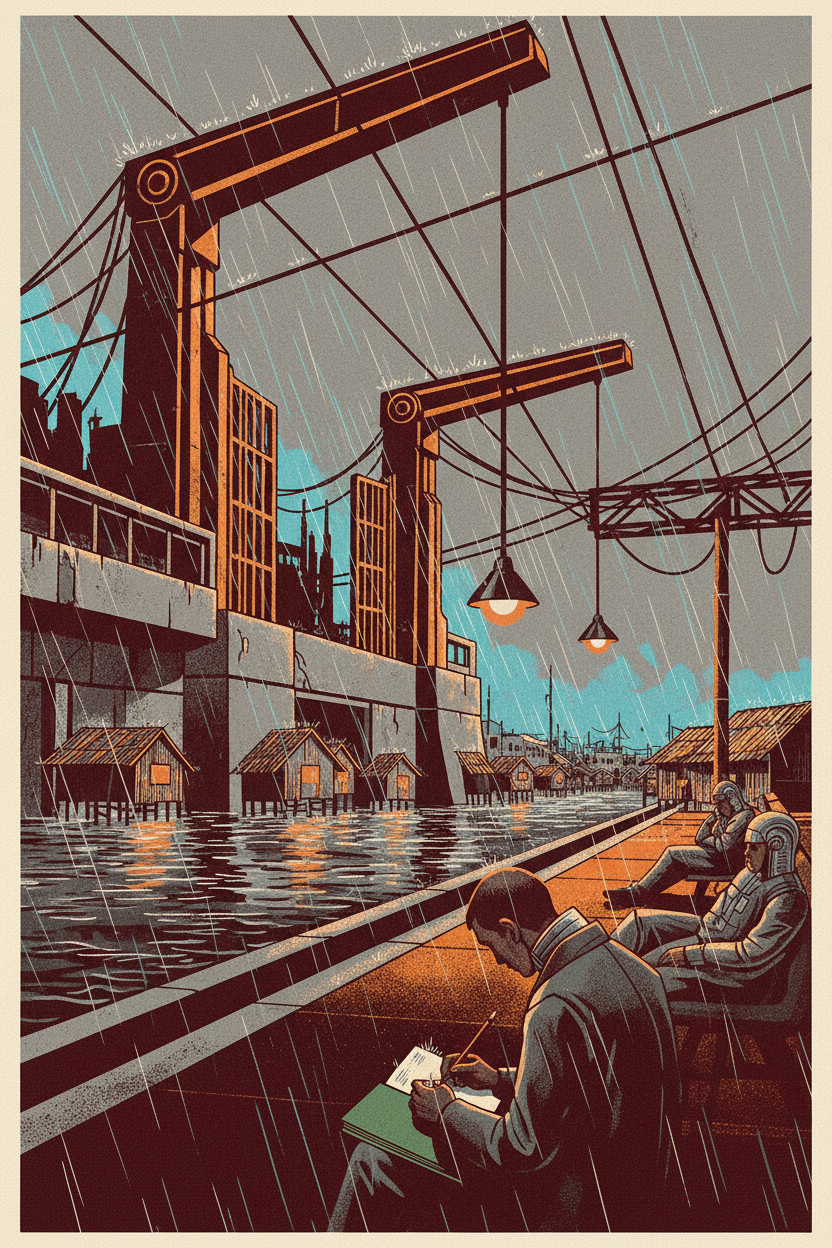
The loss-room at Kamalapur was eleven feet by nine, with a drain in the floor for the wet, and Rezaul Haque had the far bench under the window because in twenty-two years nobody had wanted it. Rain came off the gate roof in sheets and hit the flood-apron below with a sound like grain poured out. Under the boards the pumps ran their four-minute cycle; through the wall, in the tithe office, a clerk was reading the lanes of Sutrapur aloud at the pace of a man walking them, Hare Street, Loharpotti, Nabab Katra, and would be at it until nine. The 19:40 draw from Colombo Anchor landed on the tick and the stile-plates began to cool, ticking in their brass housings, and the ushers brought the passengers through in threes to sit for their ten minutes. Procedure was procedure. He offered water, he waited sixty seconds, and then he asked the four questions in the order the Board printed them: what were you reaching for, what was it near, who last said it to you, and can you say the shape of it. The first man that evening was a freight adjuster, licence 4-8812, who had gone through the gate eleven times and knew the drill and was still frightened. He had lost the name of the middle sister of three who sat in front of him at school in Narayanganj. He could give the other two sisters, he could give the braid, the ink on her collar, the fact that she laughed with her mouth shut. Where the name went there was no gap he could feel; that was what people never believed until it happened to them. It did not hurt. It was simply that the stair he had put his foot down for was not there, and his foot had already gone through. Rezaul wrote him up on page 61 of green notebook thirty-nine, in the ruled columns: date and tick, gate, licence, origin anchor, class of thing lost — person, street, dish, song, article, jetty — and then the name itself if it could be recovered, and then, in the narrow right margin, the taker's remark. His remark was recovered from sister, telephoned, no distress. The second was a cold-sleep nurse off the same draw who had lost a word for a kind of knot her father used on nets, which nobody could restore because nobody else had ever used it, and he wrote unrecoverable, class: article, and she said that was all right, and it was not, and they both let it stand.
The third came in at 19:52 with an usher carrying her coat: Sushmita Kabir, wife to a House Barisal factor, Drawn since girlhood, forty-one crossings on her card. She sat very straight and said she had lost a jetty. Rezaul asked what it was near. She said it was near her aunt's house, which was the third house along the walkway with the blue lid, at the stilt-town where they went in the dry months, and the town she could give him — Char Mohona, she said it twice, pleased to have it — but the jetty was where they tied the ferry and where she had been sick as a child over the rail, and the name of it had lifted out entire. He asked who last said it to her. She said her aunt, dead nine years. He asked for the shape and she gave him four syllables and a taste of sourness in the middle, which is the kind of thing takers learn to work with. Then he took the Sundarbans gazetteer off the shelf, the 2598 edition with the thumb-notches, and read her the six named landings of Char Mohona in a flat voice with a pause after each, because the Board held that a flinch was evidence and eagerness was not. She did not flinch at any. She nodded at the fourth, Tetulbari, and said that it fitted the hole the way a lid fits, and then asked him, politely, whether she would get it back. He said the record kept it, which was true, and was not an answer. He wrote Tetulbari, jetty, Char Mohona, Sundarbans; attributed, not attested by loser, and she signed under the remark with a small steady hand, and the usher took her out to her car.
When the room was empty he turned to the back of thirty-nine, where he kept his own tally, which was not procedure. Five strokes and a crossbar, page after page, ruled against a single gazetteer line. He added one and counted the columns twice because he always counted twice. Three hundred and one names, all of them belonging to one stilt-town of nine hundred people in the Sundarbans, taken off three hundred and one unrelated passengers in one hundred and eighty-three days. Loss was random. Every manual said so; the Board's own actuary published the distribution yearly, and the distribution was flat, and that was the whole comfort of the trade — that the lattice took a chip off everyone and aimed at nobody. He looked at the slip a while, the carbon he was meant to walk twelve feet and file into the card index, where it would be alphabetised and totalled and read by no one. He folded it twice and put it in his shirt pocket, under the letter from the Registry acknowledging his petition on the forty notebooks, number 1177, still pending in its third year. Then he signed out, and went down through the gate hall where the Drawn were queueing for the 20:20, and walked home along the flood wall in the rain with his collar up, past the pumping station and the shrine with its wet marigolds, and he thought of Ruhi and the mustard season and the boat and the exact thing her mother used to say, and his mind went around the middle of all that the way water goes around a piling, smoothly, without touching, and he did not notice himself doing it, or did, and kept walking.
Dawn came up grey over Shankhari Bazar with the brick still wet from the night and the shell-cutters' shutters going up one at a time down the lane, each with its own complaint of rust. The bangle men worked with the doors open for the light; the conch dust came out onto the step in little drifts and the rain took it. From the flood wall two streets over the first tram of the day rang once at the curve, which it did whether or not anything was on the rails. Rezaul had walked this way since the year he was married because it added eleven minutes and because a man who took losses all evening liked to start the day where things were being made by hand and signed on the inside of the wrist. Tuhin was at his usual place on the step of the shuttered press office with his copybook in a plastic sleeve, hair wet, trousers wet to the knee, having been out since four.
"Two taka," Tuhin said, before good morning. He had a way of saying it that made it sound like the fixed and ancient price of something, which after a fashion it was. Rezaul gave him the two coins and Tuhin stood up, because he always stood, and put his hands behind his back like a boy at recitation, and said: "Tanti Bazar Third Lane, off the Panitola side, where the drain crosses. I walked it at five-twenty this morning. There is a green door with a padlock and no hasp. There is a woman who was boiling water. A dog was asleep across the middle and I stepped over it and it did not wake." Then he waited, and Rezaul said the name back to him three times, Tanti Bazar Third Lane, Tanti Bazar Third Lane, Tanti Bazar Third Lane, and Tuhin wrote the date and the buyer's initials in the copybook with a stub of pencil and tore nothing out, because the receipt was the entry, and the entry stayed with him. The Drawn paid five and sometimes ten and took a written card away with them, but Rezaul was Slow and got the trade price and no card, and they had never discussed why he bought at all.
"You want another?" Tuhin said. "I have four from Farashganj. They're good. Nobody's asked for Farashganj in a month." Then, in exactly the same voice, dragging his heel on the step: "The delta ones are coming back thin."
Rezaul was putting the change away. He said, "Thin."
"Three of them came back. Two last week, one Sunday. A Chittagong man — he paid ten, he wanted six, I gave him six for eight — and he's back in four days saying they won't stick in his mouth. He can say them but they come out flat. He said it was like a song where you know the tune and the words have gone loose off it." Tuhin was scowling and also, plainly, enjoying the professional grievance of it. "I said I don't refund, it's not goods, it's walking. But I gave him two back because he had his wife with him. My Sutrapur names never do that. Nobody has ever come back off Sutrapur." He looked down the lane where a man was carrying a tray of blanks out into the wet. "It's only the ones out that way. It's like the place has gone soft underneath me."
Rezaul counted his coins into the inside pocket, where the folded carbon was, and where the letter was, and he did not look up while he did it. He said, mildly, in the flat voice he used for reading gazetteers, "Those six. Were they from Char Mohona itself, or only near it?"
"Near," Tuhin said at once, and then less certainly, "Two were the town. I never walked the town. It's a day and a half on the launch and my mother won't have it." He straightened. "I buy them honest, off the launch-hands at Sadarghat, and I make them say it twice and describe the door. That's as good as walking. It holds." He said the last part looking at Rezaul, waiting.
"It holds," Rezaul agreed, because the boy was fourteen and the tram was ringing again at the curve, and because he had three hundred and one strokes at the back of notebook thirty-nine and no standing whatever to say otherwise. He went on down the lane with the shell dust sticking to his shoes. At the corner where the pumping station threw its steam across the brick he stopped for a moment, and worked out that the tithe-hall opened at nine and that he was not on shift until six, and that he had the notebook in his satchel and the slip in his shirt, both of which he was not supposed to be carrying, and he decided to go and ask them, today, in person, what had become of petition eleven seventy-seven.
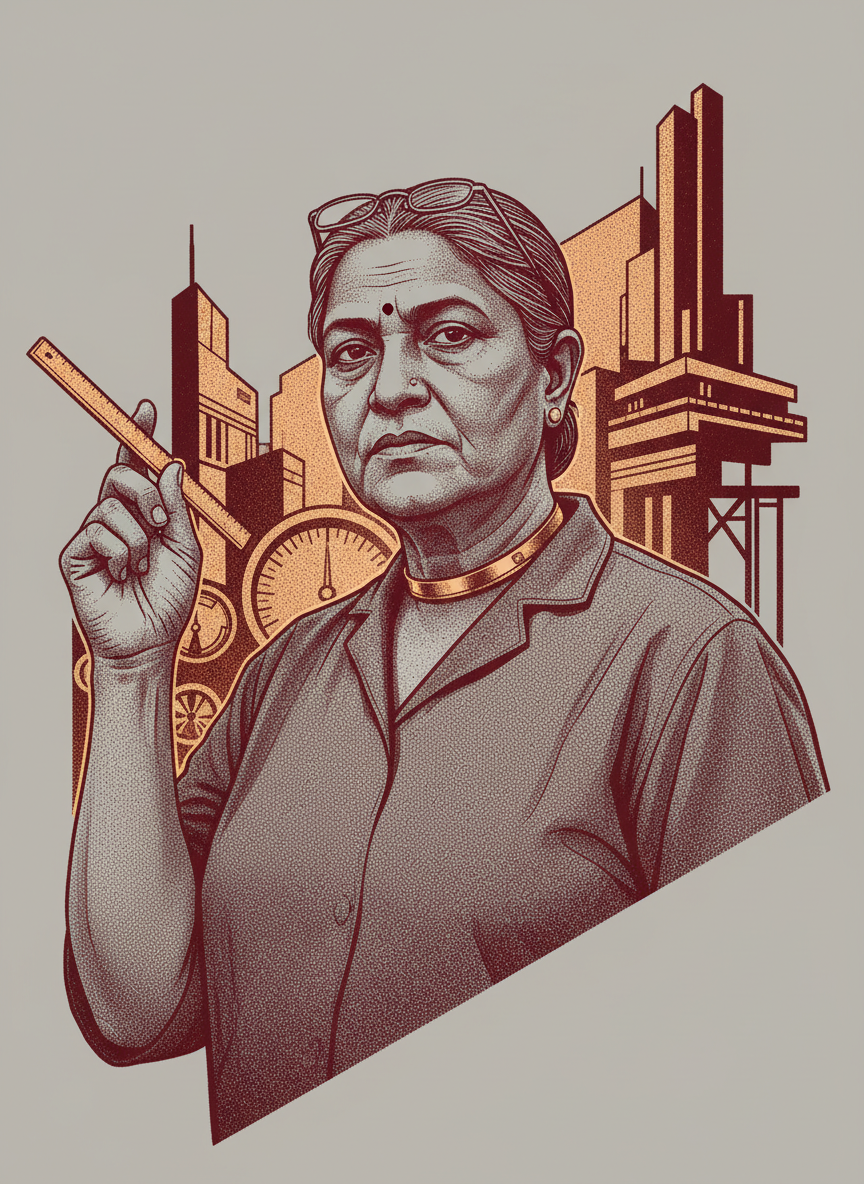
The Narayanganj tithe-hall had been a jute exchange once, and the ceiling was still forty feet up and still smelled faintly of the bales, and against the wet-wool smell of the queue the old smell came and went like a draught. Rezaul took ticket 214 from the brass hopper at half past nine and stood under the sodium lamps with the rest: two Fond Order men in oilskins waiting on stipend arrears, a woman with a folder of shrine-register extracts, a boy sent by his grandmother with her tithe-hours card and a note pinned to it. The card indices ran the length of the north wall in oak drawers, sixty to a tier, and every so often a runner went up the ladder and came down with four cards held like a hand of playing pieces. The lamps made everything the colour of weak tea. It was ten past eleven when they called him to counter four, where a clerk second grade named Fahmida Sattar had a brass rule screwed along the edge of her desk, and squared every paper she was handed against it with two fingers before she would read a word of it.
She squared the acknowledgment first. It was three years old and had been in his shirt pocket for most of that time, and it had gone soft as cloth along the folds, and the Registry seal had worn to a bruise. Your petition in the matter of forty (40) manuscript volumes has been received and entered at number 1177. That was the whole of it; it had never said anything else, and he had carried it anyway, because it was the only piece of paper in the world with his name and a number on it in the same line. She read it, and then she read the file card the runner had brought down, and then she said, without hurry and without any softening, that petition 1177 had been found against in the second quarter and the finding posted to the address of record, and that the ground of the finding was clause nine: a witness cannot witness himself. Rezaul had the notebook out by then, thirty-nine, open flat on the counter with his thumb holding page 61, and he said that the volumes were made by a named man in a named place, which was the test. She agreed that it was the test. She said the difficulty was not the making but the attesting of the making: that the Registry could not enter as witnessed goods any article whose place and date of making rested on the word of the maker alone, and that what he wanted was a licensed countersigner — someone holding the coordinate at the time of the making — to attest that these pages were written in that room, at that tick, by him. He had none. There it stopped. Then she did the only thing she could do, which was to turn the notebook round and read three of his entries aloud at the pace of a man walking, unrecoverable, class: article, the way the clerk at Kamalapur read the lanes of Sutrapur, giving them the ten seconds of honest attention that the procedure did not require and the record would not keep. Behind him somebody's umbrella dripped a slow line onto the tiles. When she finished she turned the book back and said she was sorry, in the tone of a person who had said it eleven times that morning and meant it each time, and that she was clerical grade and could not countersign so much as a laundry docket.
He had taken everything out of his coat by then to find the acknowledgment, and Sushmita Kabir's carbon was lying face up on the counter with the gate stamp on it, which was twelve feet of filing and a district away from where it should have been. Fahmida Sattar looked at it for perhaps two seconds, and moved it an inch towards him with one finger, and said nothing at all. He put it back in his shirt. Then he asked her, carefully, as if it were a small further question about forms, whether a countersigner attested only the place of making, or whether a countersigner could attest a place that was not the place of making — a place named in the pages, say, rather than the place the pages were written. She said that was two questions and only the first had an answer: the countersigner attests place and date of manufacture and nothing beyond, and must hold that coordinate at that tick, and must be licensed at gate grade or above, and the roster of those licensed within a gate district was public and kept in the index. He said he would like to see it. She sent the runner up the ladder, and the drawer came down smelling of dust and boracic, and there were three cards for Kamalapur district: one man dead in 2601 and never struck off, one transferred to Chittagong Anchor, and one current — Roy, S., gate-mistress, House Barisal, Kamalapur; nine slots, eight declared. He read it twice, because he always counted twice, and it did not change. He thanked her and went out past the queue into the rain, which had thinned to the kind that does not fall so much as stand in the air, and walked towards the station with his collar up, having known this for about a year and a half and having managed, until eleven twenty in the morning, not to ask.
He went up to the gate office at ten to six, which was when she did timesheets, because she did them on the hour before the evening draws and not at any other time. The room was over the stile floor and had a long window into it, so that she could see the plates and the queue without hearing either; the sound that came up instead was the pumps. Shefali Roy was at the meter ledgers with her sleeves turned back, working the Colombo and Chittagong columns for the week — anchor, tick, licence, units metered, House Barisal's stamp in the outer margin like a thumbprint in oxblood — and she did not look up when he came in, only turned the ledger a few degrees so he would not have to read it upside down, which was courtesy and also the opposite of it. A clerk somewhere had entered Tuesday's 14:10 against the wrong anchor. She ruled a line through the figure with the brass rule, wrote the correction above it, initialled S.R. in the margin, and squared the page against the desk edge with two fingers; then, after a beat, squared it again. The folios were ruled nine lines to the page. She wrote on eight of them and left the ninth white, every page, all the way back through the ledger, and Rezaul had been watching her do it for eleven years and had never once seen her run out of room. Her holder's card-sleeve lay open by the inkwell where she always put it, eight cards in eight windows, each with its coordinate in the House hand, and the ninth pocket empty and clean as a tooth socket.
She signed his timesheet in four seconds. Then he asked her, badly, standing up, with the satchel still on his shoulder — he said that the Registry had refused 1177 under clause nine, and that the roster showed she was the only gate-grade countersigner in the district, and would she attest his volumes. He heard himself put no manners around it at all. She did not move for about half a second longer than she needed to, and then she capped her pen and said that House Barisal did not permit rostered staff to countersign personal petitions of other rostered staff, which was so, and that in any case a countersigner swore to the room and the tick, and she had not been in the loss-room at the ticks in question; she had been up here, or at the plates, or asleep. "I don't swear to rooms I wasn't in," she said. "Not for you, not for the Board, not for anybody." It was true, it was defensible, and it took her eight words longer than her usual manner of refusing things. He said, because he had already spent the whole of his courage and there was nothing to save it for, that she had eight declared and nine slots. She looked at him. She said, "That's my business," and reached over and closed the card-sleeve, and squared that too.
Then, without his asking anything further, in the flat register she used for gate notices, she said she was moving him off evenings to daytime intake, effective Thursday — hours nine to five, the counter by the arrivals rail, mostly freight adjusters and day-trippers, no loss-room. She had the roster card already made out. He took it and read the top line twice, because he always counted twice, and it did not change: Haque, R., intake, day. Nobody had asked him. Nobody had been on at him about his numbers, or his slips, or the three years of petitions, and the day he walked into a tithe-hall and made himself a name on a counter in another district, the shift he had sat for twenty-two years quietly stopped being his. He went down into the gate hall with the card in his hand. The 20:20 was building along the rope line, the Drawn in their rain-proofed wool, tickets and hats, a woman buying a written street-name off a boy at the barrier for ten; and standing among them with the letter in his coat and Sushmita Kabir's carbon folded against it, Rezaul arrived at the thought he had been walking around for a day and a half, the way water goes around a piling. Somewhere upstream of him there was a desk. On that desk, the man who wanted his forty notebooks entered into the record and the man who had counted three hundred and one names off Char Mohona were not two files. They were one file, and it had his name on it.
The change of roster fell on Thursday, so Wednesday was his, and he took it. There was no ceremony about it. The 21:05 off Colombo Anchor came down at four minutes past and the plates began their ticking, and the ushers brought them through in threes, and the second of the last three was a woman of about fifty in a factor's household coat two sizes large, licence 6-0304, third crossing, who sat down and said before he could offer the water that she had not lost anything worth his time. She had lost a word for a way of stacking firewood. She said it the way you report a scratch. What she wanted, she said, was the register line for her brother's lane, because the postal office at Sadarghat would not take a letter into the delta without one, and she had been three years in Colombo and would be three more, and her brother was sixty-one and did not write. Rezaul said that was the counter downstairs and she said the counter downstairs had sent her up to the loss-room because the loss-room had the gazetteer. That was true. He took the 2598 edition off the shelf by the thumb-notch and asked her the name of the lane, and she gave it — Ghoshpara Walk, off the second walkway, past the school with the tin — and he turned to Char Mohona and read the column twice, and there were the six landings, Tetulbari fourth, and the anchorage, and the school, and no Ghoshpara Walk. He said gazetteers were eight years stale and went through the wall to the tithe office, where the clerk was two-thirds down the lanes of Sutrapur and stopped mid-street to help him, because it was late and nobody was listening.
The live index for the eastern delta ran in four oak drawers under the window. The clerk took out the Char Mohona tier and set it on the sill, and they went through it together with the sodium lamp pulled over. A tier of that kind, for a town of nine hundred, ought to have carried a card for every named walkway, landing, shrine, tank and lane — sixty, eighty cards, thick as a brick, each with its bearing-units for the quarter and the holder's initials in the corner. There were nineteen. There was no card for Ghoshpara Walk. There was no struck-off card for Ghoshpara Walk, no red line, no lapsed stamp, no cross-reference slip; the sequence numbers ran 4471, 4472, 4473 without interruption, and the alphabet closed over the place where the thing should have been as smoothly as water going around a piling. The clerk said perhaps it had never been attested separately, some lanes never were, and squared the cards and put them back. Rezaul stood with his hand flat on the sill. It was not the tally. The tally was three hundred and one people with a stair missing under one foot, and it had sat in him for six months like a stone swallowed, heavy and inert and portable. This was a different thing entirely and it went in somewhere lower and colder: not a gap but the absence of a gap, the ledger itself having nothing to say and no embarrassment about it, nineteen cards where there should have been eighty and the numbering perfectly continuous. He counted the cards a second time because he always counted twice, and it was nineteen. Behind him the woman in the factor's coat was standing in the doorway of the loss-room with her hands folded, waiting to be told her brother's lane was on the books, and he went back in and told her the register was being recompiled for the quarter and she should apply again in a fortnight, which was a lie of the kind the Board printed on a card, and she thanked him and signed the sheet with a cross.
The leave form was B-14, unpaid, two signatures, and he filled it in at the intake counter on Thursday morning between a freight adjuster and a school party, fourteen days, purpose of absence: family. He put it up to the gate office at ten to six because that was the hour she did timesheets. Shefali Roy read it, ruled nothing, asked no question of any kind — not where, not why, not whether he would be back for the quarter-end — and signed S.R. in the second box and squared the paper against the desk edge twice, and the card-sleeve lay open by the inkwell with its eight cards and its clean ninth window, and the ninth line of the folio under her hand was white as it had been for eleven years. She said, "Thursday fortnight," and turned the ledger back to Chittagong. He went down through the hall past the rope line and did not sleep much, and on Saturday he took the 05:40 out of Kamalapur with the notebook and the folded carbon and the Registry letter in his coat, and at Sadarghat he bought deck passage on the Khulna launch, and after the launch there would be a country boat poled through the channels for most of a day, a day and a half in all, which was what the delta cost a man who would never ride the lattice; and he thought, watching the pontoons swing and the water go the colour of the lamps, that he was going to stand in a lane and say its name out loud, which was the only thing he had ever been qualified to do.
The country boat came in at the wrong end of the tide, which the poler said was the only end there was that day, and so Rezaul's first sight of Char Mohona was of its legs. Low water in the channels took the town up four metres and left it standing on nine hundred stilts of sundari and creosoted steel, the mud beneath them grey and smoking faintly in the heat, printed all over with the small commas of crabs. The boat went in under the second walkway and he climbed a ladder of iron staples set into a piling, satchel across his back, and came up through a hatch in the boards into full sun and the smell of drying nets. Nobody met him, because nobody had been told. A woman two houses along was beating a mat over the rail and watched him the whole way up without stopping. The boards ran off north and south, cambered slightly, with a gutter-slot down the centre and the tide-marks on every post stepping up in brown bands like a ledger column; the houses stood on the landward side with their lids painted against the flare of the sun off the water, and the third along from the crossing had a blue one, weathered to the colour of a bruise, exactly where a woman in a household coat two sizes too large had put it a week ago with her hands. Rezaul stood a moment on the boards and then walked, and it was at the crossing, where the second walkway met the transverse and the deck stepped down two inches without warning, that his foot took the step before he saw it. He put it down to the way all delta towns are built to the same handful of patterns, and he was still putting it down to that ten minutes later, when he turned left at a shrine-post with no shrine on it because leftwas where the school would be, and the school was there, tin roof, lime-washed to the sill, a tin roof at the exact bearing his shoulders had expected. He stopped and counted the walkways back to the anchorage, and then counted them again, because he always counted twice, and the second count did not steady him the way second counts did.
Mira Das found him before evening, which in a town of nine hundred took no finding. She was fifty-something, sun-ruined, in the Fond Order's oilskin with the collar cut off, and she carried her rota in a tin box on a strap and her stile-plate in a cloth in the box, and she asked to see his gate licence before she gave her name. He gave her the licence and, because there was no use in anything else, the truth: that he was a loss-taker on leave, and that he had come to walk. She read the licence twice and handed it back and said the Order fed nobody's curiosity, and then, in the same breath and the same flat voice, asked whether he had eaten. They ate on the rail outside the tea-stall at the anchorage end with their legs hanging over the drop and the mud going violet below. She held the town, she said, on a fortnight rota with two unlicensed girls under her and a widower at Tetulbari who did the landings when his knees allowed, which was four days in seven. She was the last licensed attester in the Sundarbans; the district had had eleven when she took her plate. She did not say it bitterly. She said it the way a woman reads out a tide table. Rezaul asked what the children were taught, and she said the litany, at five, before letters, same as everywhere. He asked how long it ran. She chewed and thought and said about ninety seconds now. In her own schooling it had been four minutes and you were smacked for gabbling. He asked what had come out of it, and she looked at him for the first time properly and said that was a question with a shape she did not like. Then, after a while, in the tone of a person putting a stone down on a table rather than handing it over: there were cards in the district tier that she had signed for, quarter after quarter, in her own initials, and that were not in the tier now. Not struck off. Not marked lapsed, not red-lined, not slipped. Simply not in it, and the numbering closed over the place like water. She had written to Khulna twice about the first one. No notice had ever come to her, before or after, from anybody, and she had stopped writing, and she wanted him to understand that she was telling him this as a fact about paper and not as an accusation about anything else, because she had nobody to accuse and no evidence that would survive a clerk.
Tetulbari Ghat Road ran two hundred metres along the east face, boards wider than the walkways to take handcarts, with the landing at the far end and the ferry bollards dark with sixty years of rope. He went down it at first light the next morning while the tide was still out. There was a green door with a padlock and no hasp — there is one in every town, he thought, and did not quite believe himself — and a man splitting fish on a block, and a dog lying across the middle of the boards who did not wake when he stepped over it. At the bollard end he stopped and turned round and looked back up the length of it, the tin roofs, the drying racks, the blue lid three houses along on the walkway behind, and he said the name aloud three times, Tetulbari Ghat Road, Tetulbari Ghat Road, Tetulbari Ghat Road, at the pace of a man walking it, the way the clerk at Kamalapur read the lanes of Sutrapur to the empty tithe office until nine o'clock every night of the year. The man with the fish looked up on the second one and went back to his work. Nothing else happened. Rezaul took out green notebook thirty-nine, and wrote the date and the tick and, in the column where the class of thing lost went, because there was no other column for it, street, and in the narrow right margin: standing on it. 07:12. Attested by nobody.
The room they gave him was over the tea-stall at the anchorage end, reached by an outside stair, and it held a rope cot, a hurricane lamp, a tin trunk with somebody else's padlock on it, and a window with no glass and a shutter propped on a stick. The widower from Tetulbari had brought him up a plate and stood in the doorway while he ate, talking in the unhurried way of a man who did not often get a new listener: the launch timetable, the price of creosote, the state of his knees, and then, apropos of nothing, that in his father's time there had been families brought in here off the old plan, resettled, twelve or fifteen houses' worth, and given the landward frontage because nobody local wanted it, and that you could still tell their grandchildren by the way they tied a knot. Rezaul asked, with his mouth full, from where. The widower said he had never heard it said, only that they came from further in, and took the plate, and went down the stair, and after that the town went quiet in stages — the generator at eight, the last handcart, a radio, a child being called twice — until there was nothing under the window but the tide coming back, slapping up the pilings one by one as it found them, a sound with no rhythm to it at all.
He lay on the cot with the lamp turned down to a bead and did not sleep. What came was not thought. It was the smell of mustard flower, which is a flat sweet smell like warm dust, and with it a weight along his left side, a gunwale under his forearm and the particular cold that comes off river water through the planking of a boat, and Ruhi at sixteen or seventeen saying something over her shoulder that he could not hear, and her mother — her mother saying the thing she said, three words in a falling rhythm, the second one long, a thing she said every year at that season and said again at the door on the day they left. He had the rhythm exactly. He could have tapped it on the trunk lid. The words were not there and there was no place where they had been. And pressed up against all of it, without joining it, was the two-inch step at the crossing that his foot had taken before his eye, and the bearing of the tin roof, and the way his shoulders had turned left at a shrine-post with no shrine on it. He lay and felt it the way you feel a tooth with the tongue. It was homesickness, he decided, and it had no address, and the recognition of that was the first thing in six months that had frightened him properly — not the tally, not the nineteen cards, but this: that the sensation was perfectly familiar and perfectly unattached, like a key worn smooth in a pocket for years by a man who has never once tried a door with it.
He got up at some hour and lit the lamp properly and took the letter out of his coat. It had been in his shirt or his coat since the second week of Baishakh, four months, and the flap had loosened itself in the damp so that in the end he did not so much open it as unfold it. Two sheets, lined, in a hand that pressed hard enough to emboss the reverse. Dulabhai — brother-in-law — and then a name at the foot, Abed, and the whole of it in between concerning their mother's shrine-post, which had come off the parish rolls at the last audit for want of hours, and what it would cost to have it put back, and how the writer had fourteen hundred taka of it and no more, and how it had been nineteen years, and that a man who keeps a ledger for a living can keep two hours a quarter for his wife's mother, and that he was not asking for money. You will remember the mustard that year, he had written, and what she called you at the gate, and that you said you would come back in the dry. Then three lines of housekeeping, the launch days, his own knees, a nephew apprenticed to a compiler shop at Khulna. And at the end, squared off in the corner the way a man writes something he has had to go and look up, the register line for the lane, because the post office would take nothing into the delta without it: eight figures, a district code, a quarter-stamp. No name of any village anywhere in the two sheets. There was no need of one; it was a letter home from home. Rezaul sat on the edge of the cot with the sheets on his knee and the tide finding the pilings under the floor, holding eight figures where a name should be, and a brother-in-law he had, and a promise to come back in the dry.
He went down Tetulbari Ghat Road again at first light, not to say anything this time, and found Mira Das at the landing end with the tin box open on a bollard and her stile-plate out of its cloth, doing the four days in seven the widower's knees had not managed. She did not stop for him. Holding looked like nothing: a woman standing with her hand on a rope-dark post and her eyes half shut, breathing, while the tide came up the pilings with no rhythm and a boy dragged a crate past her along the boards. When she opened her eyes he had the two lined sheets out of his coat, folded back so that only the corner showed, and he asked her a practical question in the practical voice, which was the only way he had ever been able to ask for anything: could she read a district code. She said any attester could read a district code, it was on the back of the plate-licence in eight-point type, and held out her hand for the paper. He gave her the corner of it with his thumb over the body of the letter, and she looked at the eight figures the way Fahmida Sattar looked at a document, from the edge inward.
"Quarter-stamp's live," she said. "Second quarter, this year — that's the stamp they were issuing when your man went and looked it up, so it was on the books four months ago. First three figures are the district. That's us." She turned the corner of the sheet a few degrees towards the light. "Eastern Sundarbans, the Khulna tier. Same drawer as this town. Not the same card-run — ours start four-four-seven; this is four-four-one something, which is a tier or two along, but it's in the same drawer and it's read out of the same index." She gave the paper back. "The line tells you it exists and where its card is filed. It doesn't tell you what it's called. Only the card carries the name. You want the name, you go to the drawer." Then she wrapped the plate in its cloth and put it in the tin box and said, because she was not a cruel woman and had been awake since four, that the Khulna index was a month's argument and two forms and a clerk who would want to know his standing, and that the eastern delta tier was duplicated at Kamalapur, four drawers under the window in the tithe office, which he would know better than she did.
He did know. He had stood at those drawers on Wednesday night with the sodium lamp pulled over and counted nineteen cards twice, and behind him and to the left, in the same run of oak, filed under a number one hundred and thirty short of the one on his own brother-in-law's corner, there had been a tier he had never had any reason to open in twenty-two years. He did not let himself finish the sentence that was assembling behind that. He thanked her, and went up the stair over the tea-stall, and packed, which took eleven minutes: the notebook, the gazetteer's worth of pencil shavings brushed off the trunk lid into his palm and out the window, the shirt drying on the shutter-stick, two taka left under the plate for the widower, the tin trunk with its other man's padlock left exactly as squared to the wall as he had found it. The boat timetable was pinned in the tea-stall below — country boat to the Khulna launch at the top of the tide, which was ten past eight, and after that nothing until Tuesday. He had nine days of unpaid leave left and no intention now of spending them. In his coat, one against the other, Sushmita Kabir's gate-stamped carbon and two lined sheets in a hand that pressed hard enough to emboss the reverse, and he was aware of carrying both as a man is aware of carrying a lit lamp through a store of dry rope.
Coming down the second walkway to the anchorage he passed the school with the tin roof, lime-washed to the sill, and they were at it inside, the five-year-olds, at the pace of a woman walking: the anchorage, the crossing, the six landings, Tetulbari fourth, the transverse, the second walkway, the tank. It took ninety seconds. He stood at the rail with his satchel on his shoulder and timed it, because he always counted twice and there was only one of it to count, and then it stopped and there was the scrape of benches and a woman's voice starting them on something else. Four minutes, Mira Das had said, and you were smacked for gabbling. The poler was waiting with the bow against the piling, and the mud below had begun to go under, and Rezaul Haque stepped down into the boat and sat on his hands and did not look back at the town, on the reasonable ground that he had already got it by heart and had no idea when.
The launch went up on the Sunday tide with a deck of jute sacks and two goats, and he slept sitting against the rail with his satchel under his knees, and at Khulna he waited nine hours for the Dhaka boat and spent four taka on rice and watched a man paint a hull with a brush worn down to the ferrule. The river was the colour of the lamps the whole way. At Sadarghat on Monday morning the pontoons were swinging and a boy at the barrier was selling names off a copybook, not Tuhin, and Rezaul did not buy. He was back in the gate hall by eleven with nine days of leave unspent, and nobody asked him about them; the roster had him at intake from Thursday and the roster was not interested in Monday. He signed in early on the Thursday out of some instinct he did not examine and took the counter by the arrivals rail, hours nine to five, a stool instead of a bench, freight adjusters and a school party from Mymensingh and a woman who wanted to know whether her dog could be Drawn. In the intake pigeonhole, under the day's notices, there was a reconciliation docket on the green flimsy that Narayanganj used, forwarded through the House post: Query 9/44. One (1) carbon, loss-room, Kamalapur, 19:52 tick, unaccounted at quarter reconciliation. Taker of record R. Haque. Kindly produce, or certify as spoiled, within fourteen days. It was a form. Everything in it was a form. In the margin beside the routing stamp somebody had pencilled a date, lightly, in a small squared hand he had watched move a slip one inch across a counter with one finger, and the date was the day he had stood at counter four with his coat emptied out in front of him. He read the docket twice, because he always counted twice, and it did not change, and he put it in his shirt pocket with the rest.
The spent counterfoils went down to the undercroft after each quarter-end audit in tin boxes, forty to a box, stacked on duckboards above the pump-floor where the damp came up brown on the lower tiers, and Nuru who ran the night pumps had held a key for nineteen years and had never once been asked for it by anybody who was not Rezaul. He gave nothing for it and Nuru wanted nothing; it was only that in the winter of '96 Rezaul had sat with Nuru's daughter in the loss-room for forty minutes past the hour and written down the name of a song, and neither of them had ever mentioned it since. He worked four nights, six to two, with a hurricane lamp because the sodium in the undercroft only lit the aisles, and green notebook thirty-nine open on the box lid at the back pages, and he went at it the only way he knew: tick by tick, licence by licence, three hundred and one of them, matching his own entries to the gate's counterfoils, which ran anchor, tick, licence, units metered, House Barisal's stamp in the outer margin like a thumbprint in oxblood, and then the settlement box, which was where the units went to be paid for. In ordinary traffic the settlement box carried the passenger's own account, or a factor's, or a House standing order, and Rezaul had seen ten thousand of them in twenty-two years without ever reading one, because it was money and money was not his column. Sushmita Kabir's counterfoil settled to a Barisal factorage account at Chittagong. The freight adjuster, 4-8812, settled to his firm. The cold-sleep nurse settled to her own card. All three of them, and the two hundred and ninety-eight others, carried beneath the settlement line a second stamp, four characters and a stroke in the dry violet ink the meter office used for routing, which was not an account and did not appear in the House schedule of accounts pasted inside the lid of every box, and which did not appear on any other counterfoil in any tin he opened, of which he opened eleven, containing four thousand four hundred and sixty. He checked that figure twice. Three hundred and one tickets out of four thousand four hundred and sixty bore the stamp, and three hundred and one names had come off Char Mohona, and they were the same three hundred and one tickets.
It was not a discovery in the way the word is used. There was no moment. It came to him over about twenty minutes, in the manner of arithmetic, while the pumps went round on their four-minute cycle under the boards and the lamp guttered when the draught came down the stair, and what he felt when it had finished arriving was not triumph and not even fear but a kind of tiredness in the arms, as though he had been carrying the boxes rather than reading them. Loss was flat. The actuary published the distribution every year and it was flat, and it had been flat because nobody had ever thought to lay the loss column against the settlement column, because one was grief and the other was accounts, and they were kept in different rooms by different grades of clerk who did not much speak. He copied the four characters and the stroke into the back of thirty-nine and wrote beside them the eleven box numbers and the count, and then he sat on the duckboards with his back against the tins and thought about what a man does with such a thing. There was the Board, which had printed the distribution. There was the Registry, which had found against him under clause nine and which was at that moment asking him for a carbon he had in his shirt. There was Narayanganj, and a query numbered 9/44 with fourteen days on it. And there was a gate office over the stile floor with a long window and no sound in it but the pumps, where a woman ruled her ledgers eight lines to the page and left the ninth white, and squared everything twice, and had moved him off evenings within nine hours of his making himself a name on a counter in another district. He went up at half past two, washed at the tap, and slept three hours on the bench in the ushers' room; and at ten to six the following evening, which was when she did timesheets, he climbed the stair with the notebook under his arm and the counterfoils he had taken — eleven of them, one from each tin, which was theft, and he had counted them twice going up.
He put them down in the order he had rehearsed on the stair, which was the wrong order, and he knew it while he was doing it: the eleven counterfoils first, fanned a little the way a hand of cards falls when the fingers are not steady, then notebook thirty-nine open flat at the back pages where the strokes ran five and a crossbar down the ruled column against one gazetteer line, and last, because he could not make himself do it first, Sushmita Kabir's carbon with the gate stamp on it, unaccounted at quarter reconciliation, taker of record R. Haque. Shefali Roy capped her pen. She did not look at the notebook at all. She looked at the counterfoils, and moved them apart with one finger until all eleven violet stamps were showing at once — four characters and a stroke, dry, faint on the third one where the pad had wanted re-inking — and then she gathered them into a stack, and squared the stack against the desk edge with two fingers, and squared it again. That was the whole of the denial. Rezaul stood there and heard the pumps go round twice under the stile floor, which was eight minutes by the clock in his chest and four by the clock on the wall, and understood that he had come up the stair with the wrong question and would now be answered.
"Char Mohona is a designated settlement sink," she said. "Since the second week of Agrahayan. The lattice takes its chip off every crossing; that part of your manual is true. What the routing does is decide where the chip comes off. Flat distribution is a policy, not a law — you scatter the loss because scattering is cheap and nobody can feel it. If you stop scattering, you can put it all in one place, and the bearing that the rest of the ground would have spent paying for those crossings stays where it is." She said it in the register she used for gate notices, without hurry, and without once offering him a softening clause. "The order came down through the House in Khulna over Warden Farooqi's signature, and there is a counter-seal above it that I am not cleared to read and would not describe to you if I were. It is a consolidation. There are four hundred thousand coordinates in the Ledger and there will not be four hundred thousand after 'nine, and somebody with more arithmetic than either of us has decided which ground goes into the lifeboat. I meter it. I have metered it for six months. I was at the plates for every one of those ticks, which means I can swear to every room I was in, and I have." She turned a folio towards him, the Chittagong week, eight lines written and the ninth white. "You can read the units. I've never hidden the units. Nobody laid your column against mine because nobody was paid to."
He asked how long, and she told him without going to look it up, which was the thing that went in coldest of all. "The surveyor's projection for Tetulbari Ghat Road is forty-one days. That's unstreeting, not drift — the landing goes first, then the road, and when the road goes the six landings aren't six landings any more, they're a shoreline. The town will stand a while after that in people's mouths and nowhere else." Then she put her hand flat on the counterfoils and said the rest of it in the same voice, which he came to think afterwards was mercy of a kind, because a voice with any warmth in it would have made him argue. "Now hear the other number. If you file — Board, Registry, the tithe-hall at Narayanganj, any counter with a hopper on it — the first thing that happens is not an inquiry. The first thing is that a clerk second grade reads your name off the docket, and the second thing is a query already open against you for a carbon you are carrying in your coat, and the third is an audit of the tithe roll of your household. Your wife's people are on that roll. Their shrine-post came off it at the last audit for want of hours; you know that, because the letter has been in your shirt since Baishakh and it has printed itself through the cloth. Dis-survey does not require malice. It requires only that somebody senior be asked to justify the entry and decline to. I have costed this, Rezaul. I did it the week they moved you, and I did it twice."
She gave him back the counterfoils. That was the part he could not account for afterwards: she squared them one last time and held them out, and he took them, and put them in his coat with the letter and the docket and the carbon, and neither of them said anything about theft, and she signed his timesheet in four seconds because it was ten to six and that was the hour she did timesheets. He went down into the gate hall where the 20:20 was building along the rope line, the Drawn in their rain-proofed wool with their tickets and their hats, a woman at the barrier buying a written street-name off a boy for ten, and he stood among them with no plan whatever and did the only arithmetic he was fit for. Fourteen days on the query, of which eleven were left. Forty-one days on the road, of which he had already spent one standing on it saying its name aloud to a man splitting fish. He counted both again, because he always counted twice, and they did not change.
He came on the Monday, at twenty past ten, which was the slack hour between the Colombo intake and the Chittagong, and he came up the arrivals rail on the public side like anybody, with his hat in his hand and rain still on his shoulders, and waited behind a freight adjuster until the adjuster was done. That was the whole of the performance and it was well judged: a man who wanted a quiet word would have sent for Rezaul upstairs. Factor Ruhul Amin, House Barisal, Khulna and Kamalapur, card produced and laid face up on the counter and left there, a soft-spoken man of about sixty with a good coat and the sort of manner that makes a stool feel like a chair. He said he had been three days in Dhaka on the quarter-end and had asked to be shown the intake, which was true and irrelevant. He said he had read petition 1177. He said it was a disgrace — his word, said mildly, the way another man says it is a shame about the weather — that a gate should have a man of twenty-two years' standing and no line of his own in any record anywhere, and he wanted to see whether it could be put right before he went back down. He asked after Ruhi by name, and after the Narayanganj queue, and said that clerks second grade were the backbone of the service and the worst-used people in it, and at no point in any of this did he mention a carbon, or a query, or a date pencilled in a margin; he only said, once, glancing along the rail at nothing, that reconciliation matters had a way of tidying themselves up when a file came into House custody, because the House reconciled with itself and had nobody to answer to about it. Then he went back to the notebooks.
The obstacle, he said, was clause nine, and clause nine was unanswerable on its own ground: a witness cannot witness himself, and there was no countersigner living who had sat in that room at those ticks. But the Registry, he said, did not only enter goods under manufacture. It entered them under clause fourteen, custody of record — where the House stood behind the chain of holding rather than the moment of making, which did not require the maker's word at all, and had been used for a Fond Order's rota-books at Barisal in '99 and for a shipwright's pattern-book at Chalna. The volumes would be lodged, catalogued, kept dry, kept numbered, and entered: forty (40) manuscript volumes, R. Haque, Kamalapur, witnessed. Lodged, Rezaul said, and Ruhul said lodged, in the strongroom at Khulna with the survey papers, and that a man could apply to consult his own deposit on two days' notice and it was never refused. A handset went off inside his coat then and he said forgive me and stepped four paces to the pillar by the rail with his back half turned, and said yes twice and that was my understanding once, and came back putting it away and said that he was authorised to add a ticket. One Draw crossing, single, non-transferable, drawn on the House's own metering to any anchor on the lattice and back; he gave the figure it was worth and it was eleven months of Rezaul's pay. He offered it the way a man offers a chair he is not using. It was put to me, he said, that a man who has carried forty volumes ought to have gone somewhere once — and the phrase sat oddly in his mouth, the way a borrowed coat sits, and he did not seem to notice, and moved on to the launch timetable and the state of the Khulna road.
Rezaul said he would need to think, and Ruhul said of course, and that he was at the House rooms at Motijheel until Thursday, and left his card on the counter face up with the rain-mark on one corner, and went down the hall past the rope line where the 11:05 was building. The intake queue had grown to five. Rezaul took the next one, a schoolmistress from Mymensingh with a party of eleven and a rail warrant made out for ten, and worked through it properly, and then in the two minutes before the Chittagong he sat with his hands flat on the counter and did the arithmetic, because it was the only thing he was fit for. Forty volumes in a strongroom at Khulna, entered, numbered, real; a line in the record with his name and a number on it, which was the whole of what he had asked for in three years of asking. And at the back of thirty-nine, between the boards, three hundred and one strokes ruled against one gazetteer line, and eleven box numbers, and four characters and a stroke copied out in pencil — the only place in the world where the loss column and the settlement column stood on the same page, going into the custody of the House whose stamp was in the outer margin of every counterfoil he had counted. Two days' notice to consult his own deposit, never refused. He thought about the ticket, too, honestly, for longer than he liked: one lurch and eleven months of pay and the loss of some small name, and he had one soft place already and did not know its edges. He put Ruhul's card in his shirt pocket with the letter and the docket and the carbon, on top, where it would be first out, and called the next man forward.
He was four days into carrying it and had begun to notice the weight in ordinary ways: the stairs at the gate, the third step of the arrivals rail, a stool that had never needed adjusting. Seven days left on the query and thirty on the road, and he had them both in his head at all hours the way another man carries a debt. That was the trouble with it, or the beginning of the trouble. The three hundred and one names were in the notebook, but they were also in him — Tetulbari, Ghoshpara Walk, the crossing with the unmarked step, the blue lid three houses along, nineteen cards where there should have been eighty, four characters and a stroke in dry violet — and nobody had licensed him to hold anything, and there was no card in any drawer with Haque, R. and a number of slots after it. On the Friday he went up through Shankhari Bazar at half past six with the shutters going and found Tuhin's step taken by a boy he did not know, and Tuhin himself twenty feet along at the mouth of the lane with four others, waiting in a loose queue at a folding stool. The man on the stool had a good coat and a canvas satchel and a ledger with the House stamp in the outer margin, oxblood, a thumbprint, and he was buying in fifteens. He paid four taka a name, flat, which was double the trade price and half what the Drawn gave, and he took them fast: the boy said the lane and the particulars, the green door, the woman, the dog, and the man wrote it down and said next and did not say it back. Not once. Rezaul stood by the bangle-men's step with the conch dust settling on his shoes and watched eleven names go into that ledger in under four minutes, and none of them repeated aloud, and none of them going into any mouth at all, and he found he had begun counting which lanes were being asked for. Tanti Bazar, no. Farashganj, no — Tuhin had four unsold and the man waved them off. It was the river-side lanes, the low ones, the ones the pumps ran hardest under, and it was the delta if you had it, and the delta paid six.
He did not ask. He went on down towards the pumping station corner with the shell dust on his shoes and a sentence half built in his head about what a man is doing when he buys nine hundred names and never says one of them, and somewhere between the press office and the corner the lane stopped. That was the only way he could put it afterwards. His foot went down and the ground took it, and the street did not arrange itself. There was brick, wet, and a shutter with rust on the runner, and a smell of steam and drains, and a slope, and these were facts lying beside each other on a table with nothing to say to one another; there was no along, no back towards, no two streets over. He knew he was in Dhaka. He knew his own name, his licence number, the tick of the 11:05. He did not know which way the flood wall was, and when he turned to find it the turning did not help, because turning requires a thing to turn relative to. He stood in the middle of the lane with his hand out and put it flat on the brick to have one true fact, and the panic came up his back with a taste like brass, and what he felt for was Tetulbari Ghat Road, two hundred metres, bollards dark with sixty years of rope, and it came — it came warm and weighted and pulling behind the sternum, perfectly clear, a road a day and a half away, standing there in his chest with nothing under it, while the lane he had walked for nineteen years lay around him in pieces. He heard himself say a word aloud and did not know which one. A woman going past with a tin of oil looked at him and did not stop.
It took, he thought, less than a minute. What brought it back was the tram, ringing once at the curve two streets over, which it did whether or not anything was on the rails, and the sound arrived with a direction in it, and the direction had a wall at the end of it, and the wall had the pumping station before it and the shrine with the wet marigolds after, and then the lane closed up around him like water going back over a stone and was only a lane. He got to the step of the shuttered press office and sat down on it, which he had never done in his life, and put his head down until the brass taste went. He tried to count the days on the query and lost the count at four and started again and lost it at six, and the third time he got seven and did not believe it. He was fifty-one years old and had sat twenty-two years in a room eleven feet by nine writing down other people's holes, and he understood now, sitting on a wet step with conch dust on his shoes, that he had been carrying a town for six months the way a man carries a lit lamp through rope, and that nothing in the manuals said what happened to an unlicensed man who did that, because the manuals were written for people with cards. He thought about Shefali Roy's eight windows and the ninth wiped clean as a tooth socket, and about eleven years of white ninth lines, and he thought: is it like this for all of them, all the time, and they simply do not say — or did she look at something once and decide that the last space in her was the one thing she would not fill, and if so, what had she seen to decide it. He could not get further than that. In his shirt pocket, on top, first out, Factor Ruhul Amin's card had gone soft at the rain-mark, and it was Friday, and the man was at Motijheel until Thursday, and Rezaul had not answered him yet.
He sat on the wet step until the brass taste had gone out of his mouth and then took the card out and looked at it, and what decided him was not any of the things a man would want to put in a letter. It was that he could not keep going into lanes he did not know the direction of. Four days had done that; thirty more would do worse, and there was no card in any drawer with his name and a number of slots after it, no grade, no stipend, no rota, nobody to notice him gone soft in the middle of Shankhari Bazar except a woman carrying a tin of oil. He wanted out from under it. And then he did the arithmetic twice, sitting there, the way he did everything: clause fourteen entered the volumes on the House's chain of holding, which meant the House would stand behind where the forty books had been kept and not one word about what was in them, and the tally at the back of thirty-nine would go into a strongroom at Khulna with the survey papers, two days' notice to consult, never refused, and the only page in the world where the loss column and the settlement column stood together would be in the custody of the stamp in the outer margin of every counterfoil he had counted. It bought him a line in the record and it bought him the query, and it did not buy Tetulbari Ghat Road so much as an hour. It did not even buy him the thing he actually wanted, which was for somebody with a plate to say he held that, it was real, he was there. He would still be a man carrying nine hundred stilts in his chest with no licence to do it, only now with nothing written down anywhere he could reach. He put the card back in his shirt pocket, under the letter this time, and went to work, and served eleven intakes and a school party, and did not decide anything further, because it was already decided.
The House rooms at Motijheel had a porter's desk of good teak and a brass stile-plate set into the wall beside the lift for staff use, and the clerk said Factor Amin had put his crossing back to the Saturday launch, which Rezaul heard as what it was. Ruhul came down himself rather than sending, in shirtsleeves, with a pen still in his hand, and was pleased to see him, and asked after the rail warrant business at the counter, and offered tea. Rezaul stood in the middle of the carpet with his hat in both hands and said that he was grateful for the trouble taken and that he would not lodge the volumes, and that he did not want the ticket. Ruhul waited a moment in case there was more. There was not; Rezaul had nothing prepared and would not have used it. "Well," Ruhul said, in the tone a man uses about weather he has no opinion on, and then, kindly, that the offer would stand a fortnight in case he thought better of it, which Rezaul understood to be a courtesy and also a date. He asked whether Rezaul had considered that the volumes were paper in a tin-roofed room and that Dhaka flooded. Rezaul said he had. Ruhul said that was that, then, and shook his hand, and went back to the lift; and at the desk on his way past he said something short to the clerk, who wrote, and the whole of it had taken four minutes. Out on the street the rain had thinned to the kind that stands in the air, and Rezaul counted his change for the tram twice and found it right both times.
The finding on petition 1177 came on the Tuesday, forwarded through the gate post: denied with prejudice, the formal cause entered as the applicant's outstanding reconciliation query 9/44, one carbon unproduced, a want of candour going to the reliability of the record — nine words doing the work of a door being shut. On the Wednesday his gate licence was suspended pending review, thirty days, roster card surrendered at the arrivals rail, stile access lifted, pay at two-thirds; the acknowledgment came back down the stair inside an hour with S.R. in the second box and the paper squared twice against the desk edge, and no word with it, and he had expected none. On the Thursday, when he came back from the labour office with nothing, the Dis-survey notice was already pasted at the stair-head of his building, under glass, in the standard form, and a neighbour was reading it with her shopping on the step. Notice of removal from the tithe rolls of the following entries, no officer of senior grade having attended to justify their continuance. Then the entries, in the small squared hand the district used: the building and its four households; and beneath, in the dependents' column, where a man's household carries what it has undertaken to care about, Ruhi's name and her father's, and her mother's name with shrine-post, parish of and the code after it, nineteen years dead and off the rolls already for want of hours, and Abed's name, and beside Abed's name the eight figures with the second-quarter stamp that had been squared into the corner of two lined sheets in his shirt since Baishakh. Twenty-eight days to show cause, in writing, through a counter. He stood under the glass with the rain coming off the parapet and read the dependents' column twice because he always counted twice, and it did not change, and the soft place in the middle of him gave its small ache — the mustard, the gunwale, three words in a falling rhythm with the second one long — and he had, he was aware, no plan of any kind, and seven days now on the query, and somewhere in four oak drawers at Kamalapur a card he no longer had the licence to open.
There were four ways back into the gate archive and he went through them in order on the Friday, sitting on the bench at the labour office with his number not called. The tithe office was public but the eastern-delta drawers wanted a plate at the stile, and his stile was lifted. A written application to consult under suspension went to the gate-mistress, which meant a paper crossing Shefali Roy's desk with his name on it eleven days after she had costed his ruin aloud for him, and she would sign it or she would not, and either way it would exist. There was a clerk second grade at Narayanganj with a brass rule screwed to her desk who had once moved a slip an inch towards him with one finger; he thought about her on and off for two days and then stopped, because what he would be asking her for was her grade, and she had nothing else. That left the undercroft, and the undercroft left Nuru. He went out to the pump-quarters behind the flood-apron on the Saturday evening with nothing to offer and nothing to trade, and it was Saleha who opened the door, grown now, a child on her hip and flour to the wrist, and she said uncle and stood aside, and he had to stand in the passage with the smell of frying onion and ask her father, in front of her, and say the thing out loud that neither of them had said in eight years — that he had sat with her in the loss-room forty minutes past the hour in the winter of '96 and written down the name of a song. Saying it spent it. He watched it go. Nuru heard him out with his hand on the doorframe and asked one question, which was whether they were looking for him, and Rezaul said yes, and Nuru went and got the key off the nail and put it in his hand and closed his fingers over it and said: not my name to anybody, ever, and not again after this. Rezaul said not again. Nineteen years of a key that nobody had asked him for, and he had spent it on a man with a suspended licence, and the both of them knew the arithmetic of that, and neither of them said it, and Saleha shut the door.
He came in by the pump-house door on the apron side at ten past one, between cycles, with rain coming off the gate roof onto the flood-apron behind him like grain poured out, and he did not light the lamp until he was down past the second turning where the sodium ended. The retired slips were the deepest tier, below the counterfoils and inboard of the duckboards where the damp came up the boxes in brown tide-bands stepping down the stack like the marks on a piling. Anything after '85 was in tins, forty to a box, quarter by quarter. Before that they had gone in oilcloth bundles tied with tape, and the tape had perished, and the bundles had been re-sorted after the '89 flood by warrant number rather than by date, by somebody working fast in bad light, and the labels on the shelf-ends were the labels of a man who had known what he meant. Rezaul worked four hours the first night and found the wrong decade twice and put everything back squared. Old carbon has a particular smell, like a struck match a week later, thin and faintly sweet, and it got into his shirt and stayed there; the slips came apart at the folds if he was hasty and did not if he was not. The second night he went at it from the warrants and not the dates, because a boy of nineteen in 2572 had not crossed on a licence of his own. He had crossed on a labour agent's draft out of Khulna Anchor, forty of them metered as a single block, riders numbered, boots and a bundle each, and somewhere between the ledger of that and the bench in the arrivals corridor a woman he could not now picture had sat the whole draft down in threes and done the procedure on them properly, which she had not been obliged to do, because in '72 nobody made drafts sit the ten minutes. It was in the third bundle of W/Kh 44, at two in the morning, with the pumps going round under the boards and the lamp guttering when the draught came down the stair: rider 31, and his own name spelled right, and under it his own signature at nineteen, which he knew at once and would not have chosen to see.
Class of thing lost: place (village). Name: Hijolgari. And in the narrow right margin, in another woman's hand, at the pace of a woman writing: attributed from rider 29, same draft, who knew it and gave it twice. Loser states nothing missing. No distress. He sat down on the duckboards with the slip on his knee and did the only honest test he had, which was the one he had done four hundred times with the gazetteer open flat: he read the other names on the page aloud in a flat voice with a pause after each, six of them, other boys' villages, and then Hijolgari, and there was no flinch at any of the six and at the seventh the soft place in the middle of him took it the way a lid fits. A flinch is evidence; eagerness is not. He read them again in a different order, because he always counted twice, and it went the same way. So he had been told, at nineteen, on a bench, by a woman doing her job, and had signed for it, and it had not stuck; and the record had kept it, which was true, and was not an answer, and he had said that sentence to a woman in a household coat not three weeks ago and watched her be comforted by it. Mustard flower and a gunwale under his forearm and three words in a falling rhythm with the second one long. He sat there a while with the lamp low. And then, slower, colder, half-arriving and not finishing — the widower on the stair with the empty plate, twelve or fifteen households off the old plan, further in, given the landward frontage; a two-inch step at a crossing that his foot had taken before his eye; a tin roof at the bearing his shoulders expected. He did not follow it through. He put the slip inside the boards of green notebook thirty-nine and squared the bundle and retied what was left of the tape, and thought, with the flat clarity that comes at two in the morning: here at last is a thing in a record, in a licensed hand, with my name on it. And clause nine. A witness cannot witness himself.
He came up through the pump-house door onto the flood-apron at twenty past five with the notebook buttoned inside his coat and four hours of the undercroft in his clothes, that thin struck-match sweetness that carbon leaves, and the rain had stopped in the night so that the whole apron was steaming gently where the pumps put their warm water out. A goods crew was lashing tarpaulin over a handcart at the freight end. The man doing it took a turn round the rail, made a bight, passed the end under and back over itself twice and snugged it with his thumb, and Rezaul stood eleven feet away with his hands in his pockets and felt his own right hand close on nothing in the particular sequence of it, over, under, twice, thumb, before he had finished watching. He had not tied a load in thirty years. He put it away where he put things, and went up the ramp past the arrivals rail, where the cleaners were doing the stile-plates with paraffin, and out along the flood wall in the grey, and at the school by the pumping station corner the early class was already going, five-year-olds at the pace of a woman walking, the lanes of the ward in order, and he stopped to let it finish because he always did. It ran about two minutes now. There was a word in the middle of it he did not know and expected — he was eight paces past the gate before he registered that he had been waiting for it, and that it had come, and that it belonged to a lane he had never walked in a ward he had lived in for nineteen years. He did not turn round and ask which one. Six days on the query; twenty-seven on the notice; the road under thirty and going first at the landing end.
What he had in his coat was a licensed record, in a licensed hand, with his name spelled right on it and his own signature at nineteen beneath, and there was no counter in Bengal where he could put it down and be believed, because the only thing it said about him was that he was a loser, and clause nine held that a witness cannot witness himself. He turned that over on the wall for half a mile and it came out the other side as the opposite of what it had gone in as. The Board's own procedure said a flinch was evidence and eagerness was not, and a flinch required two people: one to read the names out flat with a pause after each, and one to sit and be taken unawares by the fourth. A man filing is a man alone at a hopper, and a man alone can be answered with nine words. But the clerk through the wall at Kamalapur read the lanes of Sutrapur aloud into an empty office every night of the year and it counted, and it counted because it was said and not because it was filed. Forty volumes, read out in a room, at the pace of a man walking, by somebody other than the man who wrote them, in front of people who could flinch: Mira Das with her plate out of its cloth, the widower who could still name the landings, Sushmita Kabir who would know Tetulbari the way a lid fits, a boy who had walked Tanti Bazar Third Lane at five-twenty in the morning and could prove it with a dog. That was not self-witness. That was attestation, of the ordinary kind, done in company. And Shefali Roy did not swear to rooms she had not been in — which was not a refusal at all, he saw, but a specification. It told him precisely what to build: a room, a tick she metered, and her standing in it.
He went to Narayanganj on the first tram and took ticket 88 from the brass hopper at ten to nine with a fair copy of the dependents' column in his shirt, made in his own squared hand off the glass at the stair-head — four households, Ruhi's name, her father's, her mother's with shrine-post and the parish code, Abed's with the eight figures and the second-quarter stamp — and twenty-eight days written under it, of which twenty-seven were left. The hall smelled of jute and wet wool and the runners were up the ladders already. When they called 88 it was counter two, and counter four had its brass rule and its blotter and no one behind it; the clerk at two said Sattar was on the indices for the quarter-end and would not be at a counter until Thursday. Rezaul said that was all right and did not sit down. He folded the copy once, wrote on the outside, Counter four, by hand, and in the corner where a clerk writes a thing she has had to go and look up, he pencilled a date — the Thursday, and under it the day the road went — and gave it to the runner with two taka, and walked out under the sodium into the morning without waiting to see it go up the ladder.
He went up the stair at ten to six on the Monday, which was no longer his stair, and nobody stopped him because the ushers had not been told anything and would not have enjoyed telling him. Shefali Roy was at the Chittagong week with her sleeves turned back. He did not ask for a favour, because he had thought about it on the flood wall for two miles and had concluded that she did not have any to give and would have refused a request on those grounds alone. He put down instead a sheet ruled nine lines to the page, in his own squared hand, of which he had written eight. One: the tithe office at Kamalapur, the room with the four oak drawers under the window, after nine at night, when the clerk has finished the lanes of Sutrapur and gone home and the room stands empty and is a room in which names are said aloud as a matter of course. Two: a date, and a tick off the gate's own metering, her figure, her margin. Three: a reader, not the author, at the pace of a man walking. Four: forty volumes, entire, the back pages last. Five: hearers able to flinch — Das, M., Fond Order, plate-licensed, four days in seven; the widower at Tetulbari; Kabir, S., licence carried, forty-one crossings; launch-hands off the Khulna boats; a boy who can prove Tanti Bazar Third Lane with a dog. Six: no filing, no hopper, no docket. Seven: that she be asked to swear to nothing whatever except that she was in that room at that tick, which was her own specification and he had copied the words off her. Eight: that the reading be logged, if it was logged at all, as tithe-hours against the coordinate, being hours of naming and honestly caring, which was what the thing actually was. The ninth line he had left white.
She read it the way Fahmida Sattar read a document, from the edge inward, and did not touch the pen. Then she asked three questions in the register she used for gate notices. Who reads. What is read — all forty, or the back pages. And whether he understood that the back pages were four characters and a stroke in dry violet, eleven box numbers, a count of four thousand four hundred and sixty, and her own units beside them, and that a woman standing in a room while that is said out loud in front of a plate-licensed attester has done a thing she cannot afterwards unsay, to the House, to Khulna, or to whatever holds the counter-seal. He said he understood it, and that he had not come up the stair to hide it from her, which was the whole reason he had come up the stair. She sat with that for the length of one pump cycle. Then she did not refuse. She picked the sheet up, squared it twice against the desk edge, and laid it under the inkwell beside the card-sleeve with its eight windows, and said that before she would put anything on the ninth line she wanted the reader's name in writing, and the hearers' names with licences where they had them, and a tick she could meter without inventing a crossing that had not happened, which was a harder piece of arithmetic than he thought and she would do it. "Bring me the reader," she said. "I don't swear to rooms with a hole in them." He was at the door when she said, without looking up from the Chittagong column, that the road was at twenty-eight by his count and twenty-six by the surveyor's, and that she had not corrected him earlier out of courtesy, and would not again.
Tuhin was not on his step. He found him at Sadarghat at half past five the next morning, in the wet, working the Khulna boat as it came in, and the boy heard the whole thing out with his copybook under his arm and his face doing the arithmetic openly, which was the difference between fourteen and fifty-one. He said he would come. He said it cost four taka a name at the stool and he would not pretend otherwise, and Rezaul said he knew, and that there was no money in this at all and never would be, and that what he wanted was for Tuhin to sit in a room and be surprised. Tuhin said he could bring the launch-hands — Shahjahan who was born on the second walkway, and two brothers off the Mongla run whose mother was Char Mohona and who would come if there was food — and then, standing up straight with his hands behind his back out of pure habit, he said: "The six I sold that Chittagong man. Will you read those?" Rezaul said they were on page eleven of thirty-seven and would be read in order with the rest. The boy nodded and went back to the rail. So the list had names on it by seven o'clock, five of them, with two licences and a plate; and when Rezaul got back to the stair-head under the glass notice there was nothing from Narayanganj, no runner, no green flimsy, not even the two taka returned, which meant only that the fair copy had gone up a ladder on the Sunday and was somewhere in sixty drawers to a tier, and that on the ninth line of the sheet under her inkwell there was still no reader's name to write, and no signature under it either.
She came on the Wednesday, in person, which was the part he could not have predicted and afterwards could not stop thinking about: not a runner, not a green flimsy, not the two taka back, but a clerk second grade standing at the foot of his stair at twenty past seven in the morning under the glass notice, reading the dependents' column with her hands at her sides and no umbrella. She had come out on the first tram and would go back on the ten and lose half a day off her quarter-end, and she said so before she said good morning, in the way of a woman accounting for a discrepancy. She had his fair copy folded in her coat. She did not give it back. She said that she had gone to the indices on the Monday night and pulled the household card and the parish card and the shrine-post card, and that the notice was correctly made out in every particular and could not be answered at a counter by anybody, least of all by him, because a show of cause in writing required an officer of senior grade to attend and justify the entry and no officer of senior grade would, and that she was clerical and could not countersign a laundry docket, and that she had said all this to herself twice on the tram to see whether it changed. Then she asked whether it was true that he meant to have the volumes read out loud in the tithe office. He said it was. She asked who was reading, and he told her the truth, which was nobody, and stood in the wet with his hat in his hands while she looked at the brick beside his head and did the arithmetic that people did in front of him now, openly, the way Tuhin did.
What she said was that she read street names at the pace of a man walking for eleven years at Narayanganj before they put her on a counter, that it was the whole of her training and the only thing she had ever been good at, and that if she did this and it were ever logged anywhere with her name on it she would be off counter four and off the indices and back to the hopper at forty-six years old, and that she had costed that on the tram as well. She did not say yes in those words. She said, "Forty volumes will be nine hours if I do it properly, and I will do it properly or not at all, so it cannot be one night," and that was the yes, and he took it as one, and neither of them made anything of it. They worked it out standing there while the building woke up around them: three sittings, the first two on the ordinary evenings after the Sutrapur clerk had finished and gone, the third and last on the night of the tick, back pages last; her name in writing, which she wrote out then and there on the reverse of his fair copy in her squared hand with grade and station and licence-number-none, and signed, and handed him; a day of leave taken for each sitting, unpaid, purpose of absence family, which she said was the only box on the form that had ever been honest. She would not take the tram fare. At the corner she turned round and asked him one more thing, which was whether the back pages named a woman, and he said one, and she said, "Then she should be told before, and not in the room," and went to catch the ten.
Roy had the tick by Thursday and gave it to him in the register she used for gate notices, without preamble, the folio turned a few degrees so he would not have to read it upside down. The quarter-end audit walk: on the last Thursday of the quarter the outbound plates came down at 20:52 for paraffin and did not go live again until 21:36, and in that dead interval the standing orders of House Barisal required the gate-mistress of record to be in the tithe office at Kamalapur, in person, counting the drawers against the tier-list, and to enter the count and the tick in her own hand — which meant she did not have to invent a crossing, or beg a room, or be anywhere she was not already ordered to be. Twenty-two minutes of it were hers to spend. The tick was 21:14. The date was nine days off, and she said the second number before he could ask for it: seventeen days of road remaining after it, by the surveyor's count and not his, the landing going first. She read Fahmida Sattar's name off the back of the fair copy, and the five hearers with their licences and their want of licences, Das M. plate-licensed on the Tuesday launch and the widower with her if his knees allowed, Kabir S. forty-one crossings, Tuhin no licence, Shahjahan born on the second walkway, two brothers off the Mongla run, food to be got for seven. Then she uncapped the pen, and wrote on the ninth line of the folio, which had been white for eleven years: the date, and 21:14, and Sattar, F., clerk second grade, Narayanganj, reader, and beneath it her own initials, S.R.; and squared the page twice against the desk edge, and did not look at him, and turned back to the Chittagong week.
The first sitting was on the Tuesday, in the tithe office at Kamalapur with the four oak drawers under the window and the sodium turned down to one lamp, because the Sutrapur clerk finished at nine and put his coat on and said goodnight to a room he assumed was empty until he saw them. Fahmida Sattar had come on the six o'clock tram with a flask and a shawl and had taken volume one out of the satchel herself, and she read from twenty past nine until half past one at the pace of a man walking: date and tick, gate, licence, origin anchor, class of thing lost, and then the name if there was one, and then the remark, recovered from sister, telephoned, no distress, unrecoverable, class: article, the whole ruled column of it, with a pause after each entry of about the length of a step. Tuhin sat on the floor against the drawers with his copybook shut on his knees and did not fidget. By the second hour her voice had gone down into her chest and stayed there, and she wetted it from the flask at the end of every volume and not during, and she did not once gabble. Eleven volumes the first night, nine the second. In between, on the Monday, the House post had brought a letter through the gate in Ruhul Amin's own hand, three lines, entirely courteous: that the strongroom at Khulna closed its quarterly intake on the last Thursday of the quarter, that the offer of a fortnight was therefore in practice an offer of nine days, and that he would be at Motijheel until the Wednesday and at the Khulna launch on the Saturday, and remained his well-wisher. Rezaul read it twice, because he always counted twice, and put it in his shirt under the docket and did not answer it; and what he noticed was that the man had fixed his kindness to the same date the plates came down for paraffin, and that no one in the world could prove he had known that.
The fortnight he had given the woman in the factor's coat was up on the Friday, and because his licence was lifted he could not be at the counter, so he stood at the public end of the arrivals rail from noon in a coat that smelled of undercroft and waited for the Colombo intake to clear. She came at ten past two with her card out. The man on the stool was a boy of twenty-six from the freight desk who had been given the roster the day they took Rezaul's, and he looked up Ghoshpara Walk twice and then went through the wall and came back and said there was no line for it and no cross-reference, and offered her the form for a query, and she took it and stood turning it over, and Rezaul came along the rail and said her name and her licence number, and told her the truth standing up, in about ninety seconds. He said there had been no recompiling; that he had known there was no card for her brother's lane when he told her to come back in a fortnight; that he had said it because it was printed on a card and because he had nothing else; and that he was sorry, which he had not said to anyone in the course of the whole business. She heard it out with the form in both hands. Then she asked whether the lane was gone or whether the paper was, and he said the paper, so far, and that her brother was sixty-one and on his boards this minute and could be named aloud by anyone willing to do it. She said she would come. She gave her name for the list, Rahima Sheikh, and said she could not write it and would make her cross, and that she could give the school with the tin and the second walkway and forty years of the lane in the order the houses stood. He took it up the stair at ten to six, and Shefali Roy read the name off his sheet, and wrote it in the margin beside the ninth line, and altered the food from seven to eight, and squared the page twice, and said nothing at all about the fact that a woman with a licence and a House coat had just agreed to stand in a room and be a witness against the House that fed her husband's employer, because there was nothing to say about it that would not have been an argument for stopping.
Sushmita Kabir was harder, and he did it on the Sunday, two days out, because Fahmida had said she should be told before and not in the room and he had been putting it off in the way a man puts off a thing he intends to do. The usher who had carried her coat that night knew the street, and the house had a pumped undercroft and a grille and a bell that somebody else answered, and he stood in the porch with the rain coming off the parapet and gave his name and his old licence number and said he was the loss-taker from the nineteenth, and waited eleven minutes. She came down herself in house slippers. He told it to her in the order he had rehearsed and got it right this time: that her crossing had carried a routing mark that three hundred and one crossings carried and four thousand one hundred and fifty-nine did not; that what she had lost had not been taken off her by weather or by chance but had been spent, deliberately, on keeping other ground crisp; that the carbon she had signed with her small steady hand had never gone twelve feet to the index because he had put it in his shirt pocket and had it there still; and that on Thursday night, in a tithe office, a clerk second grade would read her name and her licence and the blue lid and Tetulbari aloud in front of a plate-licensed attester, and that he had come to ask rather than to surprise her. She did not sit down and did not ask him in. She asked one question, which was whether it would come back, and he found that the sentence he had used on her in the loss-room, the record keeps it, was in his mouth again and perfectly available, and he did not say it. He said no. He said that the road it stood on had nineteen days by the surveyor's count and that after that the jetty would not be a name she had lost but a thing that had never been tied to. She stood with her hand on the grille for a while. Then she said that her husband was at Chittagong until the tenth, which was not an answer to anything he had asked, and that she would be there at nine o'clock, and that she would prefer not to be spoken to by anybody in the room before it started; and she went back up, and the bell did not ring again, and Rezaul walked to the tram in the rain and counted the days twice and got four both times.
The last two days went the way the days before them had gone, which is to say by timetable. Mira Das came up on the Tuesday launch with her tin box and the widower, whose knees had allowed, and they slept at the tea-stall end of a cousin's floor in Sutrapur; Fahmida Sattar took a third day's unpaid leave she had not budgeted for and read twelve volumes on the Wednesday night, which left eight for the Thursday; and the Sutrapur clerk, asked nothing, swapped his hours with the man who did Gendaria and finished his lanes at half past five, and then did not go home. So the third sitting began at ten past six with the sodium turned down to the one lamp over the sill and the rain standing on the window glass in beads that did not run, and the four oak drawers at their backs, and nine people in a room meant for two clerks and a ladder. Rahima Sheikh sat nearest the door with her hands in her lap. Sushmita Kabir sat at the far end and nobody spoke to her, as she had asked. Shahjahan and the two brothers off the Mongla run ate first because they were sailing at four, and Tuhin did not eat at all and sat against the drawers with his copybook shut on his knees, and when Ghoshpara Walk came up on page nine of volume thirty-three he stood, out of pure habit, and then sat down again with his ears red. Fahmida read at the pace of a man walking, entry by entry, date and tick, gate, licence, origin anchor, class of thing lost, and the name if there was one, and the remark, with a pause after each of about the length of a step. The flinches came when they came and were not commented on: Rahima at the tin-roofed school, twice; the older brother at the tank; the widower, badly, at his own landing, so that he had to go and stand at the window a while. Somewhere around a quarter past eight Rezaul understood, without any particular feeling attaching to it, that none of this would ever be entered anywhere as witnessed goods, petition 1177 being dead with prejudice, and that he did not mind, and he went on listening. Mira Das had her plate out of its cloth on the sill beside the lamp from seven o'clock onward and did not touch it.
Ruhul Amin came in at four minutes to nine with a clerk behind him, hat in hand, apologising for the interruption in the manner of a man who has already decided to make it, and Shefali Roy came up the stair from the plate floor two minutes later with the tier-list under her arm, because the plates had come down at 20:52 for paraffin and the standing orders put her in that room until 21:36; and so the challenge was made in front of everybody, which was the only part of the evening Rezaul had not planned for. It took perhaps four minutes and every word of it was correct. The volumes were House stationery, ruled books issued against the loss-room's requisition, written in a House room in House hours, and were therefore House property, and had been catalogued as such in the Khulna schedule since the quarter-end; the offer of custody under clause fourteen had been a courtesy over a claim, and remained open until noon tomorrow. The reader was clerical grade, on unpaid leave, licence-number-none, and could attest nothing; the hearers were a Fond Order attester off her rota, a suspended taker, two launch-hands, a woman who signed with a cross, and a child. Anything the gate-mistress of record entered during the audit-walk interval was House record and subject to revision at Khulna. He had his instruction from Khulna, he said, and Khulna had its instruction, and neither he nor anybody in the room was going to discuss the seal. Fahmida stopped reading with her finger on the line and kept it there. Nobody said anything for the length of two pump cycles. Then the runner from the meter office came up without knocking and gave Roy a printed strip four lines long, and she read it and gave it to Ruhul, and Ruhul read it twice. The mind that underwrote the Khulna fief had withdrawn as of the tick. No reason was printed, and no reason came afterwards, and in the space at the foot where a seal went there was nothing but the perforation. He went out to the corridor with his handset and Rezaul heard him say his own name and his station and his warrant number twice, patiently, to a line that was open and answered by nobody with authority to answer, and then he came back in and stood in the doorway with his hat still in his hand and said, to the room rather than to any person in it, on whose authority was he standing here; and there was no answer to that, and he did not appear to expect one. He sat down on the ladder step against the north drawers. Fahmida wetted her throat from the flask, found her line again, and read volume forty to the end. Then she turned back to thirty-nine, at the back, where the strokes ran five and a crossbar down the ruled column, and read them: the count, three hundred and one; the eleven box numbers; the four characters and the stroke, character by character, in dry violet, beneath the settlement line; four thousand four hundred and sixty examined, three hundred and one marked, four thousand one hundred and fifty-nine not; and the units metered against each, in the gate-mistress's own figure, with the gate-mistress standing four feet away holding a tier-list. At 21:12 she read the last line in the book, which was standing on it. 07:12. Attested by nobody, and closed it.
Roy wrote at 21:14. She logged eleven hours forty minutes of naming as tithe-hours against the coordinate, and entered beneath it that she had been in that room at that tick and swore to nothing further, and initialled it; and then, on the same folio, she metered one crossing — anchor Kamalapur, tick 21:14, House ticket, single, non-transferable, rider one of one, licence suspended, units in her own hand — and squared the page once against the desk edge and did not square it again. She had worked the figures on the Wednesday and would not say them aloud; she said only that the ground would take him, tonight, for as long as the reading held it up, and that the return half of the ticket was good for a year and he would be a fool to spend it. Ruhul Amin did not get up from the ladder step. Rezaul went down through the wall and along the empty arrivals rail past the cleaners' paraffin cans to the westernmost plate, which was the only one live in the building, and a boy of twenty-six from the freight desk who had been given his roster took the ticket and read it three times because he had never handled one on House metering, and then stood back. There was no queue. The brass came warm at the nape, which was the only thing about it anybody had ever described to him accurately, and he had time to think that he was paying an unknown price and had not flinched, and was not going to; and then the lurch, like a sneeze taken in the chest, and the boards of Tetulbari Ghat Road came up under his shoes in the dark with the tide high and slapping the pilings under him and the rain coming in off the water, and in the same instant, not before it and not a moment after, Nayabari Lane went. He felt it go. It had been second in a litany he had learned before letters, and the first and the third closed over the place where it had been as smoothly as water going around a piling, and there was no gap, and he stood with his hand out and did not reach after it, because he knew — the way a man knows a coin has left his palm — what he had just spent and that he would have spent it again. Fifteen days of road, by the surveyor's count. Two hundred metres, bollards dark with sixty years of rope. He was fifty-one years old and he had never in his life been anywhere in under a day and a half, and he was here, and his chest was empty of the warmth that had lived in it for six months because the warmth was now under his feet, which is the whole difference between holding a place and standing on one. He said the name aloud, three times, at the pace of a man walking, and on the third the ground took it the way a lid fits.
The volumes went into the strongroom at Khulna after all, eleven months later and by the other door: not under clause fourteen and not in House custody, but entered on the tithe-hours logged against the coordinate at 21:14 on the last Thursday of that quarter, eleven hours forty minutes of naming, reader named, hearers named, one signing with a cross. The Registry took nineteen months over it and then found for the applicant in four lines, and petition 1402 stood in the ledger as forty (40) manuscript volumes, R. Haque, Kamalapur, witnessed — the first private loss-record ever so entered, which a man from the Board's journal came out to Dhaka to ask him about and got nothing usable for his trouble. Nobody at Khulna ever amended the House schedule that had the books catalogued as stationery, and nobody ever pressed it, and the claim sat in two places at once for years the way such things do; the factorage was reconstituted twice under names Rezaul did not follow, and no letter came, and query 9/44 closed itself at a reconciliation he was not invited to. Fahmida Sattar kept counter four. The deposit is consulted about twice a week, mostly by Fond Order people working arrears and once by a woman off the Mongla run who wanted a page read to her, two days' notice, never refused.
Char Mohona did not unstreet. The landing went thin for a season and came back; the surveyor's projection was restated at forty days, then at a hundred and eighty, then dropped out of the quarterly altogether, which is how good news is published. Mira Das got two plates and a stipend for the widower's knees, and the litany at the tin-roofed school ran two minutes and ten seconds the last time Rezaul stood at the rail and timed it, and he timed it twice. It was in the fourth line of it, among the landward names nobody could gloss — the frontage the resettled families were given, where the boys tie a load over, under, twice, thumb — that he heard three words in a falling rhythm with the second one long, and heard a woman at a door say them, and smelled mustard flower, which is a flat sweet smell like warm dust, and went on standing at the rail with his hat in his hands until the benches scraped. He did not ask the schoolmistress what the words meant. He wrote them down that evening exactly as said, and left the margin blank where the remark goes.
The chart published the month after was four pages thinner than the last, as everyone had read it would be, and the Ledger figure went under three hundred thousand in the spring. He came up through Shankhari Bazar at half past six with the shutters going and the conch dust drifting out onto the wet step, and Tuhin was twenty-two now and had a licence and a stool of his own and still stood up, hands behind his back, out of pure habit. Two taka, he said, which was the fixed and ancient price. Then: Banglabazar, the short lane behind the press office, off the pumping-station side; walked at five-forty this morning; a man selling kerosene out of a drum, a lime tree in a tin, and the dog's grandson asleep across the middle, and I stepped over him and he did not wake. Rezaul said it back to him three times, at the pace of a man walking. Then he took out green notebook forty-one and wrote the date and the tick and the name, in a hand he no longer entirely trusted and checked twice against what he had heard, and the tram rang once at the curve two streets over, which it did whether or not anything was on the rails.
— End —