Day sixteen of the freeze, and the Ninety-Year Streets held Pell's weight at every step, which the ice tables said they would not for another four days. Pell noted the discrepancy on the wrist-ledger — pressed tissue, read and written by thumb, four grams of it strapped over the pulse — and went on walking. The tables were compiled from the last dead-plate season, which had been thirty-one years ago and shorter by nine days. Nobody revised tables in the Bight. They revised the people who used them.
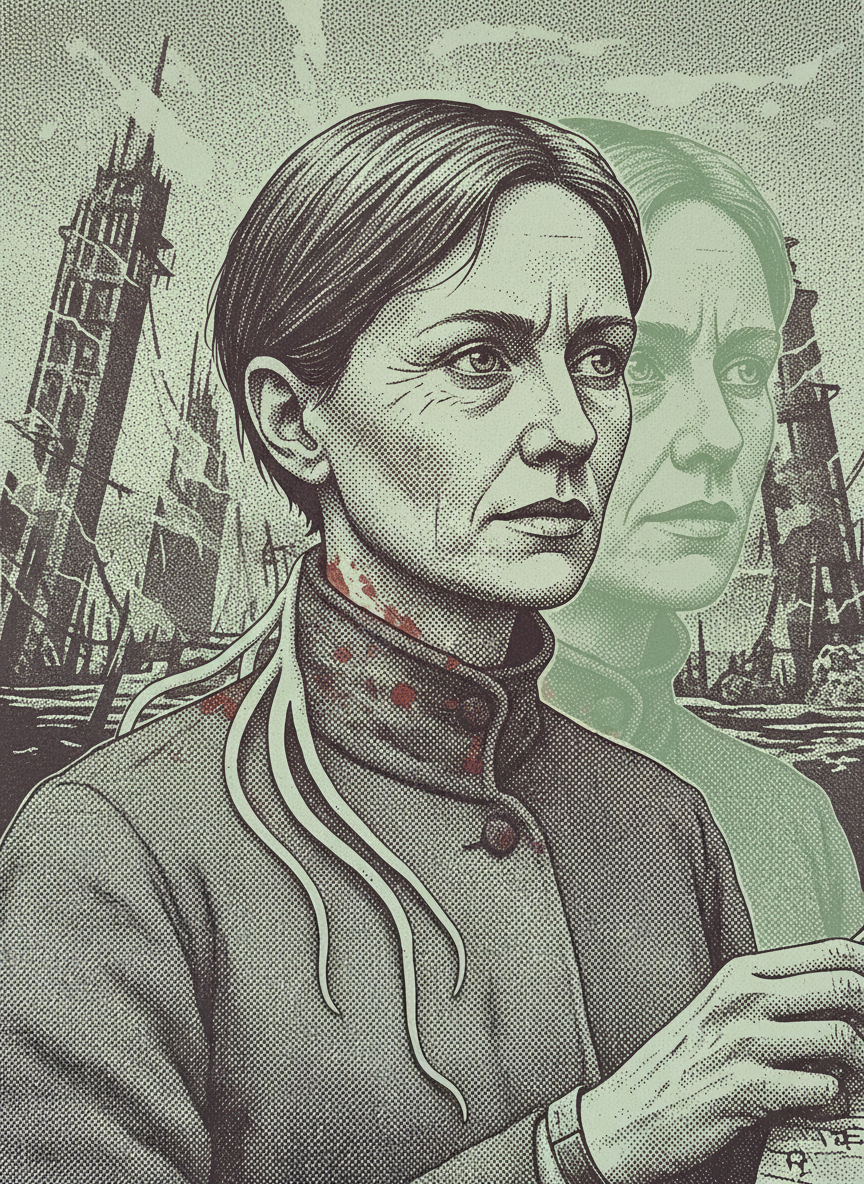
Air temperature at the third junction: minus four. Iodine on the tongue the whole way down from the quarry stair, sharpening as the drowned levels came up around the shoulders, because the quarry sea had frozen at the surface and gone on rotting underneath. Cladeweed died back to grey lace on every façade, the fat green ropes of it reduced to the mineral skeleton, so that the arcology's towers stood furred in something that looked like frost and crunched like shell. Under the lace the walls were callus, old empire callus, grown and re-grown and never once assembled, and when Pell leaned a shoulder against the north face of Tower Sixteen to check the survey bearing, the wall breathed. Slowly. Roughly twice a minute. Warm through three layers of grey felt. Pell recorded it as structure viable, respiration present, no cause for condemnation, which was true, and stepped back, which was preference.
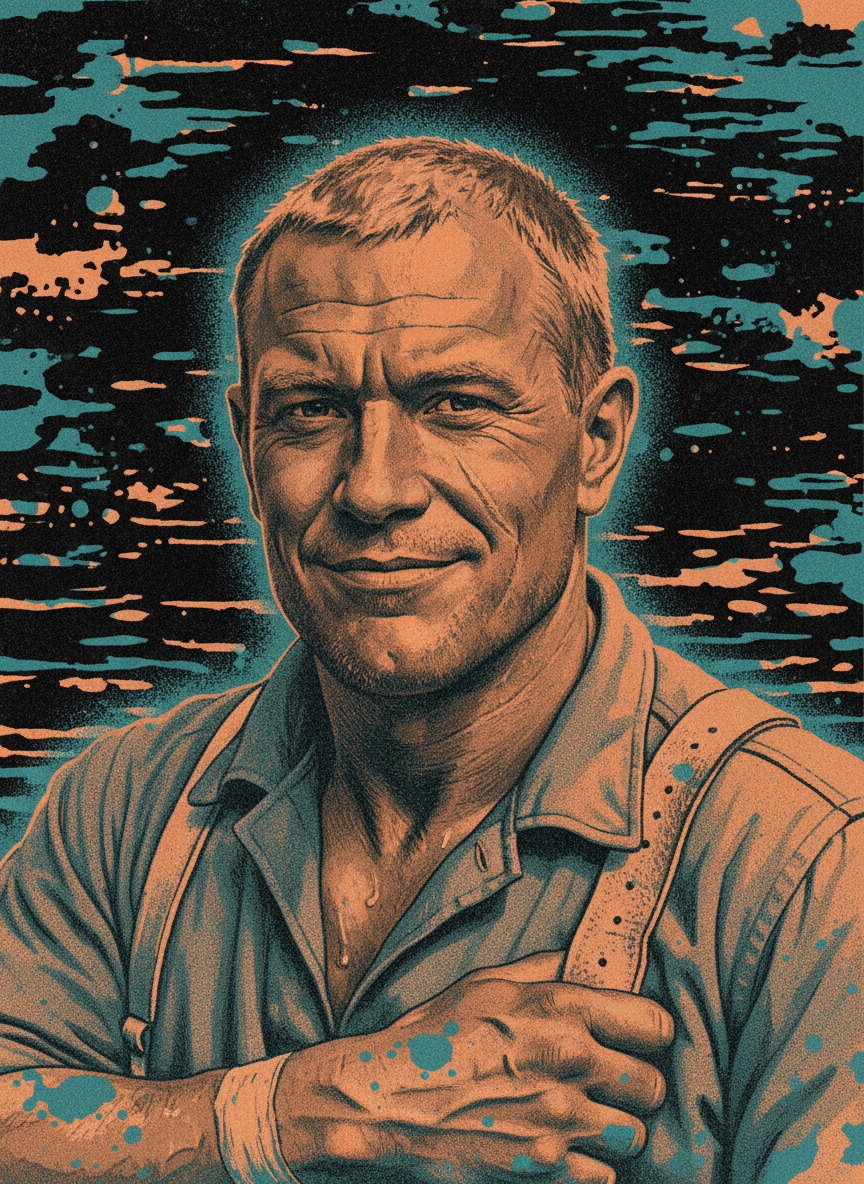
Blotch-light came down the stairwell shafts in the usual failing-lamp stutter: eleven seconds bright, a gap, forty seconds of something like dusk, a gap. It threw the shadow of the lace across the ice in patterns that moved when the sun did and not otherwise. Two streets east, at the flooded tower where the ice went thin over a methane vent, Ubbe Kell had the Slow Custom nosed into a window and was keeping the ion-weed hot in case the floor here decided to become the sea again. He had said, on the descent, that he would give Pell six hours and then come in after them, and Pell had said that coming in after them was how flat bodies got turned tidily inside out in a thickened room, and Ubbe had said six hours anyway, in the pleasant reasonable voice he used when he had already decided. The Match Bureau had paired them at nineteen. It had done excellent work. Pell had stopped resenting the quality of it somewhere around the fourth year.
The thickened hall was at the end of Fourteenth Transverse, behind a door that had no hinge because it had never needed one; it was simply that the wall there was only three-dimensional in patches, like fabric worn through. Pell took the graft-reading first, standing in the doorway. Spinal athwart-tissue, seventeen years old, grown at a cost that had taken Pell's whole grandmother and most of an uncle. Baseline ache four. In the doorway, six. Two paces in, eight, and a pressure up under the shoulder blades like a hand laid flat on a door from the other side.
Pell leaned.
It was a hand's width, no more, and it lasted a breath and a half. The hall unfolded and there was the room seen from outside its own skin: the floor a surface with a back to it, the lace-weed on the pillars revealed as tubes that went somewhere, the far wall not a wall but an edge. Nothing mystical happened. Space simply had one more way to be away from you. Pell came back into the Face with the taste of copper and made the notation — local thickening confirmed, grade three, stable — and then made the second notation, the private one, in the margin where the ledger tissue was thinnest.
Cladeweed in the hall was not dead back. It was growing, and it was not growing along the pillars. It came in through the middle of the air, entering the room from the direction the room did not have, so that each frond appeared at its widest point and tapered away in both flat directions like a thing being pushed through a membrane. Three of the fronds terminated at Pell. They had for two seasons now. There was no pain and no bleeding; the graft simply gave the weed a doorway, and the weed used it, patiently, the way weed used everything. Pell measured the nearest frond at eleven millimetres where it met the skin above the left hip. In the spring it had been nine.
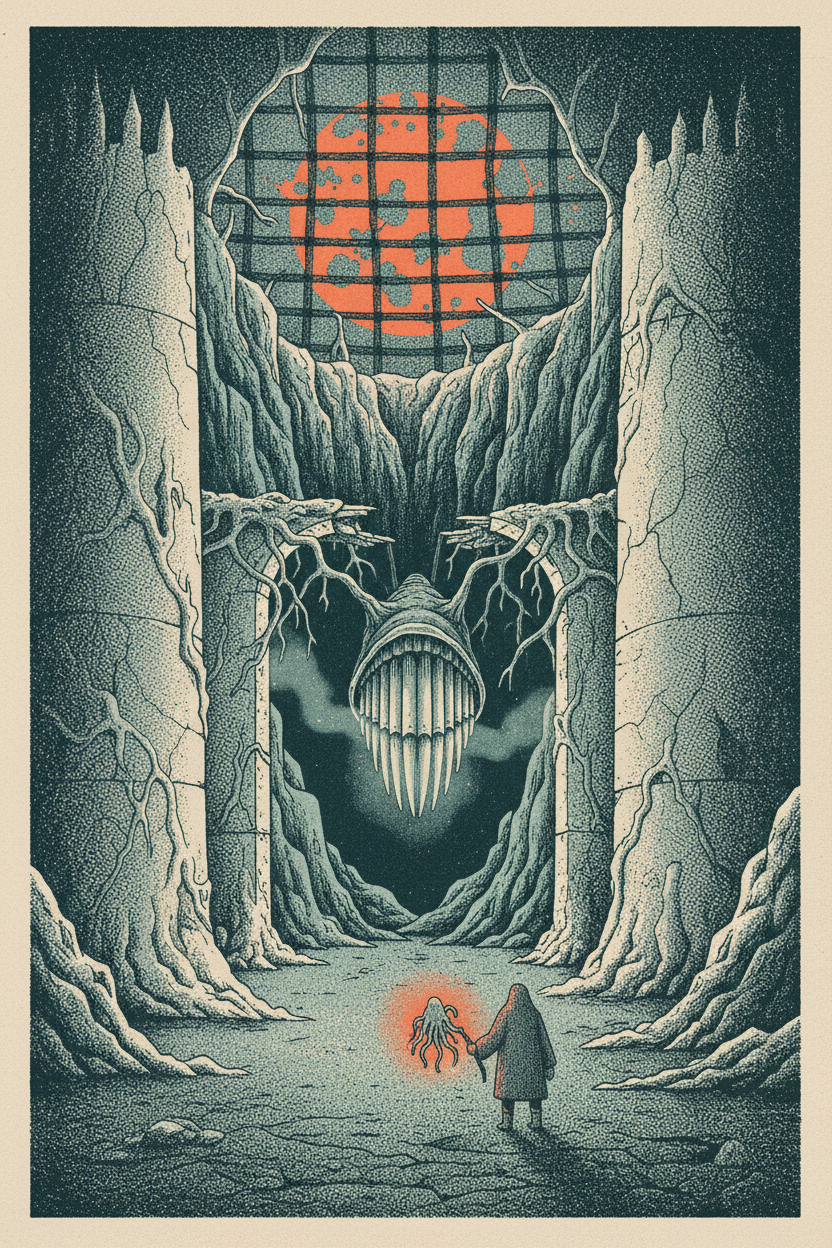
The gate-organ hung at the hall's far end, rooted in the thickened floor, pale and ribbed and mouth-shaped and inverted, the way all of them were, wild or licensed. Height four metres. Girth at the widest, two point six. Rootbole gone down into the fold with eleven visible anchor-strands, which was a mature count. It exhaled on the half-hour, and the exhalation smelled of milk and cold stone and moved the grey lace at the door.
Pell stood and counted for six hours and eleven minutes, which was twelve expected exhalations, and got eleven. The missed breath fell at the ninth interval. Pell waited, moved two metres, waited again, and got the same figure on the second cycle: one in nine, skipped. On the ledger it went down as sensor drift, thumb-ledger, recalibrate at grove. There was no sensor. There was a surveyor with a chronometer and a graft, and both were in good order.
The other inventory took nine minutes. A sleeping-bed of grown callus against the east pillar, cropped and shaped, not wild. A drinking-notch worn into the pillar itself at mouth height. A floor swept — not swept, walked: a path polished into the mineral dust between bed and rootbole and back, forty-one centimetres wide, the width of one person's stride repeated without deviation for a very long time. And a dish, shallow, callus-fired, set on the floor within reach of the mouth, holding six grove-fruit.
Pell put a finger to the dish. The dish was warm.
A wild mouth was a chokepoint, and a chokepoint was a government, and the Consistory owned six of them in the Bight and would very much like to own seven. The survey would go up as hall flooded, structure condemned, no organ present. Pell wrote it standing there, thumb steady, while the gate breathed. It was not a decision so much as the completion of one made years ago at considerable expense to a grandmother.
Behind the rootbole, where the light stuttered, something moved that was not weed.
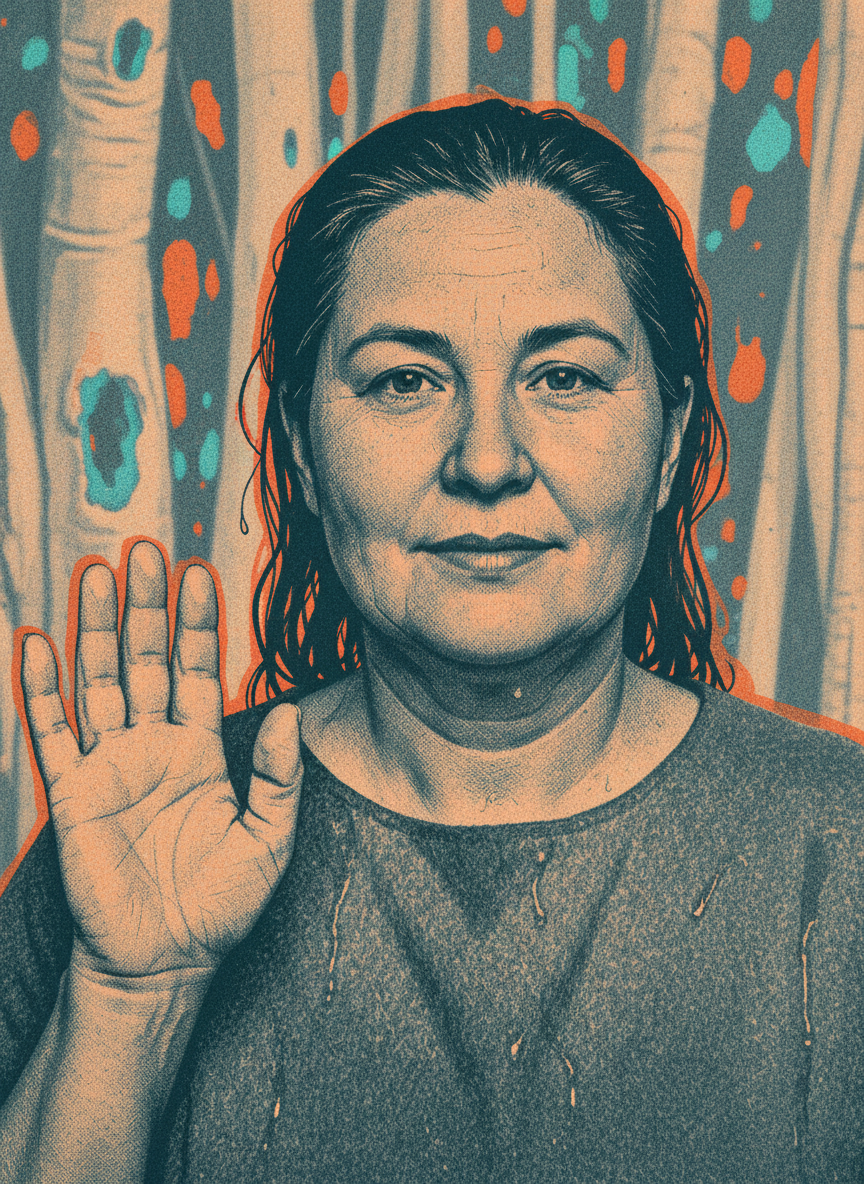
She came out of the grove without hurrying, a woman of perhaps fifty, well-fed, clean, in felt the colour of nothing. She looked at the ledger and then at Pell's face for a while, as though checking it against a list she had lost.
She picked up the dish and held it out.
"Who are you weeping for?" she said.
Pell did not take the dish. "That turns on which definition is in use," she said, "and on which instrument is taking the reading, and I'd want a second pass before I set anything down in tissue under a light this poor. What the file carries is one word, handed down from before the tables were pressed, meaning what it has always meant, and it is not a word I'd care to spend at a mouth I have not finished measuring. Salt. The entry runs no further than that."
The woman set the dish down again within reach of the mouth, precisely, so that the callus rim touched the two shallow depressions it had worn in the floor over some large number of years. "Six fruit," she said. "At morning. At dusk. It takes four. Two are left. The two go back in the dish. It has held so since the weed came." She straightened and looked at the sleeping-bed, and then at Pell, and made a small courteous movement of the hand toward it, the way a clerk offers the dry chair. "Be seated, keeper. The east side of the bole holds the warmth. You have stood six hours."
"Six hours and eleven minutes by my count, and I'd mark that provisional, having had no opportunity to recalibrate anywhere near a grove." Pell did not sit. "You've been running a count of your own."
"The mouth breathes at each half-hour. The ninth is skipped." Nothing moved in her face. "If you want a name, take it from the breathing. Others have."
"And whom is the weeping entered against?" Pell said, which was the question handed back, and was aware of doing it, and did it anyway.
"That was taken off," the woman said. "Long since, by your leave. The voice went first. Then the rest. Nothing remains to be said of it." She considered, and added, in exactly the tone she had used for the fruit count: "The weeping stayed. It has no need of a name. Travellers suppose otherwise."
Pell wrote nothing. The ledger tissue under her thumb was warm and slightly damp and had room on it for the observation, and the observation was this: harrowed stock, thoroughly drawn, went flat. That was the whole point of them; it was why they were calm and fertile and employable and why the dosing halls kept them in the back rooms doing the counting work. Flatness was a reading you could take at four paces. This woman was not flat. She was courteous, and she was quick, and she had made a joke about the mouth not having eaten her yet, and she was well-fed — genuinely well-fed, cheek and wrist and hand, in a street that had been under ice for sixteen days and under weed for ninety years, on six fruit a day of which the gate took four. Two fruit. Two fruit and a drinking-notch and fifty years of a forty-one-centimetre stride. Pell took the figures, found that they did not close, and set them down in the part of the survey that did not exist, next to the skipped breath.
The cladeweed came through the middle of the air behind her, entering from the direction the hall did not have, and three fronds of it terminated at Pell's spine and hip where the graft gave it a doorway; none of them terminated at the woman. Pell noted that too. Then she checked the chronometer, because the chronometer was in good order and Ubbe Kell was not a man who said six hours and meant seven.
"A resurvey will be wanted," Pell said, "provisional, pending conditions fit to work in, and this hall will offer none before the thaw. Should anyone come down Fourteenth Transverse carrying a garrison writ and a lamp-polyp, the hall stands flooded, the structure is condemned, and no organ is present."
"As you please," the woman said. "Come at dusk and be welcome. The count holds."
Pell went back up the transverse with the ache dropping from eight to six to four as the thickening thinned out behind her, past the breathing north face of Tower Sixteen, and came out onto the ice two streets east with eleven minutes in hand and the Slow Custom sitting in the window with her ion-weed hot and Ubbe's shape against the stutter of the blotch-light, already standing up. Cantle Lock was a day and a half north, and the false survey was pressed and dry, and the figures that did not close travelled with her the whole way.
Cantle Lock took thirty-one hours in the end, the Slow Custom coasting the frozen channel under half sail with her ion-weed banked, and a braking burn at the second bell that Ubbe laid in so gently the mugs never shifted in their gimbals. The lock itself was grinding when they came up the approach, as it always was, the great valve-muscles of it working against the ice with a sound like a slow animal chewing gravel, and the lock-town heaped above on its terraces of callus, lamp-polyps sour-yellow in the blotch-dusk, the whole of it smelling of iodine and boiled weed and the milk-and-cold-stone breath that drifted down from the grove precinct on the north shoulder. Pell went up to the survey window with the tissue dried and the thumbprints set. The clerk was a small man with the papery accent they all acquired, and he did not look up.
"Four-one-two dash Varish, thickened works, lower arcology, freeze-season survey, sheets one through nine." He ran his thumb down the returned tissue at reading speed, which was faster than anyone could lie at. "Fourteenth Transverse. Flooded, condemned, no organ present."
"Flooded as of the hour of inspection, which I would enter as provisional, pending resurvey once the thaw has had a fortnight at it," Pell said. "The ice tables set load-bearing four days later than the ice in fact delivered it, so the office had better not lean on my flood line to the centimetre either. Those tables were pressed thirty-one years ago, and no one, to my knowledge, has proposed pressing fresh ones."
"Noted as provisional. Pilot of record attests station hours?"
Ubbe stepped up and put his thumb in the wet square without being asked twice. "Six hours, window open to window shut. My girl sat in a tower two streets east with her weed hot the whole tide of it, and if the office wants the fuel figure it can have it, mate. It's ugly." The clerk did not want the fuel figure. The tissue went into the press, and the press took it, and a thing that had not happened in Fourteenth Transverse was now on record as not having happened, in nine sheets, countersigned.
On the way out Pell stopped at the notice wall, because it was there and because stopping at it was what a surveyor did. Most of it was dosing rota and tariff. Halfway along, fresh enough that the tissue was still damp and sweet-smelling, hung the revised amortisation schedule for grown tissue advanced against future bereavement, issued under the hand of Assessor Ruhl Sabbatine, Cantle Lock and the southern precincts. Column of case-numbers, column of grafts by type and year, column of principal outstanding in millilitres certified. Pell found the athwart-tissue block, spinal, seventeen-year, and read down it by thumb until the number that belonged to her came up under the pad, and the figure beside it, which had been one figure in the spring and was now another, larger by an amount the notice described as reassessment against revised expectancy of donor life. Nothing was demanded. Nothing was threatened. A number had been posted, the way weather was posted.
In the lock-town eating-hall Ubbe got soup into her before he said anything at all, which was his method, and then took out the little four-gram ledger he kept up his left sleeve and pressed two marks into it with his thumbnail, unhurried, the way a man marks off stores. He did not hide it and he did not explain it. Then he put it away and leaned back against the callus wall, which breathed, and grinned at her.
"Out early, cousin. Eleven minutes early. Seventeen years I've sat waiting on you and not once have you come up ahead of the bell." He tipped the last of the soup into her bowl. "So either that hall's cosier than you're letting on, or you turned up something down there that keeps better time than my watch. Eat. You're cold."
"The chronometer is in good order, and so is the graft, neither of which, you will note, constitutes a statement about the hall," Pell said, and drank the soup, and did not say that two fruit a day did not make a cheek like that, and put the figures that would not close back where she kept them, in the margin where the tissue was thinnest.
The eating-hall filled as the blotch went out over the lock, and Ubbe did not let the subject drop; he only put it down for a while, the way a man coils a tow-line he intends to use again. He got a second bowl, and a third for a bargeman who had no coin, and came back and sat with his shoulder against the breathing wall and said, conversationally, that a surveyor who came up eleven minutes early had either found a warm room or lost her nerve, and that he had known her seventeen years and the nerve was still where she'd left it. Pell said the hall was ninety years under weed and cold enough to crack the reading-tissue, which was a figure and not an answer, and he grinned at her over the bowl and did not blink. "Right, love. So it's cold, it's condemned, it's flooded — on the paperwork, anyway — and you sat down there six hours and came up early, and you've had a hand on that left hip since the tug. Eh. Give me one answer and I'll hand you a tide of quiet. Who's eating down there?"
She could have marked it provisional. She gave him a count instead, because a count was the smallest true thing available. "A dish, callus-fired, shallow, standing on the floor of the hall. Six grove-fruit in it, by my count, morning and dusk. Four go. Two come back. That is what the wear pattern on the floor will support, and the wear pattern runs to fifty years, give or take whatever the ice has made of the dust." She flattened her thumb on the table and did not look at his sleeve. "Two fruit a day, which — before you ask me to make the inference on your behalf — will not maintain a body of any weight I have measured, so either the tables on caloric sufficiency are as sound as the ice tables, or there is a variable I have not taken yet. I'd want a second pass."
Ubbe did not press further, which was worse; he said two fruit a day once, quietly, in the voice he used for a fuel figure he intended to raise later, and drank his soup. It was Dam Coith who filled the gap, three benches down, well into the evening's dose-hymn and considerably past the dosing — an old grove-keeper out of the north shoulder precinct, felt gone shiny at the elbows, conducting the flat unison with a spoon. He sang the seventh verse twice and then explained to no one in particular that people had the burning wrong. The wild groves in the war, he said, had not been torched because the Consistory was greedy; a greedy office harvests. You do not put a lamp to seven hundred millilitres of standing chokepoint unless there is a reason on the tissue somewhere, and the reason was never written down, and he had asked, and the answer he got was a posting to the shallows. A mouth that nobody licensed, he said, does not go hungry. That was the whole of it. It gets fed, and nobody can produce the donor, and when the clerks go looking for the donor they find a dish and a path worn in the floor, and after that the precinct keeps a fire budget. Then he lost the thread and went back to the hymn. Nobody at the table looked up; drunk liturgy was weather. Pell sat with her thumb on the wrist-ledger, in the margin where the tissue was thinnest and the private note was pressed, one in nine, skipped, and found that it itched under the pad like a splinter that had healed over, and thought about the two fruit going back into the dish, unchanged, since the weed came.
The thaw line moved three days closer while they were tied up at Cantle Lock — the precinct posted it on the same wall as the tariff, a wet strip of tissue giving the projected break of ice at Fourteenth level as eleven days out, which the ice tables said was impossible and the ice had already stopped consulting the tables about. Pell read it by thumb on the way down to the water stair and read, four fingers along, the amortisation notice again, where her case-number sat under a figure that had not changed since the reassessment and did not need to; a posted number does its work by standing still. Ubbe had the Slow Custom trimmed and her ion-weed hot before the bell and said nothing about any of it until they were an hour out, coasting the black channel between the towers with the blotch stuttering over the lace.
"Four hours," he said. "Not six. Thaw's walking at you and my girl can't swim, so four, window open to window shut, and then I come in after you and get turned inside out tidy, which is the only tidy thing in it, they tell me." He put the sleeve-ledger on his knee and pressed a mark into it with his thumbnail, without hurry, the third since the freeze began, and did not cover it with his hand. "Eh. And you'll tell me about the weed when you've a mind to. I can count, love. Been counting since the spring."
"The rate is on record; the error about the rate is not, and the tables anyone would check it against were pressed thirty-one years ago, so I'd want a second pass before I let a figure be set in tissue — provisional, pending resurvey," Pell said, which was true and which was also, by the fourth year, a sentence he could read the way a clerk reads a thumbprint. He laughed and let it go, and laid in a braking burn so soft the lamp-polyp in its bracket never swung.
In the hall the ache came up to ten two paces in, which was two grades worse than six days ago, and the frond above the left hip measured thirteen millimetres where it had measured eleven — a growth of two in six days against nine in a whole season, a third figure that did not close, entered in the thin margin under the others. The woman was at the bole, and she did not ask Pell to leave, and she did not ask Pell to help. There was no recording; there was no second person; there was no name said, before or after, and Pell stood at the sleeping-bed with the chronometer running and her eyes on the floor out of something she would not have called courtesy, and recorded only intervals. It took eleven minutes. What crossed the hall afterwards was a small grown vessel, two-thirds full and faintly warm, set within reach of the mouth; and the mouth took it, and did not seize, which is what a gate does within seconds when the grief in a dose is forged, or borrowed, or acted. The ninth exhalation was due at that moment. It did not come. Instead the mouth drew in, once, long, and the grey lace at the door leaned inward toward the rootbole rather than away from it, and Pell felt the graft pull under the shoulder blades like a hand laid flat on a door from the other side and pushing, for the first time in seventeen years, on the wrong direction of hinge.
The rootbole stood at nine paces from the sleeping-bed, and Pell walked them slowly, taking the ache at each one and pressing it into the ledger as she went: ten at two paces, eleven at four, eleven again at six, and at eight a step up to thirteen that had no gradient behind it, the way a floor has no gradient where it has a stair. She stopped inside the arc of the anchor-strands, close enough that the lace on the nearest pillar was behind her instead of between, and took the girth properly with the armspan cord — two point six one, which agreed with the first pass to within a centimetre and was therefore not growth but slack in the cord. Above her the mouth exhaled on the half-hour and the breath came down over her face, milk and cold stone, warm enough at this range to fog the reading-tissue, and she noted the fogging as a condition affecting the record. The chronometer said one hour fifty-three elapsed of the four. Ubbe would be sitting two streets east with his weed hot and his thumbnail resting on the sleeve-ledger, marking nothing yet, waiting to be given something to mark.
She leaned.
A hand's width, no more, and it was not like the doorway had been six days ago. The hall unfolded and the mouth unfolded with it, and what she had been calling four metres of ribbed organ turned out to be a cross-section, the thin flat slice of something that went on away from her in the direction the hall did not have, ribbed all the way down, eleven anchor-strands showing in the Face and a great many more than eleven where the Face was not. The dish sat on the floor beneath, and it had a back to it, and the two returned fruit sat in the dish like two coins on the lid of a box. None of that was the reading. The reading was that something in the deep part of the organ turned — not toward her, there was no toward, but the way a tongue moves to the side a crumb is on — and laid itself along the line of her graft for perhaps a second and a half, and tasted. She had nothing to give it. The voice had gone before she could hold a chronometer; the face had gone with the schooling; what was left was one word off a pressed sheet, inherited, meaning what it had always meant, and she felt it read, the whole thin remainder of a brother, the way a clerk's thumb goes down a column at reading speed. Copper in the mouth. The ache went to sixteen, which was a figure she had no comparison for. Then the pressure came off the shoulder blades, and it did not seize, and it did not close, and it let her go.
She came back into the Face on her knees with the cord still in her fist and forty seconds lost off the chronometer that she could not account for and entered as unaccounted. The frond at the left hip measured fifteen millimetres. There were now four, not three: the new one had come in through the middle of the air behind her and terminated at the graft line between the shoulder blades, and when she put two fingers on it the frond did not move against the skin at all — it moved when she moved, the way a thing moves that is anchored at both ends. She wrote fourth frond, seated, in the thin margin, under one in nine, skipped, and made the ache entries clean and in order, because the order was all she had, and got up. Behind her the woman was setting the dish straight in its two worn depressions, and did not look round, and said only that the east side of the bole held the warmth, and that the count held. One hour fifty-one remained of the window.
She came up out of the transverse with an hour and thirty-one minutes still on the window, which was the second time in seventeen years, and Ubbe had the Slow Custom out of the tower window and alongside the ice shelf before she had crossed the second street, running her in on weed alone, no sail, which he never did in a channel because it ate fuel he then had to explain. He did not offer a hand up. He stood in the hatch with the lamp-polyp behind him and looked at her face for the length of two of the sun's stutters, and Pell knew exactly what was on it to be read: the copper still at the back of the teeth, the pupils gone lazy in the blotch-dusk, and the way she had come up the shelf with her shoulders held level, because the fourth frond ran between the blades and moved only when she moved, so she had learned in three hundred metres not to shrug.
"Sit, love. You're a hand's width off going in the water," he said, quite pleasantly, and then, when she was down on the ballast locker with her back very straight and the reading-tissue out to be dried: "Four."
"Four what is the question I should want answered before I set my name to anything, a figure without its unit being not a figure but a noise," Pell said. "Ache at two paces read ten, at eight it read thirteen, and there is a step in the gradient at eight that I cannot account for by geometry, which I'd want a second pass on, and I'd want that pass made with a better chronometer than this office has ever seen fit to issue me."
He took the little ledger out of his left sleeve, unhurried, and held it flat on his palm where she could see it, and pressed the fourth mark in with his thumbnail. He did it slowly enough that she could have stopped him. Then he turned it toward the polyp so the pressure showed.
"Four marks since the ice came in. There's your unit, love — one a go. Not the weed. Not your hip. Not whatever's crawling up your back under that felt. I mark the times you come off a hall floor with your shoulders set like you're carrying a full pail, and then you stand there and tell me about gradients." He put the ledger away. "I've a number where I stop. I'll not say it out. You'd only go and survey it."
"Marking lies within your competence and outside my jurisdiction, and I'd not propose to interfere with a pilot's private stores," Pell said, and heard her own register go up a grade and could not get it down, which was itself a reading. "For the record — the record being the only article either of us will be asked to produce when the thaw arrives and the resurvey docket lands — nothing in that hall was altered by my presence, no dose passed through my hands, and the entry stands as filed: flooded, condemned, no organ present. Provisional. Pending."
"Pending." He said it the way a man repeats a fuel figure he intends to raise later. "Right. A cutter came up the channel while you were under. Garrison pennon, two clerks aboard with their thumbs already wet, asking after a surveyor's tug tied up where there's no survey posted. Told them I was warming a bad valve. Off north to the shallows they went, to look at the thaw line, which is what they came for anyhow. Eleven days, they're saying now. Eleven's blotch luck. My girl felt the channel shift under her at second bell, and the ice out past Tower Nine is talking to itself." He crouched, so their eyes were level, and put two fingers very lightly on the felt over her shoulder blade, where the frond was seated and anchored at both ends, and he did not press. "That's warm. Eh. Warmer than you are, cousin."
"Surface temperature at the graft line has run elevated since the spring, and the elevation is documented, and the documentation is thirty-one years behind everybody else's, so I'd not hang a great deal of weight upon it," Pell said. She folded the tissue into her cuff, thumb over the thin margin, where under one in nine, skipped and fourth frond, seated there sat now forty seconds, unaccounted, and it itched the way a healed-over splinter itches. "The ice will do what the ice does. I'd want the window again tomorrow. Two hours."
Ubbe stood up and went forward to his weed without answering, which was how she knew he had already decided, and the braking burn he laid in taking them off the shelf was the roughest he had given her in four years.
Ubbe gave her ninety minutes, which was not two hours and was not a negotiation. He said it while trimming ballast at the Tower Nine window with the ice talking to itself under the hull in long dry cracks like someone walking on shell, and he said it without a joke attached, which in seventeen years had happened perhaps four times. Then he found one anyway, on the way past: that the channel had shifted a second time overnight and his girl had strong opinions about drowning, and that he had once towed a barge of grove-fruit through worse and been paid in nothing but thanks, so ninety minutes was generous, all things weighed. At the hatch he stopped with his hand on the coaming and said, in a flat and pleasant voice, that she was nearer his number today than she had been yesterday, and that he did not intend to say what the number was, because the moment she had it she would start taking readings against it and finding herself within something. Pell said the request had been entered and the reduction noted, that a ninety-minute window would not support a full resurvey of a grade-three thickening and she would be filing it as partial, and went down the shaft with the wrist-ledger warm against her pulse.
The transverse had water in it now — real water, three centimetres of it over the mineral dust, running slowly north where nothing had run in ninety years, because the thaw was arriving from below the way the precinct's wet strip of tissue had not said it would. The grey lace hung heavy and dripping. In the hall the ache read eleven at two paces, which was one grade worse again, and the hip frond measured sixteen millimetres, and Pell took both figures standing in the doorway before anything else, because the order was all she had. The dish stood in its two worn depressions with two fruit in it, returned, unchanged. The woman was at the sleeping-bed with her sleeves pushed back, and Pell, who had spent the tug ride assembling a list of things that could account for a well-fed body on two fruit a day, took the forearm at four paces and found it exactly what it had been six days ago: a good arm, a fed arm, the arm of a woman who ate. There was no fruit stored anywhere in the hall. There was no second dish. There was a drinking-notch worn through eleven millimetres of pillar callus at mouth height, and Pell had spent nine minutes of the last window calculating how many years of drinking that represented, and the figure had been large enough that she had entered it in the thin margin rather than the sheet.
The woman had made two vessels. They stood side by side on the floor within reach of the mouth, grown things the size of a cupped hand, callus-walled and soft at the lip, and one of them was the mouth's and one of them was not. She set the first inside the arc of the anchor-strands, in the place the wear said it always went, and the gate drew it in and did not seize, and the half-hour exhalation that followed came down warm over both of them, milk and cold stone. Then she picked up the second and held it out at chest height, the way the dish had been held out on the first day, and said only: "By your leave, keeper. This one is yours. The mouth's was the other." No hymn. No recording playing softly in a warm grown room, no paired donor, no clerk with a wet thumb, none of the eleven procedural steps that the dosing halls posted on their own walls in flat unison. Pell did not take it, and looked at it, and got the readings she could get from four paces: two-thirds full, faintly warm, and the smell coming off it was not the milk-and-stone of the mouth's breath but iodine and something under the iodine that was nearly sweet, and Pell's back teeth answered it with copper before she had decided anything at all. The fourth frond moved when she moved. Behind the woman the gate's ninth breath came due, and did not come, and the ribbed length of it hung there in the failing blotch-light holding whatever it was holding.
"Before any article of that description went near my own chemistry, I'd want it named," Pell said, "what it was drawn from, at what interval, and against whose registry entry, and I'd want the whole of that on tissue, and then I'd want a second pass."
"As you please," the woman said, and did not lower her hand.
"Drawn this morning," the woman said. "Against my own registry, and no other's. It is not borrowed. It is not carried. It was set within reach. What is set within reach is given. What is given is not asked after." She did not lower her arm. "At dusk the count holds. Six fruit. Four go out. Two return. That is the whole schedule, keeper. The schedule is what I have to give."
"That is a feeding interval you have described to me and not a provenance, the two being told apart in every dosing hall between this doorway and the north shoulder, where a clerk with a wet thumb declines to press a dose-note absent the registry entry, the hour of draw, the donor's case-number and the name of the deceased the article was raised against, which comes to four particulars, of which you have furnished me none and a fruit count in their place." Pell heard her own register climb another grade and let it climb, because the alternative was to stand there and say the simple thing, which was that she wanted it. "I'd note further, for the record and provisional pending resurvey, that nothing produced under these conditions is certifiable, that an uncertified draw is by definition of unrecorded chemistry, and that I have neither the instrumentation nor the light nor, at this hour, the window in which to establish what it is I would be taking into myself. I'd want a second pass. I'd want it in a warm room, with an assay that works, and somebody else's thumb on the tissue."
"As you please," the woman said, and held the vessel exactly where it was.
Water came up over the toe-caps of Pell's boots while she stood deciding, which was the reading that settled it: four centimetres now, running north, one centimetre gained in the fifty-one minutes since she had come through the doorway, and if the rate held — and the rate would not hold, because nothing about this thaw was holding — the hall floor was a shallow sea before the resurvey docket was pressed, and then it was drowned for a season, and then it was burned, because the precinct kept a fire budget. Thirty-nine minutes on the chronometer. Ubbe two streets east with his weed hot and his thumbnail resting on the sleeve-ledger. Above her the ninth breath came due, and did not come, and the ribbed length of the mouth hung in the stuttering blotch-light holding its withheld exhalation the way a hand holds something behind its back; and six days ago something down inside it had laid itself along her graft line for a second and a half and gone through the thin remainder of a brother at reading speed, and she had been measuring the ache and the fronds and the girth ever since and had not once managed to get a figure on that. It was the only unmeasured article in the hall. She had been a surveyor for twenty-two years and had never yet left one standing.
She took the vessel. It was warmer than her hands and soft at the lip, and the smell came up out of it — iodine, and under the iodine the nearly sweet thing — and her back teeth answered with copper before she had brought it as far as her chin. The woman stepped back one pace, to the polished path, and folded her hands, and said only: "The east face of the bole keeps the warmth. Sit, keeper, before it comes on you."
Pell did not sit. Pell drank.
She went down without falling, which she noted, because the noting was the last instrument she had. The vessel was taken out of her hand — she registered the lip leaving her fingers as a pressure change and nothing more — and then there were hands under her arms from behind, set high and flat against the ribs the way a person is held who is meant to keep standing, and the woman's breath at her shoulder saying something about the count holding, and after that the hall went the way a wall goes when you lean athwart of it: not away, but around, one more direction added to all the ones already in use. What replaced it was Barrow Reach in blotch-summer, unfrozen. Pell had never seen it unfrozen. Nobody alive had. The ice was off the channel and the water was black and moving and there were tide-grazers out past the Ninth mole, and the cladeweed was green and fat on the façades instead of grey lace, ropes of it thick as a thigh, dripping, warm, and the light came down the stairwell shafts steady. Steady was the reading that went wrong first. Eleven seconds, then forty, then eleven — that was what a sun did; this one simply poured, unstuttering, on the wet stone, the way no sun in her twenty-two years of survey had ever once been kind enough to do, and she stood in it taking the ache in her spine and getting nothing, baseline nothing, a body with no graft in it. The smell coming up off the street was iodine and the nearly sweet thing under the iodine, and as she walked the sweetness thinned out of it and what remained was milk and cold stone.
The streets were correct. That was the second wrong reading, and the worse one. Fourteenth Transverse ran where it ran, the drinking-fountain polyps were where the ninety-year wear said they had been, and the door at the end had a hinge, because here it had never worn through into the fold. People went past her with faces that did not resolve at any distance she tried — four paces, two, arm's length — and did not look up, and there was no one on the street she could have testified to. In a doorway off the transverse somebody had left a man's felt across the back of a chair, and a working-notch cut into the jamb at shoulder height, and a coil of armspan cord hung on a peg with the slack taken up properly, which she had never in her life seen anyone but herself do, and it came up under her sternum then, an ache with no entry behind it, grade eight and rising and belonging to nobody she could name. She was still standing in front of it, trying to get a figure on a thing that had no dimensions to take, when the floor gave. Not broke. Gave, the way a fold gives: the stone remained perfectly solid and simply stopped being the top of anything, and she went down through it with her hands out and the warm street closing over her like a lid.
Below was older and drier and had no weather in it. Figures walked the sediment in every direction, many of them, none of them hurrying, wearing faces that sat on them the way borrowed felt sits, and they did not think — Pell was a surveyor and could tell an organism transacting with its surroundings from one that was not, and these were not; they walked because walking was the last shape left in them. She went along the line of them because there was nothing else to take a bearing from, and came to a doorway, and in the doorway a boy stood with his back to the light, and the boy said one word, and the word was salt. She knew the voice. That was the difficulty. She had never known the voice; the voice had gone before she was old enough to hold a chronometer, sold off her in a warm grown room by somebody else with a clerk in attendance, and there it was, being handed back to her, complete, with the crack in it where it had been about to break for good, and her chest opened on it the way ice opens on a vent — fresh, whole, six days old, a bereavement with the shine still on it for a person whose face she did not have and had never once in forty years been able to want. Copper flooded the back of her teeth. She stood in the sediment with the new grief coming up in her like water into a transverse, running north, one centimetre and then two, and got her figure at last: the mouth did not only take. It took, and then it grew the loss back in the donor, patiently, the way weed grows back on a façade after a freeze, so that the same field could be cropped again and again and again off the same dead; and upstairs, in a hall four centimetres under water, a woman had been standing that cycle for fifty years, well-fed on two fruit a day, weeping unbroken for someone whose name had been harvested off her so many times that the schedule was all that remained — six out, four taken, two returned, no exit anywhere in the count — and Pell's own case-number was now on that rotation, current, drawn this morning, provisional, pending resurvey; and then the sediment went out from under her too, and the milk-and-stone smell became the hall's own breath, and she came up choking with water at her knees and the woman's hands still flat against her ribs, and somewhere back along the transverse, much nearer than two streets east, Ubbe was shouting her name into the dark and the lamp-polyp light was swinging.
He was in the water before he had the lamp steady, which was how she knew he had stopped piloting and started wading: the Slow Custom's polyp swung from his fist on its bracket-strap and threw the grey lace into and out of existence along the transverse, and the light came at her in pieces — his boots, the black run of the flood going north, his hand, nothing, his face. He was calling her name, which was legal and which nobody in the Bight did indoors, and he was calling it the way a man calls a fuel figure across a channel, flat and loud and twice over. Then the lamp found her on her knees with the woman's hands still flat and high against her ribs, and he stopped calling, because her eyes were open and looking at him and he could not have said what was behind them.
"Up. Come on, love, you're sat in the wet." He got an arm under her and she went away from it — not far, a hand's width, the exact distance the graft allowed, except that this time there was no unfolding in it, only a body flinching off an ordinary warm touch as though a touch were a procedure and the procedure took something. He noticed. He was a man who noticed trim by the sound of the hull. He let go, held both hands up in the swinging light where she could see them empty, and came in again slower, the way you approach a beast on a tow-line. "Eh. Easy. Easy now. Nobody's taking anything off you. It's only me." Her mouth was doing something. She got the shape of the report ready, water depth at seven centimetres and rising, duration of insensibility unaccounted, condition of subject provisional — and what came out of her, in the flat voice she used for grades, was: "Salt." She heard it leave. She had no entry to put it against. Her chest was full to the lip with a bereavement six days old and shining, for someone whose face she had never owned, and there was no name at the end of it to write down, and she reached for one anyway, the way a hand goes to a pocket that was cut off the coat years ago, and found the seam.
"Right," Ubbe said. "Right. That's four, and that's — " and he stopped. He stood there in seven centimetres of ninety-year-old thaw with his thumbnail already on the sleeve-ledger and he stopped, and shut the ledger against his palm, and put it away unmarked, which she would think about later for a long time. "No. Not writing it. You'd only lie up all night counting yourself against the number." He got her arm over his shoulder and took her weight and started her north along the polished path toward the transverse, the water shoving at their shins in the same direction, and behind them the mouth exhaled its half-hour breath, milk and cold stone, and the grey lace leaned. The woman did not follow. She stood by the bole with the empty vessel held level in both hands and the light going off her in pieces, and said, to nobody in particular, in the voice of a schedule: "The tally stands. Six at dusk, set within reach." Pell turned her head to get a reading on her and could not hold the figure; what she held instead, absurdly, was a coil of armspan cord hung on a peg with the slack properly taken up, in a doorway that was not in this hall and not in any survey she had ever filed, and she could not place it, and she entered it nowhere, and it stayed.
The water was at nine centimetres by the time they made the mouth of the transverse, and Pell had the figure before she had anything else: nine, from seven, in the time it took two people to cover a hundred and ten metres badly, which gave a rate she could have set down in tissue and defended at a window. The cold was a proper reading too — shins first, then the knee-joint going stupid, the felt taking up water and doubling its weight — and the current was helping, shoving north through the dead lace at the pace of a slow walk, which meant the head of it was somewhere above them and rising faster than the floor here was filling. All of that came to her in order and stayed where she put it. Behind them the mouth let out its half-hour breath, milk and cold stone, and the sound of it came up the transverse warm against the back of her neck and then thinned, and the woman's voice thinned with it into the flat recital of a schedule — six at dusk, set within reach, two returned — until the words stopped arriving as words and arrived only as the interval between them. Pell then attempted, as an exercise, to put a grade on the thing sitting in her chest. Six-day-old bereavement, shine still on it, no name and no face at the end of it. She reached for the scale and the scale was not there. Not broken; absent, the way a floor stops being the top of anything. She could take a figure on the water to the centimetre and on the ache to the grade and on the rate of rise to two places, and on her own sternum she could take nothing at all, and she noted the failure of the instrument with the part of her that noted things, and found she was more frightened of that than of the flood, by some margin she also could not measure.
Ubbe had her right arm over his shoulder and his left hand spread flat on her back to keep her off the wall, and he was talking the whole way, which was how he worked a bad channel. "Sour valve. That's what I gave them, and it's no lie, cousin, she's run sour since the shallows hop and I've been meaning to cut the rot out of her. Eh — fuel figure's coming out filthy. Filthiest since the season I towed fruit for thanks. Office won't see it. Let them chew the weed-rot and choke." Water broke white around his knees at the junction and he went through it without slowing. "Wrote nothing down, if that's the tally you're sat there keeping. Nothing worth the ink. Pilot's stores, the lot of it, and the stores are mine, and there's no clean line left in that book anyhow." He got them past the stairwell shaft, where the blotch came down in its eleven-and-forty stutter and showed the flood going north below them like something being poured out of the level above, and he tried the joke: "You came up early, anyhow. Twice now, love. Do it again and I'll bill you for the tide of sitting about." It did not land. He heard it not land, and shut his mouth on the end of it, and after that there was only the water and his breathing.
His hand did not move off her back, and she felt him feel it — the palm settling, then holding, then deliberately not adjusting, over the place between the shoulder blades where the fourth frond was seated and anchored at both ends, and where the felt had been running warm since spring and was running warmer now. He said nothing about the heat. He said, instead, that the cutter was away north in the shallows measuring a thaw line that had already walked past them, which was blotch luck, and that they had the channel to themselves, and that his girl would be sitting exactly where he left her because he'd taken the slack up properly on the tow. The word went into Pell like a splinter going back under the same healed place: slack, taken up properly, a coil of armspan cord on a peg in a doorway that was in no hall she had ever surveyed, hanging there with the turns laid dead even, and she reached for the entry it belonged to and found the seam. She thought, briefly and without connecting it to anything, of the amortisation notice on the Cantle Lock wall, her case-number under a figure that had not changed and had no need to. Then the quarry stair came out of the dark above the waterline, dry for three more risers, and Ubbe took her weight onto it and they climbed.
The Slow Custom got clear of Tower Nine on weed alone and then Ubbe gave her half sail and let her coast, because the channel had opened enough to be honest again and there was nothing to be gained by burning fuel he would have to call stores twice. Pell sat on the ballast locker with her boots off and the felt wrung out and hung by the polyp bracket, steaming faintly, and did the proper work, which was the only work available. Water at the mouth of the transverse: nine centimetres, rising. Rate, seven to nine over a hundred and ten metres of transit at reduced pace, call it eleven minutes: one point eight centimetres the hour, which she noted as gross and unreliable, since the flood was arriving from below and a rate taken at the tail of a flood tells you about the tail and not the head. Ache at two paces, eleven. Hip frond, sixteen millimetres, taken cold and therefore low. Duration of insensibility, unaccounted — she left the field blank rather than guess, and the blank sat there on the sheet looking exactly like every blank she had ever refused to fill, and was not like them at all. Outside, the blotch came back over the ice in patches, eleven seconds here and nothing two streets along, so that the drowned towers lit and unlit out of order, which was normal and which she had stopped noticing twenty-two years ago and noticed now.
Her thumb went into the thin margin without being sent there. What it pressed was not a note. It was a schedule: a draw of unspecified volume returning a voice, six days shining; a second draw, presumably, returning something further — the crack in it, the shape of a shoulder in a doorway, the face, eventually the word with an entry behind it — set against interval of regrowth, unknown, call it provisional; set against cost per instalment, unknown; set against total tenor, unknown, and every line of it a thing she would have refused to countersign from anybody else's thumb. She was three lines in before she recognised the form she was writing in, which was the form of an amortisation, and she did not stop. She noted instead, in the way a surveyor notes a figure that has appeared twice in unrelated columns, that the path in the hall was forty-one centimetres wide. A stride is not a unit. Forty-one is a unit: it is a tide, the subjective length of a passage, the interval a traveller spends inside the organ before the far grove lets go. Fifty years of a woman walking bed to bole and back at the width of one transit, and a notch worn eleven millimetres through pillar callus by a mouth coming to the same place on a schedule, and six fruit, four taken, two returned, morning and dusk, no exit anywhere in the count. Pell looked at the numbers side by side and did not put them in the same sentence. The margin held them a line apart, which was where she left them.
Ubbe came aft to check the trim and stood over her longer than the trim required. He did not ask. He put two fingers on the wrist-ledger where it lay open on her knee and ran them down the thin edge at reading speed — he had always been able to, he read tow-manifests by thumb in the dark, and in seventeen years she had never once seen him do it to her ledger — and he came to the end of the margin and took his hand away and looked out at the ice going bright and dull in no order. Then he said the channel would hold to the shallows fork and he wanted her off the locker and into the warm before the cold got into the graft, and went forward, and did not touch the sleeve where his own ledger sat unmarked. Pell stayed where she was a while with the tissue drying under her thumb. The coil of cord hung on its peg in the doorway of a hall she had never surveyed, turns laid dead even, slack properly taken up, and she had no column for it, and it did not ask for one. Cantle Lock was thirty-one hours north with her case-number posted on a wall there under a figure that had no need to change.
The notice wall showed before the town did. That was the order of arrival at Cantle Lock from the south: first a smear of sour yellow on the underside of the blotch, then the lock's grinding coming across the ice as a vibration in the hull rather than a sound, and then, a full quarter-hour before the terraces resolved into terraces, the wall itself — a pale ribbed rectangle of pressed tissue hung under its own bank of polyps, because the Office lit its postings before it lit its stairs. Pell sat on the ballast locker with the felt dry now and watched it come up out of the dark at coasting speed, and knew to the finger's width where her case-number sat on it, four columns in, athwart-tissue spinal seventeen-year, under a figure that had been reassessed in the spring and had not needed to move since. Ubbe said nothing for the last two hours. He trimmed, he laid the braking burn in soft, he checked the tow-line on its cleat and took the slack up properly, turn on turn, dead even, and Pell looked at his hands doing it and felt the unfiled thing move under her sternum with no scale to put against it. She got a figure on the approach instead: eleven hundred metres, closing at a walking pace, sour light, nothing in it that had changed since the last visit except every single thing.
The assessor was on the receiving terrace, which did not happen. Assessors were a signature at the bottom of a schedule; assessors were a figure that stood still. This one was small and grey-felted and dry as pressed tissue herself, with a clerk at her elbow holding a fresh notice already pressed and already wet-thumbed, and she began before the warps were on the bollards. "Case four-one-two dash Varish. Athwart-tissue. Onto the terrace." Pell went down. The notice was held out at reading height and not given, and Pell put her thumb on it and read: same case-number, same principal outstanding, and beneath it a new line, accrual interval amended, collateral review pending — grafted tissue advanced against a wasting asset to be re-secured on notice. "Twice on the last line," Sabbatine said. "Every schedule this office keeps rests on one assumption. Bereavement depreciates. Voice, then face, then name, then nothing, and the tenor closes on term. Advances are priced to that curve. Now file the contrary case — a bereavement that accrues back up the column. Outcome? Not a release. An asset of indefinite tenor, and an office that has been discounting it as breakage. Is that followed, or is a written note required?" Pell stood with the wet thumb-square cooling under her hand and heard the lock chew gravel behind her and said that the proposition as stated would want an assay, a controlled interval, and instrumentation considerably better than the Bight had seen fit to issue anybody in thirty-one years, and that she would enter no opinion on a figure she had not taken herself; provisional, pending resurvey. "Entered," said the assessor, who had not asked for an opinion. "Pilot of record, forward."
Ubbe came down the plank with his hands empty. "Scheduled audit," the clerk recited, "graft-collateral exposure, class three, holder's household. Private stores-ledger, pilot's. Hand it up." He did not move at once, which was the whole of it; Pell had watched him produce papers for garrison cutters twice a season for seventeen years and he had never once taken longer than a breath about it. Then he pulled the four-gram tissue out of his left sleeve and laid it on the clerk's palm face-up, and the clerk's thumb went down it at reading speed, which is faster than anyone can lie at, and found four marks and no column headings and nothing else whatsoever. "Four marks. No headings," Sabbatine said. "Charged against what?" And Ubbe said, flat, in a voice with no joke anywhere near it, that they were valve failures — sour weed, port side, four since the ice came in, and if the Office wanted the fuel figure it could have that too, it was filthy. He said it looking at the assessor and not at Pell. It went onto the clerk's tissue as declared, four, valve, unverified, and the sleeve-ledger came back to him and he put it away, and the marks in it now meant something written down and false, which they had not meant an hour ago. The assessor was already turning. "Further item. The household is present, so it is put now. Fourteenth-level thaw: inside the precinct's holding period. Docket advanced. Garrison detail draws fire stores at the sixth bell, down the quarry stair on the morning tide, weed burned back ahead of the water. Standing budget, southern precincts. No writ required." She paused at the stair with her hand on the callus rail. "The condemned hall stands on their line of march. Attendance required: surveyor of record."
Fire stores were drawn at the sixth bell and itemised on the terrace in the cold, because the Office itemised everything: eleven oil-gourds cultured at the shallows and stoppered with wax-callus, four striker-wicks in an oiled roll, two bladders of blight-spore for the deep lace that would not take a flame, a pole-hook, and a sled of grown slats to drag it all down two hundred and ninety risers. The detail was nine garrison in grey felt with the collar-flash, two clerks, a medic-of-record with her case-book strapped to her forearm, and Assessor Sabbatine, who walked with a stick and did not use it, and who had said nothing at all since the terrace except to correct the count of gourds from ten to eleven. Pell walked fourth from the front, as surveyor of record, which put her where she could be seen. She took her own figures on the descent because taking them was the last procedure she had left: air at minus one at the stairhead, minus five at the hundredth riser; iodine sharpening; baseline ache four at the top, which was correct, and six at the hundredth, which was not, since six was a doorway reading and there was no thickening in a quarry stair, and nine at the two hundredth, which had no entry to sit under at all. She noted it as graft response, exertion, cold, provisional, and went on walking, and the sled went down behind her on its slats with a sound like a slow animal being dragged.
At the turn above the Fourteenth landing, where the stair doubled back and the blotch came down the shaft in its eleven-and-forty stutter, the join let go. Not tore — she would be exact about it afterwards, in the margin, because exactness was all she had to lay over it — but pulled, hard, in the direction the stair did not have, the way a hinge pulls when the door is opened against its own leaf, and the ache went up past sixteen and off the end of a scale she had been keeping for seventeen years and found that there was nothing written beyond it. She went down on one knee on the riser with her hand flat on the wet stone. Copper in the mouth. Forty seconds she could not have sworn to. And under the felt across her back, the seated frond moved while she did not, which it had never done, lifting the cloth between the shoulder blades in a slow travelling ridge like something turning over under a blanket, and the hip frond with it, and the youngest clerk — twenty, perhaps, thumb already wet — stood two risers above her and watched the cloth crawl.
"Strap's gone slack," Ubbe said, and was between them before the clerk had finished looking, taking the ledger-strap in his fist and hauling it round hard enough to hurt, which was the point, since a hauled strap explains a moving felt. "Rot it, cousin. Told you about tissue under the felt in a freeze. It swells. Sits up like a cat." He got her elbow and her weight and made a business of the strap for four seconds longer than it needed, and he did not look at the clerk and he did not look at Pell, and there was nothing warm anywhere in it. The medic came down past two of the garrison with her case-book already open. "Surveyor of record, on the sheet — graft, spinal, athwart, class three. Present episode: syncope or arrest of function?" Pell got upright and got formal, which was the only direction she went. "Neither of those words would come through an assay intact. What can be offered is a figure: ache four at rest, ache nine on the stair, and a transient at the turn which I'd enter as off-scale rather than dress up as a number, the scale in question being mine and not the Office's, and pressed thirty-one years ago, like every other table issued to this level." The medic wrote. Then, without looking up: "Prior episode, partial resurvey, Fourteenth Transverse. Field is blank. Duration of insensibility?" Nine people had stopped on the stair. Behind them the sled had stopped too. "Blank," Pell said, "and provisional, pending resurvey. An interval I did not time is not an interval I'll press into tissue; the Office may keep the blank, or it may keep a fabrication, and nobody has ever, by my count, asked the Office which of the two it would rather carry on its books."
"Logged," Sabbatine said, from four risers up, "as refusal. Not dispute." The stick came down once on the stone, not for balance. "The household stands on the sheet. Item raised here. Pilot of record. Valve, sour, four failures declared. Detail withdraws by water at the turn of the tide. Is the hull certified to lift eleven off a flooded level, or is the declaration amended?" And Ubbe, flat, with nothing hung off the end of it: "Eleven, she'll lift. She's sour, not spent. I'll nurse her." Nobody amended anything. The detail took up the sled and went down the last ninety risers, and at the landing the water was over the toe-caps before anyone's boot touched stone, black and moving north at the pace of a slow walk through grey lace that dripped, and the transverse ran away from them into the stuttering dark for a hundred and ten metres, at the end of which stood a door with no hinge, and beyond it a dish with two fruit in it, and a woman who would be setting the dusk count within reach in something under an hour.
They went up the transverse in file because the transverse allowed nothing else, nine garrison and two clerks and a medic and an assessor and a surveyor of record, and the sled would not float and would not drag, so the gourds came off it and went along under arms, two to a man, eleven of them, wax-callus stoppers up. The burning was done as they walked and done badly: a striker-wick to the grey lace at shoulder height, a count of four, and the lace would take a flame for perhaps a metre and then go out where the drip had got into it, so that the front two men worked the pole-hook instead, dragging the wet stuff down in sheets that fell into the water and floated north with them like skin. It smelled of iodine and scorched shell. Pell walked fourth and took what figures the dark allowed. Water at the twentieth metre: eleven centimetres. At the sixtieth: thirteen, and the current had strengthened enough to push at the back of the knee. Ache, four at rest, which was correct; six at twenty metres, which was not, there being no thickening within eighty metres of here by her own survey, pressed and countersigned; nine at sixty; and at eighty the join between her shoulder blades pulled athwart on its own again, unhurried, the way a hand turns over a page, and she stopped and stood with her palm flat on breathing callus until it let her go. She did not count the seconds because she had nothing to count them against. Ahead, where the lamp-polyps swung, the lace hung thinner and greener and did not want to burn at all, which the garrison read as damp and which Pell read as weed that had not died back with the rest because it was not coming in along the wall.
It was the young clerk who saw first, which was arithmetic: he had the second lamp and he was tall and he was looking for somewhere dry to put his book. He stopped at ninety metres with the light held out and said, in the flat registry voice they taught them and could not quite hold at twenty, that there was a floor here that had been walked, and then, a beat later, with the voice gone out of the dialect altogether: that there was a person standing in it. Eleven lamps went that way at once. The hingeless door was ten metres on and the hall beyond it had a shape to it now, water gone black and still under the arc of the anchor-strands, the two worn depressions drowned, the dish lifted off them and held; and the woman stood in the middle of the polished path at the width of one stride, in felt the colour of nothing, with the six fruit counted out in the dish in her hands and her sleeves pushed back, waiting on the dusk the way she had waited on it for fifty years. She looked at the lamps. She did not look at Pell first, which Pell noted, and was grateful for, and entered nowhere.
"Surveyor of record. Stand forward." Sabbatine's stick came down into the water and stayed there. "Sheet on file states: flooded, condemned, no organ present. I observe wear pattern. Cultivated bed. Occupancy. Under what case-number was that entered?" And Pell, who had had ninety metres to build the sentence and built it anyway out of the only material she had: "Occupancy sits outside the remit of a structural survey, the Office having issued no form on which a surveyor may enter a living woman found standing in a condemned hall, and I'll have that much entered before anybody leans on anything further — the article she is holding is a dish, the polish beneath her runs fifty years at the shortest reckoning, and I'd mark the whole of it provisional, pending instrumentation this precinct has not seen fit to issue since the tables were pressed, thirty-one years back." "Logged," the assessor said, without looking at her. "Detail. Lamps raised. Advance." And Ubbe, from behind the medic, in a voice with nothing hung on the end of it at all: "Thirteen on the water and the head's above us. Twenty minutes, then we're swimming, and my girl takes eleven or she takes nobody." Nobody amended anything. They went forward the last ten metres and the doorway opened, and the lamps went up, and the mouth was there.
Four metres of it, pale and ribbed and inverted, rooted where the floor stopped being the top of anything, the eleven strands going down into black water and not stopping at the bottom of it. The garrison in front stopped so hard the man behind walked into his gourds. Somebody said a word that was not in the registry dialect. Pell had the chronometer up before she had decided to, because the half-hour was at fourteen seconds and the count in her margin ran one in nine and this was the ninth; and the fourteen seconds went, and nothing came, and the whole detail stood in thirteen centimetres of ninety-year thaw waiting for a breath from a thing they had no form to file, and did not know they were waiting, and waited anyway.
The half-hour went by at fourteen seconds and the breath did not come, and then the thirty seconds after it did not come either, which was new; in two seasons of counting, the skipped ninth had always been a gap of exactly one interval, closing again on the tenth, and Pell had the chronometer up and the figure forming and nothing at all to put the figure against. Nobody in the detail moved. Thirteen centimetres of water went on running north past eleven pairs of boots with a sound like cloth being drawn over stone, and the lace overhead, green and unburnable, leaned in toward the rootbole and stayed leaning. The medic's case-book was open and her thumb was dry. Pell registered that as an observation and could not say what it was an observation of. Ache, four at rest was still true and had stopped meaning anything; the scale went up to sixteen and the hall was somewhere past the top of it, and a surveyor with no upper bound is a person standing in the dark with a stick.
The woman set the dish down in the black water, which drowned it, six fruit floating loose, and said a name.
She said it flat, the way she said the fruit count, and it went out across the water into nine garrison and two clerks and an assessor of the southern precincts — Ossen Tarl — and one of the clerks made a small noise, because a name of the dead spoken aloud is seized property being handed back to nobody, and there is a form for reporting it and no form for hearing it. Then she said it again, and the second time it did not come out flat. Something arrived in her face while the syllables were still in the air, arrived the way water arrives from below, and Pell watched fifty years of schedule go off a woman in under four seconds: the hands opened, the jaw went, the courteous level voice broke in the middle of the second syllable and she said it a third time badly, with the crack in it, and a fourth, and then she was not saying anything at all, only weeping in a way that had a person at the end of it. Her knees went. She did not fall; she stood in the flood shaking with her sleeves pushed back and her mouth still working, and she looked straight at Pell for the first time that evening, and her eyes had somebody behind them who wanted to be told where he was.
"Secure — " Sabbatine said, and stopped, because the word after it would have been a clause, and she did not have one. The stick came up out of the water and hung. "Clerk. Enter this. Licence absent — " Stop. "Party in occupation of a structure scheduled for condemnation, uttering — " Stop. Her voice came back down into fragments and the fragments did not connect to anything: case-number withheld, article not classified, refer the tenor, refer it. The young clerk stood with his thumb wet and his tissue held out into the dark and pressed nothing into it, because he had not been given a heading. Pell found she had taken one step forward without instruction and that her fronds had moved while she had not, the felt lifting across her shoulder blades in a slow travelling ridge, and then Ubbe's hand came flat between them from behind and stayed there, not pulling, not adjusting, warm through wet cloth. He said no number. He had a number and he kept it, and the keeping of it was the only fixed thing in the hall; Pell set her weight against it the way you set a cord against a peg and got upright. Above them the mouth did not exhale. It drew, once, long, and went on drawing — the lace bent flat toward the rootbole and the loose fruit turned in the water and began to travel, and eleven anchor-strands came up taut out of the flood all together with a sound no one there had a word for, and along four metres of pale ribbing a seam that had not been there at the sixth bell opened its whole length by two fingers' width, and held.
The seam did not widen and it did not close. Along its whole four metres the ribbing turned pale in a way that had nothing to do with the lamps — the lamps swung and the pallor stayed put — and out of the opening came not breath but a slow tumbling of small bodies, a hundred of them, two hundred, pearl-coloured and blunt at both ends and no bigger than a thumb-joint, dropping into the flood and not floating, not sinking, hanging at the level they met and turning slowly on some axis the water had no say in. They did not drift north with the current. That was the thing Pell's eye kept going back to, hunting for the figure and not finding one: thirteen centimetres of water running at a slow walking pace, and the pale bodies stood in it like nails in a board, turning. One of the garrison put his gourd down in the flood to free a hand and did not pick it up again. The air in the hall thickened with the smell that came off them, which was not milk and not stone but something sharper and greener, the way a cut stem smells in the first second — and Pell, who had entered nine hundred survey odours in her career under six approved headings, stood with her thumb on the ledger and pressed nothing, because there was no heading, and because the ache that should have told her where she was standing had gone off the end of any scale she owned and left her with a body and no instrument in it at all.
The woman stopped weeping mid-breath, which was worse to watch than the weeping. She went into the water to the thigh and her hands came up before her face had decided anything — Pell saw the half-beat of it, hands first, the rest of her following the way a tug follows a taut tow-line — and they went onto the rootbole at two points, left hand flat above the fourth strand, right hand hooked under the ribbing three fingers off the seam, without hunting for the places. They found them. They arrived the way a pilot's hand arrives at a cleat in the dark, and then they did something small and lateral that Pell could not resolve and that took perhaps two seconds, and along the seam the pallor ran from the bottom up like colour going out of a face, and the eleven strands slackened by a hand's width all together and took up again. The woman said nothing at all. Her mouth was open and her eyes were still asking the hall where he was, and her hands went on working below the waterline at a thing they plainly knew.
"Party in occupation, unlicensed, in contact with grafted tissue. Detach. Log the hour. Case — " Sabbatine said, and stopped, and did not start again. The stick came out of the water and she held it across herself in both hands like a rail. She turned her head to the young clerk, who had his tissue out and his thumb wet and nothing on it, and she looked at him for a long moment and gave him no heading, and then she looked back at the mouth and let the silence stand, which was the first thing Pell had ever seen an assessor do that was not written down somewhere. Water at the doorway had come up past the calf. Behind Pell, Ubbe's hand was flat between her shoulder blades where the felt crawled, holding a number he would not say, and she leaned back into it half a centimetre, which was the whole of her balance. Above them the seam began, slowly, to bulge.
The bulge came out of the seam the way a knuckle comes through a glove: slowly, without any sound Pell could separate from the water, and then all at once with the last of it. What came clear of the ribbing was pale and ribbed itself, and mouth-shaped, and inverted, and it was perhaps the length of a forearm, and it hung an instant on a thread of the parent tissue and then was not hanging on anything. It went down into the flood and did not float and did not sink. It stopped at the level it met, the way the pearl bodies had stopped, and turned once, and the pearl bodies came to it — not swimming, they had no means to swim; the water ran north past them at a slow walking pace and they simply were nearer, a hundred of them and then two hundred, closing on the small mouth like filings on a magnet nobody in that hall had a word for either. Pell stood in it to the calf with her thumb on a ledger she was not writing and got no figure at all. The ache behind her shoulder blades had gone past the place where scales end and become a condition of the room. She noted, because noting was reflex and no longer information, that the small mouth's ribbing showed eleven lines where the parent showed eleven strands, and that this was likely coincidence, and that she had nothing left to test it with.
The woman's hands finished below the waterline. Pell could not see what they did — the flood was black and the lamps swung — but she could see the shoulders, and the shoulders were a pilot's shoulders on a bad channel, the small economical hauling of a thing taken up turn on turn until the slack is out and the load sits where it should sit. Two seconds more, and a last quarter-turn of the right wrist, the way a hand drops a line over a cleat without looking because the hand has done it ten thousand times; and along the parent's four metres the seam closed from the bottom up and sealed and was not a seam. The strands went slack together and took up again. The woman straightened, thigh-deep, streaming, and put one wet palm flat on the ribbing at the place above the fourth strand and left it there, and her face was still the face of somebody waiting to be told where he was. Nobody in the detail moved. Nine garrison stood with eleven oil-gourds and two bladders of blight-spore and the pole-hook, and the flame had gone out of the striker-wick in the young clerk's hand some minutes ago, and he had not relit it.
"Occupation by unlicensed party. Article severed from the — " Sabbatine said, and the clause went where the others had gone. She did not try a third time. She turned her head, and the stick came out of the water, and she pointed it at Ubbe and said, in a voice with no case-number anywhere in it, that the hull's declaration stood and the pilot had the hall. Ubbe did not make anybody ask twice. "Nineteen minutes burned. My girl takes eleven and she takes them now — gourds in the water, hook in the water, everything but people. Doorway, single file, hand on the man ahead. Move." He got Pell's elbow and did not look at the small mouth turning in the black with its pearl freight gathering round it, and Pell did look, all the way to the doorway, walking backwards with his hand flat between her shoulder blades; and the woman stayed where she was with her palm on the bole and the water coming up her, and the count, for the first time in fifty years, uncalled.
The Slow Custom lifted eleven off the Fourteenth level eight minutes after the turn of the tide, which was inside the declaration and outside the valve's opinion of itself, and Ubbe nursed her out of the tower window on weed alone with nine garrison sat on his ballast and a medic bleeding heat into the youngest clerk. Nobody spoke on the way up the channel. The assessor sat forward with her stick across her knees and did not ask for a sheet.
Pell went aft once, at the second bell, and looked back down the flooded line of the transverse while the polyp still reached it. Water to the lintels. The green lace had come in across the doorway already, thick as a thigh and fattening, entering the street from the direction the street did not have, and by the time the tug came about there was no doorway to be seen at all, only weed, folding over the place where a hall had been the way skin folds over a thing that no longer requires attention. She took no figure. There was nothing left to take one with, and the taking would have been a lie dressed as an instrument.
Ubbe came aft with the four-gram tissue in his fist. He did not read it. He shut the leaf against his palm, thumbed the edge flat so the marks would never press clean again, and put it in the stove-locker with the wet felt.
"Salt on it," he said. "Office keeps its columns. What I love goes in my own book now."
Pell sat with the wrist-ledger open on her knee and the thin margin under her thumb, and found the word there where it had always been, inherited, six days shining, with a crack in it now that she could hear whenever she was foolish enough to listen. One word. No face. No entry. She could have written the next instalment; the form was already half-pressed and the schedule ran in her hand like a trade. She did not. She closed the tissue and filed no resurvey, and what she kept was a coil of cord on a peg with the slack properly taken up, which belonged to nobody and would not be surrendered, and she carried it out of the Bight unmeasured.
Somewhere above the ice, and for no stated reason, a harness plate came back on. The blotch steadied over the quarry sea for eleven days and the weed rose green in the Ninety-Year Streets, and the lock-towns filed the season as blotch luck and went on.
— End —